

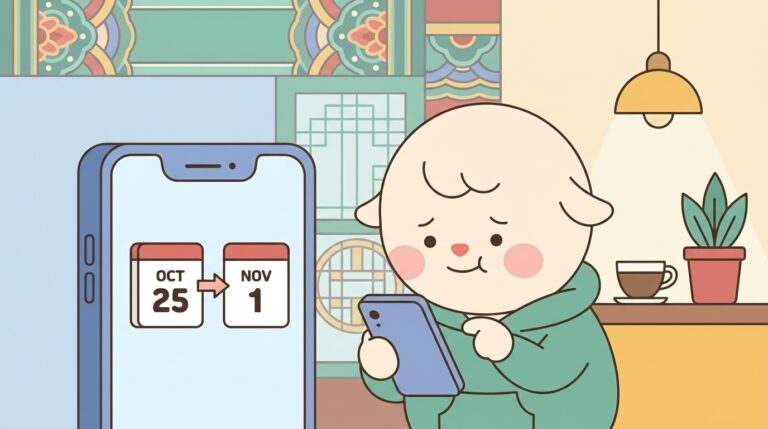
Delaying Plans in Korean: How to Politely Reschedule without Hurting Anyone’s Feelings!
Phase 1: Empathy (Welcome, Chingu!)
안녕하세요! (Annyeonghaseyo!) I’m your Senior Editor and local culture navigator at Daily Hangul (매일한글).
Imagine this: You made plans to grab delicious 삼겹살 (samgyeopsal – pork belly) with your Korean friend this Friday. But suddenly, your boss asks you to work overtime, or your throat feels a bit ticklish. Oh no! You need to push the appointment back.
In many English-speaking cultures, a quick “Hey, can we do next week instead?” works fine. But in Korea, where social harmony and respect are deeply valued, rescheduling requires a delicate touch. Many of our beginner students have told us, “I wanted to postpone, but I was so afraid of sounding rude or canceling last minute!”
Don’t worry, my friend! Today, we are going to learn how to change dates gracefully and politely, using simple A2-level Korean that sounds incredibly natural and warm. Let’s dive in!
Phase 2: Top 3 Essential Expressions for Rescheduling
Here are the three most important phrases you need to know when you need to push a date back.
1. 혹시 우리 날짜 미룰 수 있을까요? (Hoksi uri naljja mirul su isseulkkayo?)
- Pronunciation: Hok-shee oo-ree nal-jjah mee-rool soo eet-seul-kah-yo? (Sounds like “hook-shee” followed by a soft “oo-ree”)
- Meaning: “By any chance, could we postpone/push back the date?”
- K-Culture Moment: You’ll hear this in office-romance K-Dramas when the main character suddenly gets called into an emergency meeting and has to delay their dinner date.
- Editor’s Insight: Posing this as a question (
~을 수 있을까요?– Could we…?) rather than a statement shows that you care about the other person’s schedule. - Situation Spectrum: Casual: ⚠️ | Semi-formal: ✅ | Formal: ✅
- 🤔 Think About It: Notice the word
우리(uri – we/our). Koreans love using “we” instead of “you and I” to emphasize togetherness, even when rescheduling!
2. 다음 주로 미뤄도 될까요? (Daeum juro mirwodo doelkkayo?)
- Pronunciation: Dah-eum joo-ro mee-rwo-doh dwel-kah-yo?
- Meaning: “Is it okay if we push it to next week?”
- K-Culture Moment: Used between friendly classmates or colleagues when planning weekend hangouts.
- Editor’s Insight:
미뤄도 될까요?means “Is it okay to delay?”. It’s direct yet soft. - Situation Spectrum: Casual: ✅ | Semi-formal: ✅ | Formal: ⚠️
- 🤔 Think About It: Think about how easy it is to ask for permission in Korean just by adding
~도 될까요?(Is it okay if…?) to a verb!
3. 미안해요, 갑자기 일이 생겼어요. (Mianhaeyo, gapjagi iri saenggyeosseoyo.)
- Pronunciation: Mee-ahn-hae-yo, gahp-jah-gee ee-ree saeng-gyeot-seo-yo.
- Meaning: “I’m sorry, something came up suddenly.”
- K-Culture Moment: The classic line used when a dramatic phone call interrupts a cozy coffee shop scene.
- Editor’s Insight: In Korea, you don’t always have to give a 10-minute explanation of your personal problems. A simple “something came up” (
일이 생겼어요) is polite, understood, and respects privacy. - Situation Spectrum: Casual: ✅ | Semi-formal: ✅ | Formal: ✅
- 🤔 Think About It: Why do you think acknowledging the apology first (
미안해요) is so crucial before giving your reason in Korean culture?
Phase 3: Textbook Korean vs. Real-Life Korean
Let’s look at how textbooks teach this versus how real Koreans actually talk!
Situation A: Postponing to next week
- 📖 Textbook Korean: 약속 날짜를 연기해 주십시오. (Yaksok naljja-reul yeongihae jusipsio. – “Please postpone the appointment date.”)
- 🗣️ 진짜 Korean: 우리 다음 주에 볼까요? (Uri daeum jue bolkkayo? – “Shall we meet next week instead?”)
- 💡 Why is it different? The textbook version sounds like a formal military command or a cold automatic email. Real Koreans prefer inviting, warm questions like “Shall we meet next week?”
Situation B: Expressing a sudden change in schedule
- 📖 Textbook Korean: 사정이 생겨서 약속을 변경해야 합니다. (Sajeongi saenggyeoseo yaksogeul byeongyeonghaeya hamnida. – “Due to circumstances, I must change the appointment.”)
- 🗣️ 진짜 Korean: 진짜 미안한데, 오늘 무슨 일이 좀 생겨서요. (Jinjja mianhande, oneul museun iri jom saenggyeoseoyo. – “I’m so sorry, but something came up today.”)
- 💡 Why is it different? The real Korean version uses soft fillers like
좀(jom – a little/some) and ends with a trailing~서요which sounds much softer and apologetic.
Phase 4: K-Culture Deep-Dive & Non-Verbal Manners
4-1. The Art of “Mianhaeyo” (Apology) Gestures
When rescheduling in Korea, how you say it is just as important as what you say.
* The Double-Hand Clasp: When apologizing over video or in person, place your hands together in a gentle prayer pose near your chest, tilt your head slightly, and say “미안해요” (Mianhaeyo). This physically shows your sincerity.
* Speed is Key: If you must reschedule, tell them the moment you find out. Texting someone 30 minutes before a plan is considered a major social faux pas in Korea!
4-2. The “Bab (Rice)” Culture Connection
You will often hear: “다음에 밥 한끼 해요!” (Daeume bap hankki haeyo – “Let’s have a meal together sometime!”). If someone reschedules and says this, sometimes it is a polite way of softening the blow, and other times it is a genuine invitation. Pay attention to whether they suggest a specific day next time!
Phase 5: Real-Life Roleplay Scenario
Meet Ji-a (지아), your warm and understanding Korean classmate. You were supposed to study together at a café today, but you woke up with a headache. Let’s message her!
Ji-a 👩: 오늘 카페에서 2시에 만나요! (Oneul kapeeseo dushie mannayo!)
        "Let's meet at the café at 2:00 today!"

You 👤: (🎭 Holding your head, feeling apologetic)
        지아 씨, 정말 미안해요. (Ji-a ssi, jeongmal mianhaeyo.)
        "Ji-a, I am truly sorry."

You 👤: 오늘 갑자기 머리가 너무 아파요. (Oneul gapjagi meoriga neomu apayo.)
        "My head suddenly hurts so much today."

Ji-a 👩: (🎭 Gasping with worry)
        어떡해요! 약 먹었어요? 많이 아파요? (Eotteokhaeyo! Yak meogeosseoyo? Mani apayo?)
        "Oh no! Did you take medicine? Does it hurt a lot?"

You 👤: 네, 약 먹고 쉬고 있어요. 혹시 약속 미룰 수 있을까요? (Ne, yak meokgo swigo isseoyo. Hoksi yaksok mirul su isseulkkayo?)
        "Yes, I took medicine and I am resting. By any chance, could we push back our appointment?"

Ji-a 👩: (🎭 Nodding gently)
        당연하죠! 오늘은 푹 쉬고 다음 주에 봐요! (Dangyeonhajyo! Oneureun puk swigo daeum jue bwayo!)
        "Of course! Rest well today and let's meet next week!"

You 👤: (🎭 Smiling in relief)
        고마워요, 지아 씨. 다음 주에 만나요! (Gomawoyo, Ji-a ssi. Daeum jue mannayo!)
        "Thank you, Ji-a. See you next week!"
🔀 Choose Your Path!
What if Ji-a was your boss at a part-time job instead of a classmate? How should you text her?
- A) “지아 씨, 오늘 안 가요. 다음 주에 봐요.” (Ji-a ssi, oneul an gayo. Daeum jue bwayo.)
- B) “매니저님, 정말 죄송합니다. 오늘 몸이 안 좋아서 그런데, 다음 주에 가도 될까요?” (Maenijeonim, jeongmal joesonghamnida. Oneul momi an joaseo geureonde, daeum jue gado doelkkayo?)
- C) “미안, 오늘 못 가!” (Mian, oneul mot ga!)
Feedback:
- If you chose A (Risk): Too blunt! Saying “I am not going today” sounds like you don’t respect her authority.
- If you chose B (Best!): Perfect! You used the respectful title
매니저님(Manager), apologized formally (죄송합니다), and asked for permission politely. - If you chose C (Bad): Super rude! You used casual language (반말 – banmal) to someone of higher status.
Phase 6: 10-Second Emotion Shadowing Drill
Let’s practice speaking with the right emotion! Read these out loud following the pauses (/) and emotional cues:
- [🥺 Super apologetic and sad]
정말 미안해요, / 갑자기 / 일이 생겼어요.
(Jeong-mal mee-ahn-hae-yo, / gahp-jah-gee / ee-ree saeng-gyeot-seo-yo.) -
[😊 Hopeful and polite]
혹시 / 다음 주로 / 미룰 수 있을까요?
(Hok-shee / dah-eum joo-ro / mee-rool soo eet-seul-kah-yo?)
Phase 7: K-Culture Mini Dictionary
- 약속 (Yaksok) | Appointment / Promise | In Korea, a “yaksok” isn’t just a formal business meeting; it refers to any social hangout or plan with friends.
- 미루다 (Miruda) | To postpone / delay | The essential verb used whenever you need to push a date or time back.
- 갑자기 (Gapjagi) | Suddenly | A very common adverb used to explain unexpected situations in daily life.
- 피치 못할 사정 (Pichi mot-hal sajeong) | Unavoidable circumstances | A beautiful, slightly formal phrase used when you genuinely cannot make it due to reasons beyond your control.
Phase 8: Survivor Kit for Travelers
Survival Phrases TOP 3
- 시간 괜찮으세요? (Sigan gwenchaneuseyo?) – “Is your time okay/Are you free?” (Use this before suggesting a new date).
- 늦어서 죄송합니다! (Neujeoseo joesonghamnida!) – “I am sorry for being late!” (If you are just running late, not canceling).
- 어디로 가면 될까요? (Eodiro gamyeon doelkkayo?) – “Where should I go?” (To confirm the location once rescheduled).
Editor’s Travel Note
Need to find a nice quiet place to reschedule your plans online? Download the Naver Map App (네이버 지도) to find cozy cafés nearby where you can sit and send your polite KakaoTalk messages with high-speed free Wi-Fi!
Phase 9: “One Step Deeper” (Thoughtful Reflection)
In Korea, making and keeping plans involves “정” (Jeong) — a deep emotional connection and sense of mutual care. When you reschedule, adding phrases like “밥 제가 살게요!” (I’ll buy the meal next time!) shows that you value the relationship more than just the convenience of your schedule.
💬 Your Turn: Have you ever had to reschedule a plan with a Korean friend? What phrase did you use, and how did they react? Let us know in the comments below!
Phase 10: FAQ & Common Mistakes
Q: Can I use “미안해” (Mianhae) to my boss when canceling?
A: Absolutely not! “미안해” is casual language (반말). You must use “죄송합니다” (Joesonghamnida) to show proper respect to elders or superiors.
Q: How early should I ask to reschedule?
A: At least 24 hours in advance is polite. If it’s a sudden emergency, apologize profusely using “갑자기 정말 죄송합니다” (I am truly sorry for the suddenness).
Q: Does “다음에 봐요” mean we will definitely meet again?
A: It is a friendly closing remark. To make it a real plan, follow up with a specific day like, “다음 주 화요일은 어때요?” (How about next Tuesday?).
🚨 Common Mistakes Warning Board
- Mistake 1: Saying “날짜 바꾸세요” (Change the date – command form).
- Correct Action: Say “날짜 바꿀 수 있을까요?” (Could we change the date?).
- Mistake 2: Not giving any reason at all.
- Correct Action: Simply say “개인적인 일이 생겨서요” (Because something personal came up).
- Mistake 3: Forgetting to thank them after they agree to reschedule.
- Correct Action: Say “이해해 주셔서 정말 감사합니다” (Thank you so much for understanding).
Phase 11: Action Mission!
- 🥉 Bronze: Practice saying “혹시 날짜 미룰 수 있을까요?” in front of the mirror 3 times.
- 🥈 Silver: Write a imaginary message to a friend postponing a plan in the comments below using today’s expressions.
- 🥇 Gold: Next time you need to delay a call or meeting, try using “다음 주로 미뤄도 될까요?” with a language exchange partner!
🎮 K-Culture Mission: Watch your favorite K-Drama today and listen closely! See if you can spot the word “갑자기” (gapjagi) or “미안해요” (mianhaeyo) when characters reschedule plans.
Phase 12: Interactive Quiz Challenge
Test your knowledge below!
1. Which phrase is the most polite way to ask to push a date back?
- A) 오늘 못 가.
- B) 날짜 미뤄.
- C) 혹시 날짜 미룰 수 있을까요?
Click to see the answer!
Correct Answer: C
Explanation: ‘C’ uses the polite questioning format which is perfect for A2 level speakers to show respect.
2. True or False: “일이 생겼어요” means “I hate my job.”
- True
- False
Click to see the answer!
Correct Answer: False
Explanation: It actually means ‘Something came up’ or ‘I have some business to take care of’.






