

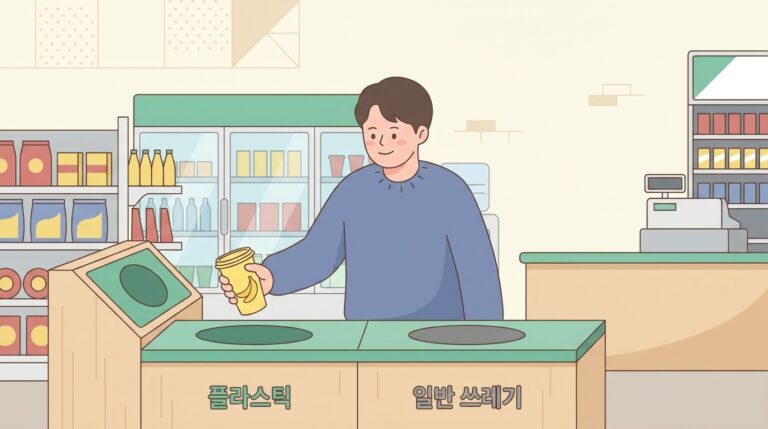
Master Korea’s Convenience Store Trash Etiquette: Say Goodbye to ‘Bin Anxiety’!
Phase 1: Empathy (Your Friendly K-Buddy Guide)
안녕하세요! (An-nyeong-ha-se-yo!) Your favorite K-culture navigator and Daily Hangul editor is here!
Imagine this: You’ve just finished a delicious, steamy cup of convenience store ramyeon (라면) and a sweet banana milk. You are happy, full, and ready to explore more of Seoul. But then, you look down at your empty cup and plastic straw. You look around the store. There is no giant, single trash can. Instead, you see a complex station with multiple slots, flaps, and mysterious Korean words written over them.
Your heart rate spikes. “Where does the liquid go? Can I throw this plastic lid in here? What if the store clerk stares at me?”
Don’t panic! You are experiencing “Bin Anxiety,” a super common feeling for visitors in Korea. Korea is world-famous for its strict recycling and waste sorting systems (called 분리수거 – bun-ri-su-geo). Even inside a small 24-hour convenience store, you are expected to play by the rules. But don’t worry—with this quick A2-level guide, you’ll master the art of trash disposal like a local in less than 3 minutes. Let’s dive in!
Phase 2: Top 3 Must-Know Expressions
1. 쓰레기 어디에 버려요? (Sseu-re-gi eo-di-e beo-ryeo-yo?)
- Pronunciation: Sseu-re-gi (like “sue-regy”) eo-di-e (like “uh-dee-eh”) beo-ryeo-yo? (like “buh-ryuh-yo”)
- Meaning: “Where do I throw away the trash?”
- K-Culture Moment: You will hear this in almost every reality travel show (like Youth Over Flowers) when cast members finish eating snacks outdoors or in an unfamiliar shop.
- Editor’s Insight: This is your ultimate survival phrase. The word 쓰레기 means “trash,” and 버려요 comes from 버리다 (to throw away).
- Situation Spectrum: Casual ✅ | Semi-formal ✅ | Formal ⚠️
- 🤔 Think About It: In many Western countries, street trash cans are everywhere. In Korea, street trash cans are very rare to prevent littering. This is why convenience stores are the holy grail of quick cleanups!
2. 남은 음료는 어디에 버려요? (Nam-eun eum-ryo-neun eo-di-e beo-ryeo-yo?)
- Pronunciation: Nam-eun (like “nah-mun”) eum-ryo-neun (like “um-ryo-nun”) eo-di-e beo-ryeo-yo?
- Meaning: “Where do I dump the leftover drink?”
- K-Culture Moment: Seen in K-Dramas when characters are cleaning up their desks at work or finishing iced americanos in a convenience store seating area.
- Editor’s Insight: 남은 means “leftover” and 음료 means “drink/beverage”. Koreans never throw plastic cups with liquid still inside into the bin. You must empty the liquid first!
- Situation Spectrum: Casual ✅ | Semi-formal ✅ | Formal ⚠️
- 🤔 Think About It: Separating liquid waste helps keep the trash bins clean and dry, making recycling much more efficient. It’s a small step that shows huge respect for the store staff.
3. 이거 일반 쓰레기예요? (I-geo il-ban sseu-re-gi-ye-yo?)
- Pronunciation: I-geo (like “ee-guh”) il-ban (like “il-bahn”) sseu-re-gi-ye-yo?
- Meaning: “Is this general trash (non-recyclable)?”
- K-Culture Moment: A classic phrase used when flatmates are arguing over who has to do the house chores or when sorting delivery food boxes.
- Editor’s Insight: 일반 means “general” or “regular.” If something cannot be recycled (like dirty tissues or wooden chopsticks), it goes into the 일반 쓰레기 bin.
- Situation Spectrum: Casual ✅ | Semi-formal ✅ | Formal ⚠️
- 🤔 Think About It: Sorting can be tricky even for locals! Asking this question shows you really care about doing things the right way.
Phase 3: Textbook Korean vs. Real-Life Korean
Let’s compare what academic books teach you versus what you actually say and hear in a real convenience store.
Situation 1: Asking where the trash can is
- 📖 Textbook: 휴지통이 어디에 있습니까? (Hyu-ji-tong-i eo-di-e is-seup-ni-ka? – “Where is the wastebasket?”)
- 🗣️ Real-Life: 쓰레기통 어디 있어요? (Sseu-re-gi-tong eo-di is-seo-yo? – “Where is the trash can?”)
- 💡 Why the difference? The textbook version is grammatically correct but sounds way too formal, like a news reporter. Locals use the friendly and soft “어디 있어요?” (eo-di is-seo-yo?) in daily life.
Situation 2: Checking if a cup is recyclable
- 📖 Textbook: 이 플라스틱 컵은 재활용품입니까? (I peu-las-tik keob-eun jae-hwal-yong-pum-im-ni-ka? – “Is this plastic cup a recyclable item?”)
- 🗣️ Real-Life: 이거 재활용 돼요? (I-geo jae-hwal-yong dwae-yo? – “Does this recycle?”)
- 💡 Why the difference? Real Korean values speed and efficiency. “재활용 돼요?” is short, sweet, and perfectly understood by any shop keeper.
Phase 4: K-Culture Deep Dive & Non-Verbal Manners
4-1. The “Polite Bow” and “Hand Cup” Gesture
When asking a busy convenience store worker for help, non-verbal cues make all the difference.
1. The Head Nod: Before speaking, give a slight 15-degree nod of your head to show respect.
2. The Two-Handed Point: If you are holding the trash item, hold it gently with both hands or support your right elbow with your left hand while pointing. This shows you are being polite and careful.
4-2. The Convenience Store “Clean-As-You-Go” Culture
Korean convenience stores (편의점 – pyeon-ui-jeom) are not just shops; they are communal dining spots. People eat ramyeon, toasties, and drink coffee at the standing tables inside or the plastic tables outside. The golden rule of Korean convenience store culture is: Leave no trace. If you spill soup, use the provided paper towels to wipe it immediately.
Phase 5: Real-Life Roleplay Scenario
Meet Ji-su (지수), a friendly 20-something university student working the night shift at a GS25 convenience store in Seoul. You’ve just finished eating bulgogi samgak-gimbap (triangle kimbap) and a plastic cup of sweet peach iced tea.
🎭 The Scene:
- Setting: A bright, clean convenience store corner next to the recycling station.
- Your Goal: Safely dispose of your leftovers and plastic cup without causing a mess.
Ji-su (Store Clerk): (Nods politely) 어서 오세요! 뭐 도와드릴까요?
                      (Eo-seo o-se-yo! Mwo do-wa-deu-ril-ka-yo?)
                      "Welcome! Can I help you with something?"

You: (Holding empty plastic cup) 저기요, 쓰레기 어디에 버려요?
     (Jeo-gi-yo, sseu-re-gi eo-di-e beo-ryeo-yo?)
     "Excuse me, where do I throw away the trash?"

Ji-su: (Points to the corner station) 아, 저기 정수기 옆에 분리수거함 있어요.
       (Ah, jeo-gi jeong-su-gi yeop-e bun-ri-su-geo-ham is-seo-yo.)
       "Ah, there is a recycling station next to the water dispenser over there."

You: (Looking at the station, a bit confused) 남은 음료는 어디에 버려요?
     (Nam-eun eum-ryo-neun eo-di-e beo-ryeo-yo?)
     "Where do I dump the leftover drink?"

Ji-su: (Points to a small sink bowl on top of the trash station)
       음료는 저기 구멍에 부으시면 돼요.
       (Eum-ryo-neun jeo-gi gu-myeong-e bu-eu-si-myeon dwae-yo.)
       "You can pour the drink into that hole over there."

You: (Pouring the liquid out, then pointing to the dirty plastic cup)
     이거 플라스틱에 버려요?
     (I-geo peul-la-seu-tik-e beo-ryeo-yo?)
     "Do I throw this into the plastic bin?"

Ji-su: (Smiling) 네, 빨대는 일반 쓰레기통에 버려주시고 컵은 플라스틱에 넣어주세요!
       (Ne, ppal-dae-neun il-ban sseu-re-gi-tong-e beo-ryeo-ju-si-go keob-eun peul-la-seu-tik-e neo-eo-ju-se-yo!)
       "Yes, please throw the straw in the general trash and put the cup in the plastic bin!"

You: (Nodding and putting everything in its place) 아, 알겠습니다! 감사합니다!
     (Ah, al-get-seum-ni-da! Gam-sa-ham-ni-da!)
     "Ah, I understand! Thank you!"
🔀 Interactive Choice Point!
You are left with a dirty plastic soup spoon. What do you do?
* A) Throw it straight into the plastic recycling bin with food still on it.
* B) Wipe the food residue off with a tissue, throw the tissue in “General Trash,” and the spoon in “Plastic.”
* C) Leave it on the table for Ji-su to clean up.
Feedback:
- Selection A (Bad): 🚫 Oh no! Recyclables must be clean. Putting dirty items in the recycling bin ruins the whole batch!
- Selection B (Best): ✅ Perfect! You are a recycling master. Wiping off the food first is the correct way to recycle plastic utensils in Korea.
- Selection C (Risk): 🚫 Oops! Leaving trash on the table is considered very impolite. Always clean up after yourself before leaving the store.
Phase 6: 10-Second Emotion Shadowing Drill
To sound natural, you need the right rhythm and emotion. Practice these sentences aloud, pausing at the / marks!
- [🥺 Worried & Politeness-packed]
저기요… / 쓰레기 / 어디에 버려요?
(Jeo-gi-yo… / sseu-re-gi / eo-di-e beo-ryeo-yo?)
*Pitch tip: Rise slightly at
Frequently Asked Questions (FAQ)
Q: What does "쓰레기 어디에 버려요? (Sseu-re-gi eo-di-e beo-ryeo-yo?)" mean in Korean and how do you pronounce it?
A: In Korean, "쓰레기 어디에 버려요? (Sseu-re-gi eo-di-e beo-ryeo-yo?)" is pronounced [Sseu-re-gi (like "sue-regy"] and means: "Where do I throw away the trash?"
Q: What does "남은 음료는 어디에 버려요? (Nam-eun eum-ryo-neun eo-di-e beo-ryeo-yo?)" mean in Korean and how do you pronounce it?
A: In Korean, "남은 음료는 어디에 버려요? (Nam-eun eum-ryo-neun eo-di-e beo-ryeo-yo?)" is pronounced [Nam-eun (like "nah-mun"] and means: "Where do I dump the leftover drink?"
Q: What does "이거 일반 쓰레기예요? (I-geo il-ban sseu-re-gi-ye-yo?)" mean in Korean and how do you pronounce it?
A: In Korean, "이거 일반 쓰레기예요? (I-geo il-ban sseu-re-gi-ye-yo?)" is pronounced [I-geo (like "ee-guh"] and means: "Is this general trash (non-recyclable)?"







