

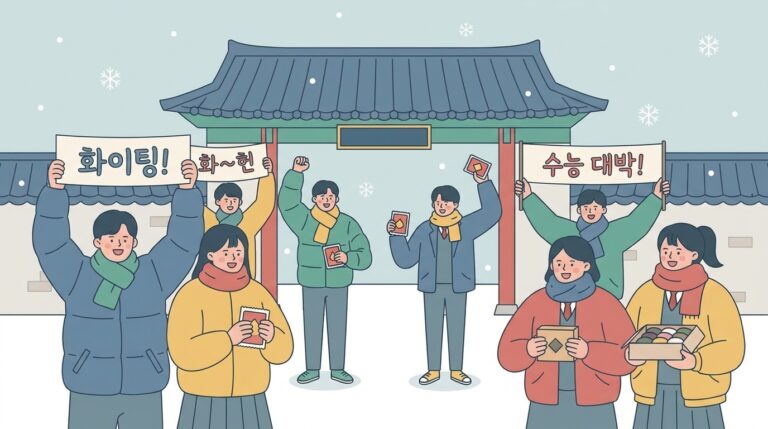
Master the Energy of CSAT Day: How Korean Juniors Cheer for Their Seniors!
Phase 1: Empathy (Welcome to the Most Intense Day in Korea!)
안녕하세요! (An-nyeong-ha-se-yo!) Welcome back to Daily Hangul, your premium companion to local Korean culture and language. I’m your Senior Editor and local cultural navigator, and today, we are diving into one of the most high-energy, emotional, and unique days in South Korea: Suneung (수능) Day!
Imagine walking toward your life-defining exam center on a freezing November morning. Suddenly, the air is filled with rhythmic drumming, giant banners, and a crowd of younger students (후배 – hubae) bowing 90 degrees, chanting your name, and handing you hot packs and sweet treats.
Many of our global students tell us, “I saw this in K-Dramas, but I never understood what they were shouting or why they went so crazy!” If you’ve felt lost trying to decipher the passionate, slang-filled chants of Korean school supporters, you are in the right place. Today, we’ll master the exact expressions used during this cultural phenomenon so you can sound like a true local supporter!
Phase 2: Deep Dive into Top 3 Core Expressions
Let’s break down the three most iconic chants and phrases shouted outside the exam gates.
1. 재수 없다! (Jae-su eop-da!)
- Pronunciation: “Chae-soo-eop-da!” (Sounds like “Jae-soo” + “op-da”)
- Meaning: Literal: “There is no second-try (failure)!” / Real Nuance: “Pass on your very first try!”
- K-Culture Moment: In high school dramas, you will see juniors hand a sticky rice cake (찹쌀떡) to a senior while screaming this.
- Editor’s Insight: Be careful! In daily life, “재수 없다” is a very common slang meaning “You are incredibly rude/obnoxious” or “unlucky.” However, in the context of Suneung, 재수 (jae-su) means “studying for a second year to retake the exam.” Therefore, wishing someone “no second-try” is the ultimate blessing of passing immediately!
- Situation Spectrum: Casual: ✅ | Semi-formal: ⚠️ | Formal: 🚫
- 🤔 Think About It: How does your culture view retaking exams? In Korea, “Jae-su” is a massive commitment, which is why this play-on-words holds so much emotional weight.
2. 잘 풀고 잘 찍어라! (Jal pul-go jal jjik-eo-ra!)
- Pronunciation: “Chal-pool-go chal-jjee-gaw-rah!”
- Meaning: Literal: “Solve well, and poke (guess) well!”
- K-Culture Moment: Written on customized banners or wet-tissue packages handed out at the school gates.
- Editor’s Insight: 풀다 (pul-da) means to solve a problem. 찍다 (jjik-da) has many meanings (to take a photo, to chop wood), but here it means “to guess multiple-choice answers.” In Korea, wishing someone luck in guessing the questions they don’t know is considered highly practical and affectionate!
- Situation Spectrum: Casual: ✅ | Semi-formal: ✅ | Formal: 🚫
- 🤔 Think About It: In English, we say “Good luck!” but Koreans give highly specific instructions like “guess well.” Why do you think Korean wishes are so literal?
3. 수능 대박 나세요! (Suneung dae-bak na-se-yo!)
- Pronunciation: “Soo-neung dae-bahk nah-seh-yo!”
- Meaning: Literal: “May your CSAT hit a huge jackpot!”
- K-Culture Moment: Broadcasted by K-Pop idols on YouTube as an official annual greeting to their fanbases.
- Editor’s Insight: 대박 (dae-bak) means “jackpot” or “huge success.” When combined with 나다 (na-da – to occur/emerge), it means to hit the jackpot. This is the safest, most polite yet enthusiastic way to wish any senior or acquaintance a fantastic exam result.
- Situation Spectrum: Casual: ✅ | Semi-formal: ✅ | Formal: ✅
- 🤔 Think About It: What is the equivalent of a “jackpot” blessing in your language’s academic context?
Phase 3: Textbook Korean vs. Real Korean
Let’s compare what textbooks teach you about encouragement versus what actually echoes through the freezing air on Suneung morning.
Situation 1: Wishing someone to do well
- 📖 Textbook: 시험을 잘 보세요. (Si-heom-eul jal bo-se-yo.) – “Take the exam well.”
- 🗣️ Real Korean: 수능 대박 가자! (Suneung dae-bak ga-ja!) – “Let’s go for a Suneung jackpot!”
- 💡 Why? Textbook Korean is grammatically perfect but lacks the raw, high-energy adrenaline that juniors try to pump into their nervous seniors.
Situation 2: Encouraging someone not to be nervous
- 📖 Textbook: 긴장하지 마세요. (Gin-jang-ha-ji ma-se-yo.) – “Do not be nervous.”
- 🗣️ Real Korean: 떨지 말고 평소대로만 해! (Tteol-ji mal-go pyeong-so-dae-ro-man hae!) – “Don’t shake, just do as you always do!”
- 💡 Why? Telling someone to “just do as usual” (평소대로만) is the most comforting thing a Korean student can hear, acknowledging their hard work over the years.
Phase 4: K-Culture Deep Dive & Non-Verbal Manners
4-1. The Art of Gate Cheering (교문 응원)
When cheering outside the exam gate, your body language represents the passion of your entire school.
* The 90-Degree Bow (큰절): It is a common tradition for junior students to perform a full deep bow on the asphalt floor toward the seniors as they enter. This is a sign of deep respect and wish of luck for their long journey.
* Eye Contact & Energy: Never look timid. When handing over a warm drink or sticky rice cake, look them in the eyes with absolute conviction, smile warmly, and nod firmly.
4-2. The “Sticky” Food Superstition
In Korea, food is language. You must never give a senior 미역국 (mi-yeok-guk – seaweed soup) because seaweed is slippery, symbolizing “slipping (failing) the exam.” Instead, you hand them 엿 (yeot – traditional taffy) or 찹쌀떡 (chap-ssal-tteok – glutinous rice cake) because they are incredibly sticky, symbolizing “sticking (passing) to the college of choice!”
Phase 5: Real-Life Roleplay Scenario
Meet Ji-hoon (지훈), a nervous third-year high school senior walking into the exam gate, and Min-ah (민아), an energetic second-year junior leading the cheering squad.
- Ji-hoon: (Walking slowly, shivering slightly)
- Min-ah: 🎭 (Spotting Ji-hoon, waving a banner loudly) “지훈 선배님! 여기요!” (Ji-hoon seon-bae-nim! Yeo-gi-yo! – Senior Ji-hoon! Over here!)
- Ji-hoon: 🎭 (Surprised but smiling slightly) “민아 너희들 아침 일찍부터 고생이 많네.” (Min-ah neo-hui-deul a-chim il-jjik-bu-teo go-saeng-i man-ne. – Min-ah, you guys went through so much trouble since early morning.)
- Min-ah: 🎭 (Handing him a hot pack and a box of sticky rice cakes) “고생은요! 오늘 무조건 수능 대박 나셔야 해요!” (Go-saeng-eun-yo! O-neul mu-jo-geon Suneung dae-bak na-syeo-ya hae-yo! – Trouble? No way! Today you absolutely must hit the Suneung jackpot!)
- Ji-hoon: “고마워. 근데 나 너무 떨려서 손이 다 시리다.” (Go-ma-wo. Geun-de na neo-mu tteol-lyeo-seo son-i da si-ri-da. – Thanks. But I’m shaking so much my hands are freezing.)
- Min-ah: 🎭 (Squeezing his hands over the hot pack) “떨지 말고 평소대로만 하세요! 저희가 뒤에서 계속 기도할게요.” (Tteol-ji mal-go pyeong-so-dae-ro-man ha-se-yo! Jeo-hui-ga dwi-e-seo gye-sok gi-do-hal-ge-yo. – Don’t shake and just do as usual! We will keep praying for you from behind.)
- Ji-hoon: “응, 정말 큰 힘이 된다. 잘 치고 올게!” (Eung, jeong-mal keun him-i doen-da. Jal chi-go ol-ge! – Yes, this really gives me huge strength. I’ll do well and come back!)
- Min-ah: 🎭 (Shouting to the rest of the cheering squad) “자, 선배님 들어가신다! 하나, 둘, 셋! 재수 없다!” (Ja, seon-bae-nim deul-eo-ga-sin-da! Ha-na, dul, set! Jae-su eop-da! – Alright, senior is entering! One, two, three! No second-try!)
- Ji-hoon: 🎭 (Laughs, feeling much lighter as he walks through the gates) “하하, 알겠어! 한 번에 붙는다!” (Haha, al-get-eo! Han beon-e but-neun-da! – Haha, got it! I’ll pass in one go!)
🔀 Interactive Choice Point
How would you respond to Ji-hoon if he says, “나 너무 긴장돼…” (I’m so nervous…)?
* Option A: “시험은 인생의 전부가 아니에요!” (Si-heom-eun in-saeng-ui jeon-bu-ga a-ni-e-yo! – Exams aren’t everything in life!)
* Option B: “진짜 공부 안 하더니 결국 떨고 있네요!” (Jin-jja gong-bu an ha-deo-ni gyeol-guk tteol-go in-ne-yo! – You really didn’t study, and now you are shaking!)
* Option C: “선배님이 노력한 시간들을 믿으세요! 화이팅!” (Seon-bae-nim-i no-ryeo-khan si-gan-deul-eul mi-deu-se-yo! Hwa-i-ting! – Believe in the hours you’ve put in, Senior! Fighting!)
Feedback:
- Option A (Risk): While true, saying this right before entering the exam room might sound like you are predicting their failure! Save the philosophy for after the exam.
- Option B (Bad): Absolutely terrible! Even as a joke, teasing someone about not studying on Suneung morning is a friendship-ending move.
- Option C (Best!): Perfect! Validating their hard work boosts their confidence right when they need it most.
Phase 6: 10-Second Emotion Shadowing Drill
To master the pacing of these emotional shouts, practice pausing at / and mimicking the mood tags!
[🔥 Bursting with passionate energy]- 수능 대박! / 재수 없다! / 가자!
- Su-neung dae-bak! / Jae-su eop-da! / Ga-ja!
[🥺 Sincerely comforting and warm]- 선배님, / 떨지 말고 / 평소대로만 / 하세요.
- Seon-bae-nim, / tteol-ji mal-go / pyeong-so-dae-ro-man / ha-se-yo.
Phase 7: K-Culture Mini Dictionary
- 수능 (Suneung) | CSAT: The College Scholastic Ability Test. A single-day, 8-hour marathon exam that determines college admission in Korea.
- 재수생 (Jaesusaeng) | Retaker: A student who has graduated high school but is studying for an extra year to retake the CSAT.
- 찹쌀떡 (Chapssaltteok) | Glutinous Rice Cake: A sticky rice cake filled with sweet red bean paste, eaten to “stick” to the exam pass list.
- 선배/후배 (Seonbae/Hubae) | Senior/Junior: The hierarchical relationship structure in schools and workplaces that dictates manners and social roles.
Phase 8: Survivor Kit for Travelers
If you find yourself in Korea on the third Thursday of November, keep these in mind!
Survival Phrases
- 수험생 화이팅! (Su-heom-saeng hwa-i-ting!)
- Pro Tip: Shout this to any student walking with a lunchbox on Suneung morning. It means “Good luck, test-takers!”
- 조용히 해 주세요. (Jo-yong-hi hae ju-se-yo.)
- Pro Tip: During the English listening section (1:10 PM – 1:35 PM), airplanes are grounded, and buses crawl quietly. Keep your voice down!
- 수고하셨습니다! (Su-go-ha-syeot-seub-ni-da!)
- Pro Tip: Say this to students leaving the gates at 5:00 PM. It means “Thank you for your hard work!”
Editor’s Travel Note
On Suneung day, public transport runs extra early. We highly recommend using the Naver Map App Download to check real-time subway and bus schedules, as some roads near test centers are completely blocked to prevent noise. (Note: Traffic schedules and road blockades are subject to change based on yearly police guidelines.)
Phase 9: “Going One Step Deeper” (Reflections on Korean Collectivism)
In Western countries, exams are mostly seen as an individual hurdle. In Korea, however, the CSAT is a national collective project. The entire society coordinates: offices open an hour late to prevent traffic jams for students, police officers offer free motorcycle rides to running late-comers, and juniors freeze for hours just to scream blessings. It highlights how deeply interconnected Korean society is, where one person’s success is celebrated and supported by the whole community.
💬 Your Turn: Does your country have a national exam day that stops traffic? How do students encourage each other in your hometown? Share your cultural stories in the comments below!
Phase 10: FAQ & Avoiding Misunderstandings
Q: Can I use “재수 없다” to my boss at work if they are taking a professional exam?
A: Absolutely not! Unless you want to get fired! “재수 없다” is highly colloquial and carries a double-entendre that is only appropriate between high school peers or from junior to senior students in an informal school setting. At work, stick to “시험 대박 나세요!” or “좋은 결과 있기를 바랍니다 (I wish you good results).”
Q: Do juniors really stay outside in the cold all morning?
A: Yes! cheeering squads (응원단) often secure spots in front of the school gates as early as 3:00 AM to set up their banners and drums.
Q: Can I give a student bread (빵) before the exam?
A: Avoid it! In Korean, the verb “to roll/fail” is 미끄러지다 (mi-kkeu-reo-ji-da), but in slang, failing an exam is also called 빵점 맞다 (getting zero points/bread points) because the number zero looks like a round bread roll!
🚨 Common Mistakes Alert!
- Mistake 1: Wishing a student “미역국 맛있게 드세요” (Enjoy your seaweed soup) on exam day.
- Correct Action: Never mention seaweed. Recommend 죽 (juk – porridge) for easy digestion instead!
- Mistake 2: Using informal 반말 (ban-mal) like “대박 나” to a senior you aren’t close to.
- Correct Action: Keep it polite with “대박 나세요!”
Phase 11: Action Missions
- 🥉 Bronze Mission: Pronounce “재수 없다!” out loud three times using our Phase 6 emotional shadowing rhythm!
- 🥈 Silver Mission: Write a supportive message using “떨지 말고 평소대로만 해!” in the comment section below.
- 🥇 Gold Mission: Next time you see a Korean friend studying for an exam or job interview, send them a KakaoTalk message with a sticky cake emoji and the phrase: “수능 대박처럼 대박 나자!”
Phase 12: Interactive Quiz Challenge
Test your cultural and linguistic knowledge! Click to reveal the answers.
1. Which food is considered a “bad luck” gift for Suneung?
- A) 찹쌀떡 (Glutinous rice cake)
- B) 미역국 (Seaweed soup)
- C) 엿 (Korean taffy)
Reveal Answer & Explanation
Answer: B
Seaweed is slippery, which symbolizes “slipping” and failing the exam. Stick to sticky rice cakes!
2. Fill in the blank: “떨지 말고 ______대로만 해!” (Don’t shake, just do as you always do!)
- A) 평소 (pyeong-so)
- B) 학교 (hak-gyo)
- C) 어제 (eo-je)
Reveal Answer & Explanation
Answer: A (평소)
“평소대로만 해” means “just do as usual.” It’s the ultimate stress-reliever!
3. True or False: “재수 없다” should be used to wish your university professor good luck on their research presentation.
Reveal Answer & Explanation
Answer: False!
“재수 없다” is informal slang with a double meaning of “unlucky/obnoxious.” Telling your professor this would be a major disaster!







