

Master Korean Honorifics: Speak Polite Korean Like a K-Drama Pro!
Phase 1: Empathy (Welcome to the Friendly Side of Korean!)
안녕하세요! (Annyeonghaseyo!) Hello! It’s your favorite Daily Hangul editor and your personal K-culture navigator.
Have you ever been watching a K-drama and noticed how a character’s voice suddenly shifts when they talk to a boss, an elder, or even a stranger? One moment they are laughing and saying “고마워 (Gomawo – Thanks!)”, and the next, they bow slightly and say “감사합니다 (Gamsahabnida – Thank you).”
If you’ve felt confused about when to use polite Korean (높임말 – Nopimmal) and feared accidentally sounding rude to your favorite Korean friend, a store clerk, or your partner’s parents, you are not alone! Many of our A2 learners tell us, “I know the words, but I’m terrified of saying the wrong thing and offending someone!”
Today, we are going to unlock the secrets of Korean honorifics. By the end of this guide, you’ll know exactly how to show respect naturally without sounding like a robotic textbook. Let’s dive in!
Phase 2: Deep Dive into Top 3 Essential Honorific Expressions
1. 안녕하세요 (Annyeong-ha-se-yo)
- Pronunciation: An-nyeong-ha-se-yo (Sounds like “An-yung-ha-say-yo”)
- Meaning: Hello (Literally: “Are you at peace?”)
- K-Culture Moment: You see this in every drama when a character walks into an office, a convenience store, or meets their partner’s parents for the first time.
- Editor’s Insight: This is your ultimate safety net. It uses the polite ending -세요 (-se-yo). Never just say “안녕 (Annyeong)” to someone older or a stranger; it’s like walking up to a boss and saying “Yo, what’s up?”
- Situation Spectrum: Casual (🚫) / Semi-formal (✅) / Formal (✅)
- 🤔 Think About It: In English, we use tone to show respect (“Could you please…”). In Korean, we change the actual endings of the words. How does changing the word ending feel compared to just changing your tone?
2. 감사합니다 (Gam-sa-ham-ni-da)
- Pronunciation: Gam-sa-ham-ni-da (Sounds like “Kahm-sah-ham-nee-dah”)
- Meaning: Thank you (Literally: “I do gratitude”)
- K-Culture Moment: When K-pop idols win an award on music shows, they always scream “감사합니다!” to their fans and staff.
- Editor’s Insight: While “고마워요 (Gomawoyo)” is polite, “감사합니다 (Gamsahabnida)” is the gold standard for public spaces, restaurants, and older people. It shows you really respect their effort.
- Situation Spectrum: Casual (🚫) / Semi-formal (✅) / Formal (✅)
- 🤔 Think About It: Why do you think Korean has so many levels of saying “Thank you”? It’s all about acknowledging the social connection!
3. 죄송합니다 (Joe-song-ham-ni-da)
- Pronunciation: Joe-song-ham-ni-da (Sounds like “Jway-song-ham-nee-dah”)
- Meaning: I am sorry (Literally: “I am deeply apologetic”)
- K-Culture Moment: When a character accidentally bumps into someone on the busy streets of Seoul, they bow slightly and quickly say this phrase.
- Editor’s Insight: Do not use “미안해 (Mianhae)” unless you are talking to a very close friend or someone younger. “죄송합니다” is the polite, respectful way to apologize to strangers.
- Situation Spectrum: Casual (🚫) / Semi-formal (✅) / Formal (✅)
- 🤔 Think About It: How would you feel if a stranger bumped into you and used an overly casual apology? Using the right level of polite language builds instant trust.
Phase 3: Textbook Korean vs. Real Korean
Let’s look at how textbooks teach polite Korean versus how real Koreans actually talk in everyday situations.
Situation 1: Asking “Are you okay?”
- 📖 Textbook Korean: 괜찮습니까? (Gwaen-chan-seup-ni-ka? – Extremely formal)
- 🗣️ Real Korean: 괜찮으세요? (Gwaen-chan-eu-se-yo? – Polite & warm)
- 💡 Why the difference? The textbook version is too stiff for daily life, like saying “Are you functioning adequately, sir?” In real life, “괜찮으세요?” is the perfect blend of politeness and friendly concern.
Situation 2: Saying “Yes”
- 📖 Textbook Korean: 예 (Ye)
- 🗣️ Real Korean: 네 (Ne)
- 💡 Why the difference? While both are polite, “예” can sound very formal or older-fashioned. “네” is the most natural, common, and friendly way to say “yes” in modern Korea.
Phase 4: K-Culture Deep Dive & Non-Verbal Manners
4-1. The Art of the “Nopimmal” Gesture
In Korea, politeness isn’t just about what you say; it’s about what you do with your body.
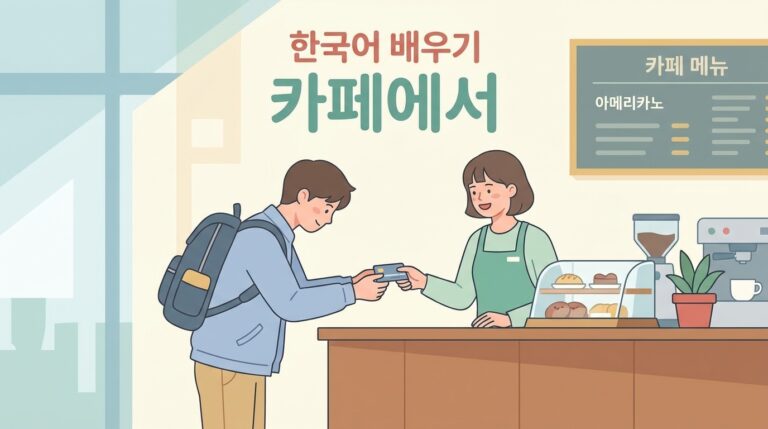
* The Two-Hand rule: When giving or receiving anything (a business card, a cup of tea, or your credit card at a convenience store), always use two hands.
* The Slight Bow: When saying “안녕하세요” or “감사합니다”, a gentle 15-degree nod/bow shows immense respect. Avoid staring directly into the eyes of an elder while bowing; cast your eyes slightly downward.
4-2. Drama Code: The Shift to Banmal (Casual Speech)
Have you ever noticed in K-Dramas when a couple starts dating, one partner asks, “말 놓으셔도 돼요” (Mal no-eu-syeo-do dwae-yo)? This means “You can lower your language (speak casually) with me.” Dropping honorifics is a huge milestone in Korean relationships, signaling that you are now officially “close!”
Phase 5: Real-Life Roleplay Scenario
Setting: You are at a cozy local cafe in Hongdae, Seoul. You want to order a hot latte from the friendly barista, Min-jun.
Characters:
- You (The eager learner)
- Min-jun (The polite Cafe Barista)
Dialogue:
- You: 🎭 [Smiles and bows slightly] 안녕하세요! (An-nyeong-ha-se-yo!) – Hello!
- Min-jun: 🎭 [Bows back warmly] 안녕하세요! 주문하시겠어요? (An-nyeong-ha-se-yo! Ju-mun-ha-si-get-eo-yo?) – Hello! Would you like to order?
- You: 🎭 [Points to the menu with two hands] 따뜻한 라떼 하나 주세요. (Tta-tteut-han ra-tte ha-na ju-se-yo.) – One hot latte, please.
- Min-jun: 네, 매장에서 드시고 가시나요? (Ne, mae-jang-e-seo deu-si-go ga-si-na-yo?) – Yes, are you having it here?
- You: 아니요, 테이크아웃 해주세요. (A-ni-yo, te-i-keu-a-ut hae-ju-se-yo.) – No, take out, please.
- Min-jun: 네, 결제 도와드리겠습니다. (Ne, gyeol-je do-wa-deu-ri-get-seup-ni-da.) – Okay, I will help you with payment.
- You: 🎭 [Hands over credit card with both hands] 네, 감사합니다. (Ne, gam-sa-ham-ni-da.) – Yes, thank you.
- Min-jun: 🎭 [Hands back card with both hands] 감사합니다. 맛있게 드세요! (Gam-sa-ham-ni-da. Mas-it-ge deu-se-yo!) – Thank you. Enjoy your drink!
🔀 Interactive Choice!
How do you respond after Min-jun gives you the hot latte?
* A) “고마워!” (Gomawo!)
* B) “감사합니다!” (Gamsahabnida!) with a small bow.
* C) Say nothing and just walk away.
Feedback:
- Best Choice – B: Perfect! You used the polite honorific “감사합니다” and matched it with a respectful bow. Min-jun will remember you as a lovely customer!
- Risk Choice – A: Uh-oh! “고마워” is casual speech (반말). Using this with a barista you just met might make them feel uncomfortable or shocked.
- Bad Choice – C: Walking away in silence can seem cold. A quick “감사합니다” takes one second but spreads warmth!
Phase 6: 10-Second Emotion Shadowing Drill
Practice saying these out loud with the correct emotion and rhythm. The / indicates a tiny pause!
- [😊 Friendly & Polite] 안녕하세요! / 만나서 / 반갑습니다!
(An-nyeong-ha-se-yo! / Man-na-seo / ban-gap-seup-ni-da!)
-> Hello! / Nice / to meet you! - [🥺 Appreciative & Soft] 정말 / 감사합니다.
(Jeong-mal / gam-sa-ham-ni-da.)
-> Thank you / so much. - [🙏 Apologetic & Sincere] 늦어서 / 죄송합니다.
(Neu-jeo-seo / joe-song-ham-ni-da.)
-> I am sorry / for being late.
Phase 7: K-Culture Mini Dictionary
- 높임말 (Nopimmal) | Honorific/Polite speech used for elders, strangers, and professional settings.
- 반말 (Banmal) | Casual/Informal speech used with close friends, younger people, or siblings.
- 존칭 (Jonching) | Respectful titles (like adding “-님” or “-씨” to someone’s name).
- 눈치 (Nunchi) | The art of reading the room and sensing others’ feelings to act appropriately.
Phase 8: Survivor Kit for Travelers
Survival Phrases TOP 3:
- 이거 주세요 (I-geo ju-se-yo) – Please give me this. (Polite and easy!)
- 저기요 (Jeo-gi-yo) – Excuse me (To get a waiter’s attention in a restaurant).
- 화장실 어디예요? (Hwa-jang-sil eo-di-yeo-yo?) – Where is the restroom?
📝 Editor’s Travel Note:
Before you land in Incheon, make sure to download the Naver Map App for flawless navigation because Google Maps doesn’t work well in Korea. When paying for buses or subways, always tap your T-money card and offer a quick nod to the driver as a sign of respect!
Phase 9:
Frequently Asked Questions (FAQ)
Q: What does "안녕하세요 (Annyeong-ha-se-yo)" mean in Korean and how do you pronounce it?
A: In Korean, "안녕하세요 (Annyeong-ha-se-yo)" is pronounced [An-nyeong-ha-se-yo (Sounds like "An-yung-ha-say-yo"] and means: Hello (Literally: "Are you at peace?")
Q: What does "감사합니다 (Gam-sa-ham-ni-da)" mean in Korean and how do you pronounce it?
A: In Korean, "감사합니다 (Gam-sa-ham-ni-da)" is pronounced [Gam-sa-ham-ni-da (Sounds like "Kahm-sah-ham-nee-dah"] and means: Thank you (Literally: "I do gratitude")
Q: What does "죄송합니다 (Joe-song-ham-ni-da)" mean in Korean and how do you pronounce it?
A: In Korean, "죄송합니다 (Joe-song-ham-ni-da)" is pronounced [Joe-song-ham-ni-da (Sounds like "Jway-song-ham-nee-dah"] and means: I am sorry (Literally: "I am deeply apologetic")







