

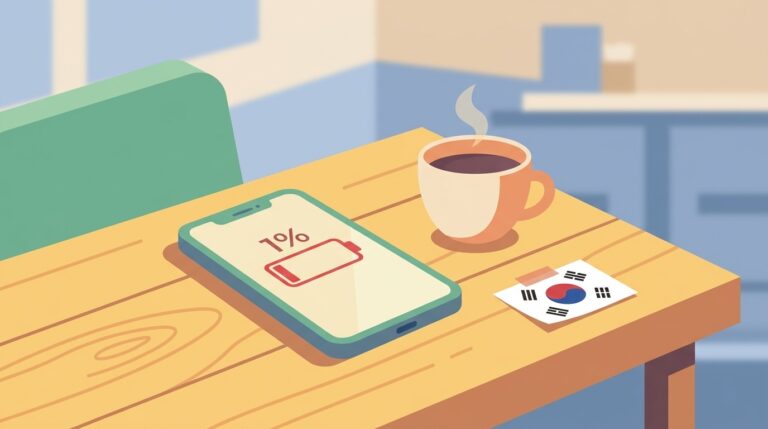
Battery Dying? Don’t Just Vanish! How to Politely Say “My Phone is About to Die” in Korean (CEFR B1)
Phase 1: Empathy (An Open Letter to Your Screen-Fading Woes)
안녕하세요! (Annyeonghaseyo!) Your Korean bestie and Daily Hangul Editor here. ✨
We’ve all been there. You’re in the middle of an exciting phone call with your Korean friend, discussing which Samgyeopsal (pork belly) place to hit tonight. Suddenly, you hear that dreaded beep-beep sound. Your screen dims. 1% battery left.
In Western cultures, you might quickly blurt out, “Hey, my phone’s dying, bye!” and hang up. But in Korea, where polite phone manners (Jeonhwa Yejeol, 껀헤라 예절) are highly valued, suddenly disappearing can sometimes leave the other person feeling anxious or wondering if they said something wrong.
Today, we’re going to master the art of the “Emergency Exit Conversation.” You’ll learn how to elegantly, politely, and naturally warn your caller that your phone is about to die, so you can save both your battery and your relationship! Let’s dive in!
Phase 2: Top 3 Essential Expressions for “My Battery is Low”
Here are the top 3 lifesaver expressions you need to memorize.
1. 배터리가 어ᄇ서서 전헤가 끈힐 새가 가타요 (Baeteoriga eopseoseo jeonhwaga kkeunhgil geot gatayo)
- Pronunciation: Beh-tuh-ri-ga up-suh-suh jun-hwa-ga gggun-hil gut gah-tah-yo
- Meaning: “I don’t have much battery, so I think the phone call will get cut off.”
- K-Culture Moment: You will hear this in almost every romantic K-Drama right before the lead actor rushes across Seoul to find the lead actress before her phone dies forever.
- Editor’s Insight: Combining “-geot gatayo” (가타요 – “it seems like”) softens the statement. In Korean culture, stating things with a bit of cautious doubt is considered much softer and more polite than saying “My phone will die.”
- Situation Spectrum: Casual ✅ / Semi-formal ✅ / Formal ✅
- ὁὁ Think About It: Why do you think Koreans prefer indirect expressions like “it seems like” (가타요) even when their battery is obviously at 1%?
2. 핸드폰 꺼지거나 배터리 나갈 거ᅣ (Haendeupon kkeojigeona baeteori nagal geoya)
- Pronunciation: Hen-deu-pon gguh-ji-guh-na beh-tuh-ri na-gal guh-ya
- Meaning: “My phone is going to turn off or the battery is going to go out.”
- K-Culture Moment: Used between close friends (Banmal / informal language) when chatting late at night while gaming or watching a live stream together.
- Editor’s Insight: “나가다” (nagada) literally means “to go out/exit.” Saying a battery “went out” (배터리가 나가다) is the most common colloquial way to say it drained.
- Situation Spectrum: Casual ✅ / Semi-formal ⚠️ / Formal ὡ2
- ὁὁ Think About It: How does switching to Banmal (informal talk) here change the pressure of the emergency?
3. 충쟌기 차ᇟ아사 다시 걸게요 (Chungjeongi chajaseo dasi geolgeoyo)
- Pronunciation: Choong-jun-gi chah-jah-suh dah-shi gul-geh-yo
- Meaning: “I’ll find a charger and call you back.”
- K-Culture Moment: This is the ultimate reassurance phrase. It tells the other person, “Our conversation is important to me, and I am actively going to solve this problem.”
- Editor’s Insight: Koreans value “Jeong” (정 – affection/bond). Leaving a promise to call back maintains this warm connection.
- Situation Spectrum: Casual ✅ / Semi-formal ✅ / Formal ✅
- ὁὁ Think About It: How does promising a callback change the social dynamic compared to just saying “Bye!”
Phase 3: Textbook Korean vs. Real-Life Korean
| Situation | Ὅ Textbook Korean | Real-Life Korean | Ὂ Why is it different? |
|---|---|---|---|
| 1. Telling someone your phone is dying | 전화기의 전원이 꺼질 애정입니다. (The phone power is scheduled to turn off.) | 아, 나 배터리 약간 가당가당해요! (Ah, my battery is acting a bit unstable/flickering!) | Textbook Korean sounds like a robotic system announcement. Real Koreans use fun onomatopoeias like “가당가당해요” (to be touch-and-go/precarious) to describe a dying device. |
| 2. Asking to text instead | 만일 꺼지먼 메시지루러 보내숴요. (If it turns off, please send a message.) | 꺼지먼 카톡 납겨줘! (If it dies, leave a KakaoTalk message!) | In Korea, “메시지” (message) is rarely used in daily life. Everyone uses “카토이” (Katalk/KakaoTalk) as a verb. |
Phase 4: K-Culture Deep-Dive & Non-Verbal Manners
4-1. The “Nunchi” of Battery Life 핸드폰 네나나
In Korea, keeping your phone alive is almost considered a basic social responsibility because of the fast-paced, hyper-connected culture.
* The Tone of Voice: When saying your phone is dying, use a slightly regretful, high-pitched “Uh-jjeo-ji?!” (어재지?! – Oh no, what should I do?!). It shows you genuinely care about the call cutting off.
* The “Palli-Palli” Speed: Speak faster than usual! This non-verbal cue signals that time is running out.
4-2. K-Drama Trope: The “1% Battery” Confession
Have you ever noticed in K-Dramas like Crash Landing on You or Business Proposal how the most important confessions happen right when the phone is about to die? The screen flashes red, and the music swells. To sound dramatic yet polite like a true K-Drama star, try saying:
“아.. 배터리가 어ᄇ서 끈힐 거ᅣ.. 다시 걸게!” (Ah.. no battery, it’s gonna cut off.. I’ll call back!)
Phase 5: Real-Life Roleplay Scenario
Setting: Ji-a (ᄌ하) and Min-woo (민우) are discussing which restaurant to go to for dinner in Hongdae. Suddenly, Min-woo’s phone starts to die.
- Min-woo (NPC): 아, 지아야! 홍대 맛집 차자뵨대.. 어디가 졶율까?
(Ah, Ji-a! I found some hot spots in Hongdae… where should we go?) - Ji-a (You): 나닌 매운 갈비집 가거 시퍼! 너니너?
(I want to go to the spicy rib place! What about you?) - Min-woo (NPC): 오, 거기 존네! 거기 위치가… 어… 잔깐만.
(Oh, that place is great! The location is… uh… wait a second.) - Ji-a (You): 애? 애 안 돼러?
(Huh? Why is it not working?) - Min-woo (NPC):
Ἲ1 Panic아, 나 배터리가 3% 나마서 끈힐 거 가타!!
(Ah, I only have 3% battery left, I think it’s gonna cut off!!) - Ji-a (You): (Select your response below)
ὐὐ Interactive Branching Decision Point!
What should Ji-a say to keep the vibe friendly and smooth?
- Choice A: “아, 그래? 그러먼 꺼지기 전에 카토이로 파르거 패스트랑 위치 보내줘!”
- Choice B: “개나가! 나정에 다시 해!”
- Choice C: “충쟌기 차자숴 다시 걸어줘! 가타요!”
Ὂ Feedback:
- If you chose A [Best Ἴ6]: Perfect! You kept the casual tone, gave a quick solution (sending the location via KakaoTalk), and saved the day before the blackout.
- If you chose B [Bad Ὢ8]: “개나가!” (It’s okay/Never mind) sounds a bit dry and cold over the phone. Min-woo might think you’re annoyed.
- If you chose C [Risk ⚠️]: Mixing Banmal (차자숴) and Jondetmal (가타요) in the same breath makes you sound grammatically confused! Stick to one speech level.
Phase 6: 10-Second Emotional Shadowing Drill
Let’s practice saying this with the exact emotion a native speaker would use. Try to pause at the slash (/) marks.
[ὣ1 Flustered & Hurried]
“아, / 배터리가 / 나가숴 / 끈힐 거 가타요!”
(Ah, / battery / went out / so I think it will cut off!)[ᾑ7 Reassuring & Friendly]
“다시 / 걸게요! / 카토이 / 납겨줘요!”
(Will call / back! / Leave a / Katalk!)
Phase 7: K-Culture Mini Dictionary (The Battery Edition)
- 배터리 나가다 (Baeteori nagada) | To have battery die/exit | Used in casual situations to describe electronic devices running out of charge.
- 보배 (Bobae) | Abbreviation of Portable Battery (보조 배터리) | Essential slang for travelers. If you ask a cafe staff for a “Bobae”, they will know you need a power bank.
- 끈히다 (Kkeunhida) | To be cut off / disconnected | Often used for weak signals, elevator rides, or low batteries.
- 충쟌 (Chungjeon) | Recharging | Can also be used metaphorically for “resting/healing” after a hard week of work.
Phase 8: Traveler’s Survival Kit
Survival Phrases TOP 3
- “충쟌 가닝한가요?” (Chungjeon ganeunghangayo?)
> Pro Tip: Ask this to any cafe barista while pointing at your phone. They will usually point you to a wall outlet or take it behind the counter to charge it for you! - “보조배터리 대여 돼나요?” (Bojobaeteori daeyeo dwenayo?)
> Pro Tip: Ask this at convenience stores or subway stations to rent portable chargers.
Editor’s Travel Note Ὗῠ
If you find yourself stranded in Seoul with 2% battery, don’t panic! Open the “Naver Map App” (the ultimate navigation tool in Korea) and search for “Everybike” or “Charge Spot” nearby. Most subway stations and convenience stores have cheap hourly rental chargers. (Note: App availability and prices are subject to change. Always check the latest app store updates).
Phase 9: “Going Deeper” — The Korean Mindset of Constant Connection
In Korea, being “unreachable” (락락 안 답) is often seen as a minor breach of trust, especially in friendships or relationships. Because the infrastructure for high-speed internet is everywhere, people assume you should always be reachable. This is why declaring your battery status ahead of time isn’t just an exchange of information—it is a proactive sign of respect and care for the other person—showing that you aren’t ignoring them on purpose.
Ὅᾬ Your Turn: How does your home country view phone calls that suddenly drop? Is it as big of a deal as it is in Korea? Let us know in the comments!
Phase 10: FAQ & Avoiding Mistakes (FAQ Schema)
Q: Can I just say “Bye” (가요) and hang up quickly if I am in a hurry?
A: It is highly recommended to add “배터리 어ᄇ서숴” (Because I have no battery) first. Just hanging up with “Bye” makes it look like you wanted to end the conversation abruptly.
Q: What is the polite way to text someone after my phone died and turned back on?
A: You should start with “배터리가 나가숴 완라디 끈혜요, 죠송해요.” (Sorry, the contact cut off because my battery went out.)
Q: Can I use “사망” (Samang – Death) for a dying phone?
A: Yes, in very casual slang, you can say “핸드폰 사망해숴…” (My phone died/passed away). But keep this purely to close friends!
Ὢ8 Common Mistakes Board
- Mistake 1: Saying “핸드폰 주거요” (My phone died literally like a human).
> Correct Action: Use “배터리가 어ᄇ서숴요” instead. - Mistake 2: Using formal “-seumnida” to your best friend during this panic.
> Correct Action: Keep it warm with “-geot gata!” or “-kkeonjilgeoya!”.
Phase 11: Action Mission & Engagement
- ᾔ7 Bronze Mission: Practice saying the Phase 6 shadowing drill 5 times out loud in front of a mirror.
- ᾔ8 Silver Mission: Post a screenshot of your low-battery screen on Instagram/Twitter, tag us
@DailyHangul, and write: “배터리가 어ᄇ서숴 안냥!” - ᾔ9 Gold Mission: Next time you chat with a language exchange partner, intentionally tell them “배터리가 나가기 전에…” to politely wrap up the call!
Phase 12: Interactive Quiz Challenge
Test your knowledge! Click on the toggle to see the answers.
Q1. Which phrase means “I’ll find a charger and call you back”?
1) 배터리 가당가당해요.
2) 충쟌기 차자숴 다시 걸게요.
3) 핸드폰 사망해숴요.
ὄ1 Click here to reveal the answer!
Correct Answer: 2) 충쟌기 차자숴 다시 걸게요.
Explanation: “충쟌기” is a charger and “다시 걸다” is to call back.
Q2. True or False: Asking for a “Bobae” (보배) at a Korean cafe is a natural way to ask for a portable battery charger.
ὄ1 Click here to reveal the answer!
Correct Answer: True! “Bobae” (보배) is the common shortcut term for “보조 배터리” (portable power bank) in Korea.







