

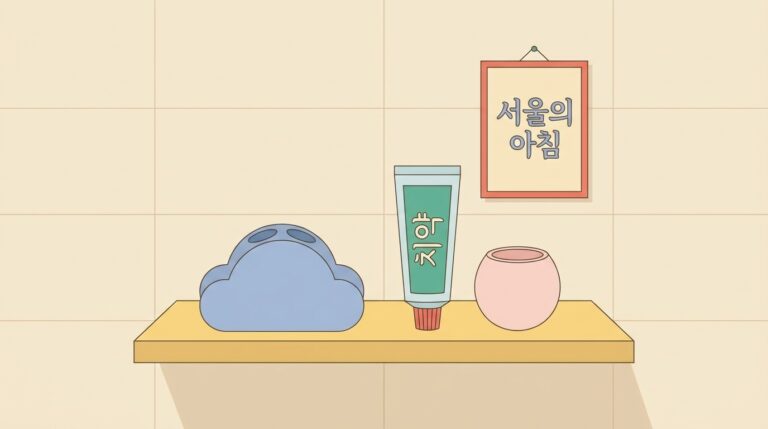
Everyday Korean: How to Talk About Brushing Your Teeth Like a K-Drama Pro
Phase 1: Empathy (An Editor’s Warm Welcome)
안녕하세요! (An-nyeong-ha-se-yo!) Hello! I’m your senior editor and your Korean culture navigator from Daily Hangul (매일한글).
Imagine this: You’re watching your favorite K-Drama, and the main characters are standing side-by-side in front of the bathroom mirror, foam in their mouths, having a cute, muffled conversation while vigorously brushing their teeth. Or maybe you’ve noticed that in Korean offices, everyone heads to the restroom with a toothbrush kit right after lunch!
Brushing your teeth is more than just a chore in Korea—it’s a major social ritual. But as an A1 beginner, how do you actually say “I brush my teeth” without sounding like a robotic translation app? Today, we’ll unlock this simple daily routine so you can talk about your morning and night like a real Seoul local! Ready? Let’s dive in!
Phase 2: Deep Dive into 3 Essential Expressions
1. 이를 닦다 (I-leul dak-da)
- Pronunciation: Ee-leul dak-da (Sounds like “ee” as in “meet” + “leul” + “dahk” with a crisp ‘k’ sound at the end)
- Meaning: To brush one’s teeth (Literally: “To wipe/rub teeth”)
- K-Culture Moment: You will hear parents saying this to their kids in family dramas: “얼른 이 닦아!” (Quickly, brush your teeth!)
- Editor’s Insight: In Korean, we don’t “brush” (솔질하다) teeth; we “wipe” or “polish” (닦다) them. It sounds much cleaner, doesn’t it?
- Situation Spectrum: Casual: ✅ | Semi-formal: ✅ | Formal: ✅
- 🤔 Think About It: Why do you think Korean uses “wipe/polish” instead of “brush”? How does this change how you picture the action?
2. 양치질하다 (Yang-chi-jil-hada)
- Pronunciation: Yang-chi-jil-ha-da (Sounds like “Yahng” + “chee” + “jeel” + “hah-dah”)
- Meaning: To brush teeth / do mouth-washing
- K-Culture Moment: Characters in reality shows like I Live Alone often wake up, look at the camera with messy hair, and head straight to do Yangchi.
- Editor’s Insight: This word comes from historical roots meaning “using a willow branch to clean teeth.” Today, it’s the most common casual way to say “brushing teeth.”
- Situation Spectrum: Casual: ✅ | Semi-formal: ✅ | Formal: ⚠️ (A bit too casual for super formal speeches)
- 🤔 Think About It: In English, we just say “brush teeth,” but Korean has a completely unique single word (Yangchi) for this act.
3. 양치하다 (Yang-chi-hada)
- Pronunciation: Yang-chi-ha-da (Sounds like “Yahng” + “chee” + “hah-dah”)
- Meaning: To brush teeth (Shortened, friendly version of Yangchi-jil-hada)
- K-Culture Moment: Friends on a trip sharing a hotel room might ask each other, “너 양치했어?” (Did you brush your teeth?)
- Editor’s Insight: This is the absolute king of daily life words. It’s short, cute, and super easy to say!
- Situation Spectrum: Casual: ✅ | Semi-formal: ✅ | Formal: 🚫
- 🤔 Think About It: Dropping the “jil” (질) makes the word faster to say. Can you think of any English habits where you shorten words for daily speed?
Phase 3: Textbook Korean vs. Real Korean
Situation 1: Telling your roommate you are going to brush your teeth
- 📖 Textbook Korean: “저는 지금 이빨을 닦을 것입니다.” (Jeo-neun ji-geum i-bpal-eul dak-eul geos-im-ni-da. – I will wipe my teeth now.)
- 🗣️ Real Korean: “나 양치하고 올게!” (Na yang-chi-ha-go ol-ge! – I’ll go do my teeth and come back!)
- 💡 Why the difference? The textbook version is too stiff, and using “이빨” (i-bpal) can sometimes refer to animal teeth if you aren’t careful. “양치하고 올게” is what 99% of Koreans actually say to friends and family.
Situation 2: Asking if someone has finished
- 📖 Textbook Korean: “당신은 이빨을 닦았습니까?” (Dang-sin-eun i-bpal-eul dak-at-seup-ni-ka? – Did you wipe your teeth?)
- 🗣️ Real Korean: “양치했어?” (Yang-chi-haet-eo? – Brushed your teeth?)
- 💡 Why the difference? “당신” (Dang-sin) sounds like a dramatic confrontation in a movie. In real life, just drop the pronoun entirely and ask “양치했어?” with a rising tone.
Phase 4: K-Culture Deep Dive & Non-Verbal Manners
4-1. The “Lunchtime Toothbrushing” Phenomenon
If you ever visit a Korean office building or university around 1:00 PM, you will witness a unique cultural phenomenon: a parade of people holding little pouches, heading to the restroom to brush their teeth. In many Western cultures, brushing is strictly a home routine. In Korea, brushing after every meal—including lunch at work or school—is highly valued. It is considered a basic social manner (에티켓) to keep your breath fresh for colleagues.
4-2. Non-Verbal Manners: The Hand Cover
When talking while brushing your teeth in a shared space, Koreans will almost always cup one hand over their mouth to prevent any foam from splashing or showing. It’s a small but powerful gesture of respect (Nunchi!).
Phase 5: Real-Life Roleplay Scenario
Setting: Morning in a shared guesthouse in Hongdae, Seoul. You and your Korean roommate, Minji, are preparing to head out for a day of shopping.
Characters:
- Minji (민지): Your friendly, energetic Korean roommate.
- You: A stylish traveler ready to conquer Seoul.
Dialogue:
- Minji: “우와, 벌써 아침이네! 잘 잤어?”
(U-wa, beol-sseo a-chim-i-ne! Jal jat-eo?)
“Wow, it’s already morning! Did you sleep well?” - You: 🎭 (Stretching and yawning) “응, 잘 잤어. 민지 너는?”
(Eung, jal jat-eo. Min-ji neo-neun?)
“Yeah, I slept well. How about you, Minji?” - Minji: “나도 잘 잤어! 우리 오늘 홍대 가기 전에 준비하자.”
(Na-do jal jat-eo! U-ri o-neul Hong-dae ga-gi jeon-e jun-bi-ha-ja.)
“Me too! Let’s get ready before we go to Hongdae today.” - You: 🎭 (Pointing to the bathroom) “좋아. 나 먼저 양치하고 올게!”
(Jo-ah. Na meon-jeo yang-chi-ha-go ol-ge!)
“Great. I’ll go brush my teeth first and come back!” - Minji: “응, 치약은 거울 뒤에 서랍에 있어!”
(Eung, chi-yak-eun geo-ul dwi-e seo-rap-e is-seo!)
“Okay, the toothpaste is in the drawer behind the mirror!” - You: 🎭 (From the bathroom, muffled) “치약 고마워!”
(Chi-yak go-ma-wo!)
“Thanks for the toothpaste!” - Minji: “다 하면 말해줘, 나도 세수하게!”
(Da ha-myeon mal-hae-jwo, na-do se-su-ha-ge!)
“Tell me when you’re done, so I can wash my face too!” - You: 🎭 (Stepping out, fresh-faced) “나 양치 끝났어! 들어가!”
(Na yang-chi kkeut-nas-seo! Deul-eo-ga!)
“I’m done brushing! Go ahead in!”
🔀 Interactive Choice Point
Minji asks you, “너 벌써 양치했어?” (Did you brush your teeth already?) How do you reply?
- A: “응, 양치했어!” (Eung, yang-chi-haet-eo! – Yes, I brushed!)
- B: “아니, 이빨을 안 닦았습니다.” (A-ni, i-bpal-eul an dak-at-seup-ni-da. – No, I did not wipe my teeth.)
- C: “나 양치 안 해!” (Na yang-chi an hae! – I don’t brush my teeth!)
Feedback:
- Selection A (Best): Perfect! It’s casual, friendly, natural, and matching Minji’s friendly level of speech.
- Selection B (Bad): Too formal! It sounds like you are reporting to a military general, and “이빨” sounds slightly awkward here.
- Selection C (Risk): Oh no! This means “I don’t brush my teeth” as a general rule. Minji might look at you with wide eyes!
Phase 6: 10-Second Emotion Shadowing Drill
Let’s practice speaking with real Korean feelings. Use the slash / to pause, and match the emotional guide in the brackets!
[😊 Energetic & Bright]
나 / 양치하고 올게!
(Na / yang-chi-ha-go / ol-ge!)
I’m going to go brush my teeth!-
[😴 Sleepy & Tired]
나 아직… / 양치 안 했어…
(Na a-jik… / yang-chi / an haet-eo…)
I hasn’t… brushed my teeth yet… -
[✨ Fresh & Proud]
양치 끝! / 가자!
(Yang-chi kkeut! / Ga-ja!)
Teeth brushing done! Let’s go!
Phase 7: K-Culture Mini Dictionary
- 칫솔 (Chit-sol) | Toothbrush | Tip: “솔” (sol) means brush. You need this to start your day!
- 치약 (Chi-yak) | Toothpaste | Tip: “약” (yak) means medicine. Historically, toothpaste was treated like a cleaning medicine for oral health.
- 양치컵 (Yang-chi-keop) | Rinsing cup | Tip: Many Korean households use a designated cup to save water while rinsing.
- 개운하다 (Gae-un-hada) | To feel refreshed | Tip: The ultimate feeling after brushing your teeth or taking a hot bath. You will hear this word constantly in Korean beauty and wellness vlogs.
Phase 8: Survivor’s Kit for Travelers
Survival Phrases TOP 3:
- “칫솔 있어요?” (Chit-sol is-seo-yo?) – Do you have a toothbrush?
- Pro Tip: Use this at a convenience store or hotel front desk.
- “치약 어디 있어요?” (Chi-yak eo-di is-seo-yo?) – Where is the toothpaste?
- “양치하고 싶어요.” (Yang-chi-ha-go sip-eo-yo.) – I want to brush my teeth.
Editor’s Travel Note:
If you run out of toiletries in Korea, don’t worry! You can easily find premium, affordable dental kits at any Olive Young store or local convenience store. For quick navigation to the nearest convenience store, we highly recommend using the Naver Map App rather than Google Maps, which does not update as quickly in Korea due to local security laws.
Note: Travel details and shop hours are subject to change depending on local circumstances.
Phase 9: “One Step Deeper” (Thoughtful Reflection)
In Western cultures, oral hygiene is mostly a private matter. However, in Korea, brushing your teeth is deeply linked to the concept of Manners (예의 – Ye-ui) and Nunchi (눈치 – social awareness). Because Korean cuisine frequently features strong aromatic ingredients like garlic, onions, and sesame oil (hello, delicious Kimchi and K-BBQ!), brushing immediately after eating is a sign of deep respect for the people around you. It shows you care about their comfort as much as your own.
💬 Your Turn: Does your country have a midday brushing culture, or is it mostly a home-only routine? Let us know in the comments below!
Phase 10: FAQ & Common Mistakes
Q: Can I use
Frequently Asked Questions (FAQ)
Q: What does "이를 닦다 (I-leul dak-da)" mean in Korean and how do you pronounce it?
A: In Korean, "이를 닦다 (I-leul dak-da)" is pronounced [Ee-leul dak-da (Sounds like "ee" as in "meet" + "leul" + "dahk" with a crisp 'k' sound at the end] and means: To brush one's teeth (Literally: "To wipe/rub teeth")
Q: What does "양치질하다 (Yang-chi-jil-hada)" mean in Korean and how do you pronounce it?
A: In Korean, "양치질하다 (Yang-chi-jil-hada)" is pronounced [Yang-chi-jil-ha-da (Sounds like "Yahng" + "chee" + "jeel" + "hah-dah"] and means: To brush teeth / do mouth-washing
Q: What does "양치하다 (Yang-chi-hada)" mean in Korean and how do you pronounce it?
A: In Korean, "양치하다 (Yang-chi-hada)" is pronounced [Yang-chi-ha-da (Sounds like "Yahng" + "chee" + "hah-dah"] and means: To brush teeth (Shortened, friendly version of Yangchi-jil-hada)







