

C1 Korean Culture & Language: Mastering the Art of Ssireum (씨름) and Chunhajangsa (천하장사)
Phase 1: Empathy (스토리 몰입형 오프닝)
안녕하세요! Daily Hangul Editor here, your ultimate cultural navigator!
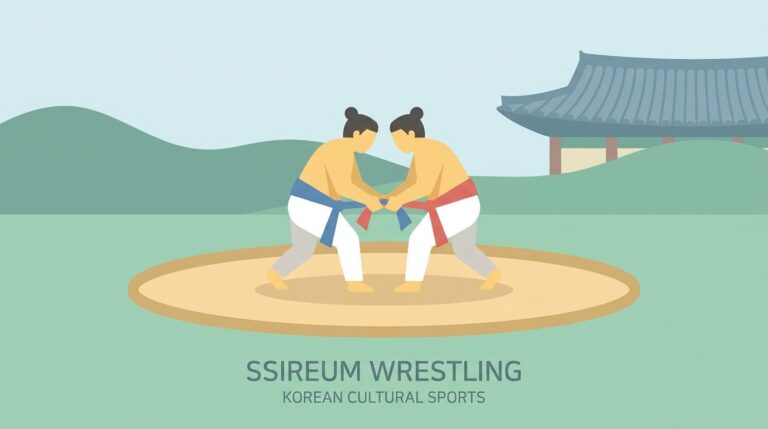
Imagine you are watching a traditional Korean holiday broadcast. Two giants—towering athletes with calves like tree trunks—are locked in a fierce, sweaty embrace in a circular sandpit. They are holding onto each other’s belts (satba, 삿바), muscles tensing, breathing heavily. Suddenly, with a swift, mind-boggling twist of the hips and an explosive lift, one giant sends the other flying onto the sand. The crowd erupts. The winner is crowned Chunhajangsa (천하장사)—the “Under-Heaven Strongman.”
You might think, “Wow, that looks cool, but it’s just wrestling.” But if you say this to a Korean friend, you’ll miss out on the profound cultural, linguistic, and historical layers hidden behind this sandpit showdown. For C1 learners, understanding the vocabulary of Ssireum (씨름) isn’t just about sports; it’s about mastering idioms of leverage, strategy, and resilience that Koreans use daily in business, politics, and relationships.
Many advanced learners struggle with the highly specialized verbs and metaphorical extensions of Ssireum terminology. Today, we’ll dive deep into these high-level linguistic maneuvers so you can discuss Korean tradition like a true native. Let’s step into the sandpit!
Phase 2: Deep Dive into 3 Essential Expressions (핵심 표현 3선 심층 분석)
1. 삿바를 맞잡다 (Sat-ba-reul mat-jap-da)
- Pronunciation: Sat-ba-reul mat-jap-da (Sounds like “sat-bah-reul maht-jahp-dah”)
- Meaning: Lit. “To grip each other’s thigh-belt (satba).” / Fig. “To enter into a direct, tense confrontation/negotiation where neither side can back down.”
- K-Culture Moment: You’ll hear this in political news commentaries or K-Dramas featuring tense business takeovers. When two major tech companies go to court over patent rights, news anchors will say: “두 기업이 특허권을 두고 마침내 삿바를 맞잡았습니다.”
- Editor’s Insight: The satba is the rope tied around the waist and thigh. Gripping it is the absolute starting point of Ssireum. Once you grip it, you feel your opponent’s heartbeat and muscle tension. Thus, 삿바를 맞잡다 implies a state of unavoidable, face-to-face, high-stakes competition.
- Situation Spectrum: Casual ⚠️ | Semi-formal ✅ | Formal ✅
- 🤔 Think About It: In Western sports, we “put on the gloves” (implying hitting). In Korea, you “grab the belt together” (implying close, physical connection even in conflict). What does this say about the Korean view of confrontation?
2. 안다리를 걸다 (An-da-ri-reul geol-da)
- Pronunciation: An-da-ri-reul geol-da (Sounds like “ahn-dah-ree-reul guhl-dah”)
- Meaning: Lit. “To hook the inner leg (an inside trip technique).” / Fig. “To catch someone off guard, often by using an unexpected internal maneuver or taking advantage of a close relationship.”
- K-Culture Moment: Commonly used in variety shows like Running Man when a member betrays another in a game, or in corporate dramas where an insider steals a deal. “믿었던 김 대리가 나한테 안다리를 걸 줄이야!” (I never expected Assistant Manager Kim, whom I trusted, to trip me up like this!)
- Editor’s Insight: The Andari-geolgi is a classic offensive move. Because you must step deep into the opponent’s personal space to hook their inner leg, in daily life, “hooking the inner leg” implies a betrayal or a surprise move from someone within your inner circle.
- Situation Spectrum: Casual ✅ | Semi-formal ✅ | Formal 🚫
- 🤔 Think About It: Think of a time someone “tripped you from the inside.” How does this physical Ssireum metaphor make the emotional pain of betrayal feel more vivid?
3. 천하장사급 (Cheon-ha-jang-sa-geup)
- Pronunciation: Cheon-ha-jang-sa-geup (Sounds like “chuhn-hah-jahng-sah-gup”)
- Meaning: Lit. “Under-Heaven Strongman level.” / Fig. “Extremely powerful, highly influential, or having an overwhelmingly grand scale/appetite.”
- K-Culture Moment: You will hear Mukbang (먹방) hosts use this when eating a monstrously large portion of food (“천하장사급 식사량”), or when describing someone’s incredible physical strength or presence on screen.
- Editor’s Insight: Historically, the Chunhajangsa was awarded a bull (황소), the ultimate symbol of wealth and agricultural power. Calling someone 천하장사급 means they possess a legendary, almost mythical level of dominance in their specific field.
- Situation Spectrum: Casual ✅ | Semi-formal ✅ | Formal ⚠️
- 🤔 Think About It: Why do you think a bull, rather than a trophy or gold medal, was the traditional prize for a Chunhajangsa?
Phase 3: Textbook Korean vs. Real Korean (교과서 한국어 vs. 진짜 한국어)
Let’s compare stiff, literal dictionary phrasing with natural, C1-level idiomatic Korean.
Situation 1: Describing a very tough business negotiation.
- 📖 Textbook style: “두 회사가 아주 치열하게 협상하고 있습니다.” (The two companies are negotiating very fiercely.)
- 🗣️ Real Korean: “두 회사가 쉽게 물러서지 않고 끝까지 삿바 싸움을 벌이고 있네요.” (The two companies are refusing to back down, engaging in a tense ‘satba fight’ to the very end.)
- 💡 Why it works: Satba-ssaeum (삿바 싸움) refers to the subtle, intense struggle athletes engage in even before the match starts, trying to get a better grip. It beautifully conveys the pre-negotiation power struggle.
Situation 2: Warning a friend about someone’s sneaky tactics.
- 📖 Textbook style: “그 사람은 교활한 방법으로 상대방을 방해합니다.” (That person sabotages the opponent in a cunning way.)
- 🗣️ Real Korean: “그 사람, 결정적인 순간에 배지기 들어올 사람이니까 늘 경계해.” (Keep your guard up; he’s the type to throw you with a ‘bae-ji-gi’ (hip toss) at the crucial moment.)
- 💡 Why it works: Baejigi (배지기) is a sudden lifting and turning throw using the stomach. In business or social dynamics, a “baejigi” represents a sudden, decisive move that completely flips the power dynamic.
Phase 4: K-Culture Deep Dive & Non-verbal Manners (K-Culture 딥다이브)
4-1. The Body Language of Respect in the Sandpit
Ssireum is not just about raw power; it is deeply rooted in Confucian etiquette (예의, Yae-ui).
* The Handshake & Kneeling: Before gripping the satba, both wrestlers must kneel facing each other in the sand. This is called Simsa (심사). They make eye contact, bow their heads slightly, and check each other’s belts.
* No Gloating: Even when a wrestler wins a dramatic victory to become Chunhajangsa, they do not boast aggressively in front of their fallen opponent. The winner often helps the loser stand up and brushes the sand off their back. Showing arrogance (거만) in the sandpit is considered highly disgraceful.
4-2. Pop Culture Connection: From Kang Ho-dong to K-Ssireum
Did you know that one of Korea’s most famous national MCs, Kang Ho-dong (강호동), was a legendary Chunhajangsa? In the late 1980s and early 90s, his charismatic, energetic, and explosive style in the sandpit revolutionized the sport. Today, a new wave of “K-Ssireum” is trending among younger generations, focusing on lighter, faster weight classes (like Taegeuk and Geumgang) where athletes showcase lightning-fast, high-flying techniques rather than pure bulk. Shows like The Joy of Ssireum (씨름의 희열) have turned these athletes into modern idols!
Phase 5: Real-Life Roleplay Scenario (실전 롤플레이 시나리오)
The Setup
You (Min-woo) are discussing a high-stakes marketing contract with your colleague, Ji-won, after a exhausting meeting with a tough client who keeps demanding more concessions.
Characters:
* 민우 (Min-woo): C1-level foreign team lead (You).
* 지원 (Ji-won): Korean Senior Marketing Manager.
- 지원: (한숨을 쉬며 차를 마신다) 민우 씨, 오늘 미팅 정말 숨 막히지 않았어요? 저쪽 대표님 기가 정말 세더라고요.
(Sighs, sipping tea. Min-woo, wasn’t today’s meeting absolutely suffocating? Their CEO has such an overwhelming aura.) - 민우: 🎭 (진지한 표정으로 고개를 끄덕이며) 맞아요. 양측 다 양보할 생각이 전혀 없어서, 완전히 삿바를 제대로 맞잡은 느낌이었어요.
(Nods with a serious face. Exactly. Neither side had any intention of yielding; it felt like we truly grabbed each other’s satba.) - 지원: 그러니까요. 특히 단가 제안 부분에서는 팽팽한 삿바 싸움만 계속되다가 끝났잖아요.
(Indeed. Especially during the unit price proposal, we just kept up a tense ‘satba struggle’ until the meeting ended.) - 민우: 🎭 (팔짱을 끼며 생각에 잠긴 듯) 다음 주 2차 미팅 때 저희가 치고 나갈 확실한 기술이 필요해요. 그냥 방어만 해서는 안 돼요.
(Crosses arms, looking thoughtful. We need a definitive technique to strike with during next week’s second meeting. We can’t just defend.) - 지원: 좋은 생각 있어요? 저쪽은 우리가 양보하기만 기다리고 있을 텐데요.
(Any good ideas? They are probably just waiting for us to concede.) - 민우: 🎭 (살짝 미소 지으며) 저쪽이 방심하고 있을 때, 예상치 못한 서비스 패키지를 제안하면서 안다리를 걸어 보는 건 어떨까요?
(Smiling slightly. How about we trip them up with an inside leg hook—proposing an unexpected service package when they least expect it?) - 지원: 오! 허를 찌르자는 거군요! 아주 날카로운 전략이에요. 만약 그게 통하면 이번 계약은 우리 쪽으로 완전히 기울겠네요.
(Oh! Striking where they are vulnerable! That is a very sharp strategy. If that works, the scale of this contract will completely tip to our side.) - 민우: 🎭 (주먹을 불끈 쥐며) 네, 이번 기회에 저희 팀의 저력을 보여주고 진짜 업계의 천하장사가 되어 보죠!
(Clenching fist tightly. Yes, let’s take this opportunity to show our team’s inner strength and become the true Chunhajangsa of this industry!)
🔀 Interactive Decision Point (인터랙티브 분기점)
At the end of the meeting, the client suddenly demands an additional 10% discount. How do you respond using your Ssireum-inspired strategy?
- A) “그 요구는 받아들일 수 없습니다. 여기서 바로 협상을 종료하죠.”
- Feedback (Bad): Too rigid! This breaks the satba rope completely. In business, you need to maintain the tension without breaking the connection.
- B) “갑작스러운 제안이네요. 그렇다면 저희도 상응하는 다른 조건을 걸어 다시 삿바 싸움을 해봐야겠습니다.”
- Feedback (Best!): Perfect! It uses the satba-ssaeum metaphor to show you are willing to stay in the ring but won’t back down without a fight.
- C) “원하시는 대로 해드리겠습니다. 부디 계약만 해주세요.”
- Feedback (Risk): You got thrown out of the ring instantly! A future Chunhajangsa never gives up their posture so easily.
Phase 6: 10-Second Emotion Shadowing Drill (10초 감정 섀도잉 드릴)
Practice these sentences with the exact emotional delivery used by native speakers. Pay attention to the pauses (/).
- [😤 Tense & Determined]
- “이번 협상은 / 쉽게 끝나지 않을 거야. / 우리 제대로 / 삿바 한번 맞잡아 보자!”
- Ibeon hyeopsangeun / swipge kkeunnaji aneul geoya. / Uri jedaero / satba hanbeon matjapa boja!
- (This negotiation won’t end easily. Let’s grab each other’s satba properly and get to it!)
- [😲 Shocked & Betrayed]
- “와, / 믿었던 동료한테 / 결정적인 순간에 / 안다리를 걸리다니 / 진짜 어이없다.”
- Wa, / mideotdeon donglyohante / gyeoljeongjeogin sungane / andarireul geollidani / jinjja eoieopda.
- (Wow, to get tripped with an inside hook by a colleague I trusted at the crucial moment… I’m speechless.)
Phase 7: K-Culture Mini-Dictionary (K-Culture 미니 사전)
- 샅바 (Sat-ba): The fabric belt wrapped around a Ssireum wrestler’s waist and thigh. Symbolizes the connection, control, and point of leverage in a struggle.
- 배지기 (Bae-ji-gi): A core lifting technique using hip and stomach power. Often used metaphorically to mean a decisive, power-based turnaround in a situation.
- 들배지기 (Deul-bae-ji-gi): An advanced variation of baejigi where you lift the opponent completely off the ground before tossing them. Represents overwhelming dominance.
- 황소 (Hwang-so): Bull. Historically the grand prize of Ssireum tournaments, representing supreme physical labor, wealth, and agricultural prosperity.
Phase 8: Survivor’s Kit for Travelers (여행자를 위한 생존 키트)
Survival Phrases for Attending a Traditional Festival
- “씨름 경기 어디서 해요?” (Ssi-reum gyeong-gi eo-di-seo hae-yo?)
- Pro Tip: Use this at local festivals like the Dano Festival (단오제) to find the sandpit.
- “우와, 저 선수 완전 천하장사네요!” (U-wa, jeo seon-su wan-jeon cheon-ha-jang-sa-ne-yo!)
- Pro Tip: Shout this when a wrestler pulls off an amazing lift. The locals around you will love your cultural knowledge!
- “샅바 체험 해볼 수 있나요?” (Sat-ba chae-heom hae-bol su in-na-yo?)
- Pro Tip: Many folk villages allow visitors to try tying and gripping the satba.
Editor’s Travel Note: To find authentic traditional festivals hosting Ssireum matches, download the Naver Map App and search for “민속촌” (Korean Folk Village) or “단오제” (Dano Festival). Note: Event schedules may change depending on weather and local circumstances.
Phase 9:
Frequently Asked Questions (FAQ)
Q: What does "삿바를 맞잡다 (Sat-ba-reul mat-jap-da)" mean in Korean and how do you pronounce it?
A: In Korean, "삿바를 맞잡다 (Sat-ba-reul mat-jap-da)" is pronounced [Sat-ba-reul mat-jap-da (Sounds like "sat-bah-reul maht-jahp-dah"] and means: Lit. "To grip each other's thigh-belt (satba)." / Fig. "To enter into a direct, tense confrontation/negotiation where neither side can back down."
Q: What does "안다리를 걸다 (An-da-ri-reul geol-da)" mean in Korean and how do you pronounce it?
A: In Korean, "안다리를 걸다 (An-da-ri-reul geol-da)" is pronounced [An-da-ri-reul geol-da (Sounds like "ahn-dah-ree-reul guhl-dah"] and means: Lit. "To hook the inner leg (an inside trip technique)." / Fig. "To catch someone off guard, often by using an unexpected internal maneuver or taking advantage of a close relationship."
Q: What does "천하장사급 (Cheon-ha-jang-sa-geup)" mean in Korean and how do you pronounce it?
A: In Korean, "천하장사급 (Cheon-ha-jang-sa-geup)" is pronounced [Cheon-ha-jang-sa-geup (Sounds like "chuhn-hah-jahng-sah-gup"] and means: Lit. "Under-Heaven Strongman level." / Fig. "Extremely powerful, highly influential, or having an overwhelmingly grand scale/appetite."







