

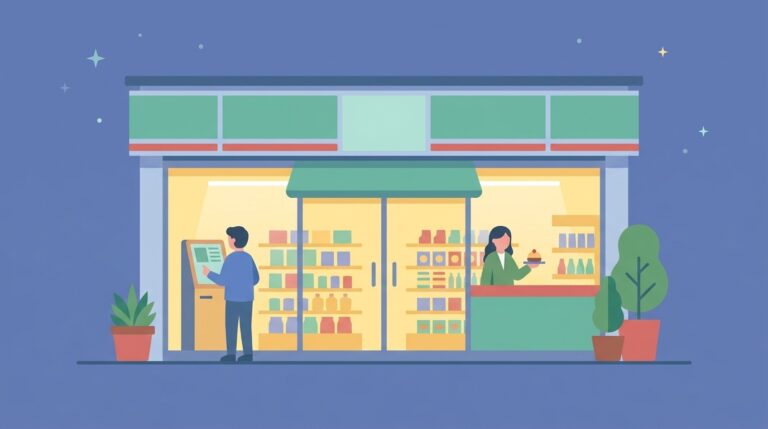
The Evolution of the Korean Convenience Store: Your Neighborhood Lifestyle Hub
안녕하세요! It’s your K-Culture Navigator and senior editor from Daily Hangul (매일한글)!
Have you ever walked into a Korean convenience store (pyeon-ui-jeom) just to grab a quick banana milk, only to find someone sending a parcel, another person picking up a pre-ordered K-pop album, and someone else paying their utility bills?
In Korea, the convenience store is no longer just a place to buy late-night snacks. It has evolved into a hyper-localized, all-in-one lifestyle platform (동네 생활 거점 플랫폼). For an advanced learner (C2), navigating this cultural hub requires more than just basic vocabulary; it demands an understanding of the sophisticated social, logistical, and digital ecosystems that define modern Korean life.
Let’s dive deep into the high-level expressions and cultural nuances that will make you sound like a true local who practically lives at GS25 or CU!
Phase 2: Deep Dive into 3 Core Advanced Expressions
1. 생활 밀착형 플랫폼 (Saeghwal milchak-hyeong peulraetpom)
- Pronunciation: Sae-hwal meel-chak-hyeong peul-raet-pom (Sounds like “say-hwal” + “meel-chuck-young” + “platform”)
- Meaning: Literally “lifestyle-integrated platform.” It refers to services or entities that are deeply interwoven into the daily routines of citizens.
- K-Culture Moment: You’ll hear this term in economy-focused YouTube channels like EO or Syuka World when discussing how retail giants are transforming local infrastructure.
- Editor’s Insight: Milchak (밀착) means “adhering closely.” When a service is milchak-hyeong, it means it solves your immediate, trivial daily problems (like laundry, shipping, or banking) right around the corner.
- Situation Spectrum: Casual 🚫 | Semi-formal ✅ | Formal ✅
- 🤔 Think About It: Does your home country have a single physical location that handles mail, banking, food, and public services simultaneously? Why do you think Korea’s urban density favored this micro-hub model?
2. 반값택배 (Ban-gapt-taek-bae)
- Pronunciation: Ban-gap-taek-bae (Sounds like “bahn-gapt-teck-beh”)
- Meaning: “Half-price parcel service.” A logistics system utilizing the convenience store’s internal distribution network rather than standard couriers.
- K-Culture Moment: Essential for anyone trading photocards on Bunjang (번개장터) or Danggeun Market (당근마켓). Gen Z K-pop fans use this exclusively.
- Editor’s Insight: Regular parcel shipping in Korea is already fast, but ban-gapt-taek-bae drops the price to about 1,800 KRW ($1.30) by shipping store-to-store. You drop it off at your local store, and the recipient picks it up at theirs.
- Situation Spectrum: Casual ✅ | Semi-formal ✅ | Formal ⚠️
- 🤔 Think About It: How does the trust-based society in Korea facilitate a system where your packages are left in public lockers or behind counters for pickup?
3. 편스토랑 (Pyeon-seu-to-rang)
- Pronunciation: Pyeon-seu-to-rang (Sounds like “pyeon-seu-toe-rang”)
- Meaning: A portmanteau of Pyeon-ui-jeom (Convenience store) and Restaurant.
- K-Culture Moment: Inspired by the popular KBS variety show Stars’ Top Recipe at Fun-Staurant (신상출시 편스토랑), where celebrities compete to create recipes that are actually released in convenience stores the next day.
- Editor’s Insight: This word captures the gourmet transformation of convenience stores. It’s no longer about cheap instant ramen; it’s about high-quality, chef-curated collaboration meals.
- Situation Spectrum: Casual ✅ | Semi-formal ✅ | Formal 🚫
- 🤔 Think About It: How does the immediate commercialization of TV recipes reflect Korea’s fast-paced trend cycle (ppalli-ppalli culture)?
Phase 3: Textbook Korean vs. Real-Life Native Korean
Here is how you bridge the gap between classroom Korean and the street-smart C2 vernacular.
Situation 1: Sending a package at the convenience store
- 📖 Textbook: “택배를 보내고 싶습니다. 어떻게 하나요?” (I would like to send a parcel. How do I do it?)
- 🗣️ Real-Life: “혹시 포스트박스 저걸로 반값택배 접수 직접 하면 되나요?” (Should I register the half-price parcel myself using that Postbox machine?)
- 💡 Why the difference? Locals rarely ask staff for basic instructions. They spot the “Postbox” kiosk, immediately identifying the service brand, and proactively ask if the machine is operational.
Situation 2: Buying a popular, hard-to-find item
- 📖 Textbook: “인기 있는 제품이 있습니까?” (Do you have popular items?)
- 🗣️ Real-Life: “요즘 이거 발주 물량 아예 안 풀리나요? 어플 보니까 재고 있다고 뜨던데…” (Are orders for this item completely blocked lately? The app showed it was in stock…)
- 💡 Why the difference? C2 speakers know that stores utilize real-time stock-tracking apps (like Pocket CU or Our Neighborhood GS). Asking about balju (store ordering/stocking) shows you understand retail operations.
Phase 4: K-Culture Deep Dive & Non-Verbal Manners
4-1. The “K-Convenience Store” Etiquette (Nunchi & Space)
When utilizing a convenience store as a lifestyle platform, pay attention to these unspoken rules:
* The Kiosk Dance: When using the parcel kiosk, if someone is waiting behind you, it’s polite to have your recipient’s address pre-written on your phone. Fumbling for address details while holding up the queue is considered a major lack of Nunchi (눈치).
* The Receipt Flick: When picking up a package or paying a utility bill, hand over your barcode/smartphone screen with both hands. It’s a subtle sign of respect that cashier staff appreciate immensely.
4-2. Cultural Analysis: The “Pyeon-Ui-Jeom” as a Sanctuary
In K-Dramas like Backstreet Rookie (편의점 샛별이) or the healing novel Uncanny Convenience Store (불편한 편의점), this space is portrayed as a micro-community. Because Korea has a high single-person household rate (일인 가구), the convenience store clerk is often the only person a lonely urbanite interacts with face-to-face all day. It’s a bright, 24-hour sanctuary in a lonely city.
Phase 5: Real-Life Roleplay Scenario
Setting: A bustling GS25 in Mapo-gu, Seoul. You are trying to pick up a package sent via “Half-Price Parcel” and ask the busy owner about a highly sought-after dessert collaboration.
Characters:
- Min-woo (You): An advanced Korean speaker who knows the system.
- Store Owner (사장님): A friendly but busy neighborhood uncle in his 50s.
Script:
- Min-woo: (Smiling, approaching the counter) 안녕하세요 사장님! 반값택배 수령하러 왔는데요.
(An-nyeong-ha-se-yo sa-jang-nim! Ban-gapt-taek-bae su-ryeong-ha-reo wat-neun-de-yo.)
“Hello! I’m here to pick up a half-price parcel.” -
Owner: (Wiping the counter) 아, 반값택배요? 핸드폰으로 온 바코드 보여주시면 찍어드릴게요.
(Ah, ban-gapt-taek-bae-yo? Haen-deu-pon-eu-ro on ba-ko-deu bo-yeo-ju-si-myeon jjik-eo-deu-ril-ge-yo.)
“Ah, half-price parcel? Show me the barcode sent to your phone, and I’ll scan it for you.” -
Min-woo: 🎭 [Quickly unlocking phone] 여기요! GS포스트박스 알림톡으로 받은 바코드예요.
(Yeo-gi-yo! GS-po-seu-to-bak-seu al-rim-tok-eu-ro ba-deun ba-ko-deu-yeo-yo.)
“Here it is! It’s the barcode I received via the GS Postbox KakaoTalk notification.” -
Owner: (Scans barcode, goes to the back room, and returns with a box) 성함 확인 한번만 할게요. 김민우 씨 맞으시죠?
(Seong-ham hwa-gin han-beon-man hal-ge-yo. Kim Min-woo ssi maj-eu-si-jyo?)
“Let me just verify your name. You are Mr. Kim Min-woo, correct?” -
Min-woo: 네, 맞아요. 아, 그리고 사장님! 혹시 그 요즘 핫한 연세우유 크림빵 신상, 발주 언제 들어오나요?
(Ne, maj-a-yo. Ah, geu-ri-go sa-jang-nim! Hok-si geu yo-jeum hat-han Yeon-se-u-yu keu-rim-ppang sin-sang, bal-ju eon-je deul-eo-o-na-yo?)
“Yes, that’s me. Ah, and by the way, boss! Do you know when the order for that trendy new Yonsei Cream Bread is coming in?” -
Owner: (Laughs) 아이구, 그거 들어오자마자 품절인데… 보통 밤 11시 물류 차 올 때 들어와요. 어플로 예약 묶어두는 게 속 편할 거예요.
(Ai-gu, geu-geo deul-eo-o-ja-ma-ja pum-jeol-in-de… Bo-tong bam yeol-han-si mul-ryu cha ol ttae deul-eo-wa-yo. Eo-peul-ro ye-yak muk-eo-du-neun ge sok pyeon-hal-geo-yeo-yo.)
“Oh boy, that sells out as soon as it arrives… It usually comes around 11 PM when the logistics truck arrives. You’ll save yourself some stress if you reserve it on the app.” -
Min-woo: 역시 그렇군요! 그럼 앱으로 픽업 예약 걸어놓고 와야겠네요. 감사합니다!
(Yeok-si geu-reot-gun-yo! Geu-reom aep-eu-ro pik-eop ye-yak geol-eo-not-go wa-ya-get-ne-yo. Gam-sa-ham-ni-da!)
“I figured! I should set up a pickup reservation via the app and come back. Thank you!” -
Owner: 네, 다음에 또 오세요!
(Ne, da-eum-e tto o-se-yo!)
“Sure, see you next time!”
🔀 Interactive Choice Point
The Owner tells you that the next delivery is at 11 PM, but there are already three people waiting in their cars outside. What do you do?
- A. “사장님, 혹시 들어오는 대로 제 거 하나만 따로 빼놔 주실 수 있나요?”
- Feedback: Risk. This is called dwit-georae (backdoor deal). While some friendly neighborhood owners might do this, busy urban locations hate this as it causes complaints from other customers.
- B. “아, 그럼 그냥 포기하고 다른 데 가볼게요. 수고하세요!”
- Feedback: Bad. You missed a great chance to build rapport with the owner, who could have given you the exact delivery schedule for tomorrow!
- C. “아, 그럼 우리 동네 GS 앱으로 재고 수량 실시간으로 확인하면서 타이밍 맞춰서 올게요!”
- Feedback: Best! It shows you are a smart digital shopper who respects store policy while utilizing the platform’s app system.
Phase 6: 10-Second Emotional Shadowing Drill
Practice matching the exact rhythm and pitch of a native speaker using physical pause markers (/) and emotional cues.
- [🥺 Disappointed & Slightly Desperate]
- 아… 이거 / 어플에는 / 재고 있다고 떴는데 / 벌써 다 나간 건가요?
- (Ah… i-geo / eo-peul-e-neun / jae-go it-da-go tteot-neun-de / beol-sseo da na-gan geon-ga-yo?)
- “Ah… according to the app, it was in stock… is it already sold out?”
- [😊 Bright & Friendly]
- 사장님, / 택배 저기 포스트박스로 / 접수하면 되죠? / 무게만 재면 되나요?
- (Sa-jang-nim, / taek-bae jeo-gi po-seu-to-bak-seu-ro / jeop-su-ha-myeon doe-jyo? / Mu-ge-man jae-myeon doe-na-yo?)
- “Boss, can I register the parcel at that Postbox over there? Do I just weigh it?”
Phase 7: K-Culture Mini-Dictionary
- 발주 (Bal-ju) | Store Ordering
- The system where a store owner orders stock from headquarters. When locals say “발주가 막혔다” (Orders are blocked), it means headquarters cannot supply the item due to a shortage.
- 물류 차 (Mul-ryu-cha) | Logistics Truck
- The delivery trucks that supply convenience stores 2-3 times a day. Night Owls wait for the mul-ryu-cha to get the freshest triangle kimbap (samgak-gimbap).
- 콜라보 신상 (Collabo Sinsang) | Brand Collaboration New Release
- Limited edition items made by combining unexpected brands (e.g., Bear Beer, flour-brand popcorn). Highly viral on Instagram.
- 수령 (Su-ryeong) | Receipt / Pickup
- A formal Hanja term used for receiving packages or official documents. Used frequently on digital retail interfaces.
Phase 8: The Traveler’s Survival Kit
Survival Expressions
- “봉투 필요하신가요?” (Do you need a bag?)
- Pro Tip: Since plastic bags are legally restricted, respond with “종이 쇼핑백으로 주세요” (Paper bag, please) or “아니요, 그냥 가져갈게요” (No, I’ll just carry it).
- “1+1 행사 상품 교차 증정 가능한가요?” (Can I mix and match this buy-one-get-one-free item?)
- Pro Tip: Useful when you want two different flavors of the same promotional drink.
- “도시락 데워 먹으려면 몇 초 돌려야 해요?” (How many seconds should I microwave this lunchbox?)
- Pro Tip: Look at the lid; it usually specifies “700W (Commercial) 1 min 30s” or “1000W (Home) 1 min 10s”.
Editor’s Travel Note
Before stepping foot in Korea, make sure to download the Our Neighborhood GS (우리동네GS) on Google Play and the Pocket CU (포켓CU) on iOS App Store to check live inventory of viral desserts and pre-order meals. Note: App store availability may vary depending on your account region settings.
Phase 9: “A Step Deeper” (Cultural Insight)
In Korea, space is premium. Because young adults often live in small one-rooms (studio apartments), they lack room to store packages, and security can be a concern. The convenience store, standing brightly lit on every block, solves this by acting as a shared physical lobby for the neighborhood. It is the physical manifestation of trust and collective efficiency in Korea’s high-density urban life.
💬 Your Turn: Do you think you would use a convenience store to ship mail or pick up groceries in your country? Let me know in the comments below!
Phase 10: FAQ & Avoiding Misunderstandings
Q: Can foreigners send packages using the Postbox without a Korean ID?
A: Yes! You can use the kiosk as a “Non-member” (비회원). However, you must have a valid Korean phone number to receive the verification and pickup notification talk.
Q: Why did the cashier look annoyed when I tried to pay with my phone?
A: Make sure you have your payment barcode (Samsung Pay, Apple Pay, or Kakao Pay) pulled up and screen brightness turned high before reaching the register to maintain the fast-paced flow.
Q: Is “Half-Price Parcel” (반값택배) shipped to my hotel?
A: No, it is exclusively shipped from store to store. You must specify the destination convenience store name (e.g., “GS25 Mapo-Branch”) and pick it up yourself.
🚨 Common Mistakes Alert!
- Mistake 1: Throwing away your food trash in the street trash cans after eating at the outdoor store tables.
- Correct Action: Convenience stores have strict separation bins (food waste, plastic, general). Always sort your trash inside or next to the store.
- Mistake 2: Expecting the clerk to microwave your food.
- Correct Action: In Korea, convenience stores are strictly self-service for microwaving and preparing instant ramyeon.
- Mistake 3: Not knowing that promotional items (2+1) can be saved digitally.
- Correct Action: If you don’t want to carry all three items, ask to save them in your app wallet using “Keep” (키핑/키프)!
Phase 11: Action Mission
- Bronze: Go to a GS25 or CU, find the Postbox machine, and switch the language settings to practice reading the shipping instructions in Korean.
- Silver: Take a photo of a unique “1+1” or “2+1” promotional item and share it on Instagram tagging
#DailyHangulwith a caption using the word 생활 밀착형. - Gold: Successfully pick up a package or purchase a reserved item using the store’s official mobile app.
Phase 12: Interactive Quiz Challenge
1. What does “반값택배” mean?
- A) A 50% discount on standard postal service.
- B) A store-to-store logistics network utilizing internal delivery trucks.
- C) Shgpping package that contains only half-priced goods.
2. Fill in the blank:
“어플로 신상 삼각김밥을 미리 ________ 예약해 뒀어요.”
* A) 발주 (Ordering)
* B) 수령 (Receipt/Pickup)
* C) 픽업 (Pickup)
3. True or False:
In Korea, you can pay your monthly electricity and water bills directly at a convenience store counter.
🔍 Click to Reveal Answers & Explanations!
- Answer: B | Half-price shipping is cheap because it uses the store’s own supply distribution route!
- Answer: C (or B) | “픽업” (Pickup) or “수령” (Receipt) works perfectly here. Balju is only done by the store owner.
- Answer: True! | Just show the paper bill barcode to the clerk, and you can pay it with cash or card. Truly a neighborhood lifestyle hub!






