

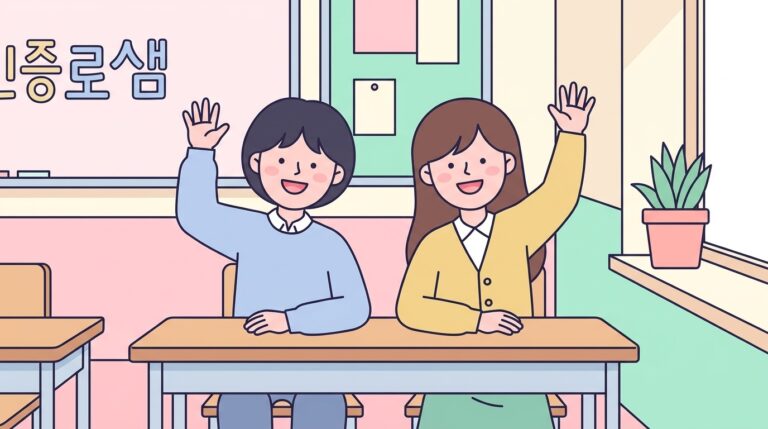
Pair Up! How to Survive and Shine in Korean Class Group Activities
Phase 1: Empathy (Your Korean Class Survival Guide)
안녕하세요! (Annyeonghaseyo!) It’s your friendly neighborhood Korean editor from Daily Hangul!
Imagine this: You are sitting in your very first Korean language class. The teacher is passionate, the whiteboards are filled with beautiful Hangul, and you are feeling great. Suddenly, the teacher smiles and says: “짝과 함께 하세요! (Jjak-gwa hamkke haseyo!)”
Everyone around you starts moving, turning their chairs, and chatting. Your heart rate spikes. “Wait, what did she say? Who is my ‘jjak’? What am I supposed to do?”
If you have ever felt that cold sweat in a language classroom, you are not alone! “Jjak” (partner) activities are the heartbeat of Korean language schools. Today, we are going to break down this exact situation with simple, real-life expressions so you can confidently find your partner, start a conversation, and make a new friend in your next class! This guide is created based on years of helping beginner students turn classroom anxiety into fun social moments. Let’s dive in!
Phase 2: Deep Dive into 3 Essential Expressions
1. 짝과 함께 하세요 (Jjak-gwa hamkke haseyo)
- Pronunciation: Jjak-gwa ham-kke ha-se-yo (Sounds like: “Jahk-gwah hahm-kkeh hah-seh-yo”)
- Meaning: Please do it with your partner (pair).
- K-Culture Moment: If you watch Korean school dramas (like True Beauty or Extraordinary You), you will hear teachers yell this out before a science lab or an English speaking test. The “jjak” (짝) is traditionally the person who sits right next to you at your double desk.
- Editor’s Insight: Jjak (짝) literally means “one of a pair” (like a pair of shoes). When a teacher says “hamkke haseyo” (please do together), they are inviting you to collaborate, not compete!
- Situation Spectrum: Casual 🚫 | Semi-formal ✅ | Formal ⚠️
- 🤔 Think About It: In Korea, pair work is highly valued because of the community-oriented mindset (Woori – we/our). How does this compare to group work in your country?
2. 저랑 같이 해요 (Jeo-rang gat-i hae-yo)
- Pronunciation: Jeo-rang gah-chee hae-yo (Sounds like: “Juh-rahng gah-chee hae-yo”)
- Meaning: Let’s do it together with me. / Would you like to pair up with me?
- K-Culture Moment: This is the ultimate icebreaker! In reality TV shows like Run BTS or Running Man, when members need to form teams of two, they look at each other and say, “Jeorang gati haeyo!” while holding out a hand.
- Editor’s Insight: Jeo (I/me) + rang (with) + gati (together) + haeyo (do). It is polite, incredibly friendly, and not too heavy. It’s the perfect way to invite someone to be your partner.
- Situation Spectrum: Casual ⚠️ | Semi-formal ✅ | Formal 🚫
- 🤔 Think About It: Asking someone to be your partner can feel vulnerable. Why does using a polite, soft expression like this make it so much easier?
3. 먼저 하실래요? (Meon-jeo ha-sil-lae-yo?)
- Pronunciation: Meon-juh ha-shil-lae-yo? (Sounds like: “Muhn-juh hah-sheel-laeh-yo?”)
- Meaning: Would you like to go first?
- K-Culture Moment: Koreans value manners and giving way to others (Yangbo – 양보). Offering your partner the chance to speak or go first is a sign of high respect and instantly builds rapport.
- Editor’s Insight: Meonjeo means “first” or “ahead”. By adding sil-lae-yo (would you like to), you sound incredibly polite and considerate.
- Situation Spectrum: Casual 🚫 | Semi-formal ✅ | Formal ✅
- 🤔 Think About It: In some cultures, going first shows confidence. In Korea, letting your partner choose shows politeness. Which style do you prefer?
Phase 3: Textbook Korean vs. Real-World Korean
Let’s compare what textbooks teach you versus how real humans actually talk in a modern classroom!
Scenario A: Asking to be partners
- 📖 Textbook Korean: “저의 동료가 되어 주시겠습니까?” (Jeo-ui dong-ryo-ga doe-eo ju-si-ges-seup-ni-ka? – “Will you become my colleague?”)
- 🗣️ Real-World Korean: “같이 해요!” (Gat-i hae-yo! – “Let’s do it together!”)
- 💡 Why the difference? Textbook language can sound like a formal business proposal from the 19th century! In real classes, keeping it short and cheerful (Gati haeyo!) makes you sound approachable and natural.
Scenario B: Reacting to an answer
- 📖 Textbook Korean: “당신의 대답은 훌륭합니다.” (Dang-sin-ui dae-dab-eun hul-ryung-hap-ni-da. – “Your answer is excellent.”)
- 🗣️ Real-World Korean: “와, 맞아요!” (Wa, ma-ja-yo! – “Wow, exactly! / That’s right!”)
- 💡 Why the difference? Real conversations are built on active listening and enthusiasm. Saying “Wa, majayo!” with a smile builds instant chemistry with your jjak.
Phase 4: K-Culture Deep Dive & Non-Verbal Manners
4-1. The Magic of ‘Nunchi’ and Gestures
In a Korean classroom, non-verbal cues are just as important as words:
* The Eye Contact & Slight Bow: When the teacher says “find a partner,” don’t just stare at your desk. Make eye contact with your neighbor, give a small, friendly nod (a micro-bow), and smile.
* The Hand Wave: When saying “Let’s do it together,” slightly wave your hand towards yourself in a welcoming motion.
4-2. The ‘Jjak’ Culture in Korea
In Korean schools, your jjak (짝) is a very special bond. You share a desk, help each other with notes, and often become best friends. When you play games or do speaking activities in a Korean language institute (like Sogang, Yonsei, or King Sejong Institute), your partner is your team. Sharing a small candy or a snack before you start is a great way to break the ice!
Phase 5: Real-Life Roleplay Scenario
Meet Minjun (민준): A friendly fellow student who sits next to you. He is a bit shy but loves to practice Korean. You are going to practice a dialogue together.
- Teacher: “자, 이제 짝과 함께 하세요!” (Now, please do it with your partner!)
- You (pointing gently): “저기… 저랑 같이 해요!” (Um… let’s do it together!)
- Minjun (smiles): “아, 네! 좋아요. 같이 해요.” (Ah, yes! Great. Let’s do it.)
- You: “반가워요. 먼저 하실래요?” (Nice to meet you. Would you like to go first?)
- Minjun: “감사합니다! 제가 먼저 읽을게요. … 다 읽었어요!” (Thank you! I will read first. … I’m done reading!)
- You (nodding): “와, 맞아요! 진짜 잘하시네요!” (Wow, that’s right! You are really good!)
- Minjun (blushing): “아니에요~ 이제 하세요!” (No, not at all~ now you go!)
- You: “네, 저도 해볼게요!” (Okay, I will try too!)
- Teacher: “다 했어요?” (Are you all done?)
- Minjun & You (together): “네, 다 했어요!” (Yes, we are done!)
🔀 Interactive Choice Point
What do you say after you finish the activity with Minjun?
* A) “수고하셨습니다!” (Su-go-ha-syeot-seup-ni-da) – “Thank you for your hard work!”
* B) “잘 가라.” (Jal ga-ra) – “Go away safely (very casual).”
* C) “아무것도 아닙니다.” (A-mu-geot-do a-nim-ni-da) – “It is nothing.”
Feedback:
- Choice A (Best!): Perfect! “Su-go-ha-syeot-seup-ni-da” is the most natural and polite way to thank your partner after finishing a task together.
- Choice B (Bad): Oops! This is too casual and sounds like a cool movie character dismissing an enemy. Don’t use this with your classmate!
- Choice C (Risk): This doesn’t make sense here. It sounds like you are dismissing a compliment coldly.
Phase 6: 10-Second Emotion Shadowing Drill
Try saying these with the right emotion and pauses (/ means a short pause):
- [😊 Friendly & Welcoming]
“저랑 / 같이 / 해요!” (Jeo-rang / gah-chee / hae-yo!) - [🥺 Considerate & Polite]
“먼저 / 하실래요?” (Meon-juh / ha-shil-laeh-yo?) - [🎉 Enthusiastic & Supportive]
“와, / 진짜 / 잘하시네요!” (Wa, / jeen-jja / jal-ha-shee-neh-yo!)
Phase 7: K-Culture Mini Dictionary
- 짝 (Jjak): Partner, peer, soulmate. Used in classrooms or romantic contexts (e.g., finding your “true half”).
- 눈치 (Nunchi): The art of sensing other people’s feelings and reading the room.
- 양보 (Yangbo): Yielding, giving way, or putting others first (e.g., letting someone go first in speaking).
- 수고 (Sugo): Hard work, effort. Used to appreciate someone’s effort.
Phase 8: Survivor Kit for Travelers & Students
Top 3 Survival Phrases
- 이름이 뭐예요? (I-reum-i mwo-yae-yo?): What is your name? (Pro Tip: Smile while asking!)
- 다시 한번 말해 주세요. (Da-si han-beon mal-hae ju-se-yo): Please say it one more time. (Pro Tip: Crucial when you don’t understand the teacher!)
- 도와주세요! (Do-wa-ju-se-yo!): Help me, please!
Editor’s Travel Note
If you are traveling to Korea to study or explore, we highly recommend downloading the Papago Translation App and Naver Map App. Google Maps does not work well in Korea, and Naver Map is the absolute gold standard for finding your way to your Korean academy!
Phase 9: “Going Deeper” (A Touch of Culture)
In Korean culture, working in pairs or groups is not just a learning method; it is a way to build Jeong (정) – a deep, warm feeling of attachment and connection. By saying “Let’s do it together” (Gati haeyo), you are inviting someone into your circle. Don’t worry about making grammar mistakes. Your classmate is just as nervous as you are!
💬 Your Turn: Have you ever done group work in a language class? What was your biggest challenge? Let us know in the comments below!
Phase 10: FAQ & Common Mistakes
Q: Can I use “같이 하자 (gati haja)” with my classmate?
A: If you are the same age and have already agreed to speak casually (banmal), yes! But on the first day, it is always safest to use “같이 해요 (gati haeyo)” to be polite and respectful.
Q: What should I do if my partner speaks too fast?
A: Just smile and say, “천천히 말씀해 주세요” (Cheon-cheon-hi mal-sseum-hae ju-se-yo – “Please speak slowly”). They will gladly slow down for you!
Q: Is “jjak” used for business partners?
A: No! “Jjak” is casual and warm, used for school desks, game partners, or romantic matches. For business, use “파트너” (pa-teu-neo) or “동료” (dong-ryo).
🚨 Common Mistakes Alert!
- Mistake 1: Saying “너랑 같이 해요” (Neorang gati haeyo).
- Why: “Neo” (you) is casual, but “haeyo” is polite. It mixes levels and sounds awkward. Just drop “you” and say “저랑 같이 해요” (Jeorang gati haeyo).
- Mistake 2: Remaining completely silent.
- Correct Action: Even if you can only say “안녕하세요!”, make eye contact and smile!
Phase 11: Action Mission!
- Bronze Mission: Practice saying “저랑 같이 해요!” (Jeorang gati haeyo) out loud in front of a mirror 3 times.
- Silver Mission: Write down this expression in your notebook and add a cute sticker next to it.
- Gold Mission: In your next online or offline Korean class, be the first one to ask your partner: “먼저 하실래요?” (Would you like to go first?).
🎮 K-Culture Mission: Watch one episode of a school K-Drama (like Boyhood or Our Beloved Summer) and listen carefully for the word “Jjak” (짝) or “Gati” (같이)!
Phase 12: Interactive Quiz Challenge
Test your skills! Read the questions and click on the toggle to check your answers.
1. What does “짝과 함께 하세요” mean?
Click to reveal the answer
Answer: Please do it with your partner!
Explanation: “Jjak” is your class partner, and “hamkke haseyo” means to do it together.
2. How do you politely ask your partner to speak first?
Click to reveal the answer
Answer: “먼저 하실래요?” (Meon-jeo ha-sil-lae-yo?)
Explanation: “Meonjeo” means first, and “hasillae-yo” is a polite invitation.
3. True or False: In Korea, it is polite to avoid eye contact when the teacher asks you to pair up.
Click to reveal the answer
Answer: False!
Explanation: Making warm eye contact and nodding is the best way to show you are ready to collaborate and make a friend!







