

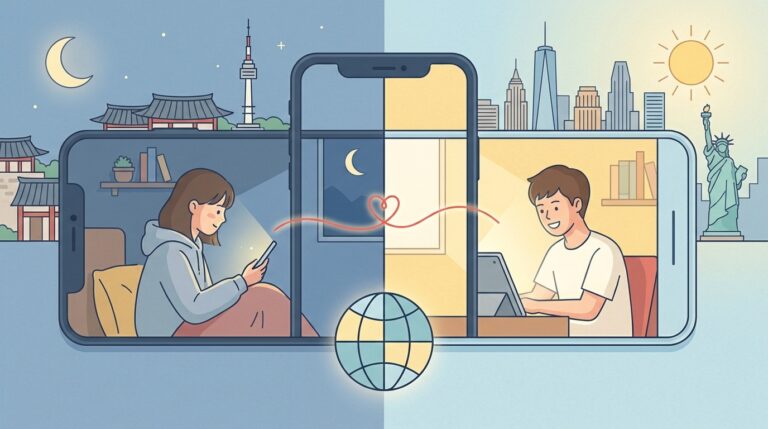
Love Across Time Zones: Mastering the Nuances of Korean Long-Distance Relationships (롱디)
Phase 1: Empathy (스토리 몰입형 오프닝)
안녕하세요! Welcome back, family! It’s your favorite K-culture navigator and chief editor at Daily Hangul (매일한글).
Picture this: It’s 11:00 PM in Seoul, and you are staring at your phone, waiting for that KakaoTalk chime. Across the world, your partner is just waking up. You want to tell them how much you miss them, but a simple “I miss you” (bogo sipeo) feels incredibly lightweight compared to the crushing weight of the 14-hour time difference. You want to express that bittersweet ache of loving someone across borders, but textbook Korean feels too stiff, and Google Translate keeps giving you robotic sentences that ruin the mood.
At the C2 level, communication isn’t just about passing information; it’s about micro-nuances, emotional resonance, and cultural alignment. Today, we are diving deep into the world of 장거리 연애 (jang-geori yeonae)—affectionately dubbed ‘롱디’ (rong-di) in Korea. Based on real-life case studies of our international students who successfully navigated long-distance relationships with Korean partners, this guide will equip you with sophisticated, culturally fluent expressions that bridge the physical gap. Let’s make love win, no matter the distance!
Phase 2: Deep-Dive into Top 3 Advanced Expressions
1. 애틋하다 (ae-teut-hada)
- Pronunciation: [Ae-teut-ha-da] (Think “eh-teut-hah-dah”)
- Meaning: Bittersweetly affectionate; deeply, achingly fond.
- K-Culture Moment: This is the ultimate “LDR” word. In the K-Drama Crash Landing on You, when Yoon Se-ri and Ri Jeong-hyeok are separated by the DMZ, their gaze isn’t just “romantic”—it is ae-teut-hada. It describes a love that is intensely deep precisely because of the sorrow, longing, or physical barriers surrounding it.
- Editor’s Insight: English doesn’t have a single word for this. It combines deep affection (jeong, 情) with a tinge of sadness. When you tell your partner “우리 롱디 하니까 더 애틋한 것 같아” (Because we’re doing LDR, I feel like our love is even more achingly precious), you elevate your relationship from a struggle to a poetic journey.
- Situation Spectrum: Casual (✅) / Semi-formal (✅) / Formal (⚠️ – sounds poetic, used mostly in interpersonal contexts)
- 🤔 Think About It: Why does Korean culture place such a high emotional value on suffering-induced affection? How does this contrast with your native language’s way of defining romantic passion?
2. 몸이 멀어지면 마음도 멀어진다 (momi meoreojimeon maeumdo meoreojinda)
- Pronunciation: [Mom-i meol-eo-ji-myeon mae-um-do meol-eo-jin-da] (Think “Momee meol-o-jee-myeon mah-eum-do meol-o-jeen-dah”)
- Meaning: Out of sight, out of mind. (Literally: “If the body grows distant, the heart grows distant too.”)
- K-Culture Moment: This proverb is used constantly in Korean variety shows and dramas when couples split up due to study abroad programs or military service. It represents the ultimate realistic fear of any Rong-di couple.
- Editor’s Insight: This phrase carries a heavy warning in Korean society, which highly values physical presence, shared meals (bap-muck-ja culture), and frequent dates. By addressing this proverb head-on with your partner (e.g., “우린 몸은 멀어도 마음은 더 가까워지자” – Even if our bodies are far, let’s keep our hearts closer), you show immense maturity and determination.
- Situation Spectrum: Casual (✅) / Semi-formal (✅) / Formal (✅)
- 🤔 Think About It: Is physical proximity essential for emotional intimacy in your culture, or do you believe digital connection can completely bridge the gap?
3. 현타가 오다 (hyeon-ta-ga o-da)
- Pronunciation: [Hyeon-ta-ga o-da] (Think “Hyeon-tah-gah oh-dah”)
- Meaning: To hit a wall of harsh reality; to experience a sudden reality check. (Derived from ‘현자타임’ – Wise Man Time)
- K-Culture Moment: Commonly used when a fan realizes their K-pop bias doesn’t know they exist, or in LDRs, when you hang up a video call and look around your empty room, feeling an overwhelming wave of loneliness.
- Editor’s Insight: At the C2 level, you must master high-level slang. Hyeonta is perfect for expressing that sudden, crushing realization of reality. Saying “화면 속 자는 모습 보는데 갑자기 현타 오더라” (I was looking at you sleeping on the screen, and suddenly reality hit me hard) communicates deep vulnerability without being overly dramatic.
- Situation Spectrum: Casual (✅) / Semi-formal (⚠️) / Formal (🚫)
- 🤔 Think About It: Why do you think modern Korean slang like hyeonta has become so crucial in expressing psychological states that traditional vocabulary cannot capture?
Phase 3: Textbook Korean vs. Real Korean
Situation 1: Expressing loneliness due to the time difference
- 📖 Textbook Korean: “시차 때문에 연락하기 힘들어서 외로워요.” (It is hard to contact you because of the time difference, so I am lonely.)
- 🗣️ Real Korean: “시차 맞추느라 밤낮 바뀌는 것도 서러운데, 네 목소리 들으면 눈물 날 것 같아.” (It’s already sorrowful enough to have my day and night flipped to match your time zone, but hearing your voice makes me want to cry.)
- 💡 Why is it different? C2 speakers use words like 서럽다 (seoreopda)—an untranslatable emotional state of feeling sad, wronged, and self-pitying all at once—instead of the generic oeropda (lonely).
Situation 2: Assuring your partner of your commitment
- 📖 Textbook Korean: “멀리 있어도 나는 너를 믿고 사랑할 거야.” (Even if you are far, I will trust and love you.)
- 🗣️ Real Korean: “몸이 백 리 떨어져 있어도 내 온 신경은 온통 너한테 쏠려 있어. 쓸데없는 걱정 붙들어 매.” (Even if we are a hundred miles apart, my entire focus is pulled to you. Hang onto your useless worries—i.e., don’t worry at all.)
- 💡 Why is it different? Advanced speakers use idioms like 신경이 쏠리다 (attention is pulled/gravitated) and the reassuringly blunt, colloquial phrase 걱정 붙들어 매다 (tie up your worries) to project absolute security.
Phase 4: K-Culture Deep-Dive & Non-Verbal Manners
4-1. The “Digital Touch”: KakaoTalk Etiquette
In Korea, Rong-di isn’t just about video calls; it’s about ‘카톡 티키타카’ (Katalk Tiki-Taka)—the rhythmic, continuous exchange of messages throughout the day.
* The Concept of ‘읽씹’ (Read and Ignore) vs. ‘안씹’ (Unread and Ignore): In Korea, leaving a partner on “read” (the yellow ‘1’ disappearing in KakaoTalk) for over an hour without explanation can cause extreme anxiety. If you are busy, always send a quick “나 이제 회의 들어가! (I’m entering a meeting now!)” rather than disappearing.
* The Non-Verbal Power of Emoticons: Korean partners heavily rely on Kakao emoticons to convey tone. A text without an emoticon can feel cold or angry. Send animated, crying, or hugging emoticons to compensate for the lack of physical touch.
4-2. Cultural Code: The ‘Bap (밥)’ Check-in
In Western cultures, “What did you do today?” is the standard check-in. In Korea, it’s “밥 먹었어?” (Did you eat?). This isn’t about nutrition; it’s a profound expression of care. In a Rong-di relationship, sending a picture of your meal (bab-sang) acts as a daily diary, showing your partner that you are taking care of yourself despite being alone.
Phase 5: Real-Life Roleplay Scenario
Characters:
- 민우 (Minwoo): A Seoul-based software engineer, exhausted by the 12-hour time difference but deeply committed.
- 지민 (Jimin – You): Located in New York, feeling the sting of hyeonta after a long week of minimal communication.
[Scene: 7:00 AM New York / 8:00 PM Seoul. A FaceTime video call.]

민우: (하품을 겨우 참으며) 어, 지민아! 이제 일어났어? 오늘 피곤해 보인다.
      (Minwoo: [Barely holding back a yawn] Oh, Jimin! Did you just wake up? You look tired today.)

지민: (씁쓸하게 웃으며 화장기 없는 얼굴을 만진다) 어, 겨우 일어났어. 오빠는 이제 퇴근한 거야? 목소리가 많이 잠겼네.
      Jimin: [Smiling bitterly, touching her makeup-free face] Yeah, barely got up. Did you just get off work, Oppa? Your voice sounds really raspy.

민우: (폰 화면을 보며 미안한 표정으로) 응, 오늘 야근했어. 시차 때문에 너 일어날 때 맞춰서 연락하려다 보니까 매일 이 시간이네.
      민우: [Looking at the phone screen with an apologetic expression] Yeah, worked overtime today. Trying to match your waking time due to the time difference makes it this time every day.

지민: (한숨을 쉬며) 매일 화면으로만 얼굴 보는 거, 이제 좀 현타 온다. 우리 언제까지 이렇게 버텨야 할까?
      Jimin: [Sighing] Seeing your face only through a screen every day... reality is hitting me hard now. How long do we have to hold out like this?

민우: (가슴 아픈 듯 화면에 손을 대며) 미안해, 지민아. 옆에 있어 주지 못해서... 나도 퇴근길에 연인들 같이 걷는 거 보면 마음이 너무 애틋하고 시려.
      민우: [As if heartbroken, putting his hand to the screen] I'm sorry, Jimin. For not being able to be by your side... When I see couples walking together on my way home, my heart feels so achingly cold too.

지민: (눈시울이 붉어지며) 나도 오빠 맛있는 거 먹을 때, 같이 마주 앉아서 먹고 싶어. '밥 먹었냐'는 톡 받을 때마다 고마우면서도 울컥해.
      Jimin: [Eyes tearing up] Me too. When you eat something delicious, I want to sit across from you and eat together. Every time I get a 'Did you eat' text, I'm grateful but suddenly overwhelmed with emotion.

민우: (단호하지만 다정한 목소리로) 몸이 멀어진다고 우리 마음까지 멀어질 일은 절대 없어. 내 온 신경은 온통 너한테 가 있잖아. 걱정 붙들어 매.
      민우: [With a firm but sweet voice] Just because our bodies are far, our hearts will absolutely never grow distant. All my focus is on you. Hang onto your worries.

지민: (미소를 되찾으며) 응, 오빠 그 말 들으니까 한결 낫다. 우리 조금만 더 힘내자. 사랑해.
      Jimin: [Regaining her smile] Yeah, hearing you say that makes me feel much better. Let's hang in there just a bit more. I love you.
🔀 Interactive Choice Point
How would you respond if Minwoo looks visibly exhausted and suggests hanging up early to sleep?
* A. “피곤하면 그냥 자. 나중에 얘기해.” (Dryly)
* B. “오빠 피곤한 거 아는데, 나 오랜만에 목소리 들어서 조금만 더 얘기하고 싶어…” (Expressing vulnerability)
* C. “야근하느라 고생했어! 얼른 자고 주말에 길게 전화하자. 얼른 눈 붙여!” (Supportive & Encouraging)
Feedback:
- Best Choice (C): Showcases C2 empathy. Using colloquial idioms like 눈 붙이다 (get some shut-eye) and prioritizing their health builds immense trust.
- Risk Choice (B): Vulnerable, but might guilt-trip an already exhausted partner.
- Bad Choice (A): Extremely cold. In Korean, “그냥 자” (Just sleep) without emoticons or soft endings reads as passive-aggressive anger.
Phase 6: 10-Second Emotional Shadowing Drill
Practice saying these lines with the exact emotional intonation of a native speaker. Pay attention to the pauses (/).
[🥺 Bittersweet and vulnerable]- Korean: 화면 속 너를 보는데 / 갑자기 현타가 훅 오더라. / 보고 싶어 죽겠어.
- Romanization: Hwa-myeon sok neo-reul bo-neun-de / gap-ja-gi hyeon-ta-ga huk o-deo-ra. / Bo-go si-peo juk-ges-seo.
- English: Looking at you inside the screen… reality suddenly hit me hard. I miss you to death.
[💪 Firm, reassuring, and romantic]- Korean: 몸이 멀어지면 / 마음도 멀어진다는 말, / 우리한텐 안 통하는 말이야. / 걱정 붙들어 매!
- Romanization: Mom-i meol-eo-ji-myeon / mae-um-do meol-eo-jin-da-neun mal, / u-ri-han-ten an tong-ha-neun mal-i-ya. / Geok-jeong but-deul-eo mae!
- English: The saying that hearts grow distant when bodies do… that doesn’t apply to us. Tie up your worries!
Phase 7: K-Culture Mini-Dictionary
- 칼답 (Kal-dap) | Rocket-fast reply
- A compound of 칼 (knife/sharp) and 답변 (reply). Replying instantly to texts, demonstrating that your partner is your top priority.
- 역공항 (Yeok-gong-hang) | Surprise airport visit
- Secretly flying into your partner’s country without telling them, turning the airport into a cinematic reunion spot.
- 시차 (Si-cha) | Time difference
- The ultimate villain of Rong-di. Navigating si-cha requires systematic synchronization of schedules.
- 권태기 (Gwon-tae-gi) | The relationship slump
- A period of stagnation or loss of interest. Often feared in LDRs due to the lack of physical intimacy.
Phase 8: Survival Kit for Travelers / LDR Lovers
Survival Phrases TOP 3
- “비행기 표 끊었어! 우리 가을에 만나!”
- Bi-haeng-gi pyo kkeun-eot-seo! U-ri ga-eul-e man-na!
- “I booked the flight! We are meeting this autumn!”
- “영상통화 끊기 전에 얼굴 캡처할래.”
- Yeong-sang-tong-hwa kkeun-gi jeon-e eol-gul kaep-cheo-hal-rae.
- “I want to screenshot your face before we hang up the video call.”
- “보고 싶어도 조금만 참자. 곧 만나니까.”
- Bo-go si-peo-do jo-geum-man cham-ja. Got man-na-ni-kka.
- “Even though we miss each other, let’s hold out a bit. We’re meeting soon anyway.”
Editor’s Travel Note
For LDR couples planning their reunion in Korea, download the Naver Map App (네이버 지도) immediately. Google Maps does not function properly in Korea for walking directions. Plan your romantic date in Ikseon-dong (익선동) or Songridan-gil (송리단길), where the narrow, beautiful alleyways will make you forget all those months of distance instantly!
Phase 9:
Frequently Asked Questions (FAQ)
Q: What does "애틋하다 (ae-teut-hada)" mean in Korean and how do you pronounce it?
A: In Korean, "애틋하다 (ae-teut-hada)" is pronounced [Ae-teut-ha-da] and means: Bittersweetly affectionate; deeply, achingly fond.
Q: What does "몸이 멀어지면 마음도 멀어진다 (momi meoreojimeon maeumdo meoreojinda)" mean in Korean and how do you pronounce it?
A: In Korean, "몸이 멀어지면 마음도 멀어진다 (momi meoreojimeon maeumdo meoreojinda)" is pronounced [Mom-i meol-eo-ji-myeon mae-um-do meol-eo-jin-da] and means: Out of sight, out of mind. (Literally: "If the body grows distant, the heart grows distant too.")
Q: What does "현타가 오다 (hyeon-ta-ga o-da)" mean in Korean and how do you pronounce it?
A: In Korean, "현타가 오다 (hyeon-ta-ga o-da)" is pronounced [Hyeon-ta-ga o-da] and means: To hit a wall of harsh reality; to experience a sudden reality check. (Derived from '현자타임' - Wise Man Time)







