

C2 Mastering: Navigating Korea’s Holiday Gift Spam Resale Market Like a Native
Phase 1: Empathy (Welcome to the Great Chuseok Spam Exchange!)
안녕하세요! Welcome back to Daily Hangul, your ultimate cultural compass. I’m your senior editor and local navigator.
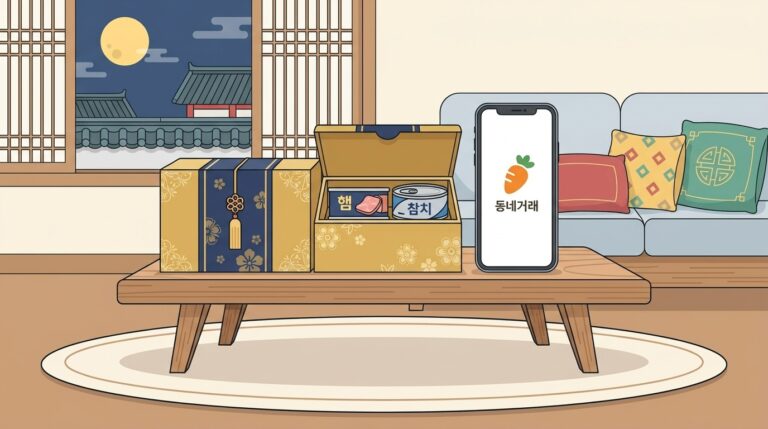
Imagine this: It is the day after Chuseok (추석) or Seollal (설날). You look at your kitchen counter and find yourself staring at five identical, heavy yellow boxes. Inside? Glossy cans of Spam (스팸) and premium canned tuna (참치캔). In Korea, receiving high-end processed food sets is a ubiquitous holiday tradition. But unless you plan on eating budae-jjigae for breakfast, lunch, and dinner for the next six months, you are faced with a dilemma.
Enter Karrot Market (당근마켓)—Korea’s hyper-local secondhand marketplace. During the holidays, Karrot turns into a virtual battlefield of “Spam trading.” If you can navigate this high-level, polite-yet-shrewd micro-economy, your Korean is truly at the C2 level. Let’s master the art of the myeongjeol-seonmul resale.
Phase 2: Deep Dive into Elite Holiday Trading Expressions
Here are three advanced-level expressions that will immediately signal to Korean buyers that you understand both the language and the nuanced social contract of secondhand trading.
1. 명절 선물 세트 미개봉 새상품 (Myeongjeol seonmul seteumi-gae-bong sae-sang-pum)
- Pronunciation: Myeong-jeol seon-mul se-teu mi-gae-bong sae-sang-pum (Think of “mi-gae-bong” as ‘unopened/sealed’—pronouncing mi like “me” and gae-bong like “gay-bong”)
- Meaning: Unopened, brand-new holiday gift set.
- K-Culture Moment: You will see thousands of listings with this exact title within 48 hours of any major holiday. It is the ultimate search keyword.
- Editor’s Insight: At the C2 level, precision is key. Avoid vague words like “새거” (new thing). Using 미개봉 새상품 guarantees high click-through rates because it assures the buyer that the individual cans inside haven’t been tampered with.
- Situation Spectrum: Casual 🚫 | Semi-formal ✅ | Formal ⚠️
- 🤔 Think About It: In many Western cultures, reselling a gift might be seen as slightly taboo or secretive. In Korea, however, the practical “Karrot-ing” (당근하다) of surplus holiday gifts is widely accepted as a smart, eco-friendly lifestyle choice. How does your culture view the recycling of gifts?
2. 네고는 정중히 사양합니다 (Negoneun jeong-jung-hi sa-yang-ham-ni-da)
- Pronunciation: Ne-go-neun jeong-jung-hi sa-yang-ham-ni-da (“Nego” is short for negotiation; “sa-yang” sounds like “sah-yang”)
- Meaning: I politely decline any price negotiations.
- K-Culture Moment: Used by seller-avatars who have already priced their Spam box at a rock-bottom, competitive rate (usually 30-40% off retail value).
- Editor’s Insight: 사양하다 (to decline/refuse politely) is an elegant Hanja-based verb. By pairing “Nego” (slang) with “정중히 사양합니다” (highly formal), you create a polite yet impenetrable barrier against lowballers.
- Situation Spectrum: Casual 🚫 | Semi-formal ✅ | Formal ✅
- 🤔 Think About It: Why does Korean secondhand culture rely so heavily on overly polite language even when setting firm boundaries? It reflects Jeong (정) and the desire to avoid direct confrontation while maintaining social harmony.
3. 직거래, 택배 거래 둘 다 가능합니다 (Jik-geo-rae, taek-bae geo-rae dul da ga-neung-ham-ni-da)
- Pronunciation: Jik-geo-rae, taek-bae geo-rae dul da gah-neung-ham-ni-da (“Jik” as in ‘direct/in-person’, “Taek-bae” as in ‘courier/delivery’)
- Meaning: Both in-person transaction and delivery are available.
- K-Culture Moment: The backbone of Korean logistical efficiency. In-person deals usually happen at subway station exits or in front of apartment complex security offices.
- Editor’s Insight: Offering both options dramatically increases your buyer pool. For jik-geo-rae, specify your preferred landmark (e.g., “00역 3번 출구 앞”).
- Situation Spectrum: Casual ✅ | Semi-formal ✅ | Formal ✅
- 🤔 Think About It: Korea’s high population density and unmatched delivery infrastructure (택배) make peer-to-peer shipping remarkably cheap and fast. How does infrastructure shape online commerce in your country?
Phase 3: Textbook Korean vs. Real-world Native Korean
Let’s compare stiff, textbook phrasing with the sleek, high-context phrasing used by native power-sellers.
Scenario 1: Describing why you are selling the item
- 📖 Textbook Korean: “선물로 받았지만 저는 스팸을 먹지 않아서 판매하려고 합니다.” (I received this as a gift, but since I do not eat Spam, I intend to sell it.)
- 🗣️ Real-world Native Korean: “명절에 들어온 선물인데, 집에 이미 스팸이 차고 넘쳐서 저렴하게 내놓습니다.” (Got this for the holiday, but my house is already overflowing with Spam, so I’m letting it go cheap.)
- 💡 Why the difference? C2 fluency requires warmth. The phrase “차고 넘쳐서” (overflowing/more than enough) adds a touch of self-deprecating humor and explains your motive naturally, making you seem trustworthy.
Scenario 2: Specifying the expiration date (crucial for food products!)
- 📖 Textbook Korean: “유통기한은 2026년 12월까지입니다.” (The expiration date is until December 2026.)
- 🗣️ Real-world Native Korean: “유통기한 26년 말까지로 넉넉합니다. 사진 첨부했어요!” (Expiration date is generous, up to the end of ’26. Photo attached!)
- 💡 Why the difference? Natives rarely say “2026년 12월” in casual listings; they abbreviate to “26년 말” (end of ’26). The word 넉넉하다 (generous/ample) reassures the buyer that they have plenty of time to consume it.
Phase 4: K-Culture Deep Dive & Non-Verbal Manners
4-1. The Non-Verbal Protocol of “Karrot-ing” (당근 매너)
When meeting a stranger in person (직거래) for a transaction:
1. The Double-Hand Handover: Always hand over the heavy Spam box with both hands (양손).
2. The Polite Bow: A subtle 15-degree nod accompanied by “감사합니다, 명절 잘 보내세요!” (Thank you, have a great holiday!) is the gold standard.
3. Cash Etiquette: If paying in cash, place the money in a clean envelope or fold it neatly. However, most modern Karrot transactions use Karrot Pay (당근페이) or instant bank transfers on the spot.
4-2. The Cultural Phenomenon of the “Premium Spam Box”
To foreigners, gifting Spam might seem like an April Fool’s joke. But in Korea, Spam is a premium product. Introduced during the Korean War, it became a symbol of nutritional wealth. Today, CJ CheilJedang designs sleek, dark navy and gold-embossed gift boxes specifically for Seollal and Chuseok. It represents practical, high-quality, and long-lasting food security. Reselling it isn’t cheap; it is a highly calculated economic transaction.
Phase 5: Live Roleplay Scenario
Character Setup
- You (민우 / Min-woo): An expat who received three identical tuna-and-spam sets and wants to declutter.
- The Buyer (은지 / Eun-ji): A savvy local looking to buy cheap sets to distribute to her part-time employees.
민우: 안녕하세요! 당근 문의드립니다. 스팸/참치 세트 아직 구매 가능한가요?
      (Hello! Inquiring via Karrot. Is the Spam/Tuna set still available?)

은지: 네, 안녕하세요! 아직 안 팔렸어요. 미개봉 새상품 맞으시죠?
      (Yes, hello! It hasn’t been sold yet. It is an unopened, brand-new product, right?)

민우: 🎭 (친절하게 포장 상자 사진을 전송하며) 네, 겉면 비닐 포장도 안 뜯은 완전 새 제품이에요. 유통기한도 26년 말까지로 아주 넉넉합니다.
      (Showing kindness while sending a photo of the packaging) (Yes, it's a completely new product with the outer vinyl packaging still intact. The expiration date is very generous, until the end of '26.)

은지: 사진 확인했습니다! 혹시 회사 앞이라 그런데 조금만 가격을 깎아주실 수 있을까요? 네고 부탁드려요.
      (Confirmed the photo! Since I'm near your office, could you lower the price just a bit? I ask for a negotiation.)

민우: 죄송하지만 글에 적어둔 대로 이미 가격을 많이 낮춰 올려서, 네고는 정중히 사양합니다.
      (I'm sorry, but as written in the post, I've already lowered the price significantly, so I must politely decline negotiations.)

은지: 아, 그렇군요! 그럼 원래 가격대로 구매할게요. 오늘 저녁에 직거래 가능하신가요?
      (Ah, I see! Then I'll purchase it at the original price. Are you available for an in-person transaction this evening?)

민우: 네, 좋습니다. 퇴강 후 7시쯤 역삼역 3번 출구 앞은 어떠신가요?
      (Yes, sounds good. How about in front of Yeoksam Station Exit 3 around 7 PM after work?)

은지: 네, 시간 맞춰서 나가겠습니다. 도착하면 채팅 드릴게요!
      (Yes, I will be there on time. I'll chat you when I arrive!)
🔀 Interactive Choice Point
At Yeoksam Station, Eun-ji arrives but realizes she forgot to bring cash and asks: “혹시 계좌이체나 당근페이도 괜찮으실까요?” How do you respond?
- A) “네, 상관없습니다. 당근페이로 보내주시면 바로 확인해 드릴게요!”
- 🟢 Best: Showcases smooth adaptation to modern Korean fintech. Extremely polite and efficient.
- B) “아… 제가 외국인 계좌라 이체 받기 좀 복잡한데, 그냥 현금으로 뽑아다 주시면 안 될까요?”
- 🟡 Risk: While understandable, asking the buyer to find an ATM in a busy subway station during rush hour might sour the interaction.
- C) “계좌이체는 사기 위험이 있어서 안 됩니다. 거래 취소할게요.”
- 🔴 Bad: Way too defensive. Mobile bank transfers on the spot are standard practice in Korea; canceling abruptly over this is considered highly rude (당근 비매너).
Phase 6: 10-Second Emotion Shadowing Drill
Practice saying these high-frequency seller phrases with the exact emotional intonation of a professional Korean trader. The slash / indicates a micro-pause for rhythm.
- [😊 Highly Friendly & Welcoming]
- “명절 선물세트 / 미개봉 새상품 / 저렴하게 올려요!”
- (Myeong-jeol seon-mul-se-teu / mi-gae-bong sae-sang-pum / jeo-ryeom-ha-ge ol-ryeo-yo!)
- [⚠️ Firm but Polished]
- “가격 제안은 / 정중히 사양합니다. / 직거래 선호해요!”
- (Ga-gyeok je-an-eun / jeong-jung-hi sa-yang-ham-ni-da. / Jik-geo-rae seon-ho-hae-yo!)
Phase 7: K-Culture Mini-Dictionary
- 당근하다 (Dang-geun-ha-da)
- Meaning: To trade/sell on Karrot Market (used as a verb).
- Usage: “이번 명절에 받은 스팸, 다 당근해야겠어.”
- 미개봉 (Mi-gae-bong)
- Meaning: Unopened/Sealed.
- Usage: Collectibles, electronics, and food must be labeled as 미개봉 to command high prices.
- 네고 (Ne-go)
- Meaning: Negotiation/Discount (derived from the English word).
- Usage: “네고 문의 시 답장하지 않습니다.” (Will not reply to negotiation requests.)
- 쿨거래 (Kul-geo-rae)
- Meaning: A cool, fast transaction without unnecessary questions or bargaining.
- Usage: “쿨거래 하시면 천 원 깎아드릴게요.” (If you buy instantly without fuss, I’ll give you a 1,000 KRW discount.)
Phase 8: The Reseller’s Survival Kit
Survival Expressions TOP 3
- “선물 세트 박스 쇼핑백도 같이 드려요.” (I will also give you the gift box shopping bag.)
- Pro Tip: Gift sets are often bought to be re-gifted. Keeping the original paper bag intact adds immense resale value!
- “집 근처 오시면 제가 나가겠습니다.” (If you come near my house, I will step outside.)
- Pro Tip: A polite way to negotiate the pickup location in your favor.
- “구성품 빠짐없이 다 들어있습니다.” (All components are included without omission.)
- Pro Tip: Assures the buyer that no single tuna can was sneaked out.
Editor’s Travel & Living Note
To get started with local trading, you must download the 당근마켓 (Karrot) App on your mobile device. Because the app utilizes GPS authentication to restrict your trading pool to your immediate neighborhood, you will get to interact directly with your actual neighbors. Note that Karrot requires a working Korean phone number for SMS verification.
Phase 9:
Frequently Asked Questions (FAQ)
Q: What does "명절 선물 세트 미개봉 새상품 (Myeongjeol seonmul seteumi-gae-bong sae-sang-pum)" mean in Korean and how do you pronounce it?
A: In Korean, "명절 선물 세트 미개봉 새상품 (Myeongjeol seonmul seteumi-gae-bong sae-sang-pum)" is pronounced [Myeong-jeol seon-mul se-teu mi-gae-bong sae-sang-pum (Think of "mi-gae-bong" as 'unopened/sealed'—pronouncing mi like "me" and gae-bong like "gay-bong"] and means: Unopened, brand-new holiday gift set.
Q: What does "네고는 정중히 사양합니다 (Negoneun jeong-jung-hi sa-yang-ham-ni-da)" mean in Korean and how do you pronounce it?
A: In Korean, "네고는 정중히 사양합니다 (Negoneun jeong-jung-hi sa-yang-ham-ni-da)" is pronounced [Ne-go-neun jeong-jung-hi sa-yang-ham-ni-da ("Nego" is short for negotiation; "sa-yang" sounds like "sah-yang"] and means: I politely decline any price negotiations.
Q: What does "직거래, 택배 거래 둘 다 가능합니다 (Jik-geo-rae, taek-bae geo-rae dul da ga-neung-ham-ni-da)" mean in Korean and how do you pronounce it?
A: In Korean, "직거래, 택배 거래 둘 다 가능합니다 (Jik-geo-rae, taek-bae geo-rae dul da ga-neung-ham-ni-da)" is pronounced [Jik-geo-rae, taek-bae geo-rae dul da gah-neung-ham-ni-da ("Jik" as in 'direct/in-person', "Taek-bae" as in 'courier/delivery'] and means: Both in-person transaction and delivery are available.







