

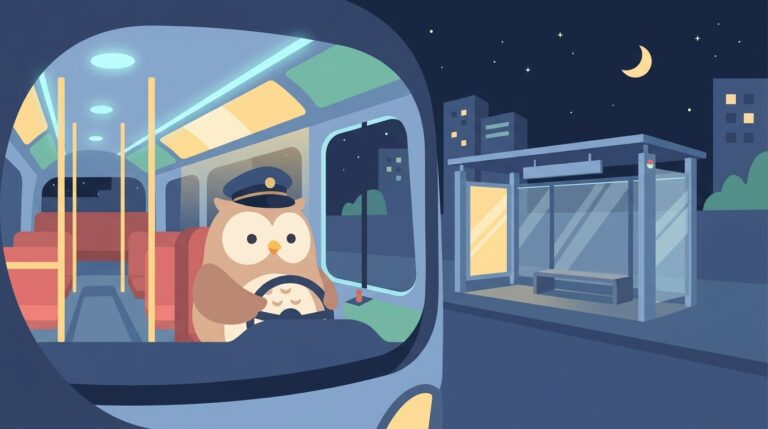
Phase 1: Empathy & Storytelling
안녕하세요! It’s your Korean bestie and Daily Hangul’s Senior Editor!
Imagine this: You’ve had the absolute best night of your life in Hongdae. You grabbed delicious Korean BBQ, sang your heart out at a Noraebang (노래방), and suddenly realized… it’s 1:30 AM. The regular subways and buses have already stopped running. A taxi ride back to your accommodation is going to cost you a fortune because of the late-night surcharge.
Your heart sinks. Are you stranded?
Not at all! Welcome to the world of the Owl Bus (올빼미 버스 – Olppaemi Beoseu), Seoul’s magical late-night transit system. However, catching a late-night bus in a foreign language when you are tired can feel incredibly daunting. “Which bus do I take? How do I tell the driver where I’m going if my card doesn’t work? Is this the right side of the street?”
Don’t worry. This guide is built based on real-life feedback from hundreds of intermediate learners who survived (and loved!) their first late-night commute in Seoul. Together, we’ll master the essential Korean phrases, cultural manners, and transit survival hacks so you can head home safely like a true Seoulite!
Phase 2: Core Expressions Deep Dive
1. 올빼미 버스 어디서 타는지 아세요? (Ol-ppae-mi beoseu eo-di-seo ta-neun-ji a-se-yo?)
- Pronunciation: Ol-ppaemi beoseu eo-dee-seo tah-neun-jee ah-seh-yo? (Rhymes with: “Ol-pa-me” bus “uh-dee-suh” “tah-nuhn-jee” “ah-say-yo?”)
- Meaning: Do you know where to catch the Owl Bus?
- K-Culture Moment: You will often see exhausted main characters in K-Dramas looking at their phones under the blue glow of a late-night bus shelter, asking a kind stranger this exact question when their phone battery dies.
- Editor’s Insight: Olppaemi means “owl.” These special night buses are marked with an “N” (e.g., N13, N62). If you are lost, asking a local near a bus stop this question is the fastest way to find the correct platform.
- Situation Spectrum: Casual ⚠️ / Semi-formal ✅ / Formal ✅
- 🤔 Think About It: In many countries, public transit stops entirely at midnight. Why do you think Korea invested so heavily in keeping a highly functional “Owl Bus” system active throughout the night?
2. 이 버스 홍대 가나요? (I beoseu Hong-dae ga-na-yo?)
- Pronunciation: Ee beoseu Hong-dae gah-nah-yo? (Soft “g” sound like in “go” but gentler)
- Meaning: Does this bus go to Hongdae?
- K-Culture Moment: Asking the bus driver directly as you step on the bus. It’s a classic, safe way to double-check your direction before tapping your transit card.
- Editor’s Insight: The suffix “-나요? (-na-yo?)” adds a very polite, gentle, and inquisitive tone to your question. It sounds much softer and friendlier than “홍대 가요? (Hong-dae ga-yo?)”.
- Situation Spectrum: Casual ⚠️ / Semi-formal ✅ / Formal ✅
- 🤔 Think About It: How does adding a soft ending like “-나요?” change the dynamic between a busy bus driver and a late-night passenger in your own culture?
3. 하차 태그 안 하면 추가 요금 나오죠? (Ha-cha tae-geu an ha-myeon chu-ga yo-geum nao-jyo?)
- Pronunciation: Ha-chah tae-geu ahn ha-myuhn choo-gah yo-guhm nah-oh-jyo?
- Meaning: If I don’t tap off, there’s an extra charge, right?
- K-Culture Moment: Experienced travelers reminding their friends to tap their cards on the reader before stepping out of the rear doors of the bus.
- Editor’s Insight: “하차 (Ha-cha)” means getting off/disembarking, and “태그 (tae-geu)” comes from “tag.” In Korea, failing to tag off on late-night or distance-based buses results in a penalty fare (추가 요금) on your next ride!
- Situation Spectrum: Casual ✅ / Semi-formal ✅ / Formal 🚫
- 🤔 Think About It: The word “태그 (tag)” is a Konglish word adapted into daily life. What other English words have you noticed being used uniquely in Korean transit?
Phase 3: Textbook Korean vs. Real Korean
Situation 1: Confirming the destination with the driver
- 📖 Textbook Korean: 이 버스는 신촌 방향으로 운행합니까? (I beoseu-neun Sin-chon bang-hyang-eu-ro un-haeng-hap-ni-kka? – Is this bus operating in the direction of Sinchon?)
- 🗣️ Real Korean: 이거 신촌 가요? (I-geo Sin-chon ga-yo? – Does this go to Sinchon?)
- 💡 Why is it different?: In real life, buses move fast. The driver wants a quick, clear question. “이거 [Destination] 가요?” is short, natural, and instantly understood.
Situation 2: Asking if the late-night bus is still running
- 📖 Textbook Korean: 심야 버스 운행 시간이 종료되었습니까? (Sim-ya beoseu un-haeng si-gan-i jong-ryo-doe-eot-seup-ni-kka? – Has the late-night bus operation time ended?)
- 🗣️ Real Korean: 올빼미 버스 끊겼어요? (Ol-ppae-mi beoseu kkeun-gyeot-seo-yo? – Are the Owl Buses cut off/done for the night?)
- 💡 Why is it different?: Koreans use the verb “끊기다 (kkeun-gi-da)” which literally means “to be cut off” or “disconnected” to describe when public transport stops running for the day.
Phase 4: K-Culture Deep Dive & Non-verbal Etiquette
4-1. Nunchi (눈치) & Late-Night Bus Manners
When boarding an Owl Bus in Korea, your Nunchi (tact/situational awareness) is your best friend.
* The Card Prep: Do not wait until you stand in front of the card reader to search your bag for your T-money card. Have it ready in your hand before the bus arrives.
* Silence is Golden: Owl buses are filled with tired workers, students, and people heading home after a long night. Keep your voice at a whisper if you are talking to a friend, and turn down your smartphone media volume. Speaking loudly on a night bus is considered highly disrespectful.
4-2. The “N” Bus Phenomenon
Seoul is one of the few metropolitan areas in the world that operates a dedicated midnight network known as the Olppaemi Bus. These buses have a bright owl logo on the front and are specifically designed to connect major commercial areas like Gangnam, Hongdae, Dongdaemun, and Jongno between 11:30 PM and 6:00 AM. Taking an N-bus is a unique cultural experience where you see the “other side” of busy Seoul life.
Phase 5: Real-Life Roleplay Scenario
Setting: A chilly bus stop in Gangnam at 2:10 AM. You are trying to find the N13 bus to get back to Dongdaemun. An older local resident (Min-su) is waiting at the same stop.
- Characters:
- You (A tired but polite traveler)
- Min-su (민수 – A helpful local in his 40s who is waiting for his bus)
- You: 저기요, 죄송한데 올빼미 버스 여기서 타는 거 맞나요?
(Jeo-gi-yo, joe-song-han-de ol-ppae-mi beoseu yeo-gi-seo ta-neun geo man-na-yo?)
🎭 Politely bowing your head slightly to catch his attention.
“Excuse me, sorry to bother you, but is this where I catch the Owl Bus?” -
Min-su: 아, 네. 맞아요. 몇 번 타시는데요?
(Ah, ne. Ma-ja-yo. Myeot beon ta-si-neun-de-yo?)
🎭 Looking up from his phone and giving a warm smile.
“Ah, yes. That’s right. Which number are you taking?” -
You: 동대문 가려고 N13(엔 십삼)번 기다리고 있어요.
(Dong-dae-mun ga-ryeo-go En-sip-sam-beon gi-da-ri-go is-seo-yo.)
🎭 Pointing at the bus route map on the shelter glass.
“I’m waiting for the N13 to go to Dongdaemun.” -
Min-su: 어, N13번 정류소 여기가 아니고 건너편이에요!
(Eo, En-sip-sam-beon jeong-ryu-so yeo-gi-ga a-ni-go geon-neo-pyeon-i-e-yo!)
🎭 Pointing across the wide avenue toward the opposite street.
“Oh, the N13 stop isn’t here, it’s on the opposite side of the street!” -
You: 아, 진짜요? 반대방향에서 타야 하는군요.
(Ah, jin-jja-yo? Ban-dae-bang-hyang-e-seo ta-ya ha-neun-gun-yo.)
🎭 Widening your eyes in surprise, realizing your mistake.
“Ah, really? I have to catch it from the opposite direction.” -
Min-su: 네, 여기서 타면 분당으로 가요. 얼른 건너가세요. 곧 올 시간이에요.
(Ne, yeo-gi-seo ta-myeon Bun-dang-eu-ro ga-yo. Eol-leun geon-neo-ga-se-yo. Got ol si-gan-i-e-yo.)
🎭 Checking his transit app and ushering you gently toward the crosswalk.
“Yes, if you ride from here, you’ll go to Bundang. Hurry and cross over. It’s coming soon.” -
You: 정말 감사합니다! 큰일 날 뻔했네요.
(Jeong-mal gam-sa-hap-ni-da! Keun-il nal ppeon-haet-nae-yo.)
🎭 Bowing deeply in gratitude before walking toward the crosswalk.
“Thank you so much! That was a close call.” -
Min-su: 조심히 가세요!
(Jo-sim-hi ga-se-yo!)
🎭 Waving lightly.
“Go safely!”
🔀 Interactive Choice Point
You crossed the street, but now the N13 bus has arrived and it is packed with people. What do you do?
- Choice A: Push your way in through the front door, tapping your card while saying loudly, “비켜주세요!” (Move please!).
- Choice B: Step on quickly, tap your card, slide into an open space in the middle aisle, and keep your backpack in front of your chest.
- Choice C: Wait for the next bus because this one looks too crowded, even though it’s 2:30 AM.
Feedback:
- Choice A (Bad 🚫): Shouting “비켜주세요!” is considered rude and aggressive. Night bus passengers are exhausted and value quiet spaces. Instead, use a gentle “잠시만요 (Excuse me for a second)”.
- Choice B (Best ✅): Perfect! Squeezing in politely is normal on busy night buses. Keeping your backpack in front of your chest (백팩 앞으로 매기) shows high cultural manners (Nunchi) by saving space for others.
- Choice C (Risk ⚠️): While safe, the interval for Owl buses is much longer than normal buses (often 20 to 35 minutes). Waiting at 2:30 AM might leave you freezing on the street for a long time!
Phase 6: 10-Second Emotion Shadowing Drill
Practicing with emotion helps build muscle memory! Read these out loud following the pauses (/) and the emotional cues:
- [🥺 Exhausted & Desperate]
저기요… / 올빼미 버스… / 아직 다니나요?
(Jeo-gi-yo… / ol-ppae-mi beoseu… / a-jik da-ni-na-yo?)
“Excuse me… / are the Owl Buses… / still running?” -
[😊 Relieved & Grateful]
와, / 정말 감사합니다! / 반대쪽이군요!
(Wa, / jeong-mal gam-sa-hap-ni-da! / ban-dae-jjok-i-gun-yo!)
“Wow, / thank you so much! / It’s the opposite side!” -
[😮 Alert & Quick]
기사님! / 이 버스 / 홍대입구역 가죠?
(Gi-sa-nim! / i beoseu / Hong-dae-ip-gu-yeok ga-jyo?)
“Driver! / This bus / goes to Hongik Univ. Station, right?”
Phase 7: K-Culture Mini Dictionary
- 교통카드 (Gyo-tong-ka-deu) | Transit Card
- The physical card (like T-money or Cashbee) or mobile app used to pay for subways, buses, and even taxis in Korea.
- 환승할인 (Hwan-seung-ha-rin) | Transfer Discount
- Korea’s amazing system where transferring between buses or subway lines within 30 minutes (40 minutes late at night) is completely free or highly discounted.
- 정류소 (Jeong-ryu-so) | Bus Stop
- The designated bus shelter or pole where buses stop. Late-night stops are often equipped with heated benches and digital arrival screens!
- 막차 (Mak-cha) | Last Ride / Last Train
- The final operating vehicle of the day. Miss this, and you are officially looking for an Owl Bus or a taxi!
Phase 8: Traveler’s Survival Kit
Survival Phrases TOP 3
- 카드 잔액이 부족해요.
- Ka-deu jan-aek-i bu-jok-hae-yo.
- Pro Tip: If your card has insufficient funds when you tap, say this to the driver before stepping off to pay in cash or use an alternative card.
- 중앙차선이 어디예요?
- Jung-ang-cha-seon-i eo-di-yeo-yo?
- Pro Tip: Many Seoul buses stop at “central bus lanes” located in the middle of the highway rather than on the sidewalk. Use this phrase to find the boarding island.
- 이번 정류장에 내릴게요!
- I-beon jeong-ryu-jang-e nae-ril-ge-yo!
- Pro Tip: If the stop button is broken or the bus is packed, call this out clearly toward the back door so the driver doesn’t skip your stop.
Editor’s Travel Note
When navigating Seoul at night, do not rely on standard Western map applications as they often fail to update real-time night bus routes in Korea. Instead, make sure to download the Naver Map App or KakaoMap App before your trip. These local platforms provide live GPS tracking of Owl Buses (N-buses) down to the exact second!
Phase 9: “Going Deeper” (Reflective Insight)
The existence of the Owl Bus network is a beautiful reflection of Korea’s dynamic night culture, often referred to as “K-Nightlife.” Unlike many global cities that shut down after midnight, South Korea operates on a multi-phase system where people enjoy 1차 (first round – dinner), 2차 (second round – drinks or cafe), and 3차 (third round – 노래방 or late snacks). The government created the Owl Bus system to protect late-night workers and weary partygoers alike, ensuring that everyone can return home safely and affordably. It highlights Korea’s deep sense of social safety and community-first infrastructure.
💬 Your Turn: Have you ever experienced getting stranded in a foreign city after midnight? How does your home country’s late-night transportation compare to Korea’s Owl Bus? Let us know in the comments below!
Phase 10: FAQ & Common Mistakes
Q: Can I use my standard T-money card on the Owl Bus?
A: Yes! The Owl Bus accepts standard T-money cards, credit cards with transit functions, and mobile transit passes. However, the base fare is slightly higher than daytime buses (around 2,500 KRW compared to the daytime 1,500 KRW).
Q: How do I know if the bus is heading in the right direction?
A: Look at the digital sign on the bus shelter or check your Naver Map. You can also ask the driver: “[Your Destination] 가나요?” as you board.
Q: Does the transfer discount apply to late-night buses?
A: Yes! If you transfer between two different Owl buses or from a late-night bus to a regular early morning bus/subway within 40 minutes, you will receive the transfer discount.
🚨 Common Mistakes Alert (Top 3)
- Mistake: Trying to board through the back door.
- Correct Action: Always board through the front door (앞문) and exit through the back door (뒷문).
- Mistake: Forgetting to press the red “Stop” (하차) button before your stop.
- Correct Action: Night drivers will skip empty stations if no one presses the button or stands near the exit door.
- Mistake: Forgetting to tap the card reader when getting off.
- Correct Action: Always tap your card on the reader near the back exit door, even if you are not transferring, to avoid penalty fares on your next journey.
Phase 11: Action Mission
- 🥉 Bronze Mission: Write down the name of your hotel or favorite Seoul neighborhood in Korean and practice saying: “이거 [Neighborhood] 가나요?” three times in front of the mirror.
- 🥈 Silver Mission: Take a screenshot of the Naver Map app showing an active N-Bus (올빼미 버스) route and share it on Instagram, tagging
@DailyHangulwith your favorite night-ride emoji! 🦉 - 🥇 Gold Mission: Next time you are in Korea, skip the expensive taxi after midnight and successfully board an N-Bus to your destination using the phrases you learned today!
🎮 K-Culture Mission
Watch a slice-of-life K-Drama (like My Liberation Notes or Reply 1988) and listen closely during scenes where characters commute. Can you spot anyone tapping their card or running to catch the “막차” (last ride)?
Phase 12: Interactive Quiz Challenge
Test your late-night transit survival skills!
1. Situation Quiz
You are boarding the N26 bus. Which is the most polite and natural way to confirm with the driver that the bus goes to Sinchon?
* A) 신촌 가요?
* B) 신촌 가라!
* C) 신촌을 향해 운행해라.
2. Fill in the Blank
Complete the phrase to ask if the last bus has stopped running:
* “올빼미 버스 ________?” (Did the Owl Bus cut off/stop?)
3. True or False?
In Korea, you only need to tap your transit card when boarding the bus, and tapping off is completely optional with no penalty.
* (True / False)
🎉 Click here to reveal the answers and explanations!
1. Correct Answer: A
* Explanation: “신촌 가요?” (Does it go to Sinchon?) is the most natural, polite, and practical phrase for busy transit situations.
2. Correct Answer: 끊겼어요 (kkeun-gyeot-seo-yo)
* Explanation: “끊기다” is the colloquial verb used by native speakers to describe public transit operations ending for the day.
3. Correct Answer: False
* Explanation: You must tap off (하차 태그) when getting off the bus, especially on late-night routes, to avoid penalty fares on your next ride!







