

Write Heartfelt Letters in Korean: The Ultimate Guide for Anniversaries (A2 Level)
Phase 1: Empathy (Welcome, My Friend!)
안녕하세요! (Annyeonghaseyo!) Hello! It’s your favorite Korean culture navigator and Daily Hangul editor.
Imagine this: It’s your friend’s birthday, or maybe your first anniversary with your Korean partner. You’ve bought a beautiful card, and you want to write something warmer than just “Happy Birthday” in English. You open your translator app, type “I am so happy to be with you,” and it spits out a translation that sounds like a dry, robotic instruction manual. Oh no!
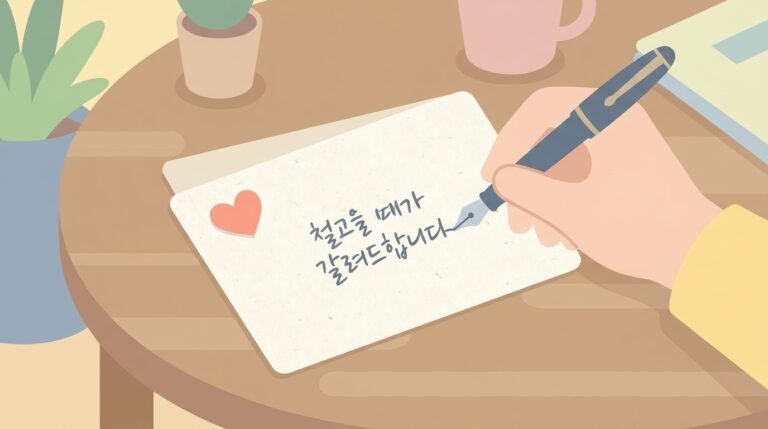
Writing a handwritten letter (손편지 – Son-pyeon-ji) is a huge deal in Korea. It’s considered the ultimate way to show your sincere feelings (정성 – Jeongseong). Today, we’re going to learn three magical, easy-to-write Korean phrases that will make your handwritten letters sound natural, sweet, and deeply touching—even if you are still an A2 beginner! Our Daily Hangul community members have used these exact lines to make their Korean friends and partners tear up with joy. Let’s dive in!
Phase 2: Deep-Dive into Top 3 Heartfelt Phrases
1. 태어나 줘서 고마워요 (Tae-eo-na jwo-seo go-ma-wo-yo)
- Pronunciation: Tae-eo-na jwoseo go-ma-wo-yo (Sounds like: “Tae-uh-nah jwasuh go-mah-wo-yo”)
- Meaning: “Thank you for being born.”
- K-Culture Moment: You will hear this constantly in K-Dramas during birthday scenes, and K-Pop idols love writing this to their fans during anniversaries.
- Editor’s Insight: In English, we say “Happy Birthday,” focusing on the day. In Korean, saying “Thank you for being born” focuses on the person’s existence. It’s incredibly sweet and warm.
- Situation Spectrum: Casual (태어나 줘서 고마워) ✅ | Semi-formal (태어나 줘서 고마워요) ✅ | Formal (태어나 주셔서 감사합니다) ⚠️
- 🤔 Think About It: Why do you think Korean culture expresses gratitude for someone’s existence rather than just celebrating the day? How does this change the feeling of a card?
2. 항상 내 옆에 있어 줘서 고마워요 (Hang-sang nae yeop-e is-seo jwo-seo go-ma-wo-yo)
- Pronunciation: Hang-sang nae yup-e is-suh jwoseo go-ma-wo-yo (Sounds like: “Hahng-sahng ney yup-ey is-suh jwasuh go-mah-wo-yo”)
- Meaning: “Thank you for always being by my side.”
- K-Culture Moment: The classic line from romantic K-Dramas when couples celebrate their 100-day anniversary (백일 – Baek-il).
- Editor’s Insight: This phrase highlights loyalty and companionship. The grammar point “~어/아 줘서” means “thank you for doing the favor of…”. It shows you appreciate their presence as a gift.
- Situation Spectrum: Casual (항상 내 옆에 있어 줘서 고마워) ✅ | Semi-formal (항상 내 옆에 있어 줘서 고마워요) ✅ | Formal (항상 제 곁에 있어 주셔서 감사합니다) ⚠️
- 🤔 Think About It: How does saying “by my side” make a relationship feel closer compared to just saying “thank you for your help”?
3. 우리 앞으로도 행복해요 (U-ri ap-eu-ro-do haeng-bok-hae-yo)
- Pronunciation: Oo-ri ahp-eu-ro-do haeng-bok-hae-yo (Sounds like: “Oo-ree ahp-eu-ro-doh heng-bohk-hey-yo”)
- Meaning: “Let’s be happy in the future too.”
- K-Culture Moment: Often written at the very end of anniversary letters as a warm promise for the future.
- Editor’s Insight: Instead of “I want to make you happy,” Koreans love using “We (우리)” to show partnership. “Let’s do this together!”
- Situation Spectrum: Casual (우리 앞으로도 행복하자) ✅ | Semi-formal (우리 앞으로도 행복해요) ✅ | Formal (앞으로도 함께 행복하시길 바랍니다) ⚠️
- 🤔 Think About It: Why does using “We (우리)” feel warmer in Korean culture than using “I” or “You”?
Phase 3: Textbook Korean vs. Real-Life Korean
Let’s compare textbook style with what Koreans actually write in cute handwritten letters!
Situation 1: Wishing someone a happy birthday
- 📖 Textbook Korean: 생일을 축하합니다. (Saeng-il-eul chuk-ha-hap-ni-da. – Happy birthday. – Too formal/stiff for a close friend)
- 🗣️ Real-Life Korean: 생일 정말 많이 축하해! (Saeng-il jeong-mal man-i chuk-ha-hae! – Happy birthday so, so much! – Much warmer and natural)
- 💡 Why the difference? The textbook version is grammatically perfect but sounds like a corporate email. Adding “정말 많이 (really a lot)” and using casual endings makes your love shine through!
Situation 2: Expressing love on an anniversary
- 📖 Textbook Korean: 당신을 사랑합니다. (Dang-sin-eul sa-rang-hap-ni-da. – I love you. – Warning! “Dang-sin” can sound awkward and distant in daily life)
- 🗣️ Real-Life Korean: 많이 고맙고 사랑해! (Man-i go-map-go sa-rang-hae! – Thank you so much, and I love you! – Natural and cute)
- 💡 Why the difference? Real Korean couples rarely use the pronoun “당신 (you)” in letters. They prefer to skip the pronoun completely and blend gratitude (고맙고) with love (사랑해).
Phase 4: K-Culture Deep Dive & Non-verbal Manners
4-1. The Manner of Giving a Letter
In Korea, how you give the letter is just as important as what you write!
* Two Hands Rule: When handing over your letter, always hold it with both hands and bow your head slightly. It shows deep respect and sincerity.
* Cute Stickers: Koreans love decorating cards with small, cute stickers (스티커 꾸미기 – Seu-ti-ku kku-mi-gi or 다꾸 – Da-kku). Adding a small cute sticker to seal the envelope shows you put effort into it!
4-2. The Romantic
Frequently Asked Questions (FAQ)
Q: What does "태어나 줘서 고마워요 (Tae-eo-na jwo-seo go-ma-wo-yo)" mean in Korean and how do you pronounce it?
A: In Korean, "태어나 줘서 고마워요 (Tae-eo-na jwo-seo go-ma-wo-yo)" is pronounced [Tae-eo-na jwoseo go-ma-wo-yo (Sounds like: "Tae-uh-nah jwasuh go-mah-wo-yo"] and means: "Thank you for being born."
Q: What does "항상 내 옆에 있어 줘서 고마워요 (Hang-sang nae yeop-e is-seo jwo-seo go-ma-wo-yo)" mean in Korean and how do you pronounce it?
A: In Korean, "항상 내 옆에 있어 줘서 고마워요 (Hang-sang nae yeop-e is-seo jwo-seo go-ma-wo-yo)" is pronounced [Hang-sang nae yup-e is-suh jwoseo go-ma-wo-yo (Sounds like: "Hahng-sahng ney yup-ey is-suh jwasuh go-mah-wo-yo"] and means: "Thank you for always being by my side."
Q: What does "우리 앞으로도 행복해요 (U-ri ap-eu-ro-do haeng-bok-hae-yo)" mean in Korean and how do you pronounce it?
A: In Korean, "우리 앞으로도 행복해요 (U-ri ap-eu-ro-do haeng-bok-hae-yo)" is pronounced [Oo-ri ahp-eu-ro-do haeng-bok-hae-yo (Sounds like: "Oo-ree ahp-eu-ro-doh heng-bohk-hey-yo"] and means: "Let’s be happy in the future too."







