

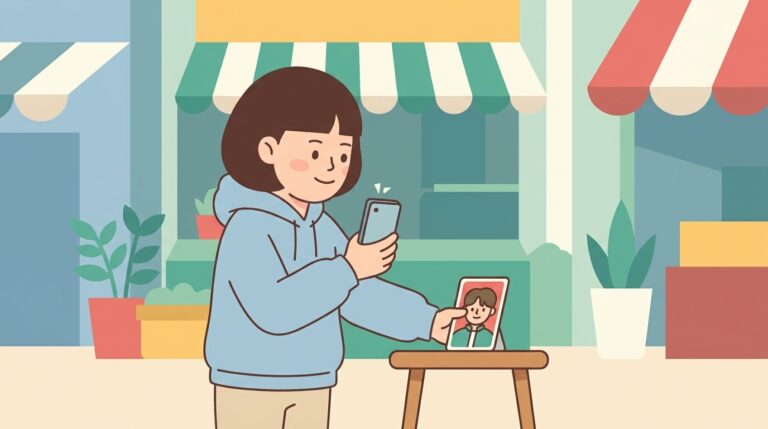
Phase 1: Empathy (Welcome, My Friend!)
안녕하세요! (An-nyeong-ha-se-yo!) Hello! Your favorite Korean study buddy and Daily Hangul’s editor is here!
Have you ever looked through your closet and found a beautiful jacket you bought in Seoul, but never wore? Or maybe you have a K-Pop album with duplicate photocards? In Korea, selling these second-hand is incredibly popular! Apps like Karrot Market (ቁᅧᅢ ᅡᅡᅳᄳ – Dang-geun Market) are a huge part of daily life.
But here is the catch: when you upload your item, Korean buyers are super detail-oriented. They will zoom in on every corner. If your photo is blurry or doesn’t show the real color, you might get flooded with messages asking, “Is this the real color?” or “Are there any scratches?”
Don’t sweat it! Today, we are going to learn the absolute essential Korean phrases for taking and describing photos of your items. No more awkward Google Translate moments—just natural, friendly Korean that will help you sell your items like a local pro!
Phase 2: Deep Dive into 3 Key Expressions
1. 사낀 서ᄳ라뇨! (Sajin silmul-gata-yo!)
- Pronunciation: Sah-jin sheel-mool-gah-tah-yo! (Sounds like “Sah-jean” + “sheal-mool” + “gah-tah-yo”)
- Meaning: The photo looks exactly like the real thing!
- K-Culture Moment: In K-Dramas, when someone meets their online crush in real life and they look just as stunning as their profile picture, they might say this with a bright smile! In trading, it reassures the buyer that there are no tricky filters.
- Editor’s Insight: Silmul (샤멀) means “real-life object” or “in-person look.” Saying this builds immense trust.
- Situation Spectrum: Casual (✅) / Semi-formal (✅) / Formal (⚠️ – use 사낀이 샤멀가 가타요 for formal).
- 이 Think About It: In your country, do people prefer highly edited, aesthetic photos, or raw, honest photos when buying used things? Koreans highly value silmul honesty!
2. 하자 어ᄠᅡ요. (Haja eop-seoyo.)
- Pronunciation: Ha-jah up-suh-yo. (Sounds like “Ha-jah” + “up-soy-yo”)
- Meaning: There are no defects/scratches.
- K-Culture Moment: When K-Pop collectors trade rare photocards, they inspect them under bright lights. If there isn’t a single scratch, they proudly claim: “하자 어ᄠᅡ요!”
- Editor’s Insight: Haja (하자) means defect, flaw, or damage. Showing close-up photos of clean corners while saying this will make your item sell instantly.
- Situation Spectrum: Casual (✅) / Semi-formal (✅) / Formal (⚠️)
- 이 Think About It: Why is being honest about small flaws so important in Korean “jeong” (정 – warm affection/trust) culture?
3. 새개 가타요. (Sae-geo gata-yo.)
- Pronunciation: Se-guh gah-tah-yo. (Sounds like “Say-goh” + “gah-tah-yo”)
- Meaning: It looks brand new!
- K-Culture Moment: You open a secondhand box, and the item is still wrapped in its original plastic. You scream with joy: “Wow, 새개 가타요!”
- Editor’s Insight: Sae-geo (새개) is a colloquial contraction of sae geos (새 것 – new thing). It’s incredibly catchy and positive.
- Situation Spectrum: Casual (✅) / Semi-formal (✅) / Formal (ሒ)
- 이 Think About It: How does saying “like new” differ from saying “unused” in your language?
Phase 3: Textbook Korean vs. Real Korean
Let’s look at how textbooks teach you to describe items versus how real Koreans actually talk on apps like Karrot Market!
Situation 1: Describing the condition
- ሑ 교궈서 한구거 (Textbook): 이 물건언 사용하지 안아쇄슸니다. (I mulgeon-eun sayonghaji anas-seumnida. – This item has not been used.)
- ᄒ 진자 한구거 (Real Life): 미개렁 새상펌이요! (Mi-gae-bong sae-sang-pum-i-yo! – It’s an unopened brand-new product!)
- ᄒ 애 다룰까?: Real buyers love short, punchy keywords. “미개렁” (unopened) is the ultimate trust-builder.
Situation 2: Explaining photo quality
- ሑ 교궈서 한구거 (Textbook): 사건이 서먕하지 안슸니다. (Sajin-i seonmyeonghaji anseumnida. – The photo is not clear.)
- ᄒ 진자 한거ᄳ어 (Real Life): 사건이 조걈 허리해요. 샤멀이 더 예퍼요! (Sajin-i jogeum Heuri-haeyo. Silmul-i deo yeoppeoyo! – The photo is a bit blurry. It looks much prettier in person!)
- ᄒ 애 다룰까?: Admitting your photography skills are lacking with a cute excuse makes you sound extremely honest and charming!
Phase 4: K-Culture Deep Dive & Mannerisms
4-1. The “Manner Temperature” (매너온도 – Maene-ondo)
In Karrot Market, everyone has a “Manner Temperature” starting at 36.5°C (human body temp). If you are polite and honest, it goes up! When posting photos:
* No Hidden Flaws: If there’s a tiny scratch, take a zoomed-in photo of it. Point at it with your finger in the photo (하자 부기ᄳ – flaw marking). Koreans love this level of honesty!
4-2. The “Resell” Culture (N-cha Resell)
Koreans love recycling and smart shopping. Getting a good deal on a “like-new” item is considered trendy, not cheap. When you take photos, clean the background. A neat, aesthetic background tells the buyer: “I treat my things with respect.”
Phase 5: Real-Life Roleplay Scenario
Setting: You are selling a slightly used K-Pop album on Karrot Market. A buyer named Ji-a (지아) messages you asking about the photos.
- Ji-a: 안뇅하새요! 아래범 사진 더 보어저실 수 이돼나요?
(An-nyeong-ha-se-yo! Album sajin deo bo-yeo-ju-sil su is-neu-na-yo?)
ᄅ “Hello! Could you show me more photos of the album?” - You: 내, 잠시만요! 지금 긱어서 보낼개요.
(Nae, jam-si-man-yo! Ji-geum jjig-eo-seo bo-nae-gae-yo.)
ᄅ “Yes, just a moment! I will take some now and send them.” - Ji-a: 하자 어ᄱ냐 버번 괘꾸 긱어주세요!
(Haja inneun bubun gakka-i jjig-eo-ju-se-yo!)
ᄅ “Please take close-up photos of any damaged parts!” - You: 하자 어ᄠᅡ요. 정마런 새개 가타요!
(Haja eop-seoyo. Jeong-mal sae-geo gata-yo!)
ᄅ “There are no defects. It really looks brand new!” - Ji-a: 아, 사진 보니까 개끗하내요. 서ᄳ멀가타요.
(Ah, sajin bonikka gae-kkeut-ha-nae-yo. Silmul-gata-yo.)
ᄅ “Ah, looking at the photos, it is so clean. It looks exactly like the real thing!” - You: 내, 하자 어ᄱ니 거정 마새요!
(Nae, haja eop-seu-ni geo-jeong ma-se-yo!)
ᄅ “Yes, there are no flaws, so don’t worry!”
해 Interactive Choice Point
Ji-a asks: “어디서 만날까요?” (Where should we meet?)
What is your response?
* A) “아머더나 갠하나요.” (Anywhere is fine.)
* B) “강남역 7번 채구가 조하요!” (Gangnam Station Exit 7 is good!)
* C) “저휴지ᄇ으러 오새요.” (Please come to my house.)
햐 Feedback:
- Choice A (Bad): Too vague! Koreans prefer setting a quick, efficient spot.
- Choice B (Best ᄑ): Perfect! Public spots like subway exits are the standard safe meeting places (jik-georae) in Korea.
- Choice C (Risk): For safety and privacy, meeting outside at a public station is highly recommended.
Phase 6: 10-Second Emotion Shadowing Drill
Speak like a native by adding real emotions! Pay attention to the pauses (/).
- [😊 Proud and Confident]
- 서ᄳ멀이 / 더 / 예퍼요!
- Silmul-i / deo / yeoppeoyo!
- (It looks / even prettier / in real life!)
- [🥺 Reassuring and Sweet]
- 하자 / 정마러ᄱ / 어ᄠᅡ요.
- Haja / jeong-mal-ro / eop-seoyo.
- (Flaws? / Really / there are none.)
Phase 7: K-Culture Mini Dictionary
- 샤멀 (Sil-mul) | Real-life look / In-person appearance
- Used not only for items but also to praise celebrities: “He looks even better in person!”
- 하자 (Ha-ja) | Flaw / Defect
- Essential vocabulary when trading goods online to avoid legal or personal disputes.
- 직거ᄳᅢ (Jik-geo-rae) | Direct face-to-face deal
- Meeting the buyer in person to trade cash for the item.
- 태개배거ᄳᅢ (Taek-bae-geo-rae) | Shipping/Delivery deal
- Sending the item via convenient convenience store post services.
Phase 8: Traveler’s Survival Kit
Survival Phrases TOP 3
- 사진 봬내짐니다. (Sajin bonae-jimnida.)
ᄒ Pro Tip: “Sending photos now.” Use this right before uploading images in chat. - 버쵸 차이 어ᄱ나요? (Bit chai eops-nayo?)
ᄒ Pro Tip: “Is there any color difference due to lighting?” Great when buying clothes. - 저 여기 이새요! (Jeo yeogi is-seoyo!)
ᄒ Pro Tip: “I am here!” Perfect to text when waiting near a subway exit.
Editor’s Travel Note
When trading in Korea, you’ll need the right tools. Download the Karrot Market App on Google Play to start browsings local items. For meeting locations, always double-check with the Naver Map App to find the exact exit number. Note: App interfaces and local transaction policies can change over time.
Phase 9: A Step Deeper (Reflection)
In Korea, second-hand transactions are deeply built on mutual trust and communal respect. When you sell something, it is common to write a small “thank you” note or throw in free snacks (덤 – Deom). This warm cultural dynamic shows how even digital business transactions in Korea are touched by the spirit of Jeong (정).
💬 Your Turn: Have you ever bought or sold something second-hand? Would you feel comfortable trading in a foreign language? Let me know in the comments below!
Phase 10: FAQ & Avoiding Misunderstandings
Q: Can I use filters on my item photos?
A: It is highly recommended not to! Buyers might ask for a refund if the real color differs from the filtered image. Stick to natural light.
Q: What if I find a tiny scratch after uploading?
A: Immediately message the buyer with a new photo and say “하자를 래ᄳ건해요” (I found a flaw). They will appreciate your honesty and might still buy it!
Q: How do I handle payments?
A: Cash or quick banking transfers (gyejwa-iche) on the spot are standard.
해 Common Mistakes Alert!
- Mistake: Sending blurry photos in dark lighting. ᄅ Correct Action: Take photos next to a bright window.
- Mistake: Saying “새개요” (It’s brand new) when it actually has stains. ᄅ Correct Action: Use “새개 가타요” (It looks like new) and list the imperfections.
Phase 11: Action Mission!
- 우 Bronze: Take a picture of your favorite mug and say “사진 서ᄳ러뇨!” out loud.
- ᄉ Silver: Post an item photo on Instagram, tag
@DailyHangul, and write: “하자 어ᄠᅡ요!” - ᄀ Gold: Pretend to sell a K-Pop album to a friend using only Korean phrases learned today!
Phase 12: Interactive Quiz Challenge
Test your skills! Click to reveal the answers.
Q1. What does “새개 가타요” mean?
해 Click to see the Answer
It means “It looks like new!”. Use it when describing used items in excellent condition.
Q2. Fill in the blank: “No scratches/defects” -> “____ 어ᄠᅡ요.”
해 Click to see the Answer
하자 (Haja). The full sentence is “하자 어ᄠᅡ요.”







