

Balancing Gold Medals and Daily Workouts: South Korea’s Sports Evolution
Phase 1: Empathy (스토리 몰입형 오프닝)
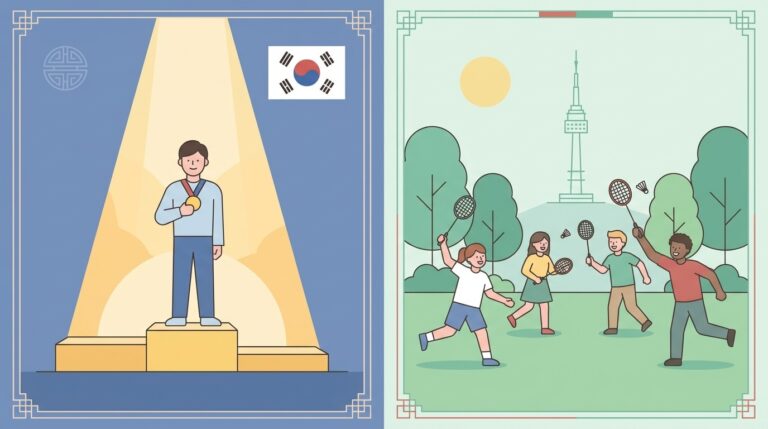
안녕하세요! Daily Hangul editor here! Have you ever watched a Korean drama like Twenty-Five Twenty-One and felt your heart race during the fencing matches? Or maybe you’ve cheered for South Korea during the Olympics, amazed by their archery dominance. South Korea has a legendary track record in elite sports (엘리트 체육). However, behind those gold medals lies a growing social debate that touches the lives of everyday Koreans: How do we balance training world-class athletes with promoting sports for everyone in daily life?
If you are aiming for advanced Korean fluency (C2), discussing social policy, athletic culture, and structural reforms is a fantastic way to showcase your linguistic precision. Today, we’re diving deep into the sophisticated vocabulary surrounding the reform of South Korea’s sports paradigm—shifting from a hyper-focused medal machine to a healthy, active society. Let’s master the expressions that will make you sound like a policy expert or a social commentator on a Korean talk show!
Phase 2: Core Expressions (핵심 표현 3선 심층 분석)
1. 엘리트 체육과 생활 체육의 선순환 (El-ri-teu che-yuk-gwa saeng-hwal che-yuk-ui seon-sun-hwan)
- Pronunciation: el-ree-teu che-yook-gwa saeng-hwal che-yook-ee sun-soon-hwan (Rhymes with “sun-soon-hwan” like a gentle wheel spinning)
- Meaning: The virtuous cycle of elite sports and grassroots/community sports.
- K-Culture Moment: You will hear this phrase in policy debates, sports documentaries, or interviews with the Minister of Culture, Sports, and Tourism, describing how community sports should feed into elite talent scouting, and vice versa.
- Editor’s Insight:
선순환(virtuous cycle) is the direct antonym of악순환(vicious cycle). Using this in a C2-level debate instantly elevates your argument, showing you understand systemic harmony. - Situation Spectrum: Casual: 🚫 | Semi-formal: ⚠️ | Formal: ✅
- 🤔 Think About It: Does your home country prioritize national team funding, or do tax dollars go directly to community parks and local clubs?
2. 저변을 확대하다 (Jeo-byeon-eul hwak-dae-ha-da)
- Pronunciation: juh-byun-eul hwak-dae-ha-da (“Jeo-byun” sounds like ‘juh’ + ‘byun’ as in beyond)
- Meaning: To expand the base / broaden the foundation (of a sport/community).
- K-Culture Moment: When a niche sport like curling suddenly gains massive popularity in Korea (like the “Team Kim” sensation in the Winter Olympics), sports commentators will talk about how this is the perfect chance to
저변을 확대하다. - Editor’s Insight:
저변literally means the lower base of a mountain or pyramid. Expanding the base means getting more regular citizens to participate, ensuring the sport survives in the long run. - Situation Spectrum: Casual: ⚠️ | Semi-formal: ✅ | Formal: ✅
- 🤔 Think About It: How can governments expand the foundation (
저변을 확대) of physical activity for an aging population?
3. 국위 선양 (Guk-wi seon-yang)
- Pronunciation: gook-wee sun-yang (“Gook” like soup, “wee” as in we, “sun-yang”)
- Meaning: Enhancing national prestige / promoting national glory.
- K-Culture Moment: This is a deeply historical term used when South Korean athletes win international tournaments, historically justifying military service exemptions or intensive, state-funded training camps.
- Editor’s Insight: In modern Korea, the younger generation increasingly questions whether
국위 선양through gold medals is more important than individual happiness and a balanced lifestyle. - Situation Spectrum: Casual: 🚫 | Semi-formal: ⚠️ | Formal: ✅
- 🤔 Think About It: Is “national prestige” still a valid motivation for modern athletes, or should sports be about personal self-actualization?
Phase 3: Textbook vs. Real Hangul (교과서 한국어 vs 진짜 한국어)
Scenario 1: Criticizing an overly demanding training system
- 📖 Textbook Korean: “운동선수들의 훈련 강도가 너무 높습니다.” (The training intensity of athletes is too high.)
- 🗣️ 진짜 한국어: “공부도 안 시키고 운동만 스파르타식으로 몰아붙이는 건 이제 바뀔 때가 됐죠.” (It’s time to stop pushing them like Spartans without even letting them study; things need to change.)
- 💡 Why the Difference? While textbooks use passive terms like
훈련 강도(intensity), native speakers use the vivid loanword스파르타식(Spartan style) and the verb몰아붙이다(to push/drive hard) to criticize the old-school, gruelling regime of elite athletic schools.
Scenario 2: Suggesting sports facilities should be closer to citizens
- 📖 Textbook Korean: “생활 체육 시설의 숫자를 늘려야 합니다.” (We must increase the number of community sports facilities.)
- 🗣️ 진짜 한국어: “슬세권에서 즐길 수 있는 동네 체육시설이 턱없이 부족해요.” (Neighborhood sports facilities within “slipper-distance” are severely lacking.)
- 💡 Why the Difference?
슬세권(Seul-se-gwon) is a trendy portmanteau of “slipper” (슬리퍼) and “station area” (역세권), meaning an area close enough to walk to in slippers. Using this show-stops your fluency!
Phase 4: K-Culture Deep Dive & Non-verbal Manners
4-1. Physical Posture and Tone in Policy Discussions
When discussing socio-political topics like sports reform in Korea, adopt a serious yet constructive tone. Keep your posture upright, and nod slightly when the other party is making a point about national health. Avoid aggressive finger-pointing; instead, use an open palm when emphasizing a balanced solution.
4-2. The Cultural Shift: From “Outcomes” to “Process”
In the past, Korean sports culture was heavily focused on the outcome (results-oriented, 성과주의). If an athlete won a silver medal, they would often apologize to the nation for not winning gold. Today, thanks to millennial and Gen Z shifts, Koreans celebrate the journey. Drama series like Racket Boys highlight the joy of playing sports for friendship and personal growth rather than just securing medals.
Phase 5: Real-Life Roleplay Scenario
Character Cast
- 지우 (Ji-woo): A passionate community sports advocate who runs a local badminton club.
- 민준 (Min-jun): A sports policy researcher who believes elite sports infrastructure still needs support.
지우: 민준 씨, 요즘 보면 우리나라 엘리트 체육에만 세금이 너무 쏠리는 것 같아요. 일반 시민들이 쓸 수 있는 체육관은 맨날 예약 전쟁이잖아요.
(Min-jun, these days it feels like tax money is way too focused on elite sports. The gyms that ordinary citizens can use are always a nightmare to reserve.)

민준: 🎭 (안경을 고쳐 쓰며 차분하게) 일리 있는 지적이십니다. 하지만 엘리트 체육을 통한 국위 선양과 국제 무대에서의 성과가 가져오는 무형의 가치도 무시할 수 없어요.
(Min-jun: [Adjusting his glasses calmly] That is a valid point. However, we cannot ignore the intangible value that national prestige and international success bring to the country.)

지우: 🎭 (고개를 저으며 단호하게) 옛날처럼 금메달 몇 개 땄다고 온 국민이 하루 종일 행복해하는 시대는 지났죠. 이제는 일상에서 건강을 챙기는 생활 체육이 기본이 되어야 해요.
(Ji-woo: [Shaking her head firmly] The days are gone when the whole nation was happy all day just because of a few gold medals. Now, community sports for daily health must be the foundation.)

민준: 저도 동감합니다. 그래서 엘리트 체육과 생활 체육의 선순환 구조를 만드는 게 시급한 과제인 거죠.
(Min-jun: I agree. That is why creating a virtuous cycle between elite and community sports is an urgent task.)

지우: 맞아요! 엘리트 은퇴 선수들이 은퇴 후에 갈 곳이 없잖아요. 그분들을 생활 체육 지도자로 매칭하면 일자리 문제도 해결되겠네요.
(Ji-woo: Exactly! Retired elite athletes often have nowhere to go. If we match them as community sports instructors, we can solve the employment issue too.)

민준: 🎭 (감탄하며 박수를 살짝 치고) 오, 아주 훌륭한 대안입니다! 그렇게 되면 자연스럽게 해당 스포츠의 저변을 확대하는 계기도 되겠군요.
(Min-jun: [Admiring, lightly clapping] Oh, that is an excellent alternative! That would naturally act as a catalyst to expand the base of those sports.)

지우: 네, 엘리트 선수 육성에 쓰던 예산 중 일부를 동네 인프라 확충에 과감하게 투자했으면 좋겠어요.
(Ji-woo: Yes, I hope they boldly invest a portion of the elite training budget into expanding neighborhood infrastructure.)

민준: 정부도 차츰 그 방향으로 정책의 무게추를 옮기고 있으니, 앞으로 긍정적인 변화를 기대해 볼 만합니다.
(Min-jun: The government is also gradually shifting its policy weight in that direction, so we can expect positive changes ahead.)
🔀 Interactive Choice Point
How would you respond to Min-jun’s last comment to wrap up this policy debate elegantly?
- Choice A: “정부 정책이 바뀔 때까지 손 놓고 기다릴 수만은 없죠. 우리가 먼저 목소리를 내야 해요!” (Action-oriented, activist approach)
- Choice B: “맞습니다. 균형 잡힌 정책이야말로 건강한 사회를 만드는 지름길이니까요.” (Balanced, philosophical approach)
- Choice C: “저는 그냥 집 앞 헬스장 가격이나 내려갔으면 좋겠어요.” (Overly casual, self-centered approach)
Feedback
- Best (Choice B): Fantastic! It perfectly aligns with the C2 level’s need for summarizing high-level socio-political concepts with poise.
- Risk (Choice A): Good and grammatically correct, but might sound slightly too aggressive depending on the context of a polite discussion.
- Bad (Choice C): While relatable, it breaks the sophisticated tone of the debate and drops the vocabulary level significantly.
Phase 6: 10-Second Emotion Shadowing Drill
To sound naturally empathetic and intellectually engaging, practice these pauses (/) and emotional cues:
[🧐 신중하고 분석적인 어조로]
국위 선양도 / 중요하지만, / 이제는 생활 체육과의 / 선순환이 / 우선되어야 합니다.
(Guk-wi seon-yang-do / jung-yo-ha-ji-man, / i-je-neun saeng-hwal che-yuk-gwa-ui / seon-sun-hwan-i / u-seon-doe-eoya hap-ni-da.)-
[💡 깨달음을 얻은 목소리로]
은퇴 선수를 / 동네 지도자로 / 영입하면, / 저변을 확대하는 데 / 큰 도움이 되겠네요!
(Eun-toe seon-soo-reul / dong-ne ji-do-ja-ro / yeong-ip-ha-myeon, / jeo-byeon-eul hwak-dae-ha-neun de / keun do-um-i doe-gess-ne-yo!)
Phase 7: K-Culture Mini Dictionary
- 체육계 (Che-yuk-gye): The sports industry/world. Used when discussing institutional scandals, reforms, or systemic achievements.
- 공부하는 운동선수 (Gong-bu-ha-neun un-dong-seon-su): “Athletes who study.” A major policy movement in Korea aimed at preventing school athletes from dropping out of academic life entirely.
- 클럽 스포츠 (Keul-leop seu-po-tsu): Club-based community sports, modeled after European systems, aiming to replace school-centered elite sports.
- 워라벨 (Wo-ra-bel): Work-life balance. Highly linked to the rise of community sports, as people refuse to work overtime and prefer going to social sports clubs.
Phase 8: Survivor Kit for Travelers
Survival Phrases TOP 3
- 혹시 근처에 무료로 이용할 수 있는 동네 운동 시설이 있나요?
(Hok-si geun-cheo-e mu-ryo-ro i-yong-hal su in-neun dong-ne un-dong si-seol-i in-na-yo?)
Pro Tip: Great for finding open-air workout parks, often jokingly called “San-스장” (Mountain + Gym) by locals! - 직장인 동호회 가입하려면 어떻게 해야 돼요?
(Jik-jang-in dong-ho-hoe ga-ip-ha-lyeo-myeon eo-tteo-ke hae-ya dwae-yo?)
Pro Tip: Use this to ask how to join neighborhood running, badminton, or soccer clubs. - 예약이 꽉 찼네요. 대기 명단에 올려주세요.
(Ye-yak-i kkwak chan-ne-yo. Dae-gi myeong-dan-e ol-ryeo-ju-se-yo.)
Pro Tip: Essential when dealing with popular community tennis or squash courts.
Editor’s Travel Note
If you want to experience Korea’s vibrant grassroots sports culture, search for “국민체육센터” (National Sports Center) on Kakao Map or Naver Map App. These government-funded centers offer incredibly cheap classes for swimming, badminton, and yoga. Note: Program registration usually opens on the 20th-25th of every month and fills up within seconds!
Phase 9: Go Deeper (한 발 더 깊이)
Historically, South Korea used elite sports as a tool to showcase its post-war recovery on the global stage. Winning Olympic medals was a source of collective national pride. However, this high-pressure environment sometimes led to negative side effects, such as academic neglect and strict hierarchy within sports teams. Today’s Korea is undergoing a quiet revolution. Citizens are demanding that physical activity be treated as a basic human right, not just a tool for national prestige. This reflects a larger shift from collective growth to individual well-being.
💬 Your Turn: How does your country handle the balance between elite athletes and citizens’ health? Do you think public funds should prioritize Olympic glory or neighborhood parks? Let’s discuss in the comments below!
Phase 10: FAQ & Common Mistakes
Q: Is
Frequently Asked Questions (FAQ)
Q: What does "엘리트 체육과 생활 체육의 선순환 (El-ri-teu che-yuk-gwa saeng-hwal che-yuk-ui seon-sun-hwan)" mean in Korean and how do you pronounce it?
A: In Korean, "엘리트 체육과 생활 체육의 선순환 (El-ri-teu che-yuk-gwa saeng-hwal che-yuk-ui seon-sun-hwan)" is pronounced [el-ree-teu che-yook-gwa saeng-hwal che-yook-ee sun-soon-hwan (Rhymes with "sun-soon-hwan" like a gentle wheel spinning] and means: The virtuous cycle of elite sports and grassroots/community sports.
Q: What does "저변을 확대하다 (Jeo-byeon-eul hwak-dae-ha-da)" mean in Korean and how do you pronounce it?
A: In Korean, "저변을 확대하다 (Jeo-byeon-eul hwak-dae-ha-da)" is pronounced [juh-byun-eul hwak-dae-ha-da ("Jeo-byun" sounds like 'juh' + 'byun' as in beyond] and means: To expand the base / broaden the foundation (of a sport/community).
Q: What does "국위 선양 (Guk-wi seon-yang)" mean in Korean and how do you pronounce it?
A: In Korean, "국위 선양 (Guk-wi seon-yang)" is pronounced [gook-wee sun-yang ("Gook" like soup, "wee" as in we, "sun-yang"] and means: Enhancing national prestige / promoting national glory.






