

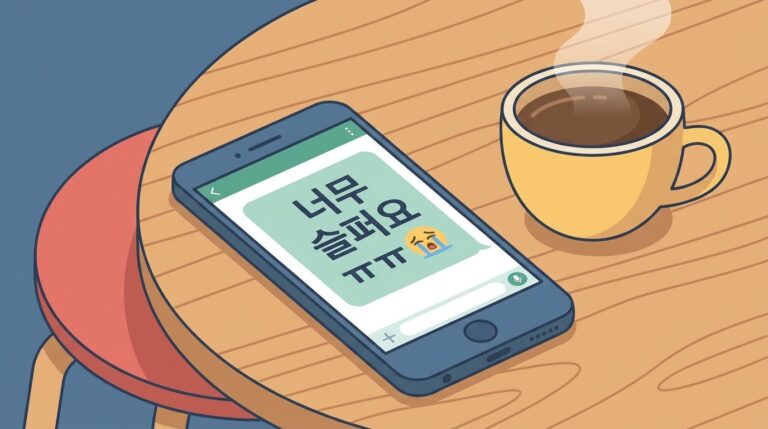
Changing Plans? No Problem! How to Say ‘Something Came Up’ in Korean
Phase 1: Empathy (An Invitation to a Friendly Chat)
안녕하세요! (An-nyeong-ha-se-yo!) Hello! It’s your friendly Daily Hangul editor and cultural navigator here.
We’ve all been there: you made exciting plans to grab delicious Samgyeopsal (pork belly) with your Korean friends, but suddenly, your boss asks for an urgent report, or your cold symptoms flare up. Oh no! You need to change or cancel the plans, but how do you do it in Korean without sounding rude or dry?
In Korea, changing plans—especially last minute—requires a delicate touch of politeness and sincere regret. Many beginners mistakenly use stiff, dictionary-translated phrases that can sound too cold or like a formal excuse. Don’t worry! Today, we will master the absolute easiest, most natural way to say “Something suddenly came up” in Korean. By the end of this guide, you’ll be able to reschedule like a true local while keeping your friendships warm and strong!
Phase 2: Deep Dive into 3 Essential Expressions
1. 갑자기 일이 생겼어요 (Gap-ja-gi il-i saeng-gyeo-sseo-yo)
- Pronunciation: Gap-ja-gi earing saeng-gyuh-ssuh-yo (Think of “il-i” sounding like “ear-ring” but shorter!)
- Meaning: “Suddenly, some work/stuff came up.”
- K-Culture Moment: You will hear this phrase in almost every K-Drama when the lead character suddenly has to rush back to the office or handle a family emergency.
- Editor’s Insight: This is the ultimate “magic phrase.” It is vague enough that you don’t have to explain your deep personal secrets, yet polite enough that the other person will immediately understand you are in a pinch.
- Situation Spectrum: Casual (⚠️ – too formal for super close friends, use ‘일이 생겼어’), Semi-formal (✅ – Perfect), Formal (✅)
- 🤔 Think About It: In your culture, do you usually give a detailed reason when canceling plans, or do you keep it general like Koreans do?
2. 미안해요, 오늘 못 갈 것 같아요 (Mi-an-hae-yo, o-neul mot gal geot ga-ta-yo)
- Pronunciation: Mee-ahn-hae-yo, oh-neul mote gahl gut gah-tah-yo
- Meaning: “I’m sorry, I don’t think I can make it today.”
- K-Culture Moment: Used by characters who feel genuinely sorry for breaking a promise, often accompanied by a sad expression.
- Editor’s Insight: Using “~것 같아요” (~geot ga-ta-yo, meaning “it seems like/I think”) is a crucial Korean cultural softner. Instead of saying “I can’t go” (못 가요) directly, saying “I think I cannot go” sounds much softer and less aggressive.
- Situation Spectrum: Casual (⚠️ – use ‘못 갈 것 같아’), Semi-formal (✅ – Perfect), Formal (⚠️ – use ‘죄송합니다’)
- 🤔 Think About It: Why do you think Korean speakers prefer to say “I think I can’t” rather than a direct “I can’t”?
3. 다음에 같이 놀아요 (Da-eum-e gat-i nol-ah-yo)
- Pronunciation: Dah-eum-eh gah-chee nol-ah-yo (Note: ‘같이’ is pronounced as gah-chee, not gat-i!)
- Meaning: “Let’s hang out together next time.”
- K-Culture Moment: The classic line used to show that you genuinely want to reschedule, keeping the friendship warm.
- Editor’s Insight: This phrase is the perfect cushion. By suggesting a “next time,” you reassure your friend that you are not ghosting them; you just had a bad timing today.
- Situation Spectrum: Casual (⚠️ – use ‘다음에 같이 놀자’), Semi-formal (✅ – Perfect), Formal (🚫)
- 🤔 Think About It: “놀다” (nol-da) literally means “to play,” but adults use it to mean “to hang out/socialize” in Korea!
Phase 3: Textbook Korean vs. Real-Life Korean
Let’s compare stiff textbook phrasing with what Koreans actually say in daily life.
Situation A: Telling someone you cannot go
- 📖 Textbook Korean: 저는 오늘 갈 수 없습니다. (Jeo-neun o-neul gal su eops-seup-ni-da. – “I cannot go today.” – Very stiff, sounds like a military report!)
- 🗣️ Real Korean: 오늘 못 갈 것 같아요. (O-neul mot gal geot ga-ta-yo. – “I don’t think I can make it today.” – Soft, polite, and natural.)
- 💡 Why is it different? Koreans value harmony and avoiding direct confrontation, so softening your refusal makes you sound warmer.
Situation B: Rescheduling
- 📖 Textbook Korean: 약속을 변경합시다. (Yak-sok-eul byeon-gyeong-hap-si-da. – “Let us change the appointment.” – Too formal, sounds like a business meeting.)
- 🗣️ Real Korean: 다음에 봐요! (Da-eum-e bwa-yo! – “See you next time!”) or 다음에 꼭 만나요! (Da-eum-e kkok man-na-yo! – “Let’s definitely meet next time!”)
- 💡 Why is it different? Real-life conversations are much warmer and use active verbs like “see” or “meet” instead of clinical words like “change appointment.”
Phase 4: K-Culture Deep Dive & Non-Verbal Manners
4-1. The
Frequently Asked Questions (FAQ)
Q: What does "갑자기 일이 생겼어요 (Gap-ja-gi il-i saeng-gyeo-sseo-yo)" mean in Korean and how do you pronounce it?
A: In Korean, "갑자기 일이 생겼어요 (Gap-ja-gi il-i saeng-gyeo-sseo-yo)" is pronounced [Gap-ja-gi earing saeng-gyuh-ssuh-yo (Think of "il-i" sounding like "ear-ring" but shorter!] and means: "Suddenly, some work/stuff came up."
Q: What does "미안해요, 오늘 못 갈 것 같아요 (Mi-an-hae-yo, o-neul mot gal geot ga-ta-yo)" mean in Korean and how do you pronounce it?
A: In Korean, "미안해요, 오늘 못 갈 것 같아요 (Mi-an-hae-yo, o-neul mot gal geot ga-ta-yo)" is pronounced [Mee-ahn-hae-yo, oh-neul mote gahl gut gah-tah-yo] and means: "I'm sorry, I don't think I can make it today."
Q: What does "다음에 같이 놀아요 (Da-eum-e gat-i nol-ah-yo)" mean in Korean and how do you pronounce it?
A: In Korean, "다음에 같이 놀아요 (Da-eum-e gat-i nol-ah-yo)" is pronounced [Dah-eum-eh gah-chee nol-ah-yo (Note: '같이' is pronounced as gah-chee, not gat-i!] and means: "Let's hang out together next time."






