Deep Dive into Korea’s Real Estate Tax Debate: Master C2-Level Policy Korean
Phase 1: Empathy (An Editor’s Welcome)
안녕하세요! Welcome back to Daily Hangul. I’m your chief editor and local cultural navigator.
If you’ve been watching K-dramas like Penthouse or reborn Rich, you know that in Korea, real estate isn’t just about finding a roof over your head—it’s practically a national sport, a socio-economic battleground, and a frequent topic of intense debate at dinner tables.
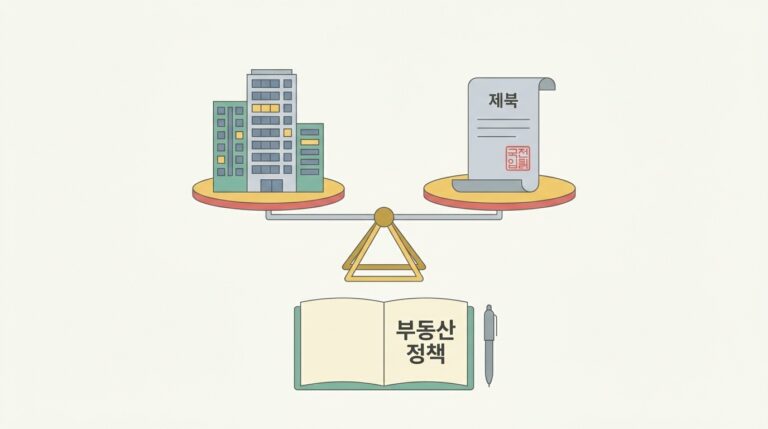
Recently, Korea’s Comprehensive Real Estate Holding Tax (종합부동산세—or “종부세” jong-bu-se for short) has been at the center of fierce political and social discourse. With recent easing measures introduced by the government, the nation is deeply divided: Is it a necessary relief for “tax-poor” homeowners, or does it destroy tax equity and deepen wealth inequality?
Discussing these high-level socio-economic issues requires more than just dictionary definitions; it demands an understanding of C2-level vocabulary, subtle cultural nuances, and the political sentiments of modern Koreans. Today, we’ll equip you with the sophisticated linguistic tools needed to join this high-society debate like a true native. Let’s dive in!
Phase 2: Deep-Dive into 3 Essential Expressions
1. 조세 형평성 (Jose Hyeongpyeongseong)
- Pronunciation: [Jo-se hyeong-pyeong-seong] (Rhymes with “joe-say hyung-pyung-sung”)
- Meaning: Tax Equity / Fiscal Fairness
- K-Culture Moment: You will hear this phrase constantly on nightly news broadcasts (like SBS 8 News) or in political thrillers where reformist politicians argue against tax cuts for the top 1%.
- Editor’s Insight: 조세 means taxation, and 형평성 means equity or balance. When Koreans talk about 조세 형평성, they are invoking a deeply held societal value that those who earn or own more should contribute proportionally more to the public coffer.
- Situation Spectrum: Casual (🚫) | Semi-formal (⚠️) | Formal (✅)
- 🤔 Think About It: How does your home country balance tax relief with the principle of tax equity? Is housing viewed primarily as a basic human right or a wealth-building asset?
2. 똘똘한 한 채 (Ttolttolhan Han Chae)
- Pronunciation: [Ttol-ttol-han han chae] (Pronounced with a tense double ‘t’ sound: “t-tol-tol-han han chae”)
- Meaning: “One smart house” / A single, high-value prime property
- K-Culture Moment: This slang was coined when the government heavily taxed multi-home owners. Instead of owning multiple cheap apartments, wealthy Koreans sold their minor properties to buy “one smart, highly valuable apartment” in Gangnam.
- Editor’s Insight: 똘똘하다 usually describes a clever, bright child. Applying this to a house (한 채) shows the highly strategic, almost personified relationship Koreans have with prime real estate.
- Situation Spectrum: Casual (✅) | Semi-formal (✅) | Formal (⚠️)
- 🤔 Think About It: Why does modern society drive people to pool all their resources into a single “super-asset” rather than diversifying?
3. 부자 감세 (Buja Gamse)
- Pronunciation: [Bu-ja gam-se] (Sounds like “Boo-ja gahm-say”)
- Meaning: Tax cuts for the rich
- K-Culture Moment: This is the ultimate political battle cry. Opponents of the Comprehensive Real Estate Tax easing use this phrase during street rallies and National Assembly debates to criticize pro-market policies.
- Editor’s Insight: 부자 (rich person) + 감세 (tax reduction). It carries a highly charged, critical political nuance. Using this word immediately signals a progressive stance on economic policies.
- Situation Spectrum: Casual (✅) | Semi-formal (✅) | Formal (✅)
- 🤔 Think About It: Is easing property tax truly a “tax cut for the rich,” or can it prevent the double taxation of middle-class citizens who are asset-rich but cash-poor?
Phase 3: Textbook Korean vs. Real-Life Korean
Situation 1: Expressing that the property tax is too high
- 📖 Textbook: 종합부동산세 납부 금액이 너무 많아서 부담스럽습니다. (The payment amount for the Comprehensive Real Estate Tax is so high that it is burdensome.)
- 🗣️ Real Life: 요즘 종부세 때문에 완전히 등골이 휘어요. (My back is literally breaking lately because of the property tax.)
- 💡 Why the difference? While the textbook expression is grammatically perfect, native Koreans use the vivid idiom 등골이 휘다 (to have one’s spine bent/broken) to express extreme financial pressure in a dramatic, empathetic way.
Situation 2: Describing a divided public opinion
- 📖 Textbook: 세금 완화 정책에 대해 찬성과 반대 의견이 팽팽합니다. (Pros and cons regarding the tax mitigation policy are tightly balanced.)
- 🗣️ Real Life: 종부세 완화를 두고 여론이 완전히 두 갈래로 갈렸어요. (Public opinion is completely split into two paths over the easing of property taxes.)
- 💡 Why the difference? 두 갈래로 갈리다 (split into two tracks) is a much more visual, idiomatic way to describe a polarized society than the dry, written-style 팽팽하다.
Phase 4: K-Culture Deep Dive & Non-Verbal Etiquette
4-1. Nunchi & Gestures: Navigating Sensitive Debates
Real estate is as sensitive as religion or politics in Korea. If you are discussing 종부세 with Koreans:
* The “Pensive Nod” (끄덕임): When someone complains about taxes, even if you disagree, do not immediately counter-argue. Tilt your head slightly, squint your eyes, and nod slowly to acknowledge the complexity of the issue.
* Tone Down the Voice: Because real estate wealth is a highly sensitive topic that can trigger relative deprivation (상대적 박탈감), discuss these matters in a quiet, analytical tone rather than an excited or boastful one.
4-2. Cultural Code: The Gangnam Republic
In K-dramas like SKY Castle, characters obsess over living in specific apartment brands in Gangnam. Why? In Korea, an apartment is not just a domicile; it is an ID card. Easing the 종부세 heavily benefits those owning properties worth millions of dollars in Seoul’s southern districts, which is why any policy change instantly triggers debates over 조세 형평성 (tax equity).
Phase 5: Real-Life Roleplay Scenario
Characters:
- 민우 (Min-woo): A pragmatic real estate analyst who supports tax mitigation.
- 수현 (Su-hyeon): A progressive civic activist who advocates for tax equity.
-
Scene: A high-end cafe near the National Assembly in Yeouido, Seoul.*
- 민우: 이번에 종부세 완화안 발표된 거 보셨어요? 저는 다주택자 중과세가 그동안 너무 과했다고 봐요.
(Have you seen the recently announced Comprehensive Real Estate Tax easing proposal? I believe heavy taxation on multi-home owners has been too excessive.) - 수현: 🎭 (찻잔을 내려놓으며 단호하게) 글쎄요. 저는 생각이 좀 다릅니다. 이번 개정안은 명백히 부자 감세의 일환 아닌가요?
(Sipping her tea, firmly: Well, I beg to differ. Isn’t this revision clearly part of a “tax cut for the rich”?) - 민우: 하지만 징벌적 세금 때문에 실소유자들까지 고통받는 상황은 해결해야죠. 은퇴하고 소득 없는 고령층은 세금 낼 돈이 없어요.
(But we must resolve situations where even actual owner-occupiers suffer due to punitive taxes. Retired elderly people with no income don’t have the cash to pay these taxes.) - 수현: 🎭 (안경을 고쳐 쓰며) 그 일부 예외적인 사례를 빌미로 초고가 주택 소유자들의 세금 부담을 줄여주는 건 조세 형평성에 어긋납니다.
(Adjusting her glasses: Using those few exceptional cases as a pretext to reduce the tax burden on ultra-expensive property owners violates “tax equity”.) - 민우: 결국 시장 활성화가 우선입니다. 세금 부담이 줄어야 매물이 나오고 거래가 돌죠.
(Ultimately, market vitalization is the priority. Only when the tax burden decreases will properties come onto the market and transactions flow.) - 수현: 세금 깎아준다고 매물이 나올까요? 결국 다들 강남에 똘똘한 한 채만 쥐고 버티는 현상만 심화될 겁니다.
(Will properties really hit the market just because of tax cuts? In the end, it will only worsen the trend of everyone holding onto “one smart house” in Gangnam and holding out.) - 민우: 🎭 (한숨을 쉬며) 정책이라는 게 양날의 검이네요. 형평성과 시장 효율성 사이에서 균형을 잡기가 참 힘듭니다.
(Sighing: Policies are indeed a double-edged sword. It’s so hard to strike a balance between equity and market efficiency.) - 수현: 맞아요. 하지만 주거 안정이 무너지면 사회 통합도 무너진다는 점을 잊지 말아야 합니다.
(Indeed. But we must not forget that when housing stability collapses, social cohesion collapses as well.)
🔀 Interactive Decision Point
How would you respond to Min-woo’s argument that “High taxes hurt retired elderly property owners”?
- A) “맞아요! 소득이 없는 고령층에게 세금을 과하게 물리는 것은 가혹합니다.” (Agreeing with market relief)
- B) “하지만 집값이 올랐으니 자산 가치에 맞게 세금을 내는 것이 조세 원칙에 맞지 않나요?” (Sticking to tax equity principles)
- C) “종부세고 뭐고 그냥 세금 다 안 냈으면 좋겠어요.” (Dismissive, overly simplistic option)
Feedback:
- Choice A (Best for conservative economic stance): Highly empathetic! This highlights the “asset-rich, cash-poor” dilemma often cited in political debates.
- Choice B (Best for progressive economic stance): Brilliant! This directly invokes the principle of unrealized gains and tax equity in standard Korean debate format.
- Choice C (Bad/Risk): Avoid this in formal debates. It sounds childish and ignores the complexity of fiscal policy.
Phase 6: 10-Second Emotion Shadowing Drill
Practice these sentences with the exact pauses (/) and emotional undertones to sound incredibly articulate.
- [🧐 Analytical & Firm]
조세 형평성을 무시한 / 세제 개편은 / 결국 양극화를 / 심화시킬 뿐입니다.
(Jo-se hyeong-pyeong-seong-eul mu-si-han / se-je gae-pyeon-eun / gyeol-guk yang-geuk-hwa-reul / sim-hwa-si-kil ppun-im-ni-da.)
“A tax reform / that ignores tax equity / will ultimately only / deepen polarization.” -
[😔 Concerned & Realistic]
집 한 채 평생 갖고 살았는데 / 종부세 때문에 / 집을 팔아야 할 지경이에요.
(Jip han chae pyeong-saeng gat-go sa-rat-neun-de / jong-bu-se ttae-mun-e / jib-eul pa-ra-ya hal ji-gyeong-i-e-yo.)
“I’ve owned this single house my whole life, / but because of the property tax, / I’m on the verge of having to sell it.”
Phase 7: K-Culture Mini-Dictionary
- 다주택자 (Da-ju-taek-ja) | Multi-home owner
- Usage: Literally “person of many houses.” In Korea’s policy debates, this group is often targeted with punitive tax rates to prevent real estate speculation.
- 실소유자 (Sil-so-yu-ja) | Actual owner-occupier
- Usage: People who buy a house to live in it, rather than as a speculative investment. Both political parties claim to protect this group.
- 양날의 검 (Yang-nal-ui Geom) | Double-edged sword
- Usage: Often used in policy debates to describe actions that have both positive and negative consequences.
- 상대적 박탈감 (Sang-dae-jeok Bak-tal-gam) | Relative deprivation
- Usage: The feeling of emptiness and poverty when seeing others get rich effortlessly through real estate skyrocketing.
Phase 8: Traveler’s Survival Kit
If you are visiting Korea and looking at apartments, or trying to understand local news:
Survival Vocab TOP 3
- 임대인 (Im-dae-in): Landlord. (Pro Tip: Be extremely polite when discussing contract renewals!)
- 임차인 (Im-cha-in): Tenant.
- 전세 (Jeon-se): Korea’s unique key-money deposit system where you loan the landlord a massive lump sum interest-free instead of paying monthly rent.
Editor’s Travel Note:
If you want to check real estate prices in Korea like a local, download the Naver Real Estate App. It is the gold standard for checking current market values and understanding which areas are currently hit hardest by the 종부세 adjustments.
Note: Real estate policies change frequently; always check official government announcements for the latest tax brackets.
Phase 9:
Frequently Asked Questions (FAQ)
Q: What does "조세 형평성 (Jose Hyeongpyeongseong)" mean in Korean and how do you pronounce it?
A: In Korean, "조세 형평성 (Jose Hyeongpyeongseong)" is pronounced [Jo-se hyeong-pyeong-seong] and means: Tax Equity / Fiscal Fairness
Q: What does "똘똘한 한 채 (Ttolttolhan Han Chae)" mean in Korean and how do you pronounce it?
A: In Korean, "똘똘한 한 채 (Ttolttolhan Han Chae)" is pronounced [Ttol-ttol-han han chae] and means: "One smart house" / A single, high-value prime property
Q: What does "부자 감세 (Buja Gamse)" mean in Korean and how do you pronounce it?
A: In Korean, "부자 감세 (Buja Gamse)" is pronounced [Bu-ja gam-se] and means: Tax cuts for the rich