

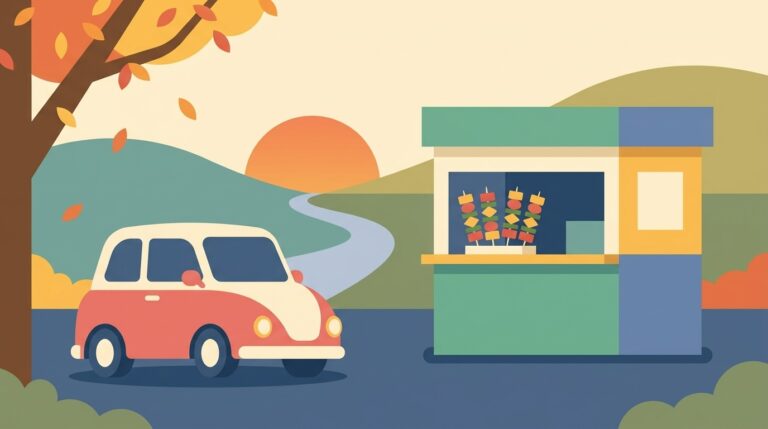
Chuseok Road Trip: Master Expressway Toll Exemptions and Rest Area Feasts like a True Korean Insider
안녕하세요! Welcome back to Daily Hangul. I’m your chief editor and local culture navigator, here to guide you through the beautiful complexity of Korean life.
Have you ever dreamed of experiencing Gwi-seong-gil (귀성길)—the great holiday exodus when millions of Koreans head back to their hometowns for Chuseok (추석) or Seollal (설날)? If you’ve ever imagined yourself cruising down the Gyeongbu Expressway, only to be intimidated by the chaotic toll gates and crowded Rest Areas (휴게소 – Hyugeso), this guide is for you.
Today, we’re going deep into C2-level nuances, analyzing the cultural phenomenon of holiday toll exemptions, and exploring the highly competitive gastronomy of Korean Highway Rest Areas. Let’s dive in!
Phase 1: Empathy & The Holiday Exodus
Imagine this: You are driving a rental car toward Busan during Chuseok. The GPS is flashing red, your stomach is growling, and you are approaching a toll gate. Suddenly, you notice the toll barriers are open, and cars are passing through without paying. Is it a glitch? Are you going to get a massive fine?
Actually, you’ve just hit the Expressway Toll Exemption (고속도로 통행료 면제) period!
Many advanced learners panic during these cultural moments because textbook Korean doesn’t prepare them for the real-world chaos of holiday transit. This guide is built on real feedback from expats who felt lost in the sea of cars, helping you master the advanced terminology and subtle social etiquette required to navigate this uniquely Korean seasonal rush.
Phase 2: Deep-Dive into 3 Essential Expressions
1. 통행료 면제 (Tong-haeng-ryo Myeon-je)
- Pronunciation: Tong-haeng-ryo Myeon-je (Think of “tongue” + “hang” + “ryo” / “myeon” + “jeh”)
- Meaning: Toll Fee Exemption
- K-Culture Moment: You will hear this phrase constantly on news broadcasts leading up to major holidays as the government announces the exact 3-to-4-day window where all expressways nationwide are free.
- Editor’s Insight: While “공짜” (Gong-jja) means free, “면제” (Myeon-je) implies a formal exemption or waiver of an obligation. Using “면제” shows an advanced grasp of official terminology.
- Situation Spectrum: Casual: ⚠️ | Semi-formal: ✅ | Formal: ✅
- 🤔 Think About It: How does your home country manage major national holidays? Does the government offer systemic benefits to encourage family reunions like Korea does?
2. 금강산도 식후경 (Geum-gang-san-do Sik-hu-gyeong)
- Pronunciation: Geum-gang-san-do Sik-hu-gyeong (Say “Geum-gang-san” + “do” + “seek” + “who” + “gyeong”)
- Meaning: Even Mount Geumgang (the most beautiful mountain) is best viewed after eating. (First things first: let’s eat!)
- K-Culture Moment: Used by travel show hosts the second they pull into a Rest Area.
- Editor’s Insight: This ancient proverb is the ultimate justification for stopping at a rest area to gorge on delicious food even if the traffic is terrible.
- Situation Spectrum: Casual: ✅ | Semi-formal: ✅ | Formal: 🚫
- 🤔 Think About It: Why do you think Korean culture places such an incredibly high value on sharing a meal before embarking on scenic or family activities?
3. 눈치 싸움 (Nunchi Ssa-um)
- Pronunciation: Noon-chi Ssa-um (“Noon” + “chee” + “Ssa” + “um”)
- Meaning: A battle of wits/tact; psychological warfare (over timing/parking)
- K-Culture Moment: Deciding exactly what time to depart (3 AM vs. 10 PM) to avoid traffic, or fighting for a parking spot at a packed rest area.
- Editor’s Insight: It describes the collective subconscious game where everyone tries to outsmart the system, resulting in everyone leaving at the exact same “secret” time.
- Situation Spectrum: Casual: ✅ | Semi-formal: ✅ | Formal: 🚫
- 🤔 Think About It: “Nunchi” is often translated as emotional intelligence. In this context, how does collective “Nunchi” shape public behavior in high-stress, crowded situations?
Phase 3: Textbook Korean vs. Real-World Korean
Situation 1: Expressing that you are hungry on the highway
- 📖 Textbook: “배가 고프니 휴게소에서 음식을 먹읍시다.” (Because I am hungry, let us eat food at the rest area.)
- 🗣️ Real-World: “금강산도 식후경인데, 이번 휴게소에서 맛집 털고 갈까요?” (Since “even Geumgangsan is best viewed after eating,” shall we raid the famous eats at this next rest area?)
- 💡 Why the difference? Textbook phrasing sounds like an instruction manual. Real Koreans use proverbs combined with playful slang like “털다” (teolda – to dust off/raid) to make eating sound like an exciting mission.
Situation 2: Deciding when to leave to avoid traffic
- 📖 Textbook: “교통 체증을 피하기 위해 출발 시간을 잘 선택해야 합니다.” (We must choose our departure time well to avoid traffic congestion.)
- 🗣️ Real-World: “귀성길 고속도로는 완전히 눈치 싸움이라, 새벽에 쏴야 해요.” (The holiday exodus highway is a total battle of wits; we have to “shoot” (bolt) in the middle of the night.)
- 💡 Why the difference? C2 speakers use vivid verbs like “쏘다” (ssoda – to shoot/speed off) and the cultural concept of “눈치 싸움” to capture the urgency of dodging holiday traffic.
Phase 4: K-Culture Deep Dive & Non-verbal Manners
4-1. The Rest Area Parking “Nunchi” Dance
When pulling into a bustling rest area (휴게소) during Chuseok, the environment is highly charged.
* The Gesture: If another driver yields a parking space or lets you merge into the tight rest area exit lane, turn on your hazard lights (비상등 – Bisangdeung) for 3 to 4 blinks. This is the ultimate non-verbal Korean thank-you on the road.
* Attitude: Patience is paramount. Honking excessively at a rest area is considered incredibly rude and low-class (품격 없는 행동).
4-2. The Gastro-Highway Culture (휴게소 맛집)
Korean rest areas are not mere pit stops; they are culinary destinations. Many have signature dishes endorsed by famous food show hosts like Baek Jong-won.
* The Sobaek-Sobaek (소떡소떡): A skewer of sausage and rice cake brushed with sweet, spicy sauce. The correct way to eat it is biting both the sausage and rice cake at the same time to experience the texture harmony.
* Al-gamja (알감자): Round, butter-roasted potatoes sprinkled with sugar and salt—the ultimate nostalgic road trip comfort food.
Phase 5: Real-World Roleplay Scenario
Setting: Inside a rental car on the Gyeongbu Expressway during Chuseok.
Characters:
* Min-jun (민준): Your Korean friend who is determined to show you the ultimate holiday road trip experience.
* You (C2 Learner): Ready to navigate the road like a local.
- Min-jun: “오늘 귀성길 진짜 장난 아니네. 벌써 정체가 시작됐어.”
- You: “그러게. 이럴 줄 알았으면 완전 새벽에 쏘는 건데, 완전히 눈치 싸움에 실패했어!”
- Min-jun: “하하, 그래도 명절이라 통행료 면제인 건 개이득이지 않아? 하이패스 차선 그냥 통과할 때 왠지 기분 좋더라.”
- You: “맞아. 처음엔 단속 카메라에 걸리는 줄 알고 쫄았는데, 통행료 면제 덕분에 프리패스니까 마음이 편하네.”
- Min-jun: “슬슬 배고프지? 저기 앞에 있는 휴게소가 소떡소떡이랑 알감자 맛집으로 진짜 유명한 곳이야.”
- You: “오! 금강산도 식후경인데 무조건 들렀다 가자. 대기 줄 엄청 길 텐데, 주차 자리 찾는 것도 보통 일이 아니겠다.”
- Min-jun: “내가 주차 공간 매의 눈으로 찾아볼 테니까, 너는 내리자마자 무인 키오스크로 달려가서 주문 선점해!”
- You: “접수 완료! 우리 오늘 휴게소 제대로 한 번 털어보자!”
🔀 Interactive Choice Point
Min-jun points out a massive queue at the snack counter, but there’s also a line for the premium indoor restaurant. What do you do?
- Option A: “Snacks are the soul of the rest area! I’ll wait in the outdoor stall line for 소떡소떡 (Sobaek-sobaek).”
- Option B: “It’s Chuseok, let’s sit down for a formal meal like 국밥 (Gukbap) inside.”
- Option C: “Let’s skip the food; the traffic is getting worse, we must keep driving!”
🧐 Feedback on Your Choice:
- Best (Option A): Excellent! You understand that highway rest areas are defined by street-food style snacks. You get the authentic culture.
- Risk (Option B): Not bad, but during holidays, indoor dining halls are extremely chaotic and might delay you by over an hour.
- Bad (Option C): Oh no! Skipping the rest area food during a holiday road trip is a cardinal sin. You will end up hungry and grumpy in a 4-hour traffic jam.
Phase 6: 10-Second Emotion Shadowing Drill
Practice saying these high-level phrases with the exact emotional cadence of a native speaker. The / indicates a micro-pause for rhythmic effect.
- [😊 Highly Excited & Playful]
“금강산도 / 식후경인데 / 우리 다음 휴게소에서 / 맛집 제대로 털고 가자!”
(Geum-gang-san-do / sik-hu-gyeong-in-de / u-ri da-eum hyu-ge-so-e-seo / mat-jip je-dae-ro teol-go ga-ja!) -
[🥺 Worried yet Strategizing]
“이번 명절 귀성길은 / 완전 눈치 싸움이야. / 새벽에 안 쏘면 / 도로에 갇혀!”
(I-beon myeong-jeol gwi-seong-gil-eun / wan-jeon nun-chi ssa-um-i-ya. / Sae-byeok-e an sso-myeon / do-ro-e gat-hyeo!)
Phase 7: K-Culture Mini-Dictionary
- 귀성길 (Gwi-seong-gil): The journey back to one’s hometown during traditional holidays. Historically associated with packed trains and frozen expressways.
- 하이패스 (Hi-pass): Korea’s electronic toll collection system. During toll exemption days, you still use this lane if you have a Hi-pass terminal; if not, you use the general blue cash lane without stopping.
- 소떡소떡 (So-tteok-so-tteok): A compound word of Sausage (소세지) and Rice Cake (떡). A cultural icon of Korean highway food.
- 개이득 (Gae-i-deuk): High-level slang meaning “extremely lucky find” or “massive benefit/profit”. Use only with close friends.
Phase 8: Survivor Kit for Travelers
Survival Phrases
- “여기 대표 메뉴가 뭐예요?” (Yeo-gi dae-pyo me-nyu-ga mwo-yae-yo?)
- Pro Tip: Use this at the food court counter to get the specific local delicacy of that region’s rest area.
- “비상등 켜줘!” (Bi-sang-deung kyeo-jwo!)
- Pro Tip: Tell your driver friend to turn on the hazard lights as a sign of thank you or warning.
- “주유소 줄이 너무 기니까 다음에서 넣자.” (Ju-yu-so jul-i neo-mu gi-ni-kka da-eum-e-seo neo-ja.)
- Pro Tip: Rest area gas stations are incredibly cheap, making their lines very long during holidays.
Editor’s Travel Note
Before you head out, make sure to download Naver Map (네이버 지도 App). It displays real-time traffic updates, exact locations of rest areas, and even lists the signature menus for each rest area along your route!
(Disclaimer: Toll exemption periods are subject to yearly government announcements; always double-check the holiday schedule via local news before your trip.)
Phase 9: “Going Deeper” (Cultural Reflection)
The phenomenon of holiday toll exemptions reflects Korea’s collectivist mindset. The government actively subsidizes the cost of travel to ensure that families can gather without financial friction. It shows that despite rapid modernization and hyper-individualism, the ritual of returning to one’s roots (귀성) remains a sacred national priority.
💬 Your Turn: Does your culture have a similar ‘exodus’ period? How does your government or society accommodate massive travel spikes? Let me know in the comments below!
Phase 10: FAQ & Common Mistakes
Q: Do I need a special card to get the highway toll exemption during holidays?
A: No! If you have a Hi-pass terminal, just drive through the Hi-pass lane as usual (the machine will announce “Toll is 0 won”). If you don’t have Hi-pass, pull a paper ticket from the entrance gate and hand it to the toll booth operator at your exit—no fee will be charged.
Q: Are all rest areas open 24 hours during holidays?
A: Most main rest area facilities (restrooms, convenience stores) are open 24/7, but specialty food courts and popular snack bars often close around 8:00 PM or 9:00 PM. Plan your eating schedule accordingly!
Q: Can I park overnight at a highway rest area?
A: While quick naps in your car are encouraged to prevent drowsy driving (졸음운전), camping or long-term parking is prohibited.
🚨 Common Mistakes Alert!
- Mistake 1: Slamming on the brakes right before a toll gate because you don’t have a Hi-pass card during the exemption period.
- Correct Action: Keep driving smoothly! Stopping abruptly causes major accidents. Just pass through.
- Mistake 2: Ordering food at the counter first.
- Correct Action: Modern Korean rest areas use centralized self-serve kiosks. Find the kiosk, order, and wait for your number to be called.
- Mistake 3: Dipping 소떡소떡 in ketchup only.
- Correct Action: The proper sauce combo is a mix of both sweet chili sauce and mustard for that authentic flavor profile.
Phase 11: Action Mission
- Bronze Mission: Read the Roleplay in Phase 5 aloud, focusing on your emotional delivery.
- Silver Mission: Share this post on your social media with the hashtag #DailyHangul and write down your favorite rest area snack.
- Gold Mission (Real Life): The next time you rent a car or take a taxi in Korea, use the phrase “금강산도 식후경” when suggesting a snack stop!
Phase 12: Interactive Quiz Challenge
1. Situational Judgment
You are driving and you want to thank a driver who yielded to you in a crowded rest area. What do you do?
* A) Honk twice.
* B) Flash your hazard lights (비상등) 3 times.
* C) Roll down the window and wave.
2. Fill in the Blank
“아무리 바빠도 밥은 먹고 가야지! 원래 ______라고 하잖아.”
* A) 눈치 싸움
* B) 통행료 면제
* C) 금강산도 식후경
🔍 Reveal Answers & Explanations
- Correct Answer: B
- Explanation: Flashing hazard lights (비상등) is the standard Korean driver etiquette for saying “Thank you” or “Sorry”. Honking is considered aggressive.
- Correct Answer: C
- Explanation: “금강산도 식후경” (Even beautiful mountains are viewed after eating) fits perfectly when emphasizing the importance of eating a meal before doing anything else.
- Explanation: “금강산도 식후경” (Even beautiful mountains are viewed after eating) fits perfectly when emphasizing the importance of eating a meal before doing anything else.







