

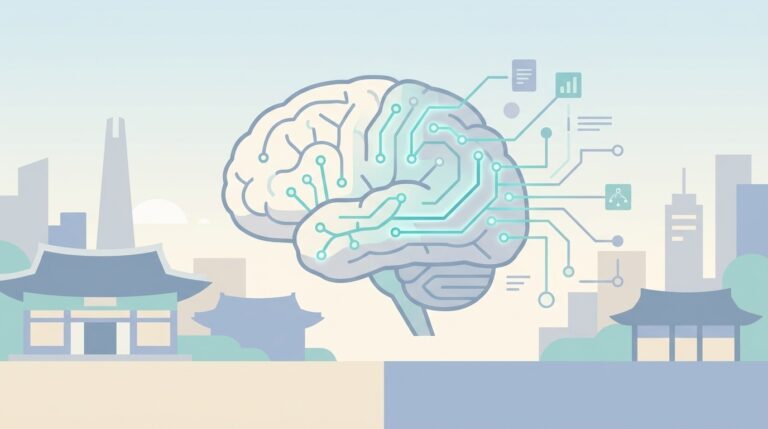
Sci-Fi Becomes Reality: Master Korean Expressions for Brain-AI Convergence (C1)
Phase 1: Empathy (Story-driven Opening)
안녕하세요! It’s your K-culture navigator and Daily Hangul editor!
Imagine watching a mind-bending K-Sci-Fi thriller like SF8 or Sisyphus: The Myth, where a character merges their consciousness with an AI network. Or picture yourself in a high-level seminar at Seoul National University, debating neural interfaces with Korean tech innovators. You want to chime in, but your tongue gets tied. You know the basic words for ‘brain’ (뇌) and ‘computer’ (컴퓨터), but how do you express complex, nuanced concepts like “seamless synchronization” or “bridging the gap between carbon and silicon” in natural, sophisticated Korean?
Many C1 learners face a major roadblock here: they translate advanced English scientific jargon literally into Korean, resulting in stiff, academic sentences that sound like Google Translate from 2012. Our advanced community has voiced how frustrating it is to sound like a textbook when talking about cutting-edge tech. Today, we’re going to fix that. Let’s dive into the fascinating world of neuro-AI convergence with expressions that will make native Korean researchers nod in admiration!
Phase 2: Deep Dive into 3 Essential Expressions
1. 뇌-기계 인터페이스를 접목하다 (Noe-gigye inteopeiseureul jeommokhada)
- Pronunciation: Noeh-ghee-gyeh in-tuh-fay-soo-reul jum-mok-hah-dah (Think of “jum-mok” as grafting a branch onto a tree—a very organic fusion!)
- Meaning: To integrate/graft a Brain-Machine Interface (BMI).
- K-Culture Moment: In a futuristic K-drama, a brilliant neuroscientist points to a holographic scan of a brain and says: “인공지능 칩을 뇌-기계 인터페이스에 접목하는 단계입니다.” (We are at the stage of integrating an AI chip with the brain-machine interface.)
- Editor’s Insight: The verb
접목하다originally comes from botany (to graft a plant). In modern professional Korean, it is widely used to describe fusing two distinct fields of cutting-edge technology. It sounds far more elegant and organic than simply using합치다(to combine) or연결하다(to connect). - Situation Spectrum: Casual: 🚫 | Semi-formal: ⚠️ | Formal: ✅
- 🤔 Think About It: Why does Korean culture use organic, botanical metaphors like “grafting” (
접목) for high-tech digital fusions? How does this compare to English, which often uses mechanical terms like “bridging” or “interfacing”?
2. 가상과 현실의 경계가 무너지다 (Gasang-gwa hyeonsil-ui gyeonggyega muneojida)
- Pronunciation: Gah-sahng-gwah hyun-shil-wee gyung-gyeh-gah moo-nuh-jee-dah (Feel the dramatic fall on “mu-neo-ji-da”—like a collapsing wall.)
- Meaning: The boundary between virtuality and reality crumbles.
- K-Culture Moment: This is a staple phrase in K-pop lore, especially with groups like aespa navigating their virtual avatars (ae) and real-world selves. It also describes neural implants that make virtual sensory inputs feel indistinguishable from real life.
- Editor’s Insight: While
없어지다(to disappear) is grammatically correct, using무너지다(to collapse/crumble) adds a powerful, dramatic literary flare that captures the paradigm-shifting nature of neuro-AI technology. - Situation Spectrum: Casual: ⚠️ | Semi-formal: ✅ | Formal: ✅
- 🤔 Think About It: How does the idea of boundaries “crumbling” affect your perception of identity? Is it an exciting evolution or a terrifying loss of self?
3. 신경망을 모사하다 (Singyeongmangeul mosahada)
- Pronunciation: Shin-gyung-mahng-eul moh-sah-hah-dah (Keep “mo-sa” light and precise—it means to mimic or replicate with high fidelity.)
- Meaning: To mimic/replicate neural networks.
- K-Culture Moment: You’ll hear this constantly in Korean tech podcasts (like EO or T-Time) discussing neuromorphic computing and how AI algorithms are modeled after the human brain.
- Editor’s Insight: Do not confuse
모사하다(to mimic scientifically/artistically) with복사하다(to photocopy).모사하다implies an intricate, functional replication of a complex organic structure. - Situation Spectrum: Casual: 🚫 | Semi-formal: ⚠️ | Formal: ✅
- 🤔 Think About It: In Korean philosophy, copying nature (
모사) is an art form. How does replicating the human brain’s neural network touch upon the traditional philosophical boundaries of human consciousness?
Phase 3: Textbook Korean vs. Real-Life Korean
Let’s compare stiff, textbook-style translations with natural, advanced professional Korean.
Scenario A: Explaining how AI learns like a human brain
- 📖 Textbook Korean: 인공지능은 인간의 두뇌 세포 구조처럼 작동하도록 만들어졌습니다.
(Artificial intelligence is made to work like the structure of human brain cells.) - 🗣️ 진짜 한국어: 이 인공지능 모델은 인간의 시냅스 가소성을 그대로 모사해서 스스로 학습해요.
(This AI model replicates synaptic plasticity to learn on its own.) - 💡 Why the Difference? Real professionals use specific cognitive terms like
시냅스 가소성(synaptic plasticity) combined with dynamic verbs like모사하다rather than the elementary두뇌 세포 구조(brain cell structure).
Scenario B: Discussing the future of neural link technology
- 📖 Textbook Korean: 컴퓨터와 머리를 연결하는 기술은 아주 대단합니다.
(The technology that connects computers and heads is very great.) - 🗣️ 진짜 한국어: 뇌-기계 인터페이스 기술이 특이점을 넘어서는 순간, 우리의 인지 능력은 비약적으로 확장될 겁니다.
(The moment Brain-Machine Interface technology passes the singularity, our cognitive abilities will expand exponentially.) - 💡 Why the Difference? To sound like a true C1 speaker in a scientific discussion, using terms like
특이점(singularity) and비약적으로(exponentially/by leaps and bounds) is crucial to conveying the scale of technological impact.
Phase 4: K-Culture Deep Dive & Non-verbal Etiquette
4-1. Nunchi & Professional Body Language
When discussing deep tech or philosophy in Korea:
* The Modest Nod (겸손한 끄덕임): In professional Korean tech circles, even if you are highly knowledgeable, avoid aggressive assertion. Nod slowly while listening to others, saying “아, 그렇군요” (Ah, I see) or “일리 있는 말씀이십니다” (That makes absolute sense) before presenting your neural integration theories. This demonstrates high-level emotional intelligence (Nunchi).
* Eye Contact: Avoid unblinking, intense staring when debating ethics. Tilt your gaze slightly during complex thought processing to show deep reflection.
4-2. Cultural Code: The Korean Obsession with “Fusing” (융합)
In Korea, you will see the word 융합 (융합 – convergence/fusion) everywhere, from university departments to government policies. This stems from a cultural drive to quickly adapt, synthesize, and create something entirely new (the dynamic Ppalli-Ppalli and Hyeoksin cultural traits). Neuro-AI convergence is viewed not just as a cold scientific pursuit, but as a holistic evolution of human capability.
Phase 5: Real-Life Roleplay Scenario
The Setup
- Setting: A high-tech laboratory inside the Pangyo Techno Valley (판교 테크노밸리).
- Characters:
- Dr. Minji Kim (김민지 박사): Lead AI scientist, passionate and sharp.
- You (C1 Specialist): An visiting international scholar specializing in neural networks.
Dialogue
- 김민지 박사:
🎭 (태블릿을 보여주며 자신만만한 표정으로)이번에 저희가 개발한 모델은 기존의 인공 신경망과는 완전히 궤를 달리합니다.
(The model we developed this time is completely different from existing artificial neural networks.) -
You:
🎭 (고개를 끄덕이며 흥미진진한 눈빛으로)아, 드디어 시냅스의 미세한 전기 신호까지 모사하는 데 성공하신 건가요?
(Ah, did you finally succeed in replicating even the micro-electrical signals of synapses?) -
김민지 박사: 맞습니다! 단순히 데이터를 처리하는 게 아니라, 인간의 학습 메커니즘을 그대로 접목했어요.
(Exactly! We didn’t just process data; we integrated the human learning mechanism itself.) -
You:
🎭 (턱을 괴며 깊이 생각하다가)대단하네요. 그렇게 되면 정말 가상과 현실의 경계가 무너지는 순간이 머지않았겠어요.
(Amazing. If that’s the case, the moment the boundary between virtuality and reality crumbles must not be far off.) -
김민지 박사: 정확해요. 하지만 윤리적 측면에서 자아의 정체성 혼란에 대한 우려도 만만치 않아요.
(Precisely. However, from an ethical standpoint, concerns about the confusion of self-identity are also significant.) -
You:
🎭 (진지한 톤으로)네, 뇌와 머신의 경계가 모호해질수록 인간 존엄성의 본질에 대한 깊은 사회적 합의가 필요하다고 봅니다.
(Yes, as the line between brain and machine blurs, I believe we need a deep social consensus on the essence of human dignity.) -
김민지 박사: 동감입니다. 다음 학회에서 이 주제로 같이 발제해보는 건 어때요?
(I agree. How about presenting on this topic together at the next symposium?) -
You:
🎭 (환하게 미소 지으며)영광입니다! 인공지능과 인지과학의 융합에 대한 새로운 패러다임을 보여주시죠.
(It’s an honor! Let’s show a new paradigm for the convergence of AI and cognitive science.)
🔀 Interactive Choice Point
Dr. Kim asks how you think the public will react to this technology. What is your response?
- Option A: “기술이 너무 무서워서 사람들이 다 반대할 거예요.” (People will all oppose it because the tech is too scary.)
- Feedback (Bad): Too simplistic for a C1 speaker. It lacks professional vocabulary and sounds emotionally reactive.
- Option B: “초기에는 거부감이 있겠지만, 인지적 한계를 극복하려는 인간의 본능이 결국 이 기술을 수용하게 만들 겁니다.” (Though there may be initial resistance, the human instinct to overcome cognitive limits will eventually lead to the acceptance of this technology.)
- Feedback (Best): Excellent! Uses advanced vocabulary (
거부감,인지적 한계,수용하다) and offers a highly intellectual perspective.
- Feedback (Best): Excellent! Uses advanced vocabulary (
- Option C: “엄청 신기하니까 다들 바로 칩을 뇌에 심고 싶어 하겠죠?” (Since it’s so cool, everyone would want to implant the chip in their brains right away, right?)
- Feedback (Risk): Too casual. While it keeps the conversation light, it misses the chance to display your C1 academic proficiency in a scientific context.
Phase 6: 10-Second Emotional Shadowing Drill
Practice these sentences focusing on natural rhythm and emotional cadence. The / indicates a slight pause to catch your breath and maintain dramatic tension.
[🧠 진지하고 학구적인 어조로]
“뇌-기계 인터페이스 기술은 / 단순한 도구를 넘어 / 인간 인지 능력의 / 비약적인 확장을 의미합니다.”
(Brain-Machine Interface technology / goes beyond a simple tool and / signifies / an exponential expansion of human cognitive ability.)-
[😲 경이롭고 살짝 압도된 감정으로]
“이 모델을 보면 / 정말 가상과 현실의 경계가 / 완전히 무너진 것 같아요.”
(Looking at this model / it truly feels like the boundary between virtuality and reality / has completely crumbled.)
Phase 7: K-Culture Mini-Dictionary
- 뇌피셜 (Noe-picial) | Brain + Official | Slang used when someone makes a claim based purely on their own biased imagination or thought process, without any objective scientific evidence.
- 싱귤래리티 (Singularity / 특이점) | Singularity | The theoretical point in time at which artificial intelligence surpasses human intelligence, trigger major societal changes.
- 인공지능 윤리 (In-gong-ji-neung Yun-ri) | AI Ethics | A highly debated topic in Korea regarding data bias, deepfakes, and cognitive implants.
- 융합형 인재 (Yung-hap-hyeong In-jae) | Convergent Talent | A highly valued professional in Korea who possesses deep knowledge in both science/technology and humanistic philosophy.
Phase 8: Survivor Kit for Tech Travelers
Top 3 Survival Phrases for Tech Seminars in Korea
- 실례지만, 이번 연구의 핵심 알고리즘에 대해 간단히 설명해 주실 수 있나요?
(Excuse me, could you briefly explain the core algorithm of this research?) - 이 기술이 실제 임상 시험 단계에 진입했는지 궁금합니다.
(I wonder if this technology has entered the clinical trial stage yet.) - 인공지능 윤리 가이드라인을 어떻게 적용하셨는지 알고 싶습니다.
(I would like to know how you applied the AI ethics guidelines.)
Editor’s Travel Note
If you visit Korea for tech conferences like AI SUMMIT SEOUL or are touring the Pangyo Techno Valley, make sure to download the Naver Map App to navigate Korea’s complex subway and bus networks flawlessly. Also, note that most high-tech research centers in Seoul/Pangyo require pre-registration and physical passports or alien registration cards at security gates to access their research zones.
Phase 9: A Step Deeper (Reflection)
In Korea, the debate surrounding Neuro-AI convergence is deeply intertwined with Confucian humanism. While tech-readiness is extremely high, society places massive importance on the preservation of the “human soul and filial connection.” Altering human consciousness or memory via AI is often viewed with beautiful but heavy philosophical skepticism in Korean society.
- 💬 Your Turn: Do you think that merging human consciousness with artificial intelligence preserves our humanity, or does it diminish it? Share your thoughts in advanced Korean in the comments below! We love reading your brilliant perspectives.
Phase 10: FAQ & Common Mistakes
Q: Can I use 접목하다 when talking about mixing ingredients in cooking?
A: No. 접목하다 is used for abstract concepts, academic disciplines, or technologies (e.g., fusing art with technology). For food, use 조합하다 (combine/match) or 퓨전 (fusion).
Q: Is 가상 (virtual) different from 허상 (illusion)?
A: Yes. 가상 refers to a simulated or computerized reality (e.g., 가상 현실 – VR), whereas 허상 refers to an empty illusion, a mental mirage, or a false image with no real substance.
Q: What is the difference between 뇌 (brain) and 두뇌 (brain/intellect)?
A: 뇌 is the physical biological organ (used in medical and technical terms like 뇌파, 뇌과학). 두뇌 is more often used when referring to mental capacity, intellect, or smart individuals (e.g., 두뇌 회전이 빠르다 – to be quick-witted).
🚨 The “Common Mistakes” Warning Board
- Mistake 1: Saying “컴퓨터를 머리에 심다” (Planting a computer in the head).
- Correct Action: Use “뇌-기계 인터페이스를 이식하다” (Implanting a Brain-Machine Interface) to sound scientific.
- Mistake 2: Translating “AI mimics brain” as “AI가 뇌를 흉내 내요.”
- Correct Action: “흉내 내다” sounds like a toddler imitating a monkey. For professional contexts, use “인공지능이 신경망을 모사합니다.”
- Mistake 3: Saying “생각이 기계와 합쳐졌어요” (My thoughts joined with a machine).
- Correct Action: Use “의식이 기계와 동기화되었습니다” (Consciousness synchronized with the machine).
Phase 11: Action Missions
- 🥉 Bronze Mission: Write a 1-sentence prediction about AI and the brain in the comments using
~을/를 접목하다. - 🥈 Silver Mission: Record yourself reading the Phase 6 Shadowing sentences on your phone and check if your pauses match the
/markers. - 🥇 Gold Mission: Watch a K-Sci-Fi drama episode (like Glitch or Rugal) and try to write down at least two advanced scientific terms you hear!
Phase 12: Interactive Quiz Challenge
1. Situational Judgment
Which is the most appropriate sentence to use when introducing a startup that combines brain waves with gaming technology?
* A) 우리 회사는 게임에 머리를 합쳤어요.
* B) 저희 기업은 뇌파 센싱 기술을 게임 콘텐츠에 접목했습니다.
* C) 저희는 게임기로 뇌를 복사해요.
👉 Click to see the answer and explanation!
Correct Answer: B
- Explanation:
접목했습니다(integrated/grafted) is the perfect sophisticated term for business and technology pitch settings. Option A is too childish, and Option C mistakenly uses복사하다(photocopy) instead of모사하다or융합하다.
2. Fill in the Blanks
“인간의 의식을 기계에 업로드하면서 가상과 현실의
(_________ )가 완전히 무너졌다.”
(By uploading human consciousness into a machine, the
[_________] between virtuality and reality crumbled completely.)
👉 Click to see the answer and explanation!
Correct Answer: 경계 (Gyeong-gye – Boundary / Border)
- Explanation: The classic phrase to express the dissolution of divisions between two realms is “경계가 무너지다” (the boundary crumbles).
3. True / False Culture Quiz
In Korea, using high-tech terms with organic metaphors (like grafting or blooming) is considered scientifically incorrect and unprofessional in corporate presentations. (T / F)
👉 Click to see the answer and explanation!
Correct Answer: False
- Explanation: On the contrary, terms like
접목(grafting) are highly favored in Korean corporate and scientific presentations as they make complex conceptual fusions sound elegant, harmonious, and highly organic.







