

Riding the Korean Bus Like a Local: Mastering the “Transfer” (Hwanseung)
Phase 1: Empathy (Your First Ride on a Seoul Bus)
Annyeonghaseyo! (안녕하세요!) Welcome back to your cozy Korean learning space at Daily Hangul. I’m your editor and local cultural navigator, and today, we’re boarding a colorful Seoul bus together!
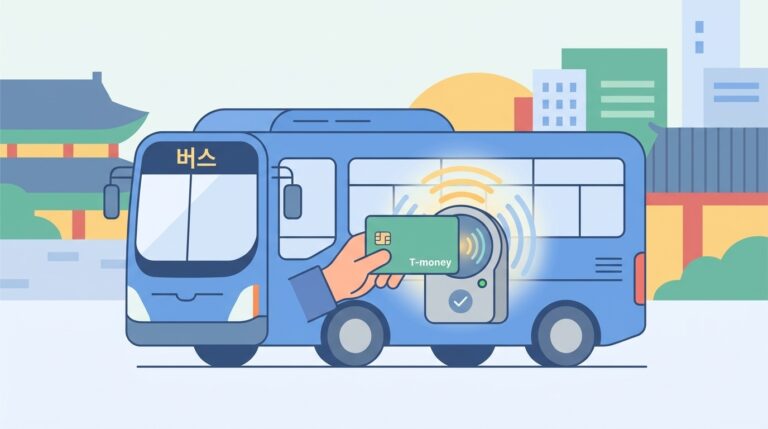
Imagine this: You’ve just tapped your transportation card on a crowded Seoul bus. You find a seat, look out the window, and enjoy the city view. But within 30 minutes, you need to hop off and catch another bus to reach your destination. As you tap your card to exit, you hear a friendly, robotic voice chime: “Hwanseung-imnida” (환승입니다).
Many of our absolute beginner students ask us, “What does that voice mean? Did my card fail? Am I paying twice?”
Take a deep breath! That sweet voice is actually saving you money. Today, you will learn exactly what 환승입니다 means, how to use Korea’s amazing transfer system, and how to sound like a local while navigating the transit system. Let’s dive in!
Phase 2: Core Expressions (The Transit Trio)
Here are the three most important phrases you will hear and use when taking a bus in Korea.
1. 환승입니다 (Hwanseung-imnida)
- Pronunciation: Hwan-seung-im-ni-da (Sounds like “Hwan” as in Juan + “seung” as in sung + “im-ni-da”)
- Meaning: “It is a transfer.”
- K-Culture Moment: You will hear this automated voice from the card reader every time you tap your card when getting on your second bus or subway within the transfer time limit.
- Editor’s Insight: This is a notification, not a command. It confirms that the system has successfully applied your free or discounted transfer rate!
- Situation Spectrum: Casual 🚫 | Semi-formal ✅ | Formal ✅ (This is an official system voice!)
- 🤔 Think About It: In Korea, public transport is seen as a highly coordinated public service. Why do you think the system verbally confirms your discount every single time?
2. 카드를 대 주세요 (Kadeureul dae juseyo)
- Pronunciation: Kah-deu-reul dae joo-seh-yo (Sounds like “Car-deu” + “reul” + “dae” as in day + “joo-say-yo”)
- Meaning: “Please place/tap your card.”
- K-Culture Moment: If you tap too quickly or hold your card too far from the reader, the screen flashes and the machine says this politely but firmly.
- Editor’s Insight: The verb 대다 (daeda) means “to touch” or “to place near.” You don’t need to slam your card; just hold it flat against the reader for one second.
- Situation Spectrum: Casual 🚫 | Semi-formal ✅ | Formal ⚠️
3. 내릴 때 카드를 찍어 주세요 (Naeril ttae kadeureul jjigeo juseyo)
- Pronunciation: Nae-ril ttae kah-deu-reul jjee-goh joo-seh-yo
- Meaning: “Please tap your card when you get off.”
- K-Culture Moment: Friendly bus drivers might shout this to passengers during rush hour to make sure everyone gets their transfer discount.
- Editor’s Insight: 찍다 (jjikda) literally means “to stamp” or “to print,” but in modern life, it is the most common slang/casual word for “tapping” a transit card.
- Situation Spectrum: Casual ✅ | Semi-formal ✅ | Formal ⚠️
Phase 3: Textbook Korean vs. Real Korean
Let’s compare how textbooks teach transit versus how Koreans actually talk on the bus.
Scenario 1: Asking if a transfer is possible
- 📖 Textbook: 환승이 가능합니까? (Hwanseungi ganeunghamnikka? – “Is a transfer possible?”)
- 🗣️ Real Korean: 환승 돼요? (Hwanseung dwaeyo? – “Does transfer work?”)
- 💡 Why the difference? The textbook version is too stiff and formal for a quick question to a bus driver. “돼요?” (Does it work/is it okay?) is much more natural and friendly.
Scenario 2: Reminding a friend to tap their card
- 📖 Textbook: 하차 카드를 접촉하십시오. (Hacha kadeureul jeobchokhasipsio. – “Please contact your exiting card.”)
- 🗣️ Real Korean: 카드 찍어! (Kadeu jjigeo! – “Tap your card!”)
- 💡 Why the difference? No Korean friend uses the word “contact” (접촉). We simply say “찍어” (tap/stamp) to our friends!
Phase 4: K-Culture Deep Dive & Etiquette
4-1. The Art of the “Nunchi” Exit
In Korea, getting off the bus is a fast-paced dance. Because Korean buses move quickly, passengers start standing up and walking toward the back door before the bus fully stops at their station.
* The Gesture: Keep your transit card in your hand early. Hold onto the yellow handrails with one hand, and tap your card on the reader as the bus slows down.
* Etiquette Tip: Do not block the card reader if your stop is not next. Stand slightly back to allow others to exit first.
4-2. The Magic 30-Minute Rule
Did you know that in Korea, your transfer is free (or deeply discounted) only if you tap your next ride within 30 minutes of tapping off the previous one? (This extends to 1 hour from 9:00 PM to 7:00 AM the next morning). This is why tapping your card on the way out is absolutely vital! If you forget to tap off, you will be charged a penalty fare on your next ride.
Phase 5: Real-Life Roleplay Scenario
Join our character, Emily, an exchange student in Seoul, as she boards a bus and tries to make sure her transfer works.
Characters:
- Emily (에밀리): An international student looking for her transfer.
- Mr. Kim (기사님 – Bus Driver): A friendly but busy Seoul bus driver.
The Conversation:
- Emily: 안녕하세요! (Taps card on reader)
(An-nyeong-ha-seh-yo!)
“Hello!” - Card Reader: 환승입니다.
(Hwan-seung-im-ni-da.)
“It is a transfer.” - Emily: 🎭 (Relieved, speaking to her friend) 와, 다행이다! 환승 됐어.
(Wa, da-haeng-i-da! Hwan-seung dwaes-seo.)
“Wow, thank goodness! The transfer worked.” - Emily: (To the driver, pointing to her map) 기사님, 이 버스 홍대 가요?
(Gi-sa-nim, i beo-seu Hong-dae ga-yo?)
“Driver, does this bus go to Hongdae?” - Mr. Kim: 🎭 (Nodding cheerfully) 네, 가요. 얼른 들어가서 앉으세요.
(Ne, ga-yo. Eol-leun deul-eo-ga-seo an-jeu-seh-yo.)
“Yes, it does. Hurry in and sit down.” - Emily: 감사합니다!
(Gam-sa-ham-ni-da!)
“Thank you!” - (A few minutes later, arriving at Hongdae…)
- Mr. Kim: 홍대입구입니다. 내릴 때 카드 찍으세요!
(Hong-dae-ip-gu-im-ni-da. Nae-ril ttae kah-deu jjee-geu-seh-yo!)
“This is Hongdae Entrance. Please tap your card as you exit!”
🔀 Choose Your Action!
Emily is about to step off the bus, but the exit door is crowded and she feels rushed. What should she do?
- A) Just push through and exit without tapping her card.
- B) Hold her card ready, wait for her turn, and tap carefully until she hears the “beep”.
- C) Panic and yell “Stop!” to the driver.
Feedback:
- Best Choice (B): Perfect! Tapping the card ensures she won’t get a double-charge penalty on her next ride, and waiting her turn is the safest behavior on a moving bus.
- Bad Choice (A): Oh no! If Emily doesn’t tap, she will lose her transfer discount and pay extra next time.
- Risk Choice (C): Yelling “Stop!” will startle the driver and other passengers, as the bus is already stopping anyway!
Phase 6: 10-Second Emotion Shadowing Drill
Practice speaking like a local with these rhythmic, emotional sentences! ( / means pause briefly).
[😊 Relieved and happy]
와, / 환승 됐다!
Wa, / hwan-seung dwaes-da!
“Wow, / the transfer worked!”-
[🥺 Slightly worried and asking a friend]
나 / 카드 찍었나?
Na / kah-deu jjee-geon-na?
“Did I / tap my card?” -
[😊 Politely asking the driver]
기사님, / 이거 / 홍대 가요?
Gi-sa-nim, / i-geo / Hong-dae ga-yo?
“Driver, / does this one / go to Hongdae?”
Phase 7: K-Culture Mini Dictionary
- 기사님 (Gisanim) | Driver/Sir
A respectful title used to address bus drivers, taxi drivers, or technicians in Korea. - 교통카드 (Gyotong-kadeu) | Transportation Card
The general term for reloadable cards like T-money, Cashbee, or linked credit cards used for transit. - 찍다 (Jjikda) | To Tap/Stamp
The casual verb everyone uses to describe placing their transit card on the reader. - 하차 (Hacha) | Getting Off/Alighting
The formal Hanja-based word seen on transit signs and card readers referring to exiting the vehicle.
Phase 8: Traveler’s Survival Kit
Survival Expressions TOP 3
- 카드 대 주세요. (Kadeu dae juseyo.) – “Please tap your card.” (If the reader fails first time)
- 환승 돼요? (Hwanseung dwaeyo?) – “Can I transfer?”
- 내릴게요! (Naerilgeyo!) – “I am getting off!” (Shout this politely if the driver accidentally closes the door before you exit)
Editor’s Travel Note 🗺️
Do not use Google Maps for walking or bus routes in Korea—it is often outdated! Instead, search for and download the KakaoMap App or Naver Map App. These local apps show real-time bus arrivals down to the second, and they will even tell you exactly which exit door to stand near for your transfer!
Phase 9: “One Step Deeper” (Cultural Insight)
In many Western cities, you pay a flat rate per ride regardless of the distance or transfers. In Korea, the public transit system operates as an integrated network. Subway and bus lines “talk” to each other to calculate your total distance. This represents Korea’s highly connected, efficiency-focused society. By tapping your card, you become a harmonious part of this massive, synchronized urban machine.
💬 Your Turn: Does your hometown have a transfer system like Korea’s? Leave a comment below sharing your city’s public transport system!
Phase 10: FAQ & Common Mistakes
Q: Can I transfer from a bus to another bus with the same route number?
A: No. The transfer system assumes you are continuing your journey in a new direction. Transferring to the same bus route number within 30 minutes will charge you a full new fare.
Q: What happens if I forget to tap my card when getting off?
A: You will lose your transfer discount, and on your next trip, you will be charged a penalty fee (usually double the base fare).
Q: Can my friend and I use one T-money card to transfer together?
A: You can pay for multiple people with one card on a single ride by telling the driver first. However, individual transfers are not supported for multi-passenger payments. It is always best to have one card per person!
🚨 Common Mistakes Alert!
- Tapping too early: Do not tap your card until the bus is very close to your stop, or the system might register it as a mid-trip tap.
- Holding the card too far: Holding your card 5cm away won’t register. Touch it directly to the plastic screen.
- Tapping with a wallet full of other cards: If you have multiple RFID cards in your wallet, the reader will say “Please hold only one card” (카드를 한 장만 대 주세요).
Phase 11: Action Mission
- Bronze Medal 🥉: Practice saying “Hwanseung-imnida” with the correct pronunciation 5 times in front of the mirror.
- Silver Medal 🥈: Next time you watch a K-Drama, look closely at the bus scene. Can you spot the yellow handrails and the card readers near the doors?
- Gold Medal 🥇: When you visit Korea, successfully transfer from a green bus to a blue bus within 30 minutes!
Phase 12: Interactive Quiz Challenge
Test your new Korean bus skills!
1. What does the voice say when your transfer discount is successfully applied?
- A) 카드를 대 주세요
- B) 환승입니다
- C) 감사합니다
2. How long is the standard transfer time limit in Korea during daytime?
- A) 15 minutes
- B) 30 minutes
- C) 1 hour
See Answers & Explanations
- Correct Answer: B) 환승입니다 (Hwanseung-imnida). This means “It is a transfer!”
- Correct Answer: B) 30 minutes. You must tap your card on the next bus or subway within 30 minutes of tapping off.







