

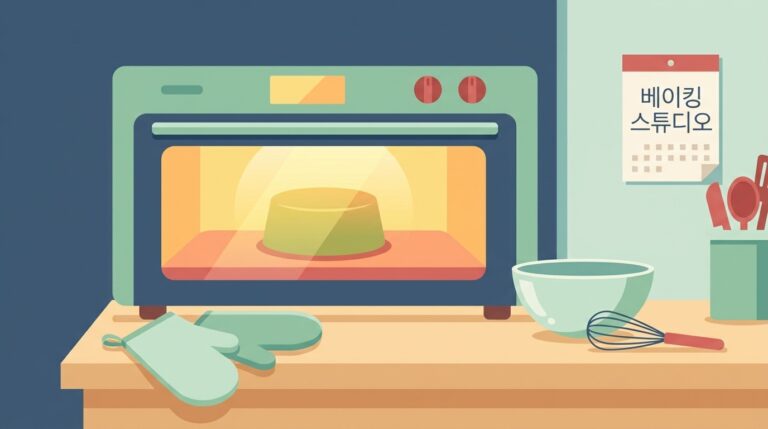
Master the Heat: Crucial Korean Oven Terminology and Baking Nuances
Phase 1: Empathy (An Editor’s Kitchen Secret)
안녕하세요! Welcome back to another sweet session with Daily Hangul. Have you ever tried baking a delicate Korean yakgwa (약과 – honey cookie) or a trendy, fluffy K-style lunchbox cake, only to have it sink or burn to a crisp? You check the recipe: “Bake at 170°C.” You set your oven, but—bam!—the exterior is scorched, and the inside is gooey.
We’ve all been there. In Korea’s bustling home-baking community, managing oven temperaments is considered an art form. One of our C1-level students recently shared: “I knew the words for ‘hot’ and ‘cold,’ but when my Korean baking instructor talked about ‘residual heat’ or ‘uneven hotspots,’ I was completely lost!” Today, we are going to dive deep into high-level baking vocabulary and cultural nuances that will make you sound like a professional pâtissier in any Seoul baking studio.
Phase 2: Deep Dive into 3 Essential Expressions
Let’s dissect three high-frequency, advanced terms used by Korean baking experts.
1. 잔열로 익히다 (janyeol-lo ik-hi-da)
- Pronunciation: Jan-yeol-lo ik-hee-dah (Rhymes with “plan-yall”)
- Meaning: To cook/bake using residual heat (carryover cooking).
- K-Culture Moment: You will hear this constantly on popular Korean baking YouTube channels like Cooking tree쿠킹트리 or 자도르 J’adore. When making delicate macarons, they will say, “Turn off the oven and let them dry janyeol-lo.”
- Editor’s Insight: Janyeol (잔열) combines jan (remaining/leftover) and yeol (heat). It is crucial for high-level baking where over-baking ruins the texture.
- Situation Spectrum: Casual ✅ | Semi-formal ✅ | Formal ✅
- 🤔 Think About It: How does your culture view patience in cooking? In Korea, utilizing janyeol reflects a broader cultural appreciation for subtle, indirect transformations rather than rushing the process.
2. 열이 골고루 퍼지다 (yeol-i gol-go-ru peo-ji-da)
- Pronunciation: Yul-ee gol-go-roo puh-jee-dah (Think “goal-goal-roo” for evenly)
- Meaning: For heat to distribute evenly.
- K-Culture Moment: In a dynamic baking class in Gangnam, an instructor might check your convection oven setup and emphasize this phrase to ensure your chiffon cake rises symmetrically.
- Editor’s Insight: Golgol-u (골고루) means “evenly” or “uniformly.” When heat peojida (spreads) unevenly, you get the dreaded “hotspot” (열점 – yeol-jeom).
- Situation Spectrum: Casual ✅ | Semi-formal ✅ | Formal ✅
- 🤔 Think About It: In Korean, the adverb golgol-u is also used for balanced diets (골고루 먹다). How does the language of food preparation overlap with health in your mother tongue?
3. 예열을 충분히 하다 (yeyeol-eul chung-bun-hi ha-da)
- Pronunciation: Yeh-yul-eul choong-boon-hee ha-dah
- Meaning: To preheat thoroughly.
- K-Culture Moment: Often written in bold letters in professional Korean recipe books: “예열은 필수입니다” (Preheating is mandatory).
- Editor’s Insight: Yeyeol (예열) literally means “pre-heat.” Skipping this step in Korea is considered a cardinal sin of baking, often linked to a lack of preparation (jeunbi).
- Situation Spectrum: Casual ✅ | Semi-formal ✅ | Formal ✅
- 🤔 Think About It: Why do you think Korean culture places such heavy emphasis on preparation (예 – pre/before) in both life and baking?
Phase 3: Textbook Korean vs. Real-Life Baking Korean
Let’s compare the rigid sentences found in grammar books with what real Korean bakers say.
Scenario 1: Discussing an oven that runs too hot
- 📖 Textbook: 오븐의 온도가 너무 높습니다. (Obeun-ui ondo-ga neomu nopsumnida. – The oven temperature is too high.)
- 🗣️ Real-Life: 오븐 불이 너무 세요. (Obeun bul-i neomu se-yo. – The oven fire/heat is too strong.)
- 💡 Why the difference? Koreans colloquially refer to oven heat as bul (불 – fire), reminiscent of traditional clay ovens. It sounds much more natural and experienced.
Scenario 2: Asking if the oven is ready
- 📖 Textbook: 예열이 완료되었습니까? (Yeyeol-i wanryo-doeeotseumnika? – Has preheating finished?)
- 🗣️ Real-Life: 온도 다 올라갔어요? (Ondo da ol-la-gat-seo-yo? – Did the temperature go all the way up?)
- 💡 Why the difference? Native speakers prefer active, visual phrasing like “temperature climbed up” over passive, dry Sino-Korean verbs like “completed.”
Phase 4: K-Culture Deep Dive & Non-Verbal Manners
4-1. The Baker’s “Nunchi” (눈치)
When baking in a shared Korean kitchen or academy, checking the oven requires a delicate balance of nunchi (social sensing). Opening the oven door frequently releases heat, ruining everyone’s soufflés. Instead of constantly opening the door, bakers gently hover their hands near the glass or peek through while slightly tilting their heads. To ask to open the oven, always say: “잠시만 문 열어봐도 될까요?” (May I open the door for a moment?).
4-2. The Aesthetic of “K-Desserts”
Korean baking isn’t just about taste; it is highly visual. From “fat-carons” (뚱카롱 – extra-thick macarons) to minimalist cakes, perfect oven control ensures that colors do not fade. Over-baking brown shades onto pastel frostings is avoided at all costs, requiring precise temperature adjustments during the final 5 minutes.
Phase 5: Real-Life Roleplay Scenario
Setting: A premium baking studio in Seongsu-dong, Seoul. You are baking a delicate matcha sponge cake under the guidance of Chef Min-ho.
- Chef Min-ho (Instructor): “우선 오븐 예열을 충분히 해 두셔야 해요. 180도로 맞췄나요?”
(First, you must preheat the oven thoroughly. Did you set it to 180 degrees?) - You: “네, 셰프님. 그런데 저희 집 오븐보다 이 오븐 불이 좀 센 것 같아요.”
(Yes, Chef. But this oven’s heat seems a bit stronger than the one at my house.) - Chef Min-ho: “아, 이 기계는 열이 골고루 퍼지긴 하는데 초반 화력이 강해요. 그럼 170도로 낮출까요?”
(Ah, this machine distributes heat evenly, but the initial fire power is strong. Shall we lower it to 170?) - You: “네, 10도 낮춰서 굽고 마지막은 잔열로 익히는 게 안전하겠어요.”
(Yes, baking it 10 degrees lower and finishing it with residual heat seems safer.) - Chef Min-ho: “좋은 판단이에요! 겉면 색이 너무 진해지면 알루미늄 호일을 덮어주세요.”
(Great judgment! If the top gets too dark, please cover it with aluminum foil.) - You: “지금 타이머 맞춰놓겠습니다. 굽는 시간은 25분 맞죠?”
(I will set the timer now. The baking time is 25 minutes, right?) - Chef Min-ho: “네, 20분 지나고 나서 꼬치 테스트 한번 해보세요.”
(Yes, do a toothpick test after 20 minutes.) - You: “네, 꼼꼼하게 확인할게요. 감사합니다!”
(Yes, I will check thoroughly. Thank you!)
🔀 Interactive Branching Point
The timer goes off, but the center of the cake still jiggles slightly. What do you say to the chef?
- A: “덜 익었으니까 그냥 오븐 온도를 200도로 확 올릴까요?”
Feedback: 🚫 Bad. Boosting the temp to 200°C will burn the outside instantly. A C1 baker knows patience. - B: “오븐 끄고 잔열로 조금 더 놔두면 속까지 익을까요?”
Feedback: ⭐️ Best! Showing understanding of janyeol (residual heat) proves you have professional baking instincts. - C: “다 익은 것 같아요. 그냥 꺼낼게요.”
Feedback: ⚠️ Risk. If it’s still jiggling, the center will collapse once cooled.
Phase 6: 10-Second Emotion Shadowing Drill
Practice saying these with the correct emotional rhythm. / represents a natural pause.
[😊 Confidently anticipating]
“오븐 예열은 / 필수 중에 필수죠!”
(Preheating the oven / is the absolute must-do!)-
[🥺 Slightly worried about burning]
“오븐 불이 너무 세서 / 겉이 탈 것 같아요.”
(The oven heat is too strong, / so I think the top is going to burn.) -
[💡 Realizing the solution]
“아! / 남은 열로 / 잔열로 익히면 되겠네요!”
(Ah! / With the remaining heat, / we can just cook it with residual heat!)
Phase 7: K-Culture Mini-Dictionary
- 겉바속촉 (Geot-ba-sok-chok) | Crispy on the outside, moist on the inside | The ultimate textural compliment for any Korean baked good.
- 꼬치 테스트 (Kko-chi Te-seu-teu) | Toothpick/skewer test | Inserting a stick into the sponge to see if wet batter clings to it.
- 화력 (Hwa-ryeok) | Heating power / Fire power | Used colloquially to describe how strong an oven or stove is.
- 구움과자 (Gu-um-gwa-ja) | Baked confectionery | Refers to small baked treats like financiers, madeleines, and cookies, currently trending in Seoul cafes.
Phase 8: The Traveler’s Survival Kit
Survival Vocab TOP 3
- 오븐 장갑 (Obeun Jang-gap) – Oven mitts. (“오븐 장갑 어디 있어요?” – Where are the oven mitts?)
- 유산지 (Yu-san-ji) – Parchment paper. (“틀에 유산지 깔아주세요.” – Please line the tin with parchment paper.)
- 식힘망 (Sik-him-mang) – Cooling rack. (“다 구워지면 식힘망에 올려주세요.” – Put it on the cooling rack when baked.)
📌 Editor’s Travel Note: If you want to find professional baking supplies in Seoul, search for “방산시장” (Bangsan Market) on the Naver Map App. It is a paradise for bakers, filled with affordable baking pans, high-quality matcha powder, and unique packaging materials.
Phase 9: “A Step Deeper” (Reflections on Korean Baking culture)
In Korea, baking is closely tied to the concept of 정성 (Jeongseong – sincere devotion). Gift-giving is a major part of social bonding, and giving handmade guum-gwaja (구움과자) represents the ultimate form of thoughtfulness. Because it requires such precision, controlling the oven heat perfectly is not just a technical step; it is viewed as a measure of how much care you have put into your creation.
💬 Your Turn: Have you ever baked something as a gift for a Korean friend? What is your favorite dessert to bake? Share your stories in the comments below!
Phase 10: FAQ & Common Mistakes
Q: Can I use the word “불” (fire) for an electric convection oven?
A: Yes! Even though modern ovens run on electricity, Koreans still say “오븐 불이 세다” (The oven fire is strong). It is an intuitive way of talking about cooking heat.
Q: What is the difference between 온도를 맞추다 and 온도를 조절하다?
A: 맞추다 (matchuda) means to “set” a specific target temperature (e.g., set to 180°C). 조절하다 (jojeolhada) means to “adjust” or control the heat dynamically while baking.
Q: How do I tell someone the oven heat is uneven?
A: You can say “열이 골고루 안 퍼져요” (The heat doesn’t distribute evenly) or “골고루 안 익어요” (It doesn’t cook evenly).
🚨 Common Mistakes Alert!
- Using “뜨겁게 하다” (tteu-geop-ge hada) for preheating: Saying “오븐을 뜨겁게 하세요” sounds like a child’s phrasing. Always use the professional term 예열하다.
- Confusing ‘식히다’ (to cool) with ‘익히다’ (to cook): They sound incredibly similar! Sikhida (식히다) cools your cake; ikhida (익히다) bakes it.
- Saying “오븐을 열다” to adjust heat: Instead of physically opening the door, use 온도를 낮추다 (lower the temperature) to prevent the cake from collapsing.
Phase 11: Action Mission
- Bronze Medal: Write down







