

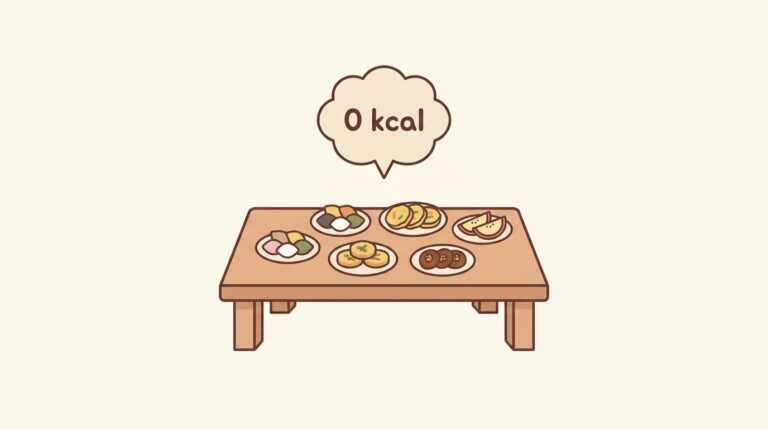
Master the Art of Worrying About Chuseok Calories Like a True Korean!
Phase 1: Empathy (Welcome to the Holiday Feast Dilemma!)
안녕하세요! (An-nyeong-ha-se-yo!) I’m your Daily Hangul editor and your Korean culture bestie!
Imagine this: It’s Chuseok (추석, Korean Thanksgiving) or Seollal (설날, Lunar New Year). You are sitting with your Korean friends or host family. The table is overflowing with golden, crispy jeon (전, savory pancakes), sweet and chewy songpyeon (송편, half-moon rice cakes), and perfectly seasoned galbi-jjim (갈비찜, braised beef short ribs). Everything smells heavenly.
You reach for another piece of sweet yakgwa (약과), but a tiny voice in your head whispers, “Wait, how many calories is this?” You want to join the conversation, express your love for the food, but also playfully complain about the inevitable holiday weight gain just like locals do!
Talking about calories and dieting during holidays in Korea isn’t just about weight—it’s a massive social bonding ritual. In this guide, we will learn how to express this dilemma naturally in Korean (B2 Level) so you can sound like a true local at the dinner table!
Phase 2: Deep Dive into 3 Essential Expressions
1. 맛있게 먹으면 0칼로리예요!
- Pronunciation: Ma-sit-ge meog-eu-myeon yeong-kal-lo-ri-yeo-yo! (Sounds like: Mah-sheet-geh mug-eum-yun young-kal-loh-ree-yeh-yo!)
- Meaning: “If it tastes good, it has zero calories!”
- K-Culture Moment: You will hear this in almost every Korean mukbang or food variety show (like Delicious Guys). When someone is about to eat a highly caloric food, they shout this to relieve the guilt.
- Editor’s Insight: This is a beloved national self-deception phrase! It is the ultimate shield against diet guilt. Use it when someone hesitates to eat another bite of jeon.
- Situation Spectrum:
- Casual: 맛있게 먹으면 0칼로리야! (✅)
- Semi-formal: 맛있게 먹으면 0칼로리예요! (✅)
- Formal: 맛있게 먹으면 0칼로리입니다. (⚠️ – A bit too stiff for a joke)
- 🤔 Think About It: Koreans love eating together, and creating a joyful eating atmosphere is highly valued. Why do you think making jokes about calories helps people bond?
2. 명절 음식은 칼로리 폭탄이에요.
- Pronunciation: Myeong-jeol eum-sig-eun kal-lo-ri pok-tan-i-e-yo.
- Meaning: “Holiday food is a calorie bomb.”
- K-Culture Moment: Often seen in lifestyle vlogs during the holidays, or heard among coworkers the day after a long weekend.
- Editor’s Insight: “폭탄” (pok-tan) means bomb. Combining it with “칼로리” (calorie) instantly creates a vivid image of high-calorie foods. It’s perfect for expressing lighthearted shock.
- Situation Spectrum:
- Casual: 명절 음식은 진짜 칼로리 폭탄이야. (✅)
- Semi-formal: 명절 음식은 칼로리 폭탄이에요. (✅)
- Formal: 명절 음식은 칼로리 폭탄입니다. (✅ – Good for presenting on health topics!)
- 🤔 Think About It: Is there a similar word for “calorie bomb” in your native language?
3. 살찌는 소리가 들려요.
- Pronunciation: Sal-jji-neun so-ri-ga deul-lyeo-yo.
- Meaning: “I can hear the sound of myself gaining weight.”
- K-Culture Moment: In K-Dramas, when characters eat late-night ramyeon or heavy holiday meals, they pat their tummies and say this with a cute sigh.
- Editor’s Insight: This is a highly figurative and humorous expression. “살찌다” means to gain weight, and “소리가 들리다” means to hear a sound. It captures that funny, imaginary moment where you feel your thighs getting thicker in real-time.
- Situation Spectrum:
- Casual: 아, 살찌는 소리가 들린다. (✅)
- Semi-formal: 아, 살찌는 소리가 들려요. (✅)
- Formal: 살찌는 소리가 들립니다. (🚫 – Too dramatic for formal settings)
- 🤔 Think About It: Why does Korean use auditory metaphors (hearing a sound) for physical changes like gaining weight?
Phase 3: Textbook Korean vs. Real Korean
Let’s compare what traditional textbooks teach versus what Koreans actually say in real life.
Situation 1: Saying you are worried about gaining weight
- 📖 Textbook: “체중 증가가 걱정됩니다.” (Che-jung jeung-ga-ga geok-jeong-dep-ni-da. / I am worried about weight increase.)
- 🗣️ Real Korean: “살찔까 봐 걱정돼요.” (Sal-jji-kka bwa geok-jeong-dwae-yo. / I’m worried I might gain weight.)
- 💡 Why the difference? The textbook expression uses “체중 증가” (weight increase), which sounds like a medical report. Locals use the active verb “살찌다” (to gain weight) with the grammar “-을까 봐” (for fear of / worried that).
Situation 2: Expressing that you shouldn’t eat anymore
- 📖 Textbook: “과식을 피해야 합니다.” (Gwa-sig-eul pi-hae-ya hap-ni-da. / I must avoid overeating.)
- 🗣️ Real Korean: “손을 멈출 수가 없어요.” (Son-eul meom-chul su-ga eops-eo-yo. / I can’t stop my hands [from reaching for food].)
- 💡 Why the difference? “과식” (overeating) is too formal. Saying “My hands won’t stop!” is a much warmer, funnier, and more relatable way to praise the host’s cooking while acknowledging you are eating a lot.
Phase 4: K-Culture Deep Dive & Non-verbal Manners
4-1. The “Nunchi” of Declining Food
In Korean holiday culture, the older generation loves to feed you. If you say “I’m on a diet” (다이어트 중이에요), they might say, “You look so thin! Eat more!”
* The Gesture: Do not just wave your hand aggressively. Instead, gently pat your stomach with both hands, make a slightly apologetic face, and say “정말 맛있는데, 배가 터질 것 같아요!” (It’s so delicious, but I feel like my stomach is going to burst!). This praises the chef while giving a clear physical cue that you are full.
4-2. The Golden Rule of Holiday Eating
Traditional dishes like Songpyeon (송편) are sesame/honey or bean-filled. One tiny songpyeon is about 50 kcal. A handful of them easily equals a bowl of rice! That is why Koreans joke about doing “cholesterol management” (콜레스테롤 조절) right after the holidays.
Phase 5: Interactive Roleplay Scenario
Setting: Chuseok feast at Ji-young’s house. You have eaten a lot of savory pancakes, and Ji-young’s mother brings out sweet sikhye (rice punch) and yakgwa.
Characters:
- 지영 (Ji-young): Your Korean friend who loves food but worries about diet.
- 지영 어머니 (Ji-young’s Mom): The ultimate host who keeps offering food.
- 민우 (Min-woo): Ji-young’s brother, a funny realist.
- You (The Learner): A polite guest trying to balance politeness with calorie worries.
Dialogue:
- 지영 어머니: 🎭 (Smiling warmly, handing you a cup of sikhye) “우리 OO 씨, 많이 먹어요! 명절이니까 눈치 보지 말고!”
- You: 🎭 (Grateful but shocked by the food amount) “우와, 어머니! 진짜 진수성찬이에요. 근데 이거 먹으면…”
- 지영: 🎭 (Sighing while looking at her own plate) “엄마, 진짜 칼로리 장난 아니야. 나 벌써 살찌는 소리가 들려.”
- 민우: 🎭 (Laughing) “야, 일 년에 한 번인데 그냥 먹어! 맛있게 먹으면 0칼로리 몰라?”
- You: 🎭 (Laughing along) “맞아요, 맛있게 먹으면 0칼로리예요! 하지만 송편 칼로리가 대단하네요.”
- 지영 어머니: 🎭 (Waving hand) “에이, 맛있는 건 0칼로리라니까! 이거 직접 만든 약과인데 하나 더 먹어봐요.”
- You: 🎭 (Tempted, looking at the sweet yakgwa) “우와… 약과는 칼로리 폭탄이라던데…”
- 민우: 🎭 (Teasing) “내일부터 다이어트 하면 되지! 자, 받으세요!”
🔀 Choose Your Reaction!
Scenario: Ji-young’s mother offers you the final, giant piece of home-made honey yakgwa. What do you do?
- A. [Best Choice] 🎭 (Take it politely but share the guilt) “감사합니다! 그럼 지영이랑 반반씩 나눠 먹을게요. 같이 살찌면 덜 억울하니까요!” (Thank you! Then I will split it half-and-half with Ji-young. It’s less unfair if we gain weight together!)
- B. [Bad Choice] “싫어요, 칼로리가 너무 높아서 안 먹을래요.” (No, the calories are too high so I won’t eat it. – Too cold and blunt!)
- C. [Risk Choice] “어머니, 저 뚱뚱해지면 책임지실 거예요?” (Mom, are you going to take responsibility if I get fat? – Could be funny if you are extremely close, but highly risky for general acquaintances!)
Phase 6: 10-Second Emotion Shadowing Drill
Let’s practice speaking with real-life emotions! Pay attention to the pauses (/) and the emotional cues.
[😊 Playfully teasing]
“맛있게 먹으면 / 0칼로리래요! / 얼른 드세요!”
(Ma-sit-ge meog-eu-myeon / yeong-kal-lo-ri-rae-yo! / Eol-leun deu-se-yo!)-
[🥺 Whining and cute]
“아고… / 오늘도 실패다… / 살찌는 소리가 / 아주 크게 들려요.”
(A-go… / o-neul-do sil-pae-da… / sal-jji-neun so-ri-ga / a-ju keu-ge deul-lyeo-yo.) -
[😱 Shocked but laughing]
“이거 진짜 / 칼로리 폭탄이네요! / 그래도 너무 맛있어요!”
(I-geo jin-jja / kal-lo-ri pok-tan-i-ne-yo! / Geu-rae-do neo-mu ma-sit-eo-yo!)
Phase 7: K-Culture Mini Dictionary
- 칼로리 폭탄 (Kal-lo-ri Pok-tan): Calorie bomb. Used for fatty, sweet, or heavily processed delicious foods.
- 확찐자 (Hwak-jjin-ja): A play on words created during COVID-19. “확진자” means “confirmed patient,” but “확찐자” sounds identical and means “someone who suddenly gained weight” (확 + 찌다).
- 소확행 (So-hwak-haeng): Small but certain happiness. Eating a delicious high-calorie snack during holiday stress is often called so-hwak-haeng.
- 식단 조절 (Sik-dan Jo-jeol): Diet/Meal management. Used when you try to balance your clean eating after a huge feast.
Phase 8: Traveler’s Survival Kit
Survival Phrases
- “배불러서 더 못 먹겠어요.” (Bae-bul-leo-seo deo mot meog-get-eo-yo.)
- Pro Tip: Use this when you are genuinely full and want to decline politely.
- “이거 칼로리가 어떻게 돼요?” (I-geo kal-lo-ri-ga eo-tteo-ke dwae-yo?)
- Pro Tip: Use this at a bakery or market stall to ask about calories nicely.
- “내일부터 다이어트 할 거예요.” (Nae-il-bu-teo da-i-eo-teu hal geo-ye-yo.)
- Pro Tip: The ultimate universal lie that everyone tells! It brings instant laughter.
Editor’s Travel Note
When you travel during holidays, many restaurants might close, but convenience stores are always open! Download Naver Map (네이버 지도) to check real-time holiday business hours for local cafes and gyms to burn those holiday calories.
Phase 9:
Frequently Asked Questions (FAQ)
Q: What does "맛있게 먹으면 0칼로리예요!" mean in Korean and how do you pronounce it?
A: In Korean, "맛있게 먹으면 0칼로리예요!" is pronounced [Ma-sit-ge meog-eu-myeon yeong-kal-lo-ri-yeo-yo! (Sounds like: Mah-sheet-geh mug-eum-yun young-kal-loh-ree-yeh-yo!] and means: "If it tastes good, it has zero calories!"
Q: What does "명절 음식은 칼로리 폭탄이에요." mean in Korean and how do you pronounce it?
A: In Korean, "명절 음식은 칼로리 폭탄이에요." is pronounced [Myeong-jeol eum-sig-eun kal-lo-ri pok-tan-i-e-yo.] and means: "Holiday food is a calorie bomb."
Q: What does "살찌는 소리가 들려요." mean in Korean and how do you pronounce it?
A: In Korean, "살찌는 소리가 들려요." is pronounced [Sal-jji-neun so-ri-ga deul-lyeo-yo.] and means: "I can hear the sound of myself gaining weight."







