

How to Say “No” in Korean Without Hurting Someone’s Feelings: Navigating ‘Jeong’ (情)
Phase 1: Empathy (An Invitation to the World of ‘Jeong’)
안녕하세요! (Annyeonghaseyo!) It’s your Korean bestie and Daily Hangul Editor here!
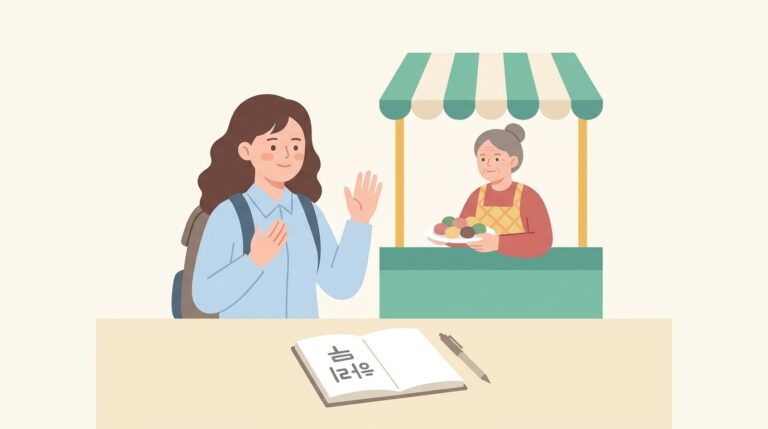
Imagine this: You are at a local Korean market, and a warm, smiling grandmother (할머니 – Halmeoni) hands you a fresh, steaming piece of rice cake. You are already completely stuffed from lunch, but she looks at you with eyes full of 정 (Jeong)—that uniquely Korean bond of deep affection, warmth, and shared humanity. You want to refuse, but your heart screams, “If I say no, will I break her heart?” Or maybe a coworker asks you to help them with a project right as you are about to clock out. You want to decline, but the invisible pressure of Jeong makes you hesitate.
Many of our intermediate (B1) learners tell us they often end up saying “Yes” to things they want to decline because they are afraid of sounding rude or cold in Korean. Today, we are going to master the art of the “soft refusal” (거절 – Geojeol). You will learn how to protect your boundaries while keeping the warm connection of Jeong perfectly intact. Let’s dive in!
Phase 2: Deep-Dive into 3 Essential Expressions
1. 마음만 받을게요 (Ma-eum-man bad-eul-ge-yo)
- Pronunciation: Mah-eum-mahn bah-deul-geh-yo (Sounds like “ma-um” + “mahn” + “bah-deul-gay-yo”)
- Meaning: I will take only your heart. (I appreciate the thought, but I must decline.)
- K-Culture Moment: In a K-Drama, when a sweet neighbor tries to give the main character a bulky secondhand sofa they don’t need, the lead character says this with a polite bow and a warm smile.
- Editor’s Insight: This is the ultimate shield of politeness. By saying you accept their “heart” (마음), you acknowledge their Jeong before declining the actual object or favor. It’s impossible to sound rude with this!
- Situation Spectrum: Casual: ✅ | Semi-formal: ✅ | Formal: ⚠️
- 🤔 Think About It: In your culture, is there a way to accept someone’s “intention” while refusing their actual gift or offer?
2. 제가 요즘 정신이 없어서요 (Je-ga yo-jeum jeong-sin-i eops-eo-seo-yo)
- Pronunciation: Jeh-gah yo-jeum jung-shin-ee up-suh-suh-yo (Think of “jung-shin” as mental focus, and “eops-eo-seo-yo” as “because I don’t have”)
- Meaning: I’ve been so out of it lately. / I’ve been extremely busy and distracted.
- K-Culture Moment: Often used in office dramas when a colleague asks you to join a voluntary weekend gathering, and you need a socially acceptable excuse.
- Editor’s Insight: Instead of saying “I don’t want to do this,” you blame your own chaotic schedule or state of mind (“정신이 없다”). It saves face for both parties.
- Situation Spectrum: Casual: ✅ | Semi-formal: ✅ | Formal: ✅
- 🤔 Think About It: Why do you think blaming circumstances rather than personal preference is preferred in group-oriented cultures like Korea?
3. 아쉽지만 다음 기회에 할게요 (A-swip-ji-man da-eum gi-hoe-e hal-ge-yo)
- Pronunciation: Ah-shweep-jee-mahn dah-eum gee-hweh-eh hahl-geh-yo (Focus on the soft “shwip” sound)
- Meaning: It’s a pity, but I’ll do it next time.
- K-Culture Moment: Used when rejecting an invitation to a second round of drinks (2차 – I-cha) after a team dinner.
- Editor’s Insight: The word “아쉽다” (to be regrettable/sad) shows that you genuinely wanted to say yes, which softens the blow of the rejection.
- Situation Spectrum: Casual: ✅ | Semi-formal: ✅ | Formal: ⚠️
- 🤔 Think About It: How does promising a “next time” help maintain social harmony, even if that “next time” is tentative?
Phase 3: Textbook Korean vs. Real-Life Korean
Let’s compare what the textbooks teach you with how Koreans actually speak to preserve relationships.
Situation 1: Declining a snack/food offer
- 📖 Textbook: 아니요, 저는 그것을 원하지 않습니다. (Aniyo, jeoneun geogeoseul wonhaji aniseumnida. – No, I do not want that.)
- 🗣️ Real Korean: 아, 괜찮아요! 방금 밥을 먹고 와서 배불러요. (Ah, gwaenchanayo! Bang-geum babeul meokgo waseo baebulleoyo. – Oh, I’m okay! I just ate, so I’m full!)
- 💡 Why the difference? Directly saying “I don’t want it” rejects the giver’s hospitality. Giving a physical reason (being full) redirects the rejection away from their kindness.
Situation 2: Turning down an extra work request or favor
- 📖 Textbook: 저는 그것을 할 수 없습니다. (Jeoneun geogeoseul hal su eopseumnida. – I cannot do that.)
- 🗣️ Real Korean: 제가 지금 하고 있는 일이 있어서 바로 도와드리기가 어렵네요. (Jega jigeum hago inneun iri isseo-seo baro dowa-deurigiga eoryeopne-yo. – Since I have work I’m doing right now, it’s a bit difficult to help you immediately.)
- 💡 Why the difference? Using “어렵다” (difficult) instead of “안 된다/할 수 없다” (cannot) creates a softer, more cooperative tone.
Phase 4: K-Culture Deep-Dive & Non-Verbal Manners
4-1. The “Soft Refusal” Body Language
When saying “no” in Korea, your physical actions carry 50% of the message:
* The Head Tilt and Hand Wave: Gently tilt your head slightly and wave your hand near your chest (palm facing outward, moving left to right) while saying “괜찮아요” (Gwaenchanayo).
* The Apologetic Eye Contact: Avoid staring directly into their eyes intensely when declining. Soften your gaze, look slightly down, and smile apologetically.
4-2. The Culture of ‘Jeong’ (情)
Jeong is the warm emotional adhesive of Korean society. When someone offers you food or asks for a favor, they are trying to build Jeong. A flat, logical “No, thank you” feels like a sharp knife cutting that invisible bond. By using phrases like “마음만 받을게요,” you keep the adhesive sticky while politely stepping aside.
Phase 5: Real-Life Roleplay Scenario
Scenario: Your kind team leader, Manager Kim, is offering you some heavy traditional snacks (such as traditional Korean rice cakes) right after you just finished a heavy lunch.
Characters:
- 김 과장님 (Manager Kim): Full of Jeong, loves sharing food.
- 유진 (Yujin – You): Stuffed, but wants to be polite.
Dialogue:
- 김 과장님: 🎭 (Holding out a box of rice cakes with a bright smile) 유진 씨, 이것 좀 먹어 봐요. 시골에서 부모님이 보내주신 떡이에요. 아주 맛있어요!
(Yujin, try some of this. These are rice cakes my parents sent from the countryside. They’re delicious!) - 유진: 🎭 (Surprised, touching stomach apologetically) 아, 과장님! 시골에서 온 떡이에요? 정말 맛있어 보여요!
(Oh, Manager! Rice cakes from the countryside? They look really delicious!) - 김 과장님: 🎭 (Nudging the box closer) 응, 그러니까 얼른 먹어 봐요. 얼른!
(Yes, so hurry up and try some. Go on!) - 유진: 🎭 (Gently waving hands with a warm, apologetic smile) 아… 정말 감사한데, 제가 방금 점심을 너무 많이 먹어서 지금은 배가 터질 것 같아요!
(Ah… I’m really grateful, but I just ate so much lunch that my stomach feels like it’s going to burst right now!) - 김 과장님: 🎭 (A bit disappointed but understanding) 아이구, 그래요? 한 개도 못 먹겠어요?
(Oh dear, really? You can’t even eat one?) - 유진: 🎭 (Bow slightly) 네, 너무 아쉽네요. 과장님, 보내주신 부모님 마음만 감사히 받을게요!
(Yes, it’s such a pity. Manager, I will gratefully accept only your parents’ warm hearts!) - 김 과장님: 🎭 (Laughing warmly) 그래요, 그럼 나중에 출출할 때 먹게 몇 개 싸줄 테니까 이따가 퇴근할 때 가져가요.
(Okay, then I’ll pack a few for you to eat later when you’re hungry, so take them when you leave work.) - 유진: 🎭 (Gratefully bowing) 와! 그러면 이따가 감사히 가져갈게요. 챙겨주셔서 정말 감사합니다, 과장님!
(Wow! Then I’ll gratefully take them later. Thank you so much for looking after me, Manager!)
🔀 Interactive Choice Point
What would you say if Manager Kim insists you take the snacks home immediately but your bag is too small?
- A. “가방이 너무 작아서 못 가져가요.” (I can’t take them because my bag is too small.)
- 🚫 Feedback (Bad): Too direct. It focuses purely on the physical limitation and can sound like you are looking for excuses to reject his kindness.
- B. “진짜 괜찮은데… 안 주셔도 돼요.” (I’m really okay… you don’t have to give them to me.)
- ⚠️ Feedback (Risk): A bit repetitive and cold. It might make the manager feel awkward about offering in the first place.
- C. “우와, 가방에 쏙 넣어 가야겠어요! 내일 아침으로 꼭 먹을게요!” (Wow, I’ll have to squeeze them right into my bag! I’ll definitely eat them for breakfast tomorrow!)
- ✅ Feedback (Best): Shows high emotional intelligence. Even if your bag is tight, showing excitement and explaining when you will eat them makes the giver extremely happy.
Phase 6: 10-Second Emotion Shadowing Drill
Let’s practice the rhythm of politeness. Read out loud with the correct pause points (/) and emotions!
- [🥺 Real regret and apology]
정말 / 감사한데, / 제가 / 배가 / 너무 / 불러서요… / 마음만 / 받을게요.
(Jeong-mal / gam-sa-han-de, / je-ga / bae-ga / neo-mu / bul-leo-seo-yo… / mae-um-man / bad-eul-ge-yo.) -
[😊 Bright and warm declination]
아쉽지만 / 다음 기회에 / 꼭 / 함께해요!
(A-swip-ji-man / da-eum gi-hoe-e / kkok / ham-kke-hae-yo!)
Phase 7: K-Culture Mini-Dictionary
- 눈치 (Nunchi) | Tact / Situational awareness | The unspoken art of reading the room and sensing other people’s feelings to maintain social harmony.
- 2차 (I-cha) | Second round | Going to a second location (like a pub or café) after a dinner gathering. Declining this requires a soft touch!
- 정 (Jeong) | Affectionate attachment | The deep feeling of loyalty and connection that makes Koreans want to share food and favors.
- 거절 (Geojeol) | Refusal / Rejection | Refusing an offer. In Korea, this is treated as a delicate social dance rather than a simple transaction.
Phase 8: Survivor’s Kit for Travelers
Survival Phrases TOP 3
- 괜찮습니다! (Gwaenchanhseumnida!)
- Pro Tip: Keep your hand up near your chest while saying this with a soft smile at markets.
- 생각해 볼게요. (Saenggak-hae bolge-yo.)
- Pro Tip: Literally “I will think about it.” Use this at shops when sales assistants are a bit too passionate.
- 죄송하지만 제가 지금 가봐야 해서요. (Joesong-hajiman jega jigeum gabwaya haeseoyo.)
- Pro Tip: “I’m sorry but I have to go now.” Perfect for when street recruiters try to talk to you in busy areas like Hongdae.
🧭 Editor’s Travel Note:
If you are navigating traditional markets like Gwangjang Market, download the KakaoMap App or Naver Map App ahead of time. Knowing exactly where you are headed next gives you a perfect, natural excuse to decline extra offers politely: “저희가 지금 예약한 곳이 있어서 가봐야 해요! (We have to leave because we have a reservation!)”
Disclaimer: Map services and operation details are subject to change over time.
Phase 9:
Frequently Asked Questions (FAQ)
Q: What does "마음만 받을게요 (Ma-eum-man bad-eul-ge-yo)" mean in Korean and how do you pronounce it?
A: In Korean, "마음만 받을게요 (Ma-eum-man bad-eul-ge-yo)" is pronounced [Mah-eum-mahn bah-deul-geh-yo (Sounds like "ma-um" + "mahn" + "bah-deul-gay-yo"] and means: I will take only your heart. (I appreciate the thought, but I must decline.)
Q: What does "제가 요즘 정신이 없어서요 (Je-ga yo-jeum jeong-sin-i eops-eo-seo-yo)" mean in Korean and how do you pronounce it?
A: In Korean, "제가 요즘 정신이 없어서요 (Je-ga yo-jeum jeong-sin-i eops-eo-seo-yo)" is pronounced [Jeh-gah yo-jeum jung-shin-ee up-suh-suh-yo (Think of "jung-shin" as mental focus, and "eops-eo-seo-yo" as "because I don't have"] and means: I've been so out of it lately. / I've been extremely busy and distracted.
Q: What does "아쉽지만 다음 기회에 할게요 (A-swip-ji-man da-eum gi-hoe-e hal-ge-yo)" mean in Korean and how do you pronounce it?
A: In Korean, "아쉽지만 다음 기회에 할게요 (A-swip-ji-man da-eum gi-hoe-e hal-ge-yo)" is pronounced [Ah-shweep-jee-mahn dah-eum gee-hweh-eh hahl-geh-yo (Focus on the soft "shwip" sound] and means: It's a pity, but I'll do it next time.







