

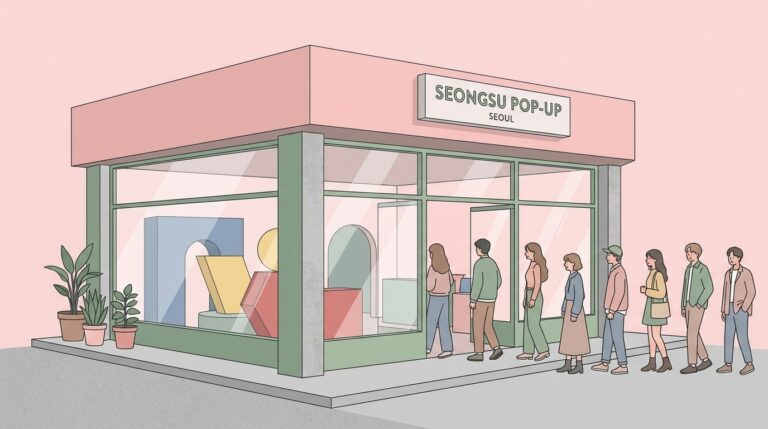
Master the Art of K-Popups: Crafting Immersive Offline Experiences in Seoul (C2 Level)
Phase 1: Empathy (스토리 몰입형 오프닝)
안녕하세요! Your Korean culture navigator and Daily Hangul senior editor is back!
Picture this: You are standing in the middle of Seongsu-dong (성수동), the undisputed mecca of Seoul’s trendiest popup stores. Your brand has spent months prepping a massive offline campaign. The design is sleek, the merchandise is exclusive, and yet, there is a lingering anxiety. You watch local trendsetters—the hipsters of Seoul—glide past your storefront. Some glance in, but they don’t enter. Why?
In Korea’s hyper-saturated marketing landscape, simply having a “cool space” isn’t enough. To truly capture the hearts of Korean consumers, you need to master the art of the 팝업 스토어 (Popup Store) by bridging the gap between digital hype and physical intimacy. Many advanced learners grasp the basic business vocabulary, but they falter when it comes to the high-level cultural nuances—like cultivating inseng-shot (인생샷) backdrops or inducing organic viral loops through subtle behavioral cues.
This guide is curated based on real-world campaigns from top K-Beauty and K-Pop brands. By the end of this post, you’ll not only speak like a C-level executive at a Korean creative agency, but you’ll also understand the exact psychological triggers that make Korean Gen Z queue up for hours in the freezing cold of midwinter Seongsu.
Phase 2: 핵심 표현 3선 심층 분석 (Deep Dive into Core Expressions)
1. 공간을 대변하다 (Gong-gan-eul dae-byeon-ha-da)
- Pronunciation: gong-gan-eul dae-byeon-ha-da (Sounds like “gong-gahn-eul dae-byun-hah-dah”)
- Meaning: To represent/epitomize a space; to visually and sensorially embody a brand’s philosophy through spatial design.
- K-Culture Moment: Used by chief spatial designers in design documentaries (like SBS Special or specialized design magazines) when explaining how Gentle Monster’s surreal installations translate their brand identity into a physical reality.
- Editor’s Insight: While ‘대변하다’ literally means “to speak on behalf of” (advocate), in marketing, it refers to how non-verbal assets—like lighting, scent, and texture—articulate the brand’s core values without a single word of copy.
- Situation Spectrum: Casual (🚫) | Semi-formal (⚠️) | Formal (✅)
- 🤔 Think About It: How does your native language describe the relationship between physical space and brand identity? Is it as active as “speaking on behalf of” the space?
2. 모객 효과를 극대화하다 (Mo-gaek hyo-gwa-reul geuk-dae-hwa-ha-da)
- Pronunciation: mo-gaek hyo-gwa-reul geuk-dae-hwa-ha-da (Sounds like “moh-gaek hyoh-gwah-reul geuk-dae-hwah-hah-dah”)
- Meaning: To maximize the crowd-pulling effect / customer acquisition potential.
- K-Culture Moment: Heard constantly in corporate strategy rooms at CJ ENM or Musinsa when analyzing which K-Pop idol ambassador will bring the longest queue to a weekend popup event.
- Editor’s Insight: ‘모객’ (collecting/attracting guests) is a highly professional marketing term. Unlike the generic ‘손님을 모으다’ (gather customers), ‘모객’ implies a strategic, targeted, and measurable funneling of foot traffic.
- Situation Spectrum: Casual (🚫) | Semi-formal (⚠️) | Formal (✅)
- 🤔 Think About It: In Korean business culture, ‘모객’ is treated as an art form. Why do you think physical crowd size still holds such massive symbolic power in Korea’s highly digitized society?
3. 바이럴을 유도하다 (Ba-i-reol-eul yu-do-ha-da)
- Pronunciation: ba-i-reol-eul yu-do-ha-da (Sounds like “bah-ee-ruhl-eul yoo-doh-hah-dah”)
- Meaning: To induce viral marketing; to trigger organic social media sharing.
- K-Culture Moment: Used by marketing agencies when pitching interactive photo booths (like ‘Life Four Cuts’ style setups) that automatically print a brand-branded keepsake for Instagram uploads.
- Editor’s Insight: Note the verb ‘유도하다’ (to induce/lead). Korean marketers rarely say “make things go viral” (바이럴을 만들다). Instead, they “induce” it, acknowledging that virality is a delicate ecosystem where you gently nudge the consumer rather than force them.
- Situation Spectrum: Casual (⚠️) | Semi-formal (✅) | Formal (✅)
- 🤔 Think About It: Contrast “inducing” virality with “forcing” a share-to-win sweepstakes. Which one aligns better with modern consumer psychology in your country?
Phase 3: 교과서 한국어 vs 진짜 한국어 (Textbook vs. Real-World Korean)
Situation 1: Discussing Instagram-worthy photogenic spots inside the popup
- 📖 Textbook Korean: “여기에 사진을 찍기 좋은 장소를 많이 만듭시다.” (Yeo-gi-e in-saeng-sat-eul geon-jil su in-neun po-in-teu-reul syeol-계합시다.)
- Translation: “Let us create many good places to take photos here.”
- 🗣️ 진짜 한국어 (Real-World C2): “포토존에 인생샷 건질 만한 포인트를 심어서, 자연스러운 인스타 업로드를 유도하는 게 핵심입니다.”
- Translation: “The key is to plant points where people can snag their ‘shot of a lifetime’ (inseng-shot) in the photo zone, thereby inducing natural Instagram uploads.”
- 💡 왜 다를까? (Why the difference?): Textbook Korean uses literal terms like ‘사진 찍기 좋은 장소’. Real-world creative directors use industry idioms like ‘인생샷을 건지다’ (to fish out/snag a lifetime photo) and treat Instagram uploads as a strategic metric.
Situation 2: Explaining a crowded, highly successful event
- 📖 Textbook Korean: “사람들이 아주 많이 와서 성공적인 행사였습니다.”
- Translation: “Many people came, so it was a successful event.”
- 🗣️ 진짜 한국어 (Real-World C2): “오픈런 대기 행렬 덕분에 인산인해를 이루었고, 덕분에 바이럴 루프가 완벽하게 돌았습니다.”
- Translation: “Thanks to the open-run queue, it created a massive human wave (insan-inhae), which perfectly completed the viral loop.”
- 💡 왜 다를까? (Why the difference?): To express “crowded” at a professional level, Koreans use the four-character idiom 인산인해 (人山人海 – mountains and seas of people) paired with modern startup jargon like ‘바이럴 루프’ (viral loop) to show both linguistic depth and industry savvy.
Phase 4: K-Culture 딥다이브 & 비언어적 매너 (Cultural Deep-Dive & Non-verbal Manners)
4-1. The Non-Verbal Art of Spatial “Nunchi” (눈치)
When presenting a popup design in Korea, your physical presentation matters as much as your deck.
* The Visual Pitch: Korean spatial designers rarely pitch with static 2D boards. They use dynamic 3D renderings or miniature physical models. During the pitch, maintain soft eye contact with the decision-makers and use open-handed gestures to “guide” them through the virtual floor plan.
* The Concept of ‘Dong-seon’ (동선 – Flow of Movement): In Korean spatial design, blocking the ‘동선’ is a cardinal sin. When presenting, always demonstrate that you have calculated the exact physical path a customer takes from entry, to photo-taking, to product trial, and finally to checkout. Showing respect for physical comfort is a high form of professional courtesy.
4-2. The Seongsu-dong (성수동) Phenomenon
Seongsu-dong, once a gritty industrial neighborhood of shoemakers, is now the global capital of popups. Brands like Dior, Tamburins, and various K-Pop labels rent out raw, concrete warehouse spaces to create contrasting ultra-luxurious, temporary worlds. Why temporary? The Korean consumer thrives on 희소성 (scarcity) and 트렌드 세터 (trendsetter) culture. If a space is open for only 10 days, it creates an immediate sense of FOMO (Fear of Missing Out). Your marketing deck must always address why this experience must happen now, and why it cannot be replicated online.
Phase 5: 실전 롤플레이 시나리오 (Interactive Roleplay Scenario)
Setting: A chic glass conference room at a creative agency in Gangnam.
Characters:
* You (Ji-won / Marketing Lead): An ambitious marketing strategist looking to launch an eco-friendly beauty popup.
* Director Han (한 부장 / Creative Director): A seasoned, sharp-eyed executive who values brand authenticity over cheap social media tricks.
- Ji-won: “부장님, 이번 성수동 팝업 스토어 기획안입니다. 브랜드의 친환경 가치를 공간 마케팅으로 풀어내고자 했습니다.”
- (Director Han, this is the proposal for the Seongsu-dong popup. We wanted to unravel our brand’s eco-friendly values through spatial marketing.)
- Director Han: “공간 마케팅이라… 이번 콘셉트가 우리 브랜드 아이덴티티를 어떻게 대변할 수 있죠? 그냥 초록색 식물만 가득 채우는 건 곤란해요.”
- (Spatial marketing… How can this concept represent our brand identity? Just filling it with green plants won’t cut it.)
- Ji-won: “
🎭 (Confidence in posture, gesturing to the rendering slide)단순한 디스플레이가 아닙니다. 버려진 폐자재를 재활용한 업사이클링 가구들로만 공간을 구성하여 진정성을 담았습니다.”- (It’s not just a simple display. We designed the space using only upcycled furniture repurposed from waste materials to convey authenticity.)
- Director Han: “음, 진정성은 좋네요. 하지만 결국 팝업은 사람이 와야 하잖아요. 모객 효과를 위한 킬러 콘텐츠는 뭡니까?”
- (Hmm, authenticity is good. But ultimately, people need to show up to popups. What’s the killer content for customer acquisition?)
- Ji-won: “
🎭 (Smiling warmly)성수동 로컬 비건 카페와 협업한 웰컴 드링크, 그리고 나만의 커스텀 에코백을 만들 수 있는 체험형 워크숍을 기획했습니다.”- (We planned a welcome drink in collaboration with a local Seongsu vegan cafe, and an interactive workshop where guests can make their own custom eco-bags.)
- Director Han: “요즘 MZ세대들은 체험한 걸 기록하는 걸 좋아하죠. SNS로 바이럴을 유도할 장치는 있나요?”
- (Young folks these days love recording their experiences. Do we have a device to induce social media virality?)
- Ji-won: “
🎭 (Enthusiastically pointing to the interactive screen)네, 생분해성 영수증 용지에 즉석 사진이 출력되는 카메라 부스를 설치하여 자연스러운 인스타 공유를 이끌어낼 예정입니다.”- (Yes, we will install a camera booth that prints instant photos on biodegradable receipt paper to naturally drive Instagram sharing.)
- Director Han: “좋습니다. 오프라인에서만 경험할 수 있는 확실한 매력이 있네요. 이 방향으로 예산안 구체화해서 다시 보고해 주세요.”
- (Excellent. It definitely has a distinct charm that can only be experienced offline. Please flesh out the budget plan in this direction and report back.)
🔀 Interactive Choice: How would you respond if Director Han suddenly asked to cut the budget for the interactive photo booth?
- Option A: “그럼 포토 부스를 제외하고 일반 포토존으로 대체하겠습니다.” (Then we will exclude the photo booth and replace it with a regular photo zone.)
- Option B: “포토 부스는 핵심 모객 및 바이럴 유도 장치입니다. 대신 디스플레이 소품 비용을 조율하여 예산을 보존하겠습니다.” (The photo booth is a core device for acquisition and virality. Instead, we will preserve the budget by adjusting the display prop costs.)
- Option C: “예산이 부족하다면 팝업 진행 자체를 다시 재고해 봐야 할 것 같습니다.” (If the budget is insufficient, I think we should reconsider running the popup altogether.)
Feedback:
- Best Choice – Option B: Highly professional! You defended a core viral driver (the photo booth) while offering a realistic compromise on non-essential operational costs (props). This shows tactical flexibility and strategic thinking.
- Bad Choice – Option A: Too passive. Giving up your main viral driver easily weakens the overall campaign’s effectiveness. You lose both ‘모객’ and ‘바이럴’ in one go.
- Risk Choice – Option C: Extremely defensive and confrontational. Reconsidered the entire project over one line-item budget cut will damage your working relationship with Director Han.
Phase 6: 10초 감정 섀도잉 드릴 (10-Second Emotion Shadowing Drill)
Practice speaking with the flow, pauses, and exact emotional delivery of a veteran Korean PR lead.
[😊 Proud & Confident]
“이번 / 팝업 스토어는 / 우리 브랜드의 / 철학을 / 온전히 대변하는 / 공간입니다.”
(I-beon / pa-beop seu-to-eo-neun / u-ri beu-raen-deu-ui / cheol-hak-eul / on-jeon-hi dae-byeon-ha-neun / gong-gan-im-ni-da.)- Tip: Pause briefly after ‘브랜드의’ and deliver ‘온전히 대변하는’ with soft but firm emphasis.
[🔥 Ambitious & Strategical]
“단순한 / 전시가 아니라 / 방문객들이 / 스스로 / 인스타 업로드를 / 유도할 수 있게 / 설계했습니다.”
(Dan-sun-han / jeon-si-ga a-ni-ra / bang-mun-gaek-deul-i / seu-seu-ro / in-seu-ta eop-ro-deu-reul / yu-do-hal su it-ge / seol-gye-haet-seum-ni-da.)- Tip: Speed up slightly on ‘방문객들이 스스로’ and punch the words ‘인스타 업로드’ clearly.
Phase 7: K-Culture 미니 사전 (Mini-Dictionary)
- 팝업 성지 (Pa-beop Seong-ji) | The Mecca of Popups
- Meaning: Neighborhoods like Seongsu-dong, Hannam-dong, or Hongdae where popups are constantly launched.
- Usage: “성수동은 이제 명실상부한 팝업 성지로 자리 잡았습니다.” (Seongsu-dong has now established itself as an undisputed popup mecca.)
- 공간 마케팅 (Gong-gan Ma-ke-ting) | Spatial Marketing
- Meaning: A marketing strategy that utilizes physical space to communicate brand values and stimulate sensory experiences.
- Usage: “오프라인 경험을 제공하는 데는 공간 마케팅만한 것이 없습니다.” (There is nothing quite like spatial marketing when it comes to providing offline experiences.)
- 오픈런 (O-peun-reon) | Open Run
- Meaning: The act of waiting in line outside a store before it opens to buy limited-edition items or enter a popular venue.
- Usage: “이번 한정판 굿즈 때문에 새벽부터 오픈런 대기 줄이 길었어요.” (There was a long open-run queue since dawn because of this limited-edition merchandise.)
- 인생샷 (In-saeng-syat) | Shot of a Lifetime
- Meaning: A photograph that turns out exceptionally well, often deemed the best picture one has ever taken.
- Usage: “인테리어가 예뻐서 어디서 찍어도 인생샷이 나오네요.” (The interior is so beautiful that you get a ‘lifetime shot’ no matter where you take it.)
Phase 8: 여행자를 위한 생존 키트 (Survival Kit for Brand Explorers)
Survival Expressions for Visiting Popups in Seoul:
- “대기 줄은 어디에 서나요?” (Dae-gi jul-eun eo-di-e seo-na-yo?)
- Pro Tip: Use this when a popup queue is chaotic and you can’t find the end of the line.
- “현장 예약은 마감되었나요?” (Hyeon-jang ye-yak-eun ma-gam-doe-eon-na-yo?)
- Pro Tip: Many popups in Seoul require online pre-registration, but some accept on-site waiting (현장 대기). This asks if on-site registration is closed.
- “인스타그램 업로드 이벤트 참여하고 싶어요.” (In-seu-ta-geu-raem eop-ro-deu i-ben-teu cham-yeo-ha-go sip-eo-yo?)
- Pro Tip: Use this to claim free merchandise, drinks, or stickers by showing your social media post to the staff.
Editor’s Travel Note:
When hunting for popups in Seoul, the KakaoTalk app is your absolute lifeline. Most popups use a digital queueing system integrated with KakaoTalk. Make sure you have a working Korean phone number (e-SIM or SIM cards with a local number can be purchased at Incheon Airport) so you can receive the queue status notification.
To discover which popups are currently active, we highly recommend checking local trend curation accounts on Instagram like @popupstorego. (Please note: operational schedules and entrance requirements for popups in Seoul can change rapidly based on brand policies; always verify on official brand channels before visiting.)
Phase 9: “한 발 더 깊이” (Deep Insight into Korean Corporate Culture)
In Western marketing, ROI (Return on Investment) is often calculated strictly in direct, immediate conversions or sales. However, in Korea, the success of a popup store is often measured by its 화제성 (Hwa-je-seong – buzzworthiness).
Korean business culture places immense value on “being talked about.” Because of Korea’s high population density and hyper-connected digital infrastructure, word-of-mouth travels at lightning speed. A highly buzzworthy popup might make zero profit on-site, but it elevates the parent brand’s status to “hip,” which implicitly boosts online sales for the next two quarters. Understanding this shift from direct sales to cultural capital is the key to pitching offline campaigns successfully to Korean executives.
💬 Your Turn: Have you ever queued up for a popup store? What made you stand in line? Let us know in the comments below! (한글로 답글을 달아보세요!)
Phase 10: FAQ & 오해 방지 (FAQ & Common Mistakes)
Q: Can we run a popup store in Seoul without a digital pre-registration system?
A: While physically possible, it is highly discouraged. Korean consumers expect seamless digital integration. Without an automated queuing system, you risk long, disorganized lines that block public pathways, leading to complaints from local residents and potential fines from the district office (구청).
Q: Does ‘모객’ (Mo-gaek) apply to digital marketing campaigns as well?
A: While ‘모객’ is occasionally used for webinars or online events, it is most naturally applied to physical, offline gatherings, tourism, or hospitality where physical bodies occupy a space.
Q: Is ‘인생샷’ (Inseng-shot) appropriate to use in a formal marketing presentation?
A: Yes! While it originated as internet slang, it has been fully adopted into the professional lexicon of Korean creative agencies. Using it shows that you understand modern lifestyle trends and consumer desires.
🚨 흔한 실수 (Common Mistakes) 경고판
- Mistake 1: Translating “Create a buzz” literally as “소음을 만들다” (So-eum-eul man-deul-da).
- Correct Action: Use 화제성을 낳다 (Hwa-je-seong-eul nat-da) or 입소문을 내다 (Ip-so-mun-eul nae-da).
- Mistake 2: Saying “팝업을 오픈하다” (Popup-eul opeun-hada) in a formal deck.
- Correct Action: Use the more elegant 팝업 스토어를 론칭하다 (Popup-eureul ron-ching-hada) or 선보이다 (seon-boi-da).
- Mistake 3: Assuming all Korean consumers will wait indefinitely.
- Correct Action: Always provide an interactive wait-time screen or interactive digital games to keep users engaged while they queue.
Phase 11: 액션 미션 & 참여 유도 (Action Mission)
- 🥉 Bronze Mission: Translate this English marketing goal into professional Korean: “Our goal is to maximize customer acquisition in Seongsu-dong next month.” (Hint: Use ‘모객 효과’ and ‘최대화하다’)
- 🥈 Silver Mission: Write a mock Instagram caption for your imaginary eco-friendly brand’s popup store using the word 인생샷 and share it in the comments.
- 🥇 Gold Mission: Pitch a 30-second audio clip of yourself using the Phase 6 Shadowing Drill sentences with correct pauses and email it to us for personalized feedback!
🎮 K-Culture Mission: Watch a video of any recent K-Beauty or K-Pop popup tour on YouTube. Write down how many times you spot people taking photos in areas designed specifically to 바이럴을 유도하다.
Phase 12: 인터랙티브 퀴즈 챌린지 (Interactive Quiz)
1. Which of the following best describes the professional term for “maximizing customer attraction” in Korean marketing?
- A) 고객을 많이 모으기
- B) 모객 효과 극대화
- C) 인산인해 유도
2. True or False: ‘대변하다’ can only be used when a human lawyer speaks for their client.
- True
- False
🔍 Reveal Answers & Explanations
- Correct Answer: B
- Explanation: While ‘A’ is correct in plain speech, ‘모객 효과 극대화’ is the professional, C2-level corporate term used in marketing decks.
- Correct Answer: False
- Explanation: In marketing, non-verbal brand assets like spatial design, lighting, and textures can ‘대변하다’ (speak on behalf of/represent) the brand’s core identity.







