

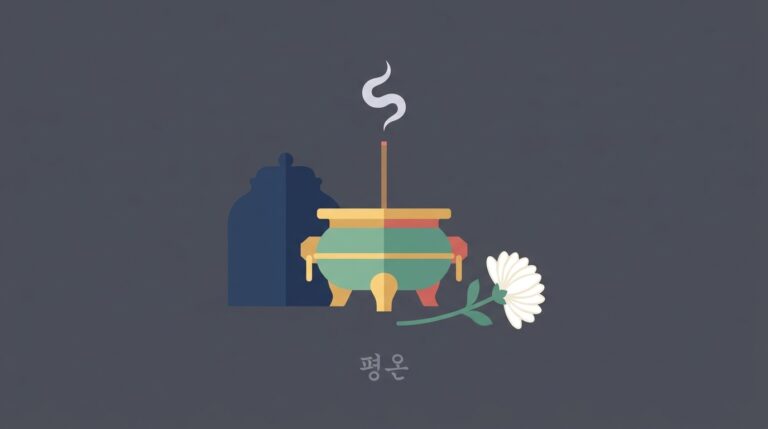
How to Light Incense at a Korean Funeral: A Gentle Guide for Beginners
Phase 1: Empathy (Welcome, Friend!)
안녕하세요! (Annyeonghaseyo!) I’m your Daily Hangul editor and your personal Korean culture companion.
Have you ever watched a K-Drama where the main character visits a funeral hall (장례식장 – jang-rye-sik-jang), stands before the altar with deep sorrow, and carefully lights a thin stick of incense? The room is quiet, filled with the gentle scent of sandalwood, and everyone moves with quiet respect.
If you find yourself attending a Korean funeral to support a friend or colleague, you might feel a sudden wave of anxiety. “What if I do it wrong? How do I hold the incense? How do I put out the flame?” Don’t worry at all! Today, we are going to learn the gentle, respectful art of 향 피우기 (Hyang pi-u-gi – Lighting Incense). It is much simpler than you think, and your Korean friends will be deeply touched by your effort to respect their cultural traditions. Let’s walk through this together, step-by-step.
Phase 2: Top 3 Essential Expressions for a Korean Funeral
As an A1 beginner, you don’t need to speak long, complex sentences. Just knowing these three simple phrases will show immense respect.
1. 삼가 고인의 명복을 빕니다
- Pronunciation: Sam-ga go-in-ui myeong-bo-geul bim-ni-da (Sound analogy: “Sam-gah go-een-wee myung-bo-gool bim-nee-dah”)
- Meaning: “My heartfelt condolences. May the deceased rest in peace.”
- K-Culture Moment: This is the most formal and standard phrase written on funeral wreaths or spoken quietly to the grieving family (상주 – sang-ju).
- Editor’s Insight: Although it looks long, it is a set phrase. You don’t need to break down the grammar; just memorize it as one warm, respectful sentence.
- Situation Spectrum: Casual: 🚫 | Semi-formal: ⚠️ | Formal: ✅
- 🤔 Think About It: In your home country, what is the most common phrase you say to someone who is grieving? How does it compare to wishing peace for the soul of the deceased?
2. 향을 피우다
- Pronunciation: Hyang-eul pi-u-da (Sound analogy: “Hyang-ool pee-oo-dah”)
- Meaning: To light incense (Literally: “to bloom incense”).
- K-Culture Moment: When you enter the memorial room, a helper might whisper: “향 피우시면 됩니다” (Hyang pi-u-si-myeon doem-ni-da – “You may light the incense”).
- Editor’s Insight: Koreans use the verb ‘피우다’ (to bloom/smoke) for incense, comparing the rising smoke to a flower gently blooming in memory of the loved one.
- Situation Spectrum: Casual: ✅ | Semi-formal: ✅ | Formal: ✅
- 🤔 Think About It: Why do you think many cultures use incense or candles during memorials? What does the smoke represent to you?
3. 향로에 넣다
- Pronunciation: Hyang-ro-e neo-ta (Sound analogy: “Hyang-no-eh nuh-tah” – Note: ‘Hyang-ro’ is pronounced as ‘Hyang-no’ due to a natural sound blend!)
- Meaning: To place inside the incense burner.
- K-Culture Moment: After lighting the incense, you carefully place it into the large bronze pot filled with sand/ash.
- Editor’s Insight: Always place it gently. Never drop it or throw it in!
- Situation Spectrum: Casual: ✅ | Semi-formal: ✅ | Formal: ✅
- 🤔 Think About It: Why does Korea use sand or ash in the burner instead of a simple holder? (It symbolizes holding the memory safely and letting the incense stand steady).
Phase 3: Textbook Korean vs. Real Korean
Scenario 1: Greeting the grieving family
- 📖 Textbook Korean: 슬픔을 위로합니다. (Seul-peum-eul wi-ro-ham-ni-da. – “I comfort your sadness.”)
- 🗣️ Real Korean: 삼가 고인의 명복을 빕니다. (Sam-ga go-in-ui myeong-bo-geul bim-ni-da.)
- 💡 Why the difference? While the textbook version is grammatically correct, it sounds a bit unnatural or like a translated book. Real Koreans always use the traditional phrase to express deep, formal respect.
Scenario 2: Asking if you should light incense or lay a flower
- 📖 Textbook Korean: 내가 향을 피웁니까? (Nae-ga hyang-eul pi-um-ni-ka? – “Do I light incense?”)
- 🗣️ Real Korean: 향 피우면 돼요? (Hyang pi-u-myeon dwae-yo? – “Should I light the incense?”)
- 💡 Why the difference? The textbook sentence sounds too aggressive and robotic because of ‘내가’ (I) and the stiff question ending. Using “~면 돼요?” is polite, warm, and natural for an A1 learner.
Phase 4: K-Culture Deep Dive & Non-Verbal Manners
4-1. The Ultimate Golden Rule: NEVER Blow on the Flame!
In Korea, blowing out a flame with your breath is considered extremely disrespectful during memorials or ancestral rites. Your breath is seen as “unclean” in a sacred ritual space.
* How to put out the flame: Gently wave your hand over the burning stick to create a small breeze, or gently shake the incense stick up and down to extinguish the flame.
4-2. The Hand-Support Gesture (The “Left-Hand-Under-Right-Arm” Rule)
When lighting the incense stick with a candle or match, or when placing it in the burner, always use your right hand to hold the incense stick, and place your left hand gently under your right wrist or forearm. This is the universal Korean gesture of polite, respectful giving and receiving.
Phase 5: Interactive Roleplay Scenario
Meet Min-jun (민준), your close Korean colleague. His grandfather has passed away, and you have arrived at the funeral hall (장례식장) to support him. You are standing in front of the memorial altar.
[Scene: A quiet, white-and-black decorated memorial room. Warm candlelight shines on the portrait of Min-jun's grandfather. Min-jun is wearing a black suit with a white armband.]

1. Min-jun: (🎭 Bowing quietly) 와 주셔서 감사합니다.
   (Wa ju-syeo-seo gam-sa-ham-ni-da. / Thank you for coming.)

2. You: (🎭 Giving a comforting look) 삼가 고인의 명복을 빕니다.
   (Sam-ga go-in-ui myeong-bo-geul bim-ni-da. / My condolences. May he rest in peace.)

3. Min-jun: (🎭 Gesturing toward the altar) 향을 피우시겠어요?
   (Hyang-eul pi-u-si-ges-seo-yo? / Would you like to light incense?)

4. You: (🎭 Nodding gently) 네, 향을 피울게요.
   (Ne, hyang-eul pi-ul-ge-yo. / Yes, I will light the incense.)

5. You: (🎭 Picking up one stick of incense with your right hand, supporting your right wrist with your left hand. You light it on the candle.)

6. Min-jun: (🎭 Watching quietly as you gently wave your hand to put out the flame, then place it in the incense burner (향로).)

7. You: (🎭 Stepping back slightly and bowing deeply twice toward the portrait, then bowing once to Min-jun.)

8. Min-jun: (🎭 Bowing back with a soft, grateful smile) 감사합니다. 정말 힘이 되네요.
   (Gam-sa-ham-ni-da. Jeong-mal him-i doe-nae-yo. / Thank you. It really gives me strength.)
🔀 Your Turn! Choose Your Action:
- Option A: You light the incense stick, and then blow on it with your mouth (Whoosh!) to put out the flame quickly.
- Option B: You use your right hand to light the incense, gently wave your hand to put out the flame, and carefully place it in the burner with both hands.
- Option C: You hold the incense stick with your left hand, light it, throw it into the pot, and walk away immediately.
Feedback:
- If you chose A (Risk!): Oh no! Blowing on the flame is a major cultural taboo. Though Min-jun knows you are a foreigner and will forgive you, it might make the surrounding elders gasp! Let’s wave our hands instead next time.
- If you chose B (Best!): Perfect! You showed incredible respect by using both hands and waving out the flame. Min-jun and his family are deeply touched by your manners.
- If you chose C (Bad): Yikes! Using only the left hand and throwing the incense is considered impolite. Always use your right hand with left-hand support, and place it gently!
Phase 6: 10-Second Emotion Shadowing Drill
Let’s practice speaking with the right emotion. At a funeral, keep your voice low, quiet, and warm. Pause at the slashes /.
[🥺 Quiet and comforting]
삼가 / 고인의 / 명복을 / 빕니다.
Sam-ga / go-in-ui / myeong-bo-geul / bim-ni-da.-
[🙏 Polite and gentle]
향을 / 피울게요.
Hyang-eul / pi-ul-ge-yo. -
[👥 Soft and appreciative]
와 주셔서 / 감사합니다.
Wa ju-syeo-seo / gam-sa-ham-ni-da.
Phase 7: K-Culture Mini Dictionary
- 향 (Hyang): Incense. Used to purify the space and connect the physical world with the spiritual world.
- 향로 (Hyang-ro): The incense burner/pot. Pronounced as ‘Hyang-no’ due to Korean pronunciation rules.
- 상주 (Sang-ju): The chief mourner (usually the eldest son or close male relative wearing a black suit with armbands).
- 조의금 (Jo-ui-geum): Condolence money. Placed in a white envelope with your name written vertically on the back.
Phase 8: Traveler’s Survival Kit
Survival Expressions for a Korean Funeral Hall:
- 화장실이 어디예요? (Hwa-jang-sil-i eo-di-yeo-yo?) – “Where is the restroom?” (Funeral halls can be large and confusing; this is a lifesaver!).
- 봉투 주세요. (Bong-tu ju-se-yo.) – “Please give me an envelope.” (If you forgot to bring a condolence money envelope, there is usually a desk with free white envelopes).
- 감사합니다. (Gam-sa-ham-ni-da.) – “Thank you.” (Always say this softly when leaving).
💡 Editor’s Travel Note:
When visiting a Korean funeral, dress in quiet, dark colors (black, navy, or dark grey is best). Avoid colorful patterns, open-toed shoes, or bare legs. If you need to find the funeral hall quickly, download the Naver Map App which provides real-time subway and bus directions directly to the hospital’s funeral parlor (장례식장).
Phase 9:
Frequently Asked Questions (FAQ)
Q: What does "삼가 고인의 명복을 빕니다" mean in Korean and how do you pronounce it?
A: In Korean, "삼가 고인의 명복을 빕니다" is pronounced [Sam-ga go-in-ui myeong-bo-geul bim-ni-da (Sound analogy: "Sam-gah go-een-wee myung-bo-gool bim-nee-dah"] and means: "My heartfelt condolences. May the deceased rest in peace."
Q: What does "향을 피우다" mean in Korean and how do you pronounce it?
A: In Korean, "향을 피우다" is pronounced [Hyang-eul pi-u-da (Sound analogy: "Hyang-ool pee-oo-dah"] and means: To light incense (Literally: "to bloom incense").
Q: What does "향로에 넣다" mean in Korean and how do you pronounce it?
A: In Korean, "향로에 넣다" is pronounced [Hyang-ro-e neo-ta (Sound analogy: "Hyang-no-eh nuh-tah" - Note: 'Hyang-ro' is pronounced as 'Hyang-no' due to a natural sound blend!] and means: To place inside the incense burner.






