

Master the Korean Library Study Room: How to Check In and Book Your Seat Like a Pro
Phase 1: Empathy (Welcome to the Daily Hangul Library Guide! 📚)
안녕하세요! (An-nyeong-ha-se-yo!) I’m your Daily Hangul editor and your personal cultural navigator.
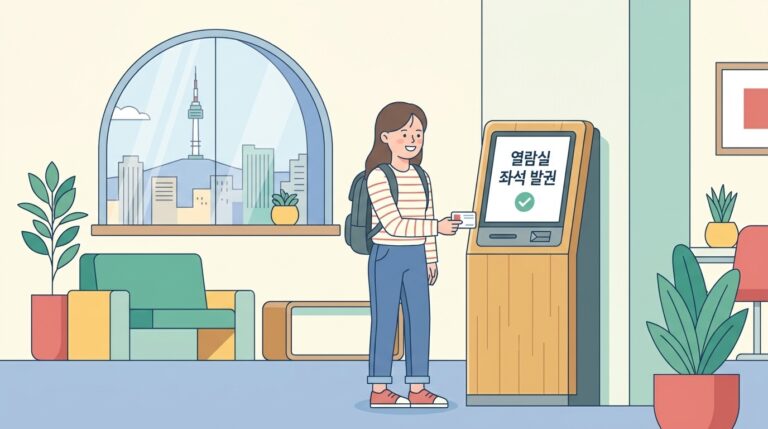
Imagine this: You’ve walked into a gorgeous, modern Korean public library (like the Starfield Library or a local municipal one) determined to spend a productive afternoon studying. You see a row of sleek kiosks with digital screens and students scanning their cards, getting printed slips, and heading into a quiet, cozy study room (열람실 – yeol-lam-sil). You want to join them, but the machine is entirely in Korean, and there is a small queue forming behind you. Your heart beats a little faster. Should you just leave and go to a cafe?
Don’t walk away! Booking a seat in a Korean library is actually a breeze once you know the core patterns. Today, we’re unlocking the exact phrases, cultural manners, and kiosk survival steps so you can reserve your study spot with absolute confidence. This guide is built from real-world questions asked by our intermediate learners who wanted to study alongside local university students. Let’s dive in!
Phase 2: Deep Dive into 3 Key Expressions
1. 좌석을 발권하고 싶어요 (Jwa-seog-eul bal-gwon-ha-go sip-eo-yo)
- Pronunciation: Jwa-seok-eul bal-gwon-ha-go sip-eo-yo (Sounds like “jwa-suck-eul” + “bahl-gwon” + “hah-go ship-uh-yo”)
- Meaning: I would like to issue/get a seat ticket.
- K-Culture Moment: In K-Dramas like Startup or Cheese in the Trap, you often see college students rushing to the library kiosk early in the morning to “ticket” (발권) their favorite study desks during exam week.
- Editor’s Insight: The word 발권 (bal-gwon) literally means “issuing a ticket” (발 – to issue, 권 – ticket). In Korea, you don’t just “sit” in library study rooms; you must “issue a seat ticket” through a digital kiosk first.
- Situation Spectrum:
- Casual: 좌석 발권할래 (⚠️ Only with close friends)
- Semi-formal: 좌석 발권하고 싶어요 (✅ Perfect for asking staff)
- Formal: 좌석을 발권하고자 합니다 (🚫 Too stiff for general use)
- 🤔 Think About It: How does your home country handle library seating? Is it first-come, first-served, or do you have a digital ticketing system like Korea?
2. 이용증을 태그해 주세요 (I-yong-jeung-eul tae-geu-hae ju-se-yo)
- Pronunciation: Ee-yong-jeung-eul tae-geu-hae joo-seh-yo (Sounds like “E-yong-jung-eul” + “tag-gae” + “ju-say-yo”)
- Meaning: Please tag/scan your library card.
- K-Culture Moment: The English word “tag” has been adopted into Korean as 태그 (tae-geu). You’ll hear this on buses, subways, and at library kiosks where you tap your barcode or RFID card.
- Editor’s Insight: 이용증 (i-yong-jeung) is your library user card. If you are a visitor, some libraries allow mobile barcodes via apps, while others require a physical card. Keep this card handy, as you also need to tag it to enter the quiet zone!
- Situation Spectrum:
- Casual: 카드 태그해 (⚠️ Too blunt)
- Semi-formal: 이용증 태그해 주세요 (✅ Standard screen/staff instruction)
- Formal: 이용증을 태그하여 주시기 바랍니다 (✅ Official signboards)
- 🤔 Think About It: Why do you think Korea adopted the English word “tag” (태그) instead of creating a purely Korean word for this action?
3. 좌석 연장해야 돼요 (Jwa-seog yeon-jang-hae-ya dwae-yo)
- Pronunciation: Jwa-seok yeon-jang-hae-ya dway-yo (Sounds like “jwa-suck” + “yuhn-jahng-hae-ya” + “dway-yo”)
- Meaning: I need to extend my seat reservation.
- K-Culture Moment: Library seats in Korea usually have a time limit (typically 3 to 5 hours). If you want to keep studying, you must “extend” (연장) your time at the kiosk before your reservation expires.
- Editor’s Insight: If you forget to extend (연장) your seat, the system automatically releases it, and someone else can book it! A friendly warning: Korean students are very punctual about this.
- Situation Spectrum:
- Casual: 나 자리 연장해야 돼 (✅ Sharing with a study buddy)
- Semi-formal: 좌석 연장해야 돼요 (✅ Asking library staff how to do it)
- Formal: 좌석 연장을 신청하고자 합니다 (🚫 Too formal)
- 🤔 Think About It: How does having a seat time limit affect the studying atmosphere? Does it make people more focused?
Phase 3: Textbook Korean vs. Real-Life Korean
Situation 1: Asking where the booking machine is
- 📖 Textbook: “도서관 열람실 좌석 예약 기계가 어디에 있습니까?” (Where is the library study room seat reservation machine?)
- 🗣️ Real Life: “혹시 좌석 발권기 어디 있어요?” (Excuse me, where is the seat ticketing machine?)
- 💡 Why the difference? Textbook Korean uses long, formal, and compound nouns. Real-life Koreans shorten “seat reservation machine” to just 발권기 (bal-gwon-gi – ticketing machine) and use the friendly, natural “혹시… 어디 있어요?” to soften the question.
Situation 2: Informing a friend you got a seat
- 📖 Textbook: “저는 열람실의 45번 좌석을 예약하였습니다.” (I have reserved seat number 45 in the reading room.)
- 🗣️ Real Life: “나 열람실 45번 자리 잡았어!” (I grabbed seat 45 in the study room!)
- 💡 Why the difference? Real Koreans rarely use 예약 (reservation) or 좌석 (formal word for seat) when talking to friends. Instead, they say 자리 (spot/seat) and use the verb 잡다 (to catch/grab) to mean they secured a spot.
Phase 4: K-Culture Deep Dive & Non-Verbal Manners
4-1. The Silent Library: Nunchi (눈치) and Gestures
When entering a Korean library reading room (열람실), your non-verbal manners are just as important as your language skills.
* The Soft Step: Avoid wearing squeaky shoes or heavy boots. Walking quietly is considered basic respect.
* Keyboard & Mouse Silence: Standard reading rooms are strictly “No Keyboard” zones. If you need to type, look for a specialized “Laptop Room” (노트북실 – no-teu-buk-sil).
* The Apologetic Bow: If you accidentally drop a pen or make a sound, make brief eye contact with the person next to you and do a tiny, silent head-nod (bow) to show you are sorry.
4-2. Culture Code: The Korean Study Café (스터디카페) Phenomenon
If public libraries are fully booked, Koreans head to “독서실” (dok-seo-sil – traditional private study rooms) or the highly popular “스터디카페” (seoteodi-kape – Study Cafes). These are 24/7 paid spaces equipped with high-tech kiosks, free coffee, and ultra-quiet study booths. Knowing how to use a library kiosk prepares you 100% for study cafes too!
Phase 5: Real-Life Roleplay Scenario
Setting: Mapo Municipal Library. You are standing in front of the kiosk, looking slightly confused. A helpful library staff member (NPC: 민우 – Min-woo) notices you and approaches.
- 민우 (Staff): 🎭 Approaching with a warm smile
무엇을 도와드릴까요?
(Mu-eot-eul do-wa-deu-ril-kka-yo? / How can I help you?) - You: 🎭 Pointing at the screen with an embarrassed smile
저기요, 열람실 좌석을 발권하고 싶은데 어떻게 해요?
(Jeo-gi-yo, yeol-lam-sil jwa-seog-eul bal-gwon-ha-go sip-eun-de eo-tteoh-ge hae-yo? / Excuse me, I want to book a study room seat, but how do I do it?) - 민우 (Staff): 🎭 Pointing at the scanner on the machine
아, 먼저 여기에 도서관 회원증을 태그해 주세요.
(Ah, meon-jeo yeo-gi-e do-seo-gwan hoe-won-jeung-eul tae-geu-hae ju-se-yo. / Oh, first please tag your library membership card here.) - You: 🎭 Searching your pockets
혹시 외국인 등록증으로도 회원증 만들 수 있어요?
(Hok-si woe-guk-in deung-rok-jeung-eu-ro-do hoe-won-jeung man-deul su is-seo-yo? / By any chance, can I make a membership card with an Alien Registration Card?) - 민우 (Staff): 🎭 Nodding and pointing to the information desk
네, 가능해요! 안내데스크 가시면 바로 만들어 드려요.
(Ne, ga-neung-hae-yo! An-nae-de-seu-keu ga-si-myeon ba-ro man-deul-eo deu-ryeo-yo. / Yes, it’s possible! If you go to the information desk, they will make it for you right away.) - You: 🎭 Relieved
아, 다행이네요! 그럼 카드 만들고 올게요.
(Ah, da-haeng-i-ne-yo! Geureom ka-deu man-deul-go ol-ge-yo. / Oh, what a relief! Then I will go make the card and come back.) - 민우 (Staff): 🎭 Smiling kindly
네, 카드 발급 받으신 후에 비어 있는 자리를 터치해서 선택하시면 됩니다.
(Ne, ka-deu bal-geub ba-deu-sin hu-e bi-eo in-neun ja-ri-reul teo-chi-hae-seo seon-taek-ha-si-myeon doem-ni-da. / Yes, after you receive the card, you can just touch and select an empty seat.) - You: 🎭 Giving a small bow
친절하게 알려주셔서 정말 감사합니다!
(Chin-jeol-ha-ge al-ryeo-ju-syeo-seo jeong-mal gam-sa-ham-ni-da! / Thank you so much for kindly letting me know!)
🔀 Interactive Choice Point
You got your card and went back to the kiosk, but all the standard seats are taken! What do you do?
* A) “노트북석이라도 괜찮은데, 노트북석은 어떻게 선택해요?” (Is it okay to use a laptop seat? How do I select it?)
* B) “오늘 자리가 아예 없네요. 그냥 갈게요.” (There are no seats at all today. I’ll just leave.)
* C) “남는 자리 생길 때까지 여기서 그냥 기다릴게요.” (I will just wait here until a vacant seat opens up.)
Choice Feedback:
- Best Choice – A: Excellent! Asking for 노트북석 (laptop seats) is a smart alternative. Many libraries separate these, and they often have more vacancies.
- Bad Choice – B: Oh, don’t give up so easily! You can ask the staff if there are other areas, like the open reading room (자료실), which doesn’t require a ticket.
- Risk Choice – C: Waiting around the kiosk can block traffic and feel a bit awkward. It’s better to check the mobile library app to see real-time seat updates!
Phase 6: 10-Second Emotion Shadowing Drill
Practice speaking like a native speaker! Pay attention to the pauses (/) and dive into the emotion.
- [😊 Friendly & Asking for help]
저기요, / 열람실 좌석은 / 어떻게 발권해요?
(Jeo-gi-yo, / yeol-lam-sil jwa-seog-eun / eo-tteoh-ge bal-gwon-hae-yo?) -
[🥺 Slightly worried/disappointed]
혹시 / 오늘 / 남는 자리 / 없나요?
(Hok-si / o-neul / nam-neun ja-ri / eob-na-yo?) -
[💖 Happy & Grateful]
우와, / 자리 진짜 좋다! / 알려주셔서 감사해요!
(U-wa, / ja-ri jin-cha jo-ta! / Al-ryeo-ju-syeo-seo gam-sa-hae-yo!)
Phase 7: K-Culture Mini Dictionary
- 발권기 (Bal-gwon-gi) | Ticket/Seat Issuing Machine
- Usage: Found near library entrances or study cafes to assign seat numbers and print receipts.
- 노트북실 (No-teu-buk-sil) | Laptop Room
- Usage: A designated space inside libraries where keyboard typing and mouse clicks are allowed.
- 퇴실 (Toe-sil) | Checking Out / Leaving
- Usage: When leaving the library, you must scan your card and press “퇴실” (Check-out) at the machine to release the seat for others.
- 사물함 (Sa-mul-ham) | Locker
- Usage: Perfect for storing heavy books if you plan to visit the library regularly.
Phase 8: Traveler’s Survival Kit
Survival Phrases TOP 3
- 이거 어떻게 써요? (I-geo eo-tteoh-ge sseo-yo?)
- Translation: How do I use this?
- Pro Tip: Use this while pointing at the kiosk if you get stuck on a screen.
- 와이파이 비밀번호가 뭐예요? (Wa-i-pa-i bi-mil-beon-ho-ga mwo-yeo-yo?)
- Translation: What is the Wi-Fi password?
- Pro Tip: Usually posted on the walls or printed on your seat ticket!
- 자리 비워주셔야 할 것 같아요. (Ja-ri bi-wo-ju-syeo-ya hal geot gat-ah-yo.)
- Translation: I think you need to vacate this seat.
- Pro Tip: Say this politely if someone is sitting in the seat you just booked.
Editor’s Travel Note 🗺️
Most public libraries in Seoul require a Seoul Citizen Card or a physical library card. To easily find municipal libraries nearby, download the Naver Map App (네이버 지도). Note: Operating hours and reservation policies can change during public holidays or exam seasons, so it’s always smart to check the library’s website beforehand!
Phase 9:
Frequently Asked Questions (FAQ)
Q: What does "좌석을 발권하고 싶어요 (Jwa-seog-eul bal-gwon-ha-go sip-eo-yo)" mean in Korean and how do you pronounce it?
A: In Korean, "좌석을 발권하고 싶어요 (Jwa-seog-eul bal-gwon-ha-go sip-eo-yo)" is pronounced [Jwa-seok-eul bal-gwon-ha-go sip-eo-yo (Sounds like "jwa-suck-eul" + "bahl-gwon" + "hah-go ship-uh-yo"] and means: I would like to issue/get a seat ticket.
Q: What does "이용증을 태그해 주세요 (I-yong-jeung-eul tae-geu-hae ju-se-yo)" mean in Korean and how do you pronounce it?
A: In Korean, "이용증을 태그해 주세요 (I-yong-jeung-eul tae-geu-hae ju-se-yo)" is pronounced [Ee-yong-jeung-eul tae-geu-hae joo-seh-yo (Sounds like "E-yong-jung-eul" + "tag-gae" + "ju-say-yo"] and means: Please tag/scan your library card.
Q: What does "좌석 연장해야 돼요 (Jwa-seog yeon-jang-hae-ya dwae-yo)" mean in Korean and how do you pronounce it?
A: In Korean, "좌석 연장해야 돼요 (Jwa-seog yeon-jang-hae-ya dwae-yo)" is pronounced [Jwa-seok yeon-jang-hae-ya dway-yo (Sounds like "jwa-suck" + "yuhn-jahng-hae-ya" + "dway-yo"] and means: I need to extend my seat reservation.







