

Phase 1: 공감 (스토리 몰입형 오프닝)
안녕하세요! 매일한글(Daily Hangul)의 수석 에디터이자 여러분의 든든한 한국 문화 네비게이터입니다!
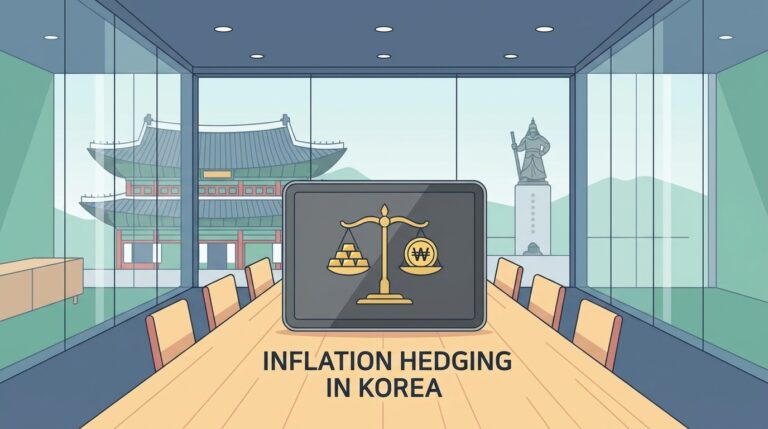
Imagine sitting in a sleek, glass-walled cafe in Yeouido (여의도)—Seoul’s Wall Street—surrounded by intense financial analysts sipping their iced Americanos (아아). You overhear a heated debate about skyrocketing rent in Gangnam and the soaring costs of raw materials. One analyst sighs, “이제는 예적금만으로는 답이 없어요. 진짜 실물자산으로 갈아타야 하나…” (Traditional savings accounts just don’t cut it anymore. Should we pivot to tangible assets?)
When navigating high-level economic discussions in Korean, especially regarding Inflation Hedging Strategies (인플레이션 헤지 전략), textbook vocabulary like ‘물가 상승’ (price rise) just won’t cut it. To truly sound like an expert investor or a seasoned corporate strategist at a C2 level, you need to master the subtle linguistic nuances that Korean finance professionals actually use.
Based on feedback from our advanced learners working in global finance, we’ve crafted this guide to help you transition from merely understanding economic news to leading strategic board discussions in Korean. Let’s dive in!
Phase 2: 핵심 표현 3선 심층 분석
1. 헤지 수단으로 부각되다 (헤지 수단으로 부각되다)
- Pronunciation: [He-ji su-dan-eu-ro bu-gak-doe-da] (Sounds like “Heh-jee soo-dan-eu-ro boo-gahk-dweh-dah”)
- Meaning: To emerge/be highlighted as a hedging instrument.
- K-Culture Moment: You’ll hear this constantly on economic YouTube channels like 3ProTV (삼프로TV) or when discussing whether Bitcoin or K-art pieces are viable alternatives to traditional real estate.
- Editor’s Insight: ‘부각되다’ means to be highlighted or brought to the forefront. Combining it with ‘헤지 수단’ (hedging tool) shows you aren’t just translating “used as a hedge” literally, but speaking with the gravitas of a professional analyst.
- Situation Spectrum: Casual: 🚫 | Semi-formal: ⚠️ | Formal: ✅
- 🤔 Think About It: In your home country, what asset is currently “부각되고” (being highlighted) as the ultimate shield against inflation?
2. 구매력 약화를 상쇄하다 (구매력 약화를 상쇄하다)
- Pronunciation: [Gu-mae-ryeok yak-hwa-reul sang-swae-ha-da] (Sounds like “Goo-meh-ryeok yahk-hwah-reul sahng-shweh-hah-dah”)
- Meaning: To offset/neutralize the weakening of purchasing power.
- K-Culture Moment: Used in heavy-duty K-dramas like Reborn Rich (재벌집 막내아들) where characters plot to preserve their dynastic wealth amidst macroeconomic shifts.
- Editor’s Insight: ‘상쇄하다’ (to offset/cancel out) is a crucial C2-level verb. Instead of the basic ‘막다’ (to block/prevent), ‘상쇄하다’ indicates a sophisticated mathematical equilibrium.
- Situation Spectrum: Casual: 🚫 | Semi-formal: ⚠️ | Formal: ✅
- 🤔 Think About It: How does the concept of ‘상쇄’ reflect the balance-oriented mindset of Korean corporate culture?
3. 실물 자산으로의 자금 유입이 가속화되다 (실물 자산으로의 자금 유입이 가속화되다)
- Pronunciation: [Sil-mul ja-san-eu-ro-ui ja-geum yu-ip-i ga-sok-hwa-doe-da] (Sounds like “Sheel-mool jah-sahn-eu-ro-ee jah-geum yoo-eep-ee gah-sohk-hwah-dweh-dah”)
- Meaning: The influx of capital into tangible/real assets is accelerating.
- K-Culture Moment: Commonly printed in the headlines of Maeil Business Newspaper (매일경제) during real estate bubbles.
- Editor’s Insight: ‘실물 자산’ refers to tangible assets (gold, real estate, commodities) as opposed to ‘금융 자산’ (financial assets). ‘가속화되다’ (to accelerate) adds a dynamic sense of market momentum.
- Situation Spectrum: Casual: 🚫 | Semi-formal: ⚠️ | Formal: ✅
- 🤔 Think About It: Why does Korean society historically place such an incredibly high value on ‘실물 자산’ (especially apartments) compared to other investment vehicles?
Phase 3: 교과서 한국어 vs 진짜 한국어
Situation 1: Discussing market movement during inflation
- 📖 교과서 한국어: 인플레이션 때문에 사람들이 금을 많이 삽니다.
(Because of inflation, people buy a lot of gold.) - 🗣️ 진짜 한국어: 고물가 기조 속에서 안전 자산인 금으로의 자금 쏠림 현상이 두드러지고 있습니다.
(Amidst the high-inflation trend, the concentration of capital into gold, a safe-haven asset, is becoming highly pronounced.) - 💡 왜 다를까?: Textbooks use simple active verbs (‘사다’). Professionals use abstract noun structures like ‘자금 쏠림 현상’ (capital concentration phenomenon) and high-level verbs like ‘두드러지다’ (to stand out/be prominent).
Situation 2: Explaining how to protect asset value
- 📖 교과서 한국어: 돈의 가치가 떨어지는 것을 막아야 합니다.
(We must prevent the value of money from dropping.) - 🗣️ 진짜 한국어: 화폐 가치 하락에 따른 자산 잠식 리스크를 방어해야 합니다.
(We must defend against asset erosion risks resulting from the depreciation of currency value.) - 💡 왜 다를까?: ‘자산 잠식’ (asset erosion/eating away of assets) is the precise financial term used in boardroom strategies, carrying much more urgency than ‘돈의 가치가 떨어지다’.
Phase 4: K-Culture 딥다이브 & 비언어적 매너
4-1. 여의도 비즈니스 매너 (Yeouido Business Manners)
When discussing high-stakes hedging strategies in Korea, non-verbal cues carry immense weight:
* The “Nod of Critical Thinking” (진지한 끄덕임): Do not nod rapidly (which signals casual agreement). Instead, slow, deep nods while maintaining slight eye contact convey that you are deeply analyzing the risk parameters.
* Pen Alignment: During a strategy debate, keeping your tablet or notepad aligned neatly with the edge of the table signifies structured, analytical thinking.
4-2. 문화 코드 분석: The Korean Obsession with “Real” Assets
Why is ‘실물 자산’ (tangible assets) such a hot topic in Korea? Korean economic history is marked by rapid modernization and sudden crises (like the 1997 IMF crisis). This created a cultural collective consciousness that paper money can depreciate overnight, but land and buildings (‘부동산’) never betray you. Hence, the phrase “조물주 위에 건물주” (Above the Creator is the Building Owner) became a famous cultural meme.
Phase 5: 실전 롤플레이 시나리오
Setting: A high-level investment committee meeting room in Gwanghwamun.
Characters:
* 최 상무 (Executive Director Choi): A conservative, risk-averse veteran strategist.
* 지우 (You/C2 Analyst): A brilliant global macro analyst.
- 최 상무: 지우 씨, 최근 인플레이션 압력이 심상치 않아요. 포트폴리오 조정이 시급합니다.
(Ji-woo, the recent inflationary pressure is unusual. Portfolio adjustment is urgent.) - 지우 (Naively): 🎭 [진지한 표정으로 노트를 짚으며] 네, 최 상무님. 화폐 가치 하락에 따른 자산 잠식 리스크가 현실화되고 있습니다.
(Yes, Director Choi. The risk of asset erosion due to the depreciation of currency is materializing.) - 최 상무: 맞아요. 채권 비중을 줄이는 것만으로는 한계가 있어요. 어떤 대안을 보고 있습니까?
(Exactly. Just reducing the bond weight has its limits. What alternatives are you looking at?) - 지우: 🎭 [차트를 가리키며] 원자재와 인프라 펀드가 유효한 헤지 수단으로 부각되고 있습니다. 이쪽으로 자금 유입이 가속화되는 추세입니다.
(Commodities and infrastructure funds are emerging as effective hedging tools. Capital influx is accelerating in this direction.) - 최 상무: 하지만 원자재는 변동성이 너무 크지 않나요? 리스크 관리는 어떻게 할 겁니까?
(But aren’t commodities too volatile? How will you manage the risk?) - 지우: 🎭 [자료를 넘기며] 배당 귀족주를 병행 매수하여 원자재의 변동성을 상쇄하는 하이브리드 전략을 제안합니다.
(I propose a hybrid strategy that offsets commodity volatility by concurrently purchasing dividend aristocrats.) - 최 상무: 흠, 변동성 상쇄라… 일리 있군요. 구체적인 시뮬레이션 데이터를 내일 아침까지 보고해 줄 수 있나요?
(Hmm, offsetting volatility… that makes sense. Can you report the concrete simulation data by tomorrow morning?) - 지우: 🎭 [신뢰감 주는 미소를 지으며] 네, 시나리오별 스트레스 테스트 결과를 포함해 보고서를 준비하겠습니다.
(Yes, I will prepare the report, including stress test results for each scenario.)
🔀 인터랙티브 분기점
최 상무님이 구체적인 시뮬레이션 데이터 보고를 요구했습니다. 당신의 다음 행동은?
- 선택 A: “네, 밤을 새워서라도 완벽한 보고서를 올리겠습니다!” (Overwork appeal)
- 선택 B: “네, 내일 오전 9시 전까지 이메일로 송부해 드리겠습니다.” (Professional execution)
- 선택 C: “지금 바로 제 패드에 있는 러프한 초안이라도 보시겠습니까?” (Impatient push)
[선택지별 피드백]
- 선택 A (Bad): Extreme overwork promises sound desperate rather than professional at a C2 level. Keep it measured.
- 선택 B (Best!): Explicitly stating a clean deadline (before 9 AM) shows professional boundary control and reliable execution.
- 선택 C (Risk): Pushing unfinished drafts to a conservative executive like Choi might look unorganized unless explicitly asked.
Phase 6: 10초 감정 섀도잉 드릴
Train your prosody to sound like an executive. Pay attention to pauses (/) and emotional tone indicators.
[🧐 이성적이고 차분하게]
고물가 기조 속에서 / 자산 잠식 리스크를 / 방어하는 것이 / 최우선 과제입니다.
(Go-mul-ga gi-jo sok-e-seo / ja-san jam-sik-ri-seu-keu-reul / bang-eo-ha-neun geo-si / choe-u-seon gwa-je-im-ni-da.)-
[💡 통찰력 있게 분석하며]
원자재 투자는 / 인플레이션에 따른 / 구매력 약화를 / 효과적으로 상쇄할 수 있습니다.
(Won-ja-jae tu-ja-neun / in-ple-i-syeon-e tta-reun / gu-mae-ryeok yak-hwa-reul / hyo-gwa-jeok-eu-ro sang-swae-hal su it-seum-ni-da.)
Phase 7: K-Culture 미니 사전
- 헤지 수단 (He-ji Su-dan) | Hedging Instrument
- Historically used in derivative markets, but now universally applied in Korean business when discussing diversifying personal or corporate risk.
- 자산 잠식 (Ja-san Jam-sik) | Asset Erosion
- Literally “assets being eaten away.” Used to describe the silent loss of real monetary value due to negative real interest rates.
- 상쇄하다 (Sang-swae-ha-da) | To Offset
- A highly formal term used in physics, accounting, and business strategies to denote the neutralizing of one force/value by another.
- 실물 자산 (Sil-mul Ja-san) | Tangible Assets
- Real estate, gold, art, and commodities. The holy grail of conservative Korean investment portfolios.
Phase 8: 여행자를 위한 생존 키트
서바이벌 표현 TOP 3
- 혹시 부가세 포함 가격인가요? (Hok-si bu-ga-se po-ham ga-gyeok-in-ga-yo?)
- Pro Tip: Is tax included? Crucial when buying expensive tangible goods or luxury items in high-end stores.
- 영수증 발행해 주세요. (Yeong-su-jeung bal-haeng-hae ju-se-yo.)
- Pro Tip: Please issue a receipt. Necessary for tax write-offs if you are conducting business in Korea.
- 수수료는 얼마인가요? (Su-su-ryo-neun eol-ma-in-ga-yo?)
- Pro Tip: How much is the transaction fee? Essential when exchanging currency or executing swift local asset transfers.
Editor’s Travel Note:
When dealing with corporate trips, use the 국세청 홈택스 for tracking tax invoices. Disclaimer: Financial regulations and tax codes in Korea change frequently; please verify current policies directly on the official platform.
Phase 9: “한 발 더 깊이” (생각 질문)
Korean economic discourse heavily relies on Hanja (Sino-Korean characters). Words like ‘상쇄’ (相殺 – mutually kill/offset) or ‘잠식’ (蠶食 – silkworm eating/encroaching) possess vivid physical metaphors. To speak Korean at a C2 level is to look beyond phonetic sounds and grasp the historic weight embedded in these classical metaphors.
💬 Your Turn: How does your native language metaphorically describe “hedging against inflation”? Does it sound as physical as Korean’s “silkworm eating your assets”? Tell us in the comments!
Phase 10: FAQ & 오해 방지
Q: Is ‘헤지’ (Hedge) understood by ordinary Koreans, or is it strictly for Wall Street?
A: While average citizens might just say ‘분산 투자’ (diversified investment) or ‘위험 대비’ (risk preparation), anyone who reads a basic economic news portal daily knows and uses the loanword ‘헤지’ (Hedge).
Q: Can I use ‘상쇄하다’ in casual situations, like offsetting a bad diet with exercise?
A: You can, but it sounds highly dramatic or dryly humorous. Saying “오늘 피자 먹었으니 운동으로 상쇄해야지” (I ate pizza today, so I must offset it with exercise) sounds like you are treating your body like an corporate balance sheet!
Q: How do I distinguish ‘실물 자산’ from ‘실제 자산’?
A: ‘실물 자산’ strictly refers to tangible/physical assets (property, commodities). ‘실제 자산’ means actual/real assets in terms of verified net worth, which can include liquid digital cash.
🚨 흔한 실수 (Common Mistakes) 경고판
- Incorrect: 인플레이션을 커버하기 위해 금을 삽니다. (Too casual/Konglish)
- Correct Action: 인플레이션 헤지 수단으로 금을 매수합니다. (Sophisticated, native business term)
Phase 11: 액션 미션 & 참여 유도
- Bronze: Read the Phase 6 Shadowing Drill aloud 3 times with perfect professional pauses.
- Silver: Write down your personal hedge strategy in the comments using at least one key expression (e.g., “저는 실물 자산으로의 자금 유입이 중요하다고 생각합니다.”)
- Gold: Watch a 5-minute clip of 삼프로TV on YouTube and spot if they use ‘상쇄하다’ or ‘부각되다’!
Phase 12: 인터랙티브 퀴즈 챌린지
Q1. 빈칸에 가장 알맞은 단어는?
“최근 현금 가치 하락으로 인해, 많은 자산가들이 이를 ( )할 수 있는 실물 자산으로 눈을 돌리고 있다.”
1) 삭감
2) 상쇄
3) 소멸
Q2. True or False?
In professional Korean, ‘자산 잠식’ refers to legally freezing someone’s bank account.
정답 및 해설 보기 (Click to reveal)
Q1 정답: 2) 상쇄 (To offset)
* 해설: 현금 가치 하락을 ‘상쇄’하여 가치 균형을 맞춘다는 맥락이 가장 자연스럽습니다.
Q2 정답: False
* 해설: ‘자산 잠식’은 인플레이션 등으로 인해 자산의 실제 가치가 점차 깎여 나가는 현상을 의미합니다. 법적 동결은 ‘자산 동결’ 또는 ‘압류’라고 합니다.







