

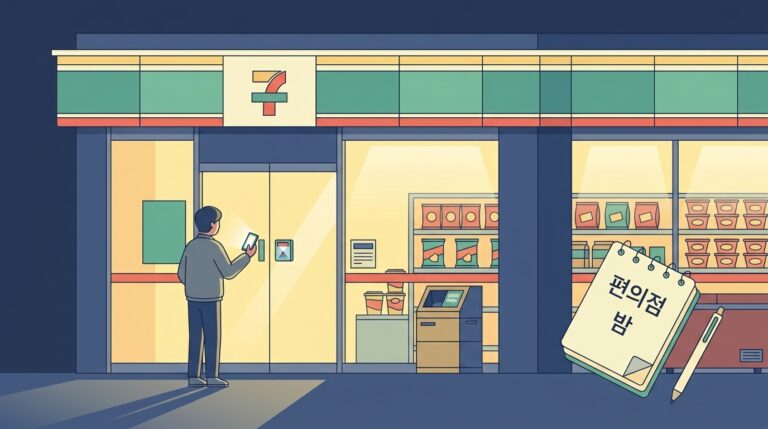
편의점의 무한 변신! How Korean Convenience Stores Became the Ultimate Neighborhood Lifeline
안녕하세요! It’s your friendly neighborhood Korean tutor and editor from 매일한글 (Daily Hangul)! 👋 Have you ever walked into a Korean convenience store (편의점 – pyeon-ui-jeom) just to grab a quick triangle kimbap, only to find someone sending a parcel, another person picking up a pre-ordered luxury item, and someone else paying their utility bills?
If you did, you’ve witnessed firsthand how these 24/7 hubs have evolved from mere snack shops into the absolute lifeline of Korean neighborhood culture (생활 거점 플랫폼). For advanced C2 learners, mastering the linguistic nuances of this hyper-functional space is the ultimate test of cultural fluency. Let’s dive deep into the sophisticated language and cultural codes that power this convenience store revolution!
Phase 2: 핵심 표현 3선 심층 분석 (Deep-Dive into Key Expressions)
To navigate this high-tech, multi-functional hub like a true local, you need to move beyond textbook vocabulary. Here are three sophisticated expressions used in the modern pyeon-ui-jeom ecosystem.
1. 반값택배로 부치다 (Ban-gap-taek-bae-ro bu-chi-da)
- Pronunciation: Ban-gap-taek-bae-ro bu-chi-da (Sounds like “Ban-gapt-teck-beh-ro boo-chee-dah”)
- Meaning: To send a parcel via half-price convenience-store-to-convenience-store delivery.
- K-Culture Moment: In K-Dramas depicting slice-of-life neighborhood scenes, characters selling second-hand items on apps like Danggeun Market (당근마켓) will almost always say, “우편 말고 반값택배로 할게요” (Let’s do half-price delivery instead of regular mail).
- Editor’s Insight: Ban-gap means “half-price.” This system uses the convenience store’s existing logistics trucks that deliver inventory daily, which is why it is incredibly cheap (usually under 2,000 KRW). It requires the recipient to pick up the package at their own local convenience store.
- Situation Spectrum: Casual ✅ | Semi-formal ✅ | Formal ⚠️
- 🤔 Think About It: Why does Korean society favor peer-to-peer hyper-local delivery systems over traditional home delivery? How does this reflect the high density and trust-based community culture of Korea?
2. 편스토랑 출시작 (Pyeon-seu-to-rang chul-si-jak)
- Pronunciation: Pyeon-seu-to-rang chool-shee-jak (Sounds like “Pyeon-suh-toh-rang chool-shee-jack”)
- Meaning: A product released on the market through a convenience store cooking survival show.
- K-Culture Moment: Walking down the aisle, you’ll see stickers on food containers saying “편스토랑 우승 상품” (Convenience Store Cooking Show Winner). These are highly sought-after gourmet collaborations.
- Editor’s Insight: A portmanteau of “Convenience Store” (Pyeon-ui-jeom) and “Restaurant” (Res-to-rang). It signifies how convenience store food has transitioned from “cheap emergency meals” to “gourmet culinary trends.”
- Situation Spectrum: Casual ✅ | Semi-formal ✅ | Formal 🚫
- 🤔 Think About It: How does the gamification of food product launches in Korea differ from the food marketing strategies in your home country?
3. 미수령 상품을 찾아가다 (Mi-su-ryeong sang-pum-eul cha-ja-ga-da)
- Pronunciation: Mee-soo-ryeong sang-poom-eul cha-jah-gah-dah
- Meaning: To retrieve/pick up an unclaimed pre-ordered item.
- K-Culture Moment: Used when picking up pre-ordered concert tickets, limited-edition wines, or high-value electronics pre-purchased via convenience store mobile apps (like Pocket CU or Our URI).
- Editor’s Insight: Mi-su-ryeong (미수령) is a formal Hanja-based term meaning “unreceived” or “unclaimed.” Using this term at the counter shows a highly sophisticated level of Korean proficiency compared to just saying “제 물건 찾으러 왔어요” (I came to find my stuff).
- Situation Spectrum: Casual ⚠️ | Semi-formal ✅ | Formal ✅
- 🤔 Think About It: The integration of digital apps with brick-and-mortar convenience stores highlights Korea’s “O2O” (Online-to-Offline) lifestyle. How comfortable are you utilizing offline spaces for online transactions?
Phase 3: 교과서 한국어 vs 진짜 한국어 (Textbook vs. Real-Life Korean)
Situation 1: Asking if a package has arrived
- 📖 교과서 한국어: “제가 주문한 물건이 여기에 도착했습니까?” (Has the item I ordered arrived here?)
- 🗣️ 진짜 한국어: “앱으로 픽업 예약한 거 바코드 보여드리면 되나요?” (Should I show you the barcode for the app pick-up reservation?)
- 💡 왜 다를까? Koreans rarely ask if something “has arrived” because the app sends a push notification with a barcode as soon as it is scanned at the register. Showing the barcode immediately streamlines the process.
Situation 2: Inquiring about promotional products
- 📖 교과서 한국어: “이 과자는 두 개를 사면 하나를 무료로 줍니까?” (If I buy two of these snacks, do you give me one for free?)
- 🗣️ 진짜 한국어: “이거 2플러스1(투플러스원) 행사 적용되는 거죠? 키핑도 돼요?” (This is part of the 2+1 promotion, right? Can I ‘keep’ the extra one on the app?)
- 💡 왜 다를까? Advanced users know about “Keep” or “Keep-ing” (키핑/나만의 냉장고), a revolutionary system where you can digitally save your “+1” promotional item on the store’s app to redeem later at any branch!
Phase 4: K-Culture 딥다이브 & 비언어적 매너 (K-Culture Deep Dive)
4-1. 눈치 (Nunchi) & Spatial Manners
- The Quick Scan: When using multi-functional kiosks (for printing, taxing, or shipping) in a small convenience store, keep an eye on the register queue. If the solo staff member gets busy, step back momentarily. It shows immense nunchi (social wit).
- The Barcode Ready-to-Scan Hand: When picking up a parcel, hold your phone with the barcode facing outward, screen brightness turned to the maximum. It’s a silent sign of respect for the worker’s efficiency.
4-2. Cultural Code: The Evolution of ‘Pyeon-Ui-Jeom’
In Korea, the convenience store is no longer just a commercial space; it is a safety net and public service station. Under the Safety Guard Store (아동안전지킴이집) initiative, lost children or individuals seeking shelter from danger can find refuge inside. Furthermore, during late-night hours, many convenience stores serve as automated medicine dispensers and emergency battery rental hubs. It represents the pinnacle of Korean community reliance and hyper-efficiency.
Phase 5: 실전 롤플레이 시나리오 (Interactive Roleplay Scenario)
Scenario: You are at a busy neighborhood GS25. You need to pick up a “반값택배” (half-price parcel) and buy a gourmet meal kit you reserved on the app, but there’s a slight issue with your barcode.
- NPC: 민우 (Min-woo – overworked but efficient convenience store part-timer)
- 민우: 어서 오세요. GS25입니다. 봉투 필요하세요?
(Welcome to GS25. Do you need a bag?) - You: 🎭 (Politely shaking your head slightly) 아니요, 괜찮습니다. 저… 앱으로 예약한 편스토랑 출시작 도시락 픽업하러 왔는데요.
(No, it’s okay. I… came to pick up the Pyeon-seu-to-rang lunchbox I reserved on the app.) - 민우: 아, 픽업 상품이요? 점포 보관함에 있을 거예요. 예약 바코드 좀 보여주시겠어요?
(Ah, the pickup item? It must be in the store storage. Could you show me the reservation barcode?) - You: 🎭 (Fumbling with your phone) 아, 데이터가 갑자기 안 터지네요. 혹시 휴대폰 뒷번호나 이름으로도 조회가 가능할까요?
(Ah, my cellular data is suddenly not working. By any chance, can you look it up with my phone’s last four digits or my name?) - 민우: 네, 가능합니다. 뒷번호 네 자리랑 성함 말씀해 주세요.
(Yes, that’s possible. Please tell me your last four digits and your name.) - You: 1234에 김민지입니다. 그리고 혹시 제 이름으로 온 반값택배도 같이 수령할 수 있나요?
(It’s 1234 and Kim Min-ji. And can I also collect the half-price parcel that arrived under my name?) - 민우: 아, 반값택배요? 그건 전용 바코드가 꼭 있어야 확인 서명이 넘어가서요. 와이파이 잡아서 바코드 보여주셔야 해요.
(Ah, the half-price parcel? For that, we absolutely need the dedicated barcode to process the confirmation signature. You’ll need to connect to the Wi-Fi and show me the barcode.) - You: 🎭 (Nodding understandingly) 아, 그렇군요! 그럼 와이파이 연결해서 바코드 두 개 다 한꺼번에 보여드릴게요. 잠시만요!
(Ah, I see! Then I’ll connect to the Wi-Fi and show you both barcodes at once. Just a moment!) - 민우: 네, 천천히 하세요. 바코드 찍어주시면 바로 준비해 드릴게요.
(Sure, take your time. Once you scan the barcodes, I’ll get them ready for you right away.)
🔀 Interactive Choice Point
Now, you need to pay for an additional drink, but your mobile pay isn’t working. What do you do?
- Choice A: “죄송한데 카드 단말기에 이 카드를 그냥 꽂아주시면 안 될까요?” (Handing over your physical backup card)
- Choice B: “바쁜데 시간 끌어서 죄송해요. 그냥 다음에 올게요.” (Giving up and walking away embarrassed)
- Choice C: “그럼 이거 일단 키핑(Keep)해 주시고 나중에 결제할게요!” (Asking to ‘keep’ the item on the app without paying first)
💡 Feedback on Your Choice
- Choice A (Best – ⭐⭐⭐⭐⭐): Perfect! Handing over a physical card to be inserted into the reader (ic card insertion) is the fastest backup solution. You resolved the issue smoothly without delaying the queue.
- Choice B (Bad – ⭐⭐): Too passive. Convenience store staff are extremely used to minor tech glitches. There is no need to give up on your delicious meal kit!
- Choice C (Risk – 🚫): Critical error! You cannot “Keep” an item in the app’s digital fridge before making the initial payment at the counter. The transaction must go through first.
Phase 6: 10초 감정 섀도잉 드릴 (10-Second Shadowing Drill)
Practice these natural intonations with real emotions. The / marks represent slight pauses.
- [😊 Friendly & Polite]
- “저/ 반값택배 찾으러 왔는데요,/ 바코드가 여기 있어요.”
- Jeo / ban-gap-taek-bae cha-jeu-reo wat-neun-de-yo, / ba-ko-deu-ga yeo-gi is-seo-yo.
- (I came to pick up a half-price parcel… and here is the barcode.)
- [🥺 Apologetic but clear]
- “죄송해요,/ 데이터가 안 터져서/ 와이파이 좀 연결할게요!”
- Joe-song-hae-yo, / de-i-teo-ga an teo-jyeo-seo / wa-i-pa-i jom yeon-gyeol-hal-ge-yo!
- (Sorry, my data isn’t working, let me connect to the Wi-Fi real quick!)
Phase 7: K-Culture 미니 사전 (Mini-Dictionary)
- 나만의 냉장고 (Na-man-ui Naeng-jang-go) | *Lit.
Frequently Asked Questions (FAQ)
Q: What does "반값택배로 부치다 (Ban-gap-taek-bae-ro bu-chi-da)" mean in Korean and how do you pronounce it?
A: In Korean, "반값택배로 부치다 (Ban-gap-taek-bae-ro bu-chi-da)" is pronounced [Ban-gap-taek-bae-ro bu-chi-da (Sounds like "Ban-gapt-teck-beh-ro boo-chee-dah"] and means: To send a parcel via half-price convenience-store-to-convenience-store delivery.
Q: What does "편스토랑 출시작 (Pyeon-seu-to-rang chul-si-jak)" mean in Korean and how do you pronounce it?
A: In Korean, "편스토랑 출시작 (Pyeon-seu-to-rang chul-si-jak)" is pronounced [Pyeon-seu-to-rang chool-shee-jak (Sounds like "Pyeon-suh-toh-rang chool-shee-jack"] and means: A product released on the market through a convenience store cooking survival show.
Q: What does "미수령 상품을 찾아가다 (Mi-su-ryeong sang-pum-eul cha-ja-ga-da)" mean in Korean and how do you pronounce it?
A: In Korean, "미수령 상품을 찾아가다 (Mi-su-ryeong sang-pum-eul cha-ja-ga-da)" is pronounced [Mee-soo-ryeong sang-poom-eul cha-jah-gah-dah] and means: To retrieve/pick up an unclaimed pre-ordered item.







