

Decoding Your Destiny: The Ultimate Guide to Reading Your New Year’s Fortune (토정비결) in Korea
Phase 1: Empathy (An Immersive Opening)
안녕하세요! (Annyeonghaseyo!) It’s your K-culture navigator and Daily Hangul editor.
Imagine this: It’s the first week of January in Seoul. The chilly winter wind is blowing, but inside a cozy, dimly lit tent in Hongdae or a traditional wooden pavilion in Insadong, there’s a warm, bustling crowd. You see young couples, students, and businessmen alike waiting anxiously to meet a fortune teller. They are there to look up their 토정비결 (Tojeongbigyeol)—Korea’s traditional New Year’s fortune-telling book written by the Joseon scholar To Jeong.
As an intermediate (B2) learner, you might have tried to peek into this world, only to get lost in a sea of complex terms like Saju, Samjae, or Gungap. Maybe you felt intimidated to sit across from a fortune teller (역술가 – Yeoksulga) because you didn’t know how to ask about your career, love life, or health without sounding like a textbook robot.
Today, we are going to change that. Based on real feedback from our Daily Hangul learners who successfully navigated their first fortune-telling sessions in Seoul, this guide will arm you with the exact natural phrasing, cultural nuances, and hidden etiquette you need to unlock your destiny like a true local. Let’s dive in!
Phase 2: Deep Dive into 3 Key Expressions
1. 신년 운세를 보다 (Sin-nyeon un-se-reul bo-da)
- Pronunciation: Sin-nyeon un-se-reul bo-da (Sounds like “sheen-nyeon oon-seh-rule bo-dah”)
- Meaning: To have one’s New Year’s fortune read/told (literally, “to see the New Year’s fortune”).
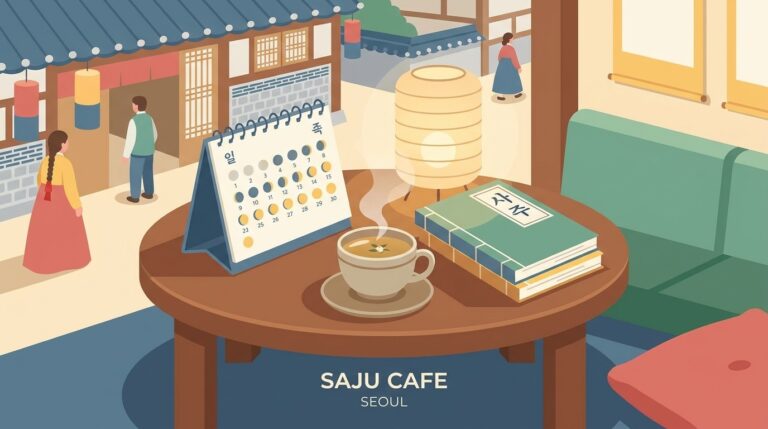
- K-Culture Moment: In K-Dramas, you’ll often see best friends heading to a cozy tent called a Saju Cafe (사주카페) in January to hear if they will finally meet their soulmate or land that dream job this year.
- Editor’s Insight: Koreans use the verb ‘보다’ (to see/watch) for fortunes, much like how we “see” a doctor (진찰을 보다) or “see” an exam (시험을 보다). It implies an active, visual consultation.
- Situation Spectrum: Casual ✅ | Semi-formal ✅ | Formal ⚠️
- 🤔 Think About It: Why do you think looking up fortunes is so deeply integrated into modern, tech-savvy Korean society? How does this compare to how people view astrology or tarot in your home country?
2. 귀인을 만나다 (Gwi-in-eul man-na-da)
- Pronunciation: Gwi-in-eul man-na-da (Sounds like “gwee-een-eul mahn-nah-dah”)
- Meaning: To meet a helper/benefactor (literally, “to meet a noble person”).
- K-Culture Moment: This is the ultimate phrase everyone hopes to hear during a fortune reading! If a fortune teller says, “올해는 귀인을 만날 운세야” (You have the fortune of meeting a benefactor this year), it means someone influential will appear to solve your problems.
- Editor’s Insight: In Korean fortune-telling, success is rarely seen as a solo achievement. It is almost always connected to relationships. A Gwi-in (귀인) could be a new boss, a mentor, or even a friend who introduces you to a great opportunity.
- Situation Spectrum: Casual ✅ | Semi-formal ✅ | Formal ✅
- 🤔 Think About It: How does the concept of a “helper” or “noble person” reflect the relationship-oriented nature of Korean social structures?
3. 삼재를 조심하다 (Sam-jae-reul jo-sim-ha-da)
- Pronunciation: Sam-jae-reul jo-sim-ha-da (Sounds like “sahm-jae-rule jo-sheem-hah-dah”)
- Meaning: To be careful during the three years of misfortune (Samjae).
- K-Culture Moment: If you hear the word Samjae (삼재), don’t panic! It is a traditional belief that every zodiac sign goes through a three-year cycle of minor misfortunes or hurdles every nine years.
- Editor’s Insight: Fortune tellers use this not to scare you, but to advise caution (조심). If you are in Samjae, you might postpone big risks like starting a new business or making hasty investments.
- Situation Spectrum: Casual ✅ | Semi-formal ✅ | Formal ⚠️
- 🤔 Think About It: Is there a concept of cyclic bad luck or a “testing period” in your culture? How do people psychologically prepare for tough times?
Phase 3: Textbook Korean vs. Real-Life Korean
Situation 1: Asking if the fortune is good
- 📖 Textbook Korean: “제 운세가 좋습니까?” (Je un-se-ga jot-seup-ni-ka? / Is my fortune good?)
- 💡 Why is it unnatural? It sounds too stiff, almost like an interrogation or a formal interview.
- 🗣️ Real-Life Korean: “저 올해 대박 날 수 있을까요?” (Jeo ol-hae dae-bak nal su is-seul-kka-yo? / Will I hit the jackpot/be super successful this year?)
- 💡 Why it works: Using the slang 대박 나다 (to hit the jackpot/be wildly successful) shows a friendly, enthusiastic, and highly natural attitude that fortune tellers love to hear!
Situation 2: Asking about career prospects
- 📖 Textbook Korean: “직업 운에 대해 말해주십시오.” (Jig-eob un-e dae-hae mal-hae-ju-sip-si-o. / Please speak about my job fortune.)
- 💡 Why is it unnatural? It sounds like you are ordering a software program to output data.
- 🗣️ Real-Life Korean: “올해 이직이나 승진 운이 있나요?” (Ol-hae i-jik-i-na seung-jin un-i in-na-yo? / Do I have any luck with changing jobs or promotions this year?)
- 💡 Why it works: It specifies practical real-life transitions like 이직 (changing jobs) and 승진 (promotion), making it easier for the teller to give concrete advice.
Phase 4: K-Culture Deep Dive & Non-Verbal Manners
4-1. Nunchi (눈치) & Gestures at the Fortune Teller’s
When you sit down to get your Tojeongbigyeol read, nunchi (the art of reading the room) is key.
* Handing over your birth details: You must provide your birth date and precise birth time (생년월일시 – Saeng-nyeon-wol-il-si). Write these down on a piece of paper beforehand. When handing it to the master, always use two hands as a sign of respect.
* Reaction & Nodding: Fortune tellers respond to energy. Nodding your head (끄덕이기) and letting out soft reactions like “아, 진짜요?” (Oh, really?) or “맞아요” (That’s true) creates a warm flow, prompting them to share deeper insights.
4-2. Cultural Code: Saju (사주) vs. Tojeongbigyeol (토정비결)
While both are based on the lunar calendar and the cosmic elements (wood, fire, earth, metal, water), they serve different purposes. Saju (Four Pillars of Destiny) is your lifetime blueprint based on your birth year, month, day, and hour. Tojeongbigyeol, on the other hand, is a specific annual forecast focused on the upcoming year’s ups and downs. It is a beloved New Year ritual for Koreans of all generations to plan their year ahead!
Phase 5: Real-Life Roleplay Scenario
Characters:
- 유진 (Yujin): An ambitious foreign professional working in Seoul (B2 Korean speaker).
- 도사님 (Dosanim): A warm, experienced fortune-telling master at a Saju Cafe in Insadong.
[Scene: Inside a cozy booth decorated with traditional screens and ink paintings. Tea cups are steaming between them.]

도사님: 자, 생년월일이랑 태어난 시를 여기에 적어봐요.
       (Ja, saeng-nyeon-wol-il-i-rang tae-eo-nan si-reul yeo-gi-e jeog-eo-bwa-yo.)
       [🎭 Handing over a small notepad and a brush-pen.]

유진: 네, 여기 있습니다. 양력으로 적었어요. 시간은 오전 8시 반이에요.
     (Ne, yeo-gi is-seup-ni-da. Yang-ryeok-eu-ro jeog-eos-seo-yo. Si-gan-eun o-jeon yeo-deol-si ban-i-e-yo.)
     [🎭 Carefully handing the paper back with both hands.]

도사님: (Calculates rapidly on a calendar) 올해는 아주 흥미진진하네. 초반에는 고생을 좀 하겠어.
       (Ol-hae-neun a-ju heung-mi-jin-jin-ha-ne. Cho-ban-e-neun go-saeng-eul jom ha-ges-seo.)

유진: 고생이요? 헉, 혹시 제가 올해 삼재인가요?
     (Go-saeng-i-yo? Heok, hok-si je-ga ol-hae sam-jae-in-ga-yo?)
     [🎭 Widening eyes with a look of genuine worry.]

도사님: 하하, 삼재는 아니고! 이동수가 강하게 들어왔어. 혹시 직장을 옮기거나 이사할 계획이 있어?
       (Ha-ha, sam-jae-neun a-ni-go! I-dong-su-ga gang-ha-ge deul-eo-was-seo. Hok-si jik-jang-eul om-gi-geo-na i-sa-hal gye-hoe-gi is-seo?)

유진: 맞아요! 사실 이직을 고민 중인데, 혹시 이직 운이 좋을까요?
     (Ma-ja-yo! Sa-sil i-jik-eul go-min jung-in-de, hok-si i-jik un-i jo-heul-kka-yo?)
     [🎭 Leaning forward, showing intense interest.]

도사님: 가을 쯤에 귀인이 나타나서 도와줄 거야. 걱정 말고 소신껏 밀고 나가 봐요.
       (Ga-eul jjeum-e gwi-in-i na-ta-na-seo do-wa-jul geo-ya. Geok-jeong mal-go so-sin-kkeot mil-go na-ga bwa-yo.)

유진: 우와, 다행이네요! 귀인을 만날 수 있도록 주변을 잘 살펴야겠어요. 감사합니다!
     (U-wa, da-haeng-i-ne-yo! Gwi-in-eul man-nal su it-do-rok ju-byeon-eul jal sal-pyeo-ya-ges-seo-yo. Gam-sa-hap-ni-da!)
     [🎭 Sighing with relief and bowing politely.]
🔀 Interactive Choice Points
If the fortune teller says you have bad luck in the first half of the year, how do you respond?
* A) “제 운명이 너무 슬프네요. 망했어요.” (My destiny is so sad. I’m ruined.)
* Feedback (Bad ❌): Too dramatic! Korean fortune readings are meant to be guides, not ultimate sentences. Saying “I’m ruined” dampens the energy of the session.
* B) “혹시 안 좋은 운을 막거나 조심할 수 있는 방법이 있을까요?” (Is there a way to prevent or be careful of this bad luck?)
* Feedback (Best ): Excellent! This shows a proactive and constructive attitude. The master will often give practical, comforting advice or suggest minor behavioral adjustments.
* C) “에이, 그거 미신이잖아요. 안 믿어요.” (Eh, that’s just a superstition. I don’t believe it.)
* Feedback (Risk ⚠️): Extremely rude. Even if you are skeptical, saying this directly to the practitioner in their workspace is highly disrespectful to their craft.
Phase 6: 10-Second Emotional Shadowing Drill
Practice speaking like a native by injecting real emotion. Use the pauses (/) and emotional cues below!
- [🥺 Worried & Anxious]
- “혹시… / 올해 제가 / 삼재인가요?”
- Hok-si… / ol-hae je-ga / sam-jae-in-ga-yo?
- (Is it possible… / that this year I am / in the three-year bad luck cycle?)
- [😊 Relieved & Excited]
- “우와, 다행이다! / 귀인을 / 만날 운세래요!”
- U-wa, da-haeng-i-da! / Gwi-in-eul / man-nal un-se-rae-yo!
- (Wow, what a relief! / They say my fortune / is to meet a benefactor!)
Phase 7: K-Culture Mini-Dictionary
- 이동수 (I-dong-su): “The energy of movement.” Refers to a period in your life where you are highly likely to move houses, change jobs, or travel abroad.
- 역술가 (Yeok-sul-ga): A professional practitioner of traditional fortune-telling methods like Saju, physiognomy (관상), or palmistry (수상).
- 양력 / 음력 (Yang-ryeok / Eum-ryeok): Solar calendar / Lunar calendar. Most traditional Korean fortune-telling calculations are based on the Lunar calendar (음력).
- 궁합 (Gung-hap): Marital/relationship compatibility. Couples often get their Gung-hap checked before marriage to see how their elemental energies align.
Phase 8: Traveler’s Survival Kit
Survival Phrases TOP 3
- “사주(또는 토정비결) 보고 싶어서 왔어요.”
- Saju (to-neun to-jeong-bi-gyeol) bo-go si-peo-seo was-seo-yo.
- Pro Tip: Say this immediately when entering a Saju Cafe so they can guide you to the right master.
- “올해 연애 운은 어떤가요?”
- Ol-hae yeon-ae un-eun eo-tteon-ga-yo?
- Pro Tip: Use this to ask specifically about your love and relationship life for the year.
- “녹음해도 괜찮을까요?”
- Nok-eum-hae-do gwan-chan-eul-kka-yo?
- Pro Tip: Reading terminologies can be fast and complex. Most masters gladly let you record the audio so you can listen back and study the Korean terms later!
Editor’s Travel Note
To find authentic Saju Cafes in Seoul, open the 네이버 지도 (Naver Map) app and search for “사주카페” (Saju Cafe) or “사주 타로” (Saju Tarot) in vibrant districts like Hongdae (홍대), Sincheon (신촌), or Insadong (인사동). Many modern Saju Cafes now offer services with English or Japanese translation sheets, making them extremely friendly for global travelers! (Note: Pricing typically ranges from 20,000 KRW to 50,000 KRW; cash or bank transfer is highly preferred.)
Phase 9: “One Step Deeper” (Cultural Reflection)
In many Western cultures, seeking a fortune teller might carry a mysterious, slightly taboo, or deeply occult connotation. In Korea, however, going to a Saju Cafe is a casual, social, and therapeutic activity. It functions almost like a communal counseling session.
When young Koreans face extreme job market pressures or relationship struggles, they don’t just seek answers to find out the absolute “future”; rather, they go to seek comfort (위로). Hearing a warm master say, “Your energy is currently weak, but it will bloom beautifully in two years,” provides a psychological safety net. It reflects the deeply rooted Korean value of endurance (Jeong and resilience) through communal hope.
💬 Your Turn:
Do you think knowing your “destiny” makes life more exciting or less exciting? Would you ever visit a Saju cafe in Seoul? Share your thoughts in the comments below!
Phase 10: FAQ & Common Mistakes
Q: Do I need to know my exact time of birth?
A: Yes! While you can get a general reading with just your birth date, the birth hour and minute (태어난 시) are crucial for calculating the precise “four pillars” (Saju). Try asking your parents for your birth certificate details before booking a session.
Q: Is Saju related to shamanism or spirits?
A: No. Saju and Tojeongbigyeol are based on Eastern philosophy, astronomy, and statistical cosmic patterns compiled over thousands of years. It is considered an academic discipline (역학 – Yeokhak), whereas shamanic fortune-telling (신점 – Sinjeom) involves a spiritual medium.
Q: Can I go to a Saju cafe alone?
A: Absolutely! While many go with friends or partners for fun, going alone is highly respected and allows for a more personal, deep counseling session without distractions.
🚨 Common Mistakes Alert!
- Mistake: Confusing Lunar (음력) and Solar (양력) calendar birthdates.
- Correct Action: Make sure to tell the master, “양력이에요” (It’s solar calendar) or “음력이에요” (It’s lunar calendar) so they run the correct formulas.
- Mistake: Taking negative predictions too literally and getting deeply depressed.
- Correct Action: Treat the advice as a weather forecast. If they say “it will rain (bad luck),” simply pack an umbrella (be cautious) rather than cancelling your trip altogether.
- Mistake: Speaking in overly formal, military-style Korean.
- Correct Action: Saju masters prefer a warm connection. Use conversational, polite endings like -요 (e.g., “~있나요?”, “~궁금해요”) to build natural rapport.
Phase 11: Action Mission & Engagement
🏆 Your 3-Step Action Mission
- Bronze (Solo Practice): Write down your birth year, month, day, and time in Korean characters (e.g., “1995년 7월 12일 오후 2시 15분, 양력”).
- Silver (Share with Us): Comment below using one of today’s key expressions: “올해 제 목표는 [career/personal goal] 인데, 귀인을 만나면 좋겠어요!”
- Gold (Real-world Challenge): Next time you watch a K-Drama and a character mentions getting their fortune read, take a screenshot or write down the phrase they used, and tag us on Instagram
@DailyHangul!
🎮 K-Culture Mission:
Find a clip of a Korean variety show (like Running Man or Knowing Bros) during their “New Year Special” episodes. They almost always invite a fortune teller to read the members’ fortunes. Listen closely for the word 삼재 (Samjae) or 대박 (Daebak)!
Phase 12: Interactive Quiz Challenge
Test your knowledge of Korean fortune culture!
1. Situational Judgment
If a fortune teller tells you that “올해 이동수가 있네요,” what should you prepare for?
* A) Getting sick
* B) Moving houses or changing jobs
* C) Meeting a marriage partner
2. Fill in the Blank
“올해는 안 좋은 일들을 피하기 위해 매사에 ________해야 해요.”
(This year, to avoid bad things, you must be cautious in everything.)
* Choice: 귀인 (Gwi-in) / 조심 (Jo-sim) / 이동수 (I-dong-su)
3. True or False?
Tojeongbigyeol is a lifetime blueprint reading, while Saju only analyzes the fortune of one specific year.
* True / False
🎉 Click here to see the Answer Key & Explanations!
- Answer: B
- Explanation: 이동수 (I-dong-su) literally refers to the luck/energy of movement, meaning relocating or changing career environments.
- Answer: 조심
- Explanation: 조심하다 (to be cautious) is the essential verb paired with warning fortunes.
- Answer: False
- Explanation: It is the exact opposite! Saju is your lifetime cosmic blueprint, while Tojeongbigyeol is a specialized yearly forecast for the New Year.







