

Master the Korean Bank: How to Ask for the Best Savings Rates Like a Local!
Phase 1: Empathy (Your Korean Bank Adventure Awaits!)
안녕하세요! (Annyeonghaseyo!) It’s your Favorite Korean Editor from Daily Hangul here!
Imagine this: You’ve been living in Korea for a few months. You’re working hard, enjoying your Han River picnics, and sipping your daily iced Americano. But then you look at your Korean bank account and think, “My money is just sitting here doing nothing. I want to grow it!”
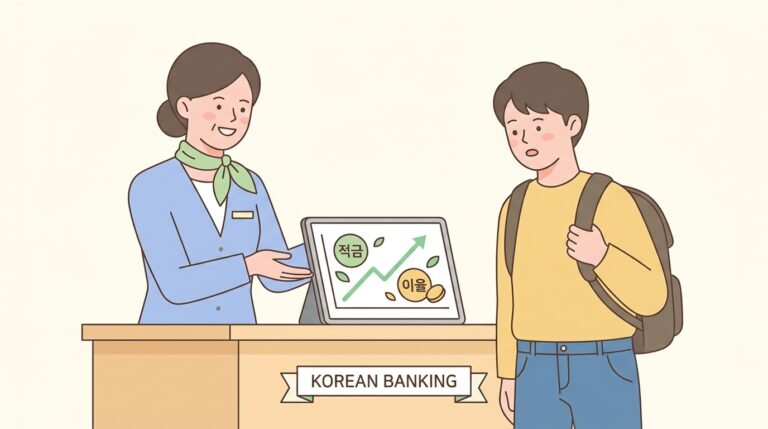
You walk into a sleek, busy Korean bank. The air is cool, the queue machine is buzzing, and the digital screens are flashing numbers like 적금 (Jeok-geum – installment savings) and 이율 (I-yul – interest rate). Suddenly, your mind goes blank. How do you ask the teller for the highest-paying savings account without sounding like a textbook robot?
Many of our intermediate learners tell us, “I know basic Korean, but talking about money makes me so nervous!” Don’t worry. Today, we are going to unlock the exact, natural phrases that Korean young professionals use to get the best interest rates. By the end of this guide, you’ll walk into any bank in Seoul with total confidence! Let’s dive in! 💸
Phase 2: Deep Dive into 3 Key Expressions
Let’s master the three most critical expressions you need to ask for high-interest savings products.
1. 이율이 제일 높은 적금 상품이 뭐예요? (I-yul-i je-il nop-eun jeok-geum sang-pum-i mwo-yeo-yo?)
- Pronunciation: Ee-yool-ee je-eel nope-eun jeok-geum sang-poom-ee mwo-yeo-yo? (Sounds like “Ee-yool-ee” + “jey-ill” + “no-pun”…)
- Meaning: “What is the savings product with the highest interest rate?”
- K-Culture Moment: You often hear young characters in K-Dramas (like the hardworking characters in Fight for My Way or Start-Up) asking this exact question at the bank counter to secure their hard-earned cash.
- Editor’s Insight: 적금 (Jeok-geum) refers to installment savings (where you deposit a set amount monthly), whereas 예금 (Ye-geum) is a lump-sum deposit. If you want to build a habit of saving monthly, ask for Jeok-geum!
- Situation Spectrum: Casual: ⚠️ | Semi-formal: ✅ | Formal: ✅
- 🤔 Think About It: In Korean culture, saving money diligently is highly respected. Why do you think Korean banks offer so many different specialized “themed” savings accounts compared to your home country?
2. 요즘 금리가 가장 좋은 상품으로 추천해 주세요. (Yo-jeum geum-ri-ga ga-jang jo-eun sang-pum-eu-ro chu-cheon-hae ju-se-yo.)
- Pronunciation: Yo-jeum geum-ree-ga gah-jahng jo-eun sang-poom-eu-ro choo-cheon-hae joo-sey-yo.
- Meaning: “Please recommend a product with the best interest rate these days.”
- K-Culture Moment: This is the ultimate “adulting” phrase. Saying 금리 (Geum-ri – interest rate) instead of just 이율 (I-yul) makes you sound incredibly fluent and financially savvy.
- Editor’s Insight: 요즘 (Yo-jeum) means “these days.” Interest rates change constantly, so adding Yo-jeum tells the bank clerk you are looking for the most current, competitive deals.
- Situation Spectrum: Casual: 🚫 | Semi-formal: ✅ | Formal: ✅
- 🤔 Think About It: Koreans love recommendations (추천 – chu-cheon). Instead of researching everything beforehand, it is very common to ask experts directly for their recommendations.
3. 우대 금리를 받으려면 어떤 조건이 필요해요? (U-dae geum-ri-reul bad-eu-ryeo-myeon eo-tteon jo-geon-i pil-yo-hae-yo?)
- Pronunciation: Oo-dae geum-ree-reul bah-deu-ryeo-myeon eo-tteon jo-geon-ee peel-yo-hae-yo?
- Meaning: “What conditions are needed to receive a preferential (bonus) interest rate?”
- K-Culture Moment: Korean banks often offer “bonus” interest rates if you use their bank card, set up auto-pay, or even walk a certain number of steps daily!
- Editor’s Insight: 우대 금리 (U-dae geum-ri) is the magic word here. It means “preferential/special interest rate.” Asking about this can boost your interest rate significantly!
- Situation Spectrum: Casual: 🚫 | Semi-formal: ✅ | Formal: ✅
- 🤔 Think About It: How do banks in your country incentivize clients? Do they have unique conditions like Korea’s “walking challenge” savings accounts?
Phase 3: Textbook Korean vs. Real-Life Korean
Let’s compare stiff, textbook sentences with what natives actually say to sound natural and friendly.
Situation 1: Asking for a high-interest product
- 📖 Textbook Korean: 고이율 적금 상품을 보여주십시오. (Go-i-yul jeok-geum sang-pum-eul bo-yeo-ju-sip-si-o.)
- Translation: “Please show me high-interest installment savings products.” (Sounds like a robot from a 1990s instructional tape!)
- 🗣️ Real-Life Korean: 요즘 제일 잘 나가는 적금 추천해 주실 수 있나요? (Yo-jeum je-il jal na-ga-neun jeok-geum chu-cheon-hae ju-sil su in-na-yo?)
- Translation: “Could you recommend the most popular savings product these days?”
- 💡 Why the difference? 잘 나가는 (jal na-ga-neun) means “best-selling” or “most popular.” It sounds friendly, modern, and instantly builds rapport with the bank teller.
Situation 2: Asking if there are extra interest benefits
- 📖 Textbook Korean: 이자율을 더 올려주는 방법이 존재합니까? (I-ja-yul-eul deo ol-ryeo-ju-neun bang-beop-i jon-jae-hap-ni-ka?)
- Translation: “Does a method exist to raise the interest rate higher?” (Too dramatic and academic!)
- 🗣️ Real-Life Korean: 금리 더 받을 수 있는 우대 조건 같은 게 있을까요? (Geum-ri deo bad-ul su in-neun u-dae jo-geon gat-eun ge is-seul-kka-yo?)
- Translation: “Is there any preferential condition to get a higher interest rate?”
- 💡 Why the difference? Using 같은 게 있을까요? (…gat-eun ge is-seul-kka-yo?) softens the question, making it sound polite yet natural, which is a key trait of Korean social communication.
Phase 4: K-Culture Deep Dive & Non-Verbal Manners
4-1. The Art of “Bank Manners” (은행 예절)
When you walk up to a bank teller in Korea, non-verbal cues are just as important as the words you use.
* The Soft Nod: When you sit down, give a polite, slight head bow and say “안녕하세요 (Annyeonghaseyo)” with a smile.
* Handling Documents: If the teller hands you a document or a tablet to sign, receive it with both hands. This is a crucial sign of respect in Korean culture.
* Eye Contact: Keep polite eye contact, but don’t stare too intensely. Nod gently to show you are following along with their explanation of terms and conditions.
4-2. The “App-Tech” (앱테크) Craze
In Korea, savings aren’t just about passive interest; they are part of App-Tech (App + Technology), a massive trend among Korean millennials and Gen Z. Many banks offer high-interest rates through their mobile apps if you complete daily missions. For example, some accounts give you a bonus 1% interest if you walk 10,000 steps a day or log in every morning. Asking about app-linked products makes you look like a true trend-conscious local!
Phase 5: Real-Life Roleplay Scenario
Let’s practice! You are sitting at the counter of “Daehan Bank” (대한은행). Your helpful bank teller is Min-ji (민지).
- Scenario: You want to open a high-interest installment savings account.
👤 Min-ji (Teller): 고객님, 오늘 어떤 업무 도와드릴까요?
(Go-gaek-nim, o-neul eo-tteon eop-mu do-wa-deu-ril-kka-yo?)
"Valued customer, how may I help you today?"
🙋♂️ You: 저, 요즘 이율이 제일 높은 적금 상품 추천받으러 왔어요.
(Jeo, yo-jeum i-yul-i je-il nop-eun jeok-geum sang-pum chu-cheon-bad-eu-ro was-seo-yo.)
"Uh, I came to get a recommendation for the savings product with the highest interest rate these days."
👤 Min-ji: 아, 적금 상품이요! 마침 이번 달에 새로 나온 고금리 상품이 있어요.
(A, jeok-geum sang-pum-i-yo! Ma-chim i-beon dal-e sae-ro na-on go-geum-ri sang-pum-i is-seo-yo.)
"Ah, a savings product! Actually, we have a new high-interest product that came out this month."
🙋♂️ You: 와, 정말요? 기본 금리는 어떻게 돼요?
(Wa, jeong-mal-yo? Gi-bon geum-ri-neun eo-tteoh-ge dwae-yo?)
"Wow, really? What is the base interest rate?"
👤 Min-ji: 기본 금리는 연 3.5%인데요, 우대 금리 조건이 아주 좋습니다.
(Gi-bon geum-ri-neun yeon sam-jeom-o-pro-in-deu-yo, u-dae geum-ri jo-geon-i a-ju jo-seub-ni-da.)
"The base interest rate is 3.5% annually, but the preferential conditions are very good."
🙋♂️ You: 우대 금리를 받으려면 어떤 조건이 필요해요?
(U-dae geum-ri-reul bad-eu-ryeo-myeon eo-tteon jo-geon-i pil-yo-hae-yo?)
"What conditions are needed to receive the preferential interest rate?"
👤 Min-ji: 저희 은행 체크카드를 사용하시고, 자동이체를 신청하시면 최대 연 5.5%까지 가능해요.
(Jeo-hui eun-haeng che-keu-ka-deu-reul sa-yong-ha-si-go, ja-dong-i-che-reul sin-cheong-ha-si-myeon choe-dae yeon o-jeom-o-pro-kka-ji ga-neung-hae-yo.)
"If you use our bank's debit card and apply for automatic transfer, you can get up to 5.5% annually."
🙋♂️ You: 조건이 생각보다 간단하네요! 그걸로 신청할게요.
(Jo-geon-i saeng-gak-bo-da gan-dan-ha-ne-yo! Geu-geol-lo sin-cheong-hal-ge-yo.)
"The conditions are simpler than I thought! I'll apply for that one."
🔀 Interactive Choice Points
Now, Min-ji asks you: “How much would you like to transfer to this account every month?” (매달 얼마씩 납입하시겠어요?)
How do you respond?
- Option A: “그냥 마음대로 할게요.” (Geu-nyang ma-eum-dae-ro hal-ge-yo. – “I’ll just do whatever I want.”)
- Option B: “매달 30만 원씩 자동이체 해 주세요.” (Mae-dal sam-sip-man-won-ssik ja-dong-i-che hae ju-se-yo. – “Please set up an automatic transfer of 300,000 KRW every month.”)
- Option C: “돈 없는데 안 하면 안 돼요?” (Don eop-neun-de an ha-myeon an dwae-yo? – “I don’t have money, so can I not do it?”)
Feedback on Your Choice:
- Best Choice (Option B): 🌟 Excellent! This is a clear, realistic amount and explicitly requests automatic transfer (자동이체 – ja-dong-i-che), which helps you secure that 5.5% bonus interest rate!
- Bad Choice (Option A): ⚠️ This sounds slightly rude and uncooperative. Banks need a fixed monthly amount to set up an installment savings (적금) account.
- Risk Choice (Option C): 🚫 If you can’t deposit monthly, 적금 is not for you! You might want to ask for a free savings account (입출금 통장 – ip-chul-geum tong-jang) instead.
Phase 6: 10-Second Emotion Shadowing Drill
Let’s practice speaking with real Korean feelings. Pay attention to the pauses (/) and the emotional cues!
- [😊 Expressing Hope & Curiosity]
저, / 요즘 이율이 / 제일 높은 적금 / 추천받으러 왔어요.
(Jeo… / yo-jeum i-yul-i / je-il nop-eun jeok-geum / chu-cheon-bad-eu-ro was-seo-yo.) -
[😲 Pleasantly Surprised]
와, / 조건이 / 생각보다 / 진짜 간단하네요!
(Wa… / jo-geon-i / saeng-gak-bo-da / jin-jja gan-dan-ha-ne-yo!) -
[🙋♂️ Confident Decision]
네! / 그럼 / 그걸로 신청할게요.
(Ne! / geu-reom / geu-geol-lo sin-cheong-hal-ge-yo.)
Phase 7: K-Culture Mini Dictionary
- 우대 금리 (U-dae Geum-ri) | Preferential Interest Rate
- The extra bonus interest you get on top of the base rate by fulfilling certain bank conditions.
- 자동이체 (Ja-dong-i-che) | Automatic Transfer / Direct Debit
- Setting up your account to automatically send money to your savings account on a fixed date every month.
- 비대면 개설 (Bi-dae-myeon Gae-seol) | Non-face-to-face (Online) Account Opening
- Opening an account via a smartphone app without visiting a physical bank branch.
- 만기 (Man-gi) | Maturity
- The date when your savings plan ends and you get all your money back plus interest! 만기일 (Man-gi-il) is the maturity date.
Phase 8: Survivor’s Kit for Travelers
Survival Phrases TOP 3:
- 대기표 어디서 뽑아요? (Dae-gi-pyo eo-di-seo ppob-a-yo?)
- “Where do I pull a queue ticket?” (Essential for busy Korean banks!)
- 외국인 등록증도 괜찮죠? (Oe-guk-in deung-rok-jeung-do gwaen-chan-cho?)
- “An Alien Registration Card (ARC) is fine too, right?”
- 모바일 앱으로 하고 싶어요. (Mo-ba-il aep-eu-ro ha-go sip-eo-yo.)
- “I want to do it via the mobile app.”
📝 Editor’s Travel Note
Before visiting a branch, make sure to search for the bank on Naver Map (네이버 지도) to check operating hours. Most Korean banks close their doors early at 4:00 PM! Don’t get locked out!
(Note: Bank operating hours may vary by location and are subject to change.)
Phase 9: “Going Deeper” (Cultural Reflection)
In Korea, the concept of saving money diligently is deeply tied to the historical values of the older generation who rebuilt the country’s economy. Today, even though interest rates aren’t as high as they were in the 1980s, young Koreans still gamify savings. Through virtual “moneyboxes” and adorable digital pet-saving apps, saving is treated as a fun daily challenge rather than a boring chore.
💬 Your Turn: How does your home country’s banking culture compare to Korea’s highly digital and gamified banking system? Let us know in the comments below!
Phase 10: FAQ & Common Mistakes
Q: Can I open a high-interest savings account as a tourist?
A: Generally, no. To open a regular savings (적금) account, you need a valid Alien Registration Card (ARC) or domestic residence report. Tourists can usually only exchange money or perform basic transactions.
Q: What is the difference between 예금 (Ye-geum) and 적금 (Jeok-geum)?
A: 예금 is a deposit account where you put in a large lump sum at once. 적금 is an installment account where you save a small amount periodically (usually monthly).
Q: Is it better to open an account in person or via the mobile app?
A: Many banks offer higher 우대 금리 (preferential rates) if you open the account yourself through their mobile app because it reduces their operational costs!
🚨 Common Mistakes Alert!
- Saying “돈을 넣고 싶어요” (I want to put money in) in a formal setting.
- Better: 저축하고 싶어요 (I want to save/invest) or 입금하고 싶어요 (I want to deposit).
- Forgetting to bring physical ID.
- Correction: You must always bring your physical Passport or ARC. Digital copies on your phone are usually not accepted.
- Confusing base interest (기본 금리) with maximum interest (최대 금리).
- Correction: Always ask what the actual base rate is, as the maximum rate often requires complex conditions.
Phase 11: Action Mission!
- Bronze Medal 🥉: Read the Roleplay Dialogue out loud 3 times using the 10-Second Emotion Shadowing Drill.
- Silver Medal 🥈: Open your favorite Korean dictionary app and look up the word 이자 (I-ja – interest).
- Gold Medal 🥇: If you are in Korea, open your banking app (like KakaoBank or Toss) and navigate to the 적금 section to see what their current rates are!
Phase 12: Interactive Quiz Challenge
Test your knowledge below! Click to reveal the answers.
1. Which word refers to “installment savings” where you deposit money monthly?
- A) 예금 (Ye-geum)
- B) 적금 (Jeok-geum)
- C) 환전 (Hwan-jeon)
👉 Click to see the Answer & Explanation
Answer: B) 적금 (Jeok-geum)
Explanation: 적금 is installment savings. 예금 is a lump-sum deposit, and 환전 is currency exchange.
2. True or False: “우대 금리” is the base interest rate that everyone gets automatically.
👉 Click to see the Answer & Explanation
Answer: False!
Explanation: 우대 금리 is the preferential/bonus interest rate you get only if you meet certain conditions (like using a credit card or auto-pay). The base rate is called 기본 금리 (gi-bon geum-ri).







