

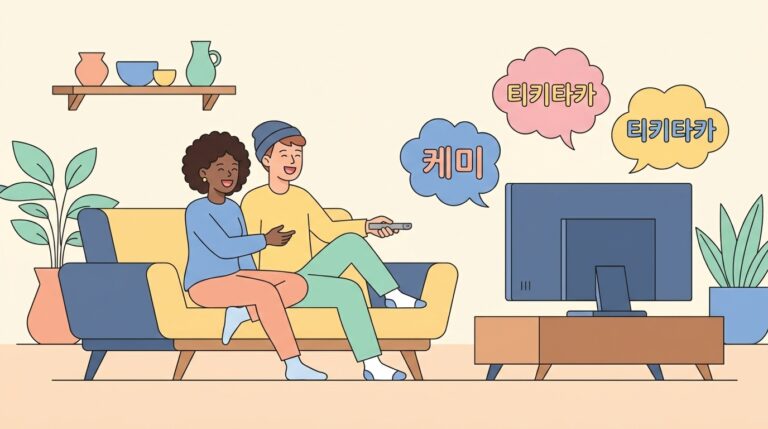
Talk Like a Variety Show Expert: Master the Art of Describing Cast Chemistry (케미)!
Phase 1: Empathy (스토리 몰입형 오프닝)
안녕하세요! It’s your favorite Korean culture navigator and K-editor from Daily Hangul (매일한글)!
Have you ever stayed up until 2 AM watching clips of Running Man (런닝맨), Going Seventeen (고잉 세븐틴), or I Live Alone (나 혼자 산다), laughing your head off not just at the games, but at how the cast members tease, support, and bicker with each other?
You want to jump into the comments section on YouTube or talk with your Korean friends about how amazing their dynamic is. But you find yourself stuck using basic words like “친해요” (They are close) or “재밌어요” (It’s fun). It feels so frustrating when your vocabulary can’t match the explosive energy of Korean entertainment!
Today, we are going to level up your Korean to a solid B2 level by mastering the exact words native speakers use to describe that magical, chaotic, and heartwarming cast chemistry. By the end of this guide, you’ll sound like a seasoned K-variety show critic!
Phase 2: In-Depth Analysis of 3 Key Expressions
Let’s dive into the three most essential expressions to describe cast dynamics. These are the gold standards of Korean entertainment vocabulary!
1. 티키타카가 잘 맞다 (Ti-ki-ta-ka-ga jal mat-da)
- Pronunciation: Tee-kee-tah-kah-gah jahl maht-dah (Think of the quick, rhythmic ticking of a clock, or the Spanish football style ‘tiki-taka’)
- Meaning: High-speed conversational banter; having great verbal chemistry.
- K-Culture Moment: Think of Yoo Jae-suk (유재석) and Lee Kwang-soo (이광수) in Running Man. One starts a ridiculous joke, and the other instantly fires back with an even more ridiculous reaction without a single second of awkward silence.
- Editor’s Insight: Originally from the Spanish football passing style “tiki-taka,” Koreans adopted this to describe fast-paced, witty conversations. If your “티키타카” is good, it means you don’t even need to think; your minds are perfectly in sync.
- Situation Spectrum: Casual ✅ | Semi-formal ✅ | Formal ⚠️
- 🤔 Think About It: In your native language, is there a specific word that describes this fast, rhythmic banter, or do you have to use a longer phrase? How does having a specific word like “티키타카” reflect the fast-paced nature of Korean humor?
2. 케미가 폭발하다 (Ke-mi-ga pok-pal-ha-da)
- Pronunciation: Keh-mee-gah pohk-pahl-hah-dah (Sounds like “chemistry” + “poke-pal” with an energetic ‘ha-da’)
- Meaning: Chemistry is exploding; showing incredible, undeniable synergy.
- K-Culture Moment: When two cast members who are complete opposites (like an extreme introvert and an extreme extrovert) get paired up in a travel show and somehow create the most heartwarming, hilarious friendship of the season.
- Editor’s Insight: “케미” is the shortened Korean slang for “chemistry.” When you add “폭발하다” (to explode), it amplifies the feeling. It means their synergy is so strong that it dominates the entire screen and captivates the audience.
- Situation Spectrum: Casual ✅ | Semi-formal ✅ | Formal 🚫
- 🤔 Think About It: Why do you think Korean variety shows focus so heavily on creating unique pairings (pairs/couples/rivals) rather than just focusing on individual star power?
3. 환상의 티키타카 / 찰떡호흡 (Chal-tteok-ho-heup)
- Pronunciation: Chahl-tteok-ho-heup (Think of the sticky, chewy sound of “Chahl-tteok” + a deep breath “ho-heup”)
- Meaning: Perfect harmony; a match made in heaven (literally “sticky rice cake breathing”).
- K-Culture Moment: When a cooking show duo prepares a complex dish without even talking—one reaches out their hand, and the other instantly passes the salt.
- Editor’s Insight: “찰떡” (chal-tteok) is a super sticky rice cake. “호흡” (ho-heup) means breathing. Put them together, and you get “breathing/working together so closely that you stick like rice cake.” It represents a deep level of mutual trust and seamless teamwork.
- Situation Spectrum: Casual ✅ | Semi-formal ✅ | Formal ✅ (often used in entertainment news articles!)
- 🤔 Think About It: How does comparing teamwork to sticky food (찰떡) show the warmth and relational focus of Korean culture?
Phase 3: Textbook Korean vs. Real-Life Korean
Let’s compare the dry, textbook phrases with the vibrant, natural expressions variety fans actually use!
Situation 1: Describing a funny bickering duo
- 📖 Textbook Korean: “두 사람은 자주 다투지만 친합니다.” (Du sa-ram-eun ja-ju da-tu-ji-man chin-ham-ni-da.)
- Translation: “The two people fight often but are close.” (A bit dry and clinical.)
- 🗣️ 진짜 한국어 (Real-Life): “둘이 투닥거리는 케미가 진짜 꿀잼이에요!” (Dul-i tu-dak-geo-ri-neun ke-mi-ga jin-jja kkul-jaem-i-e-yo!)
- Translation: “The chemistry of those two bickering is seriously so fun!”
- 💡 왜 다를까? (Why is it different?): “투닥거리다” (bickering lightheartedly) and “꿀잼” (extremely fun/sweet honey fun) are colorful, emotional words that capture the playful warmth of variety shows, whereas “다투다” sounds like a serious, unhappy argument.
Situation 2: Praising their comedic timing
- 📖 Textbook Korean: “대화가 아주 빠르게 잘 이어집니다.” (Dae-hwa-ga a-ju bpa-reu-ge jal i-eo-jim-ni-da.)
- Translation: “The conversation flows very quickly and well.” (Sounds like a linguistic analysis.)
- 🗣️ 진짜 한국어 (Real-Life): “대화 티키타카가 장난 아니에요! 오디오가 안 비어요.” (Dae-hwa ti-ki-ta-ka-ga jang-nan a-ni-e-yo! o-di-o-ga an bi-eo-yo.)
- Translation: “Their conversational tiki-taka is no joke! There is never a silent moment (the audio never goes empty).”
- 💡 왜 다를까? (Why is it different?): Variety show fans care about “오디오가 비다” (silent audio, which is a nightmare for editors). Saying “오디오가 안 비어요” is a highly natural, insider way to praise non-stop, entertaining banter.
Phase 4: K-Culture Deep Dive & Non-Verbal Manners
4-1. The Art of ” 리액션 (Reaction)” and Body Language
In Korean variety shows, reaction is just as important as action. When describing chemistry, notice these non-verbal cues:
1. The “Clapping Laugh” (박수치며 웃기): When someone says something funny, Koreans don’t just smile; they often clap their hands rapidly or playfully hit the person next to them. If you see this, you can say, “서로 때리면서 웃는 거 보니까 진짜 친한가 봐요!” (Seeing them hit each other while laughing, they must be really close!)
2. Eye Contact (눈빛 교환): A lot of chemistry is non-verbal. When host A makes a subtle joke and host B instantly catches it with a side-eye or a smirk, that is pure 찰떡호흡 (perfect harmony).
4-2. The “Tom and Jerry” (톰과 제리) Trope in Korean Entertainment
From Family Outing to modern YouTube shows, the “Tom and Jerry” dynamic—where an older, seemingly bossy cast member constantly tries to tease a younger, cleverer member, only to get outsmarted—is a staple of K-variety. This dynamic is the epitome of “혐관 케미” (hate-relationship chemistry), which is actually incredibly affectionate. Koreans love this because it breaks rigid social hierarchies in a safe, comedic space.
Phase 5: Real-Life Roleplay Scenario
Meet Ji-won (지원), a passionate K-variety show fan who runs a fan account. You are talking about last night’s episode of your favorite show.
Cast & Dialogue
- Ji-won: “어제 예능 새로 시작한 거 봤어요? 출연진 조합이 미쳤던데요!” (Did you watch the new variety show that started yesterday? The cast lineup was crazy!)
- You: “아, 진짜요? 저 아직 안 봤는데, 어땠어요?” (Oh, really? I haven’t watched it yet. How was it?)
- Ji-won: “특히 민우랑 수아 케미가 장난 아니에요. 둘이 성격이 완전 반대거든요.” (Especially Min-woo and Soo-ah’s chemistry is no joke. Their personalities are complete opposites.)
- You: “오, 🎭 (Excitedly clapping) 반대라서 더 티키타카가 잘 맞았겠네요!” (Oh, because they are opposites, their bickering banter must have been even better!)
- Ji-won: “맞아요! 민우가 장난치면 수아가 바로 받아치는데, 완전 찰떡호흡이었어요.” (Exactly! When Min-woo plays a prank, Soo-ah fires right back. They had perfect harmony.)
- You: “🎭 (Leaning in) 와, 듣기만 해도 대박이네요. 둘이 분량 다 챙겼겠어요.” (Wow, just hearing about it sounds amazing. They must have stolen the screen time.)
- Ji-won: “네! 진짜 오디오가 쉴 틈이 없더라고요. 꼭 보세요!” (Yes! The audio seriously had no time to rest. You must watch it!)
- You: “오늘 집 가자마자 바로 정주행해야겠어요! 추천 고마워요!” (I should binge-watch it as soon as I get home today! Thanks for the recommendation!)
🔀 Interactive Choice Point
How would you respond if Ji-won asked: “둘 중에 어떤 캐릭터가 더 취향이에요?” (Which of the two characters is more your style?)
- A) “저는 당하는 쪽이 더 귀여워요. 당황할 때 리액션이 재밌잖아요!”
- B) “저는 아무나 상관없어요. 재미만 있으면 돼요.”
- C) “예능은 대본대로 하는 거 아닌가요? 실제 성격은 모르는 거죠.”
🧐 Feedback on your choices:
- Choice A (Best!): Perfect! You showed deep understanding of variety show dynamics by focusing on the “reaction of the one being teased.” This shows great B2 cultural immersion.
- Choice B (Bad): A bit too dismissive. It shuts down the fun conversation and doesn’t showcase your vocabulary.
- Choice C (Risk): Too cynical! Variety shows are built on “entertainment immersion” (몰입). Breaking the magic by mentioning the script too seriously can ruin the lighthearted vibe of the chat.
Phase 6: 10-Second Emotion Shadowing Drill
Practice saying these with the right emotion and rhythmic pauses (/) to sound like a native!
- [😊 Exited & Amazed]
- “둘이 / 티키타카가 / 진짜 미쳤어요!”
- (Dul-i / ti-ki-ta-ka-ga / jin-jja mi-cheost-eo-yo!)
- Translation: The conversational banter between those two is seriously crazy!
- [🥺 Amazed and slightly jealous of their chemistry]
- “어떻게 저렇게 / 호흡이 / 찰떡같이 맞지?”
- (Eo-tteo-ke jeo-reo-ke / ho-heup-i / chal-tteok-gat-i mat-ji?)
- Translation: How can their teamwork/breathing be so perfectly in sync like sticky rice cake?
Phase 7: K-Culture Mini-Dictionary
- 정주행 (Jeong-ju-haeng) | Binge-watching | Originally meant “driving in the correct direction,” but now universally used to mean watching a drama or variety show from episode 1 to the end.
- 분량 (Bun-ryang) | Screen time / Amount | Literally “amount.” In entertainment, it refers to how much a cast member actually appears on screen. If you are funny, you “secure screen time” (분량을 챙기다).
- 억텐 (Eok-ten) | Forced tension/high energy | Short for “억지 텐션” (forced tension). Used when a cast member is fake-laughing or trying too hard to seem excited.
- 찐텐 (Jjin-ten) | Genuine excitement/tension | Short for “진짜 텐션” (real tension). When the cast is genuinely having a blast and laughing for real.
Phase 8: Survivor Kit for Travelers & Show Goers
If you ever go to a live recording of a Korean show in Sangam-dong or want to write a fan letter:
* Survival Phrase 1: “실물이 훨씬 멋있어요!” (Sil-mul-i hwol-ssin meos-iss-eo-yo!) – You look way cooler/prettier in real life!
* Survival Phrase 2: “평생 방송해 주세요!” (Pyeong-saeng bang-song-hae ju-se-yo!) – Please stay on air for the rest of your life!
* Survival Phrase 3: “멤버들 케미가 최고예요!” (Mem-beo-deul ke-mi-ga choe-go-ye-yo!) – The members’ chemistry is the absolute best!
📌 Editor’s Travel Note:
To find out where and when public recordings are happening, or to apply for audience tickets, check out the official SBS 방송 참여 신청 or MBC 예능 방청 신청 pages. Be sure to use a map app like Naver Map to find your way to Digital Media City (DMC) station, where most broadcasting stations are located!
Phase 9: “A Step Deeper” (생각 질문)
In Korean entertainment, the word “우리” (uri – we/our) is extremely powerful. When a variety show succeeds, the cast members often stop referring to themselves as individuals and start calling themselves a “family” (식구/가족). This collective identity is why Korean viewers feel so attached to cast chemistry. We aren’t just watching professionals do a job; we are watching a group of friends build a mini-community on screen. This reflects the deep-rooted Korean value of relational harmony and warmth over pure individualism.
💬 Your Turn: Who is your absolute favorite “K-variety duo” or group, and how would you describe their chemistry using today’s words? Leave a comment below!
Phase 10: FAQ & Common Mistakes
Q: Can I use “케미” (chemistry) to describe my coworkers at an office?
A: Yes! While it started in media, it is now incredibly common to say “우리 부서 사람들이랑 케미가 잘 맞아요” (I have great chemistry with the people in my department) in casual work environments.
Q: Is “티키타카” rude to use with older people?
A: Because it is slang, avoid using it to your boss in a formal presentation. However, in a lighthearted team dinner (회식), saying “부장님이랑 저랑 티키타카가 잘 맞는 것 같습니다!” can actually make you sound very charming and witty.
Q: What is the difference between “찰떡호흡” and “티키타카”?
A: “티키타카” focuses heavily on verbal banter (talking fast and wittily). “찰떡호흡” is broader; it can be used for physical teamwork, dancing, working, or cooking together without even speaking.
🚨 The “Common Mistakes” Warning Board
- Using “케미스트리” instead of “케미”: Saying “그 둘은 케미스트리가 좋아요” sounds a bit too scientific. Always use the shortened “케미” for variety/drama contexts.
- Saying “오디오가 조용해요”: To describe a boring show with no talk, don’t say “the audio is quiet.” Use “오디오가 비어요” (the audio is empty/blank).
- Using “찰떡” for everything: “찰떡” means sticky rice cake. Only pair it with words like “호흡” (찰떡호흡) or “궁합” (찰떡궁합 – perfect match). Saying “우리는 찰떡이에요” on its own sounds incomplete.
Phase 11: Action Mission!
- 🥉 Bronze Mission: Open YouTube, search for your favorite variety show, and write down one moment where the cast had a great “티키타카” moment.
- 🥈 Silver Mission: Share this post on your social media with the hashtag
#DailyHanguland name your favorite Korean variety duo. - 🥇 Gold Mission: Next time you comment on a YouTube video of a Korean show, write: “이 둘 티키타카 진짜 꿀잼ㅋㅋㅋ 오디오가 안 비네요!” (The banter between these two is so fun, no quiet moments lol) and see if other fans like your comment!
Phase 12: Interactive Quiz Challenge!
Test your knowledge! Can you get 3/3?
1. Which word best describes “perfect teamwork that sticks together like rice cake”?
- A) 억텐
- B) 찰떡호흡
- C) 오디오
2. Fill in the blank: “이 두 사람 대화
가 장난 아니에요! 한 마디도 안 지네요.”
* A) 정주행
* B) 티키타카
* C) 식구
3. True or False: “혐관 케미” means two cast members genuinely hate each other and refuse to film together.
- True / False
🎉 Click here to reveal the answers and explanations!
- Answer: B) 찰떡호흡 (Perfect sticky-rice-cake harmony!)
- Answer: B) 티키타카 (Tiki-taka fits perfectly because the sentence describes “not losing a single word in a conversation.”)
- Answer: False! “혐관 케미” (hate-relationship chemistry) is a playful, entertaining bickering dynamic (like Tom and Jerry) that viewers find highly affectionate and fun to watch. They actually love filming together!







