

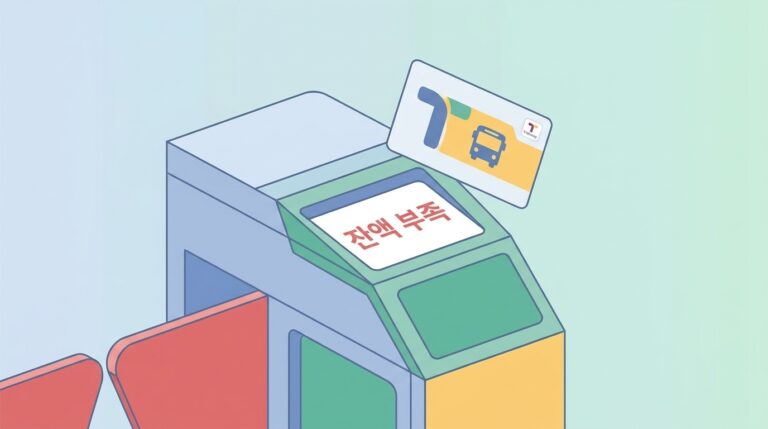
Uh-Oh, My T-Money Card is Empty! How to Handle “Insufficient Balance” on Korean Subways Like a Local
Phase 1: Empathy (An On-the-Scene Korean Subway Drama)
Annyeonghaseyo! (안녕하세요!) Your Daily Hangul editor is here to save your day!
Imagine this: You’re in Seoul, rushing to catch a train to meet your friends in Hongdae. You hear the rhythmic ding-dong of the approaching subway train. You confidently tap your sleek T-Money card at the turnstile, expecting a cheerful beep.
Instead, a harsh, buzzing sound rings out, and the small screen flashes red with a frustrating message: “잔액이 부족합니다” (Insufficient balance). The metal barrier blocks your way, and a line of busy commuters is suddenly piling up behind you. Your heart does a little panic-hop. What do you do? Do you walk away? Do you try to jump the gate? (Please, don’t!)
Don’t worry, my friend! This is a classic rite of passage for anyone living in or visiting Korea. Today, we are going to learn how to handle this exact situation gracefully, using natural, B1-level Korean that will make you look like a seasoned Seoulite. Let’s dive in!
Phase 2: Deep Dive into 3 Essential Expressions
Here are the three life-saving phrases you need when your transit card fails you.
1. 잔액이 부족해요. (Jan-aeg-i bu-jog-hae-yo.)
- Pronunciation: Jan-eck-ee boo-jock-heh-yo (Think of “Jan” like the first syllable of ‘January’, and “bu-jog” like ‘boo’ + the first part of ‘jogging’).
- Meaning: “My balance is insufficient.” / “I don’t have enough balance.”
- K-Culture Moment: You will hear this robotic but polite warning voice from the bus fare terminal or see it written on the subway turnstile screen when your card goes under the minimum fare (usually around 1,400 KRW).
- Editor’s Insight: “잔액” (jan-aeg) means “remaining balance” and “부족하다” (bu-jog-ha-da) means “to be lacking/insufficient”. While the machine says “잔액이 부족합니다” (formal -ni-da style), you should use the friendly “요” (-yo) style when talking to a station employee.
- Situation Spectrum: Casual: ⚠️ (잔액 부족해) | Semi-formal: ✅ (잔액이 부족해요) | Formal: ✅ (잔액이 부족합니다)
- 🤔 Think About It: In English, we often say “My card is empty” or “I don’t have enough money.” Korean uses the precise Sino-Korean noun “잔액” (remaining sum). Why do you think Korean public transport systems prioritize such precise, formal vocabulary on their screens?
2. 어디서 충전할 수 있어요? (Eo-di-seo chung-jeon-hal su iss-eo-yo?)
- Pronunciation: Uh-dee-suh choong-jun-hal soo eet-suh-yo? (Make the “chung” sound like the ‘choo’ of a train with an ‘ng’ at the end).
- Meaning: “Where can I top up / recharge my card?”
- K-Culture Moment: You’ve just walked up to the information booth (or the station assistant) near the gates, looking slightly lost with your card in hand.
- Editor’s Insight: “충전” (chung-jeon) means “charging” or “recharging”. In Korea, you “recharge” both your phone battery and your transit card! “~수 있어요?” is the classic B1 structure for “Can I…?” or “Is it possible to…?”
- Situation Spectrum: Casual: ⚠️ (어디서 충전해?) | Semi-formal: ✅ (어디서 충전할 수 있어요?) | Formal: ✅ (어디서 충전할 수 있습니까?)
- 🤔 Think About It: Recharging a card and recharging a phone use the exact same word in Korea. It shows how Koreans view the transit card as a utility that needs “energy” to keep you moving!
3. 현금만 가능해요? (Hyeon-geum-man ga-neung-hae-yo?)
- Pronunciation: Hyun-geum-man gah-neung-heh-yo? (The ‘hyeon’ rhymes with ‘yawn’ with an ‘h’ sound; ‘man’ sounds like ‘mahn’).
- Meaning: “Is only cash accepted?” / “Can I only use cash?”
- K-Culture Moment: You are standing in front of the giant “Ticket Vending and Card Reload Device” (교통카드 충전기) and realize it doesn’t seem to take your international credit card.
- Editor’s Insight: Crucial Tip! Most subway reload machines in Korea only accept physical Korean cash (won bills). “현금” (hyeon-geum) is cash, and “~만” (man) is the particle for “only”.
- Situation Spectrum: Casual: ⚠️ (현금만 돼?) | Semi-formal: ✅ (현금만 가능해요?) | Formal: ✅ (현금만 가능합니까?)
- 🤔 Think About It: Korea is nearly a cashless society, yet transit card reloads at stations still heavily rely on physical cash for security and system compatibility. Always keep a 5,000 or 10,000 won bill in your phone case just in case!
Phase 3: Textbook Korean vs. Real Korean
Let’s look at how textbooks teach this versus how real Koreans actually talk near the ticket gates.
Scenario A: Asking for the reload machine
- 📖 Textbook Korean: “교통카드 충전기는 어디에 위치합니까?” (Gyo-tong-ka-deu chung-jeon-gi-neun eo-di-e wi-chi-ham-ni-ka? – “Where is the transit card charger situated?”)
- 🗣️ Real Korean: “저기요, 교통카드 충전하는 데 어디 있어요?” (Jeo-gi-yo, gyo-tong-ka-deu chung-jeon-ha-neun de eo-di iss-eo-yo? – “Excuse me, where is the place to charge transit cards?”)
- 💡 Why the difference? Textbook Korean uses heavy vocabulary like “위치하다” (to be situated), which sounds like a GPS robot. Real Koreans use the descriptive “~하는 데” (the place where you do X) to sound natural and friendly.
Scenario B: Explaining your card issue
- 📖 Textbook Korean: “교통카드의 잔액이 소진되었습니다.” (Gyo-tong-ka-deu-ui jan-aeg-i so-jin-deoeot-seum-ni-da. – “The balance of my transit card has been depleted.”)
- 🗣️ Real Korean: “카드가 잔액이 없어서 안 찍혀요.” (Ka-deu-ga jan-aeg-i eop-seo-seo an jjik-hyeo-yo. – “My card has no balance, so it’s not scanning.”)
- 💡 Why the difference? “소진” (depletion) is a highly technical term. Locals simply say “잔액이 없다” (no balance) and use the vivid verb “찍히다” (to be stamped/scanned) to describe the tapping action on the sensor.
Phase 4: K-Culture Deep Dive & Non-Verbal Manners
4-1. The “Anxious Tap” & Turnstile Body Language
If your card doesn’t work, do not keep tapping it 10 times while walking forward. This causes a jam. Instead:
1. Step back immediately to let others pass.
2. Slightly bow your head toward the person behind you as a silent “I’m sorry for the delay” gesture.
3. Walk to the “Help Gate” (a small metal gate next to the turnstiles). It has a big helper button. You can press it and speak to the station agent through the intercom using the phrases we’ve learned.
4-2. The K-Travel Cash Reality
While you can pay with Apple Pay or credit cards almost everywhere in Seoul’s trendy cafes, public transport is the one place where physical cash is king for tourists. If you don’t have cash, you will have to find a nearby convenience store (like GS25, CU, or 7-Eleven) where you can sometimes reload your T-Money using a credit card (though cash is still highly preferred there too!).
Phase 5: Real-Life Roleplay Scenario
Setting: Gangnam Station (강남역). You are stuck inside the gate because you don’t have enough balance to tap out. You press the orange “Help” button on the side gate to speak to a Station Employee (역무원).
[Characters]
- You (The confused traveler)
- Station Employee (역무원 - Helpful but busy)
- You: 저기요… 카드가 안 찍혀요.
(Jeo-gi-yo… ka-deu-ga an jjik-hyeo-yo.)
「 🎭 Tapping your card hesitantly on the closed gate 」
“Excuse me… my card isn’t scanning.” -
Employee: 아, 잔액이 부족하신 것 같아요. 저쪽 기계에서 충전하셔야 해요.
(Ah, jan-aeg-i bu-jog-ha-shin geot gat-ah-yo. Jeo-jjok gi-gye-e-seo chung-jeon-ha-shyeo-ya hae-yo.)
「 🎭 Pointing gently toward the big machines outside the gate 」
“Ah, I think your balance is insufficient. You need to recharge at that machine over there.” -
You: 그런데 제가 지금 현금이 없어요. 카드도 돼요?
(Geun-de-ge jyeo-ga ji-geum hyeon-geum-i eop-seo-yo. Ka-deu-do dwae-yo?)
「 🎭 Showing your empty wallet and holding up a Visa card 」
“But I don’t have cash right now. Do cards work too?” -
Employee: 기계는 현금만 가능해요. 편의점에 한 번 가보셔야겠어요.
(Gi-gye-neun hyeon-geum-man ga-neung-hae-yo. Pyeon-ui-jeom-e han beon ga-bo-shyeo-ya-gess-eo-yo.)
「 🎭 Shrugging slightly with an apologetic smile 」
“The machines only accept cash. You might need to try a convenience store.” -
You: 아, 알겠습니다. 그럼 저 지금 나갈 수 있어요?
(Ah, al-get-seum-ni-da. Geureom jeo ji-geum na-gal su iss-eo-yo?)
「 🎭 Looking pleadingly through the glass gate 」
“Ah, I understand. Then… can I go out right now?” -
Employee: 네, 게이트 열어드릴게요. 편의점에서 충전하고 오세요.
(Ne, ge-i-teu yeol-eo-deu-ril-ge-yo. Pyeon-ui-jeom-e-seo chung-jeon-ha-go o-se-yo.)
「 🎭 Pressing a remote button to buzz the gate open 」
“Yes, I’ll open the gate for you. Please recharge at the convenience store and come back.” -
You: 정말 감사합니다!
(Jeong-mal gam-sa-ham-ni-da!)
「 🎭 Giving a polite 15-degree bow 」
“Thank you so much!” -
Employee: 네, 조심히 가세요.
(Ne, jo-shim-hi ga-se-yo.)
「 🎭 Nodding kindly 」
“Yes, go safely.”
🔀 Interactive Choice Points
What would you say if the employee opened the gate and you wanted to find the nearest convenience store?
* Choice A: “편의점 어디예요?” (Pyeon-ui-jeom eo-di-yeo-yo? –
Frequently Asked Questions (FAQ)
Q: What does "잔액이 부족해요. (Jan-aeg-i bu-jog-hae-yo.)" mean in Korean and how do you pronounce it?
A: In Korean, "잔액이 부족해요. (Jan-aeg-i bu-jog-hae-yo.)" is pronounced [Jan-eck-ee boo-jock-heh-yo (Think of "Jan" like the first syllable of 'January', and "bu-jog" like 'boo' + the first part of 'jogging'] and means: "My balance is insufficient." / "I don't have enough balance."
Q: What does "어디서 충전할 수 있어요? (Eo-di-seo chung-jeon-hal su iss-eo-yo?)" mean in Korean and how do you pronounce it?
A: In Korean, "어디서 충전할 수 있어요? (Eo-di-seo chung-jeon-hal su iss-eo-yo?)" is pronounced [Uh-dee-suh choong-jun-hal soo eet-suh-yo? (Make the "chung" sound like the 'choo' of a train with an 'ng' at the end] and means: "Where can I top up / recharge my card?"
Q: What does "현금만 가능해요? (Hyeon-geum-man ga-neung-hae-yo?)" mean in Korean and how do you pronounce it?
A: In Korean, "현금만 가능해요? (Hyeon-geum-man ga-neung-hae-yo?)" is pronounced [Hyun-geum-man gah-neung-heh-yo? (The 'hyeon' rhymes with 'yawn' with an 'h' sound; 'man' sounds like 'mahn'] and means: "Is only cash accepted?" / "Can I only use cash?"







