

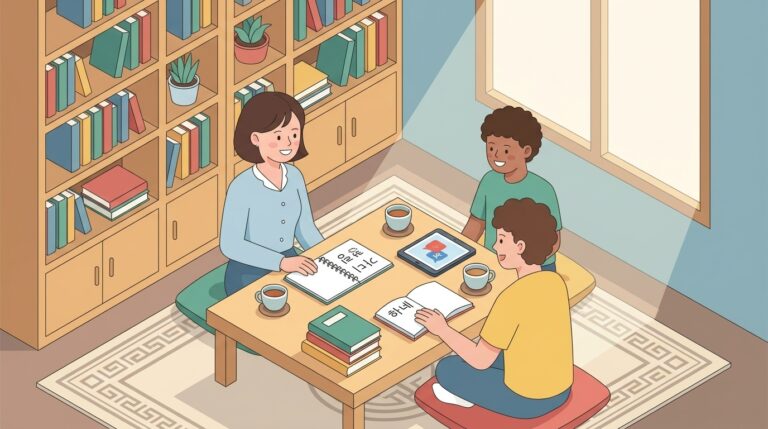
Finding the Perfect Private Tutor in Korea: Navigating the World of ‘Gwa-oe’
안녕하세요! It’s your K-culture companion and editor from Daily Hangul (매일한글).
If you’ve ever watched K-Dramas like Sky Castle or Crash Course in Romance, you already know that Korea’s passion for education (교육열 – gyo-ung-yeol) is on another level. But what happens when you, as an expat, student, or parent in Korea, need to find a private tutor (과외 선생님 – gwa-oe seon-saeng-nim)?
Navigating the tutoring market in Korea can feel overwhelming. How do you ask for recommendations? What is the polite way to negotiate fees? Today, we will dive deep into the essential vocabulary, cultural nuances, and real-life phrases you need to secure the best tutor like a true local!
Phase 2: Top 3 Core Expressions Deep Dive
1. 과외 구하고 있어요 (gwa-oe gu-ha-go isseo-yo)
- Pronunciation: gwa-oe (sounds like “gwa-way”) + gu-ha-go isseo-yo (seeking/looking for)
- Meaning: “I am looking for a private tutor (or tutoring gig).”
- K-Culture Moment: In K-Dramas, university students often post flyers or use apps saying “과외 구합니다” (Looking for tutoring students) to earn pocket money.
- Editor’s Insight: The word 과외 (gwa-oe) literally means “extra-curricular” but is exclusively used to mean private tutoring.
- Situation Spectrum: Casual: ✅ | Semi-formal: ✅ | Formal: ⚠️
- 🤔 Think About It: In many Western countries, “tutoring” is seen as remedial. In Korea, gwa-oe is often used to get ahead of the class. How does your culture view private tutoring?
2. 시강 가능할까요? (si-gang ga-neung-hal-kka-yo?)
- Pronunciation: si-gang (short for 시범 강의 – si-beom gang-ui / trial lesson) + ga-neung-hal-kka-yo? (Is it possible?)
- Meaning: “Would a trial lesson be possible?”
- K-Culture Moment: Korean parents are highly selective. Before committing to a long-term contract, they almost always request a “trial run” to see if the tutor’s style matches their child.
- Editor’s Insight: Si-gang (시강) is a crucial portmanteau word. Asking for this politely shows you know how the Korean system works.
- Situation Spectrum: Casual: 🚫 | Semi-formal: ✅ | Formal: ✅
3. 페이는 어떻게 되나요? (pei-neun eo-tteo-ke doe-na-yo?)
- Pronunciation: pei (English word “pay”) + neun eo-tteo-ke doe-na-yo? (How is it?)
- Meaning: “What is the tuition rate?”
- K-Culture Moment: Talking about money directly can feel awkward in Korea. Using the English loanword “페이” (pay) softens the question compared to the blunt Korean word 돈 (don – money).
- Editor’s Insight: Always ask this after discussing the schedule and student’s level to remain polite.
- Situation Spectrum: Casual: ✅ | Semi-formal: ✅ | Formal: ⚠️
Phase 3: Textbook Korean vs. Real-Life Korean
Situation 1: Asking about the tutor’s experience
- 📖 Textbook: “선생님의 경력은 어떻게 되십니까?” (Seon-saeng-nim-ui gyeong-ryeok-eun eo-tteo-ke doe-sim-ni-ka? – What is your career background?)
- 🗣️ Real-Life: “혹시 과외 경력은 얼마나 되세요?” (Hok-si gwa-oe gyeong-ryeok-eun ol-ma-na doe-se-yo? – By the way, how long have you been tutoring?)
- 💡 Why the difference? The textbook version sounds like a formal job interview at a conglomerate. The real-life version is polite yet warm, using hok-si (by any chance) to soften the question.
Situation 2: Asking if they can teach a specific level
- 📖 Textbook: “초보자를 가르칠 능력이 있습니까?” (Cho-bo-ja-reul ga-reu-chil neung-ryeok-i is-seum-ni-ka? – Do you have the ability to teach a beginner?)
- 🗣️ Real-Life: “기초부터 천천히 봐주실 수 있나요?” (Gi-cho-bu-teo cheon-cheon-hi bwa-ju-sil su in-na-yo? – Could you guide me slowly right from the basics?)
- 💡 Why the difference? Asking about “ability” (neung-ryeok) sounds accusatory. Using bwa-ju-da (literally “to look after/help”) sounds respectful and cooperative.
Phase 4: K-Culture Deep Dive & Non-Verbal Manners
4-1. Nunchi (눈치) & Bowing Etiquette
When meeting a potential tutor for a trial lesson in Korea, Nunchi (tact/intuitive awareness) is everything. Keep these in mind:
* The Initial Bow: Give a polite 15-to-30-degree bow when greeting them.
* The Tea Etiquette: If meeting at your home, always offer a beverage (coffee, green tea, or juice). It is a basic sign of hospitality in Korean education culture.
4-2. The “Daechi-dong” Syndrome
In Korea, the mecca of tutoring is Daechi-dong in Seoul. Parents there spend thousands of dollars on gwa-oe and hagwon (cram schools). While you don’t need to go to those extremes, knowing about Korea’s intense academic drive helps you understand why tutors take their preparation so seriously.
Phase 5: Real-Life Roleplay Scenario
Setting: You are a foreign professional living in Seoul, texting Min-ho, a recommended Korean language tutor, to set up your first class.
- You (Sarah): 안녕하세요! 추천 받고 연락드렸어요. 혹시 한국어 과외 구하시나요?
(An-nyeong-ha-se-yo! Chu-cheon bat-go yeol-lak-deu-ryeo-seo-yo. Hok-si Han-gug-eo gwa-oe gu-ha-si-na-yo?)
“Hello! I got your contact through a recommendation. By any chance, are you looking for a Korean tutoring student?” - Min-ho (Tutor): 네, 안녕하세요! 맞습니다. 혹시 배우시는 분 레벨이 어떻게 되나요?
(Ne, an-nyeong-ha-se-yo! Mat-seum-ni-da. Hok-si bae-u-si-neun bun re-bel-i eo-tteo-ke doe-na-yo?)
“Yes, hello! That’s correct. What is the learner’s level?” - You (Sarah): 🎭 [Politely responding] 제가 배울 건데, 토픽(TOPIK) 3급 목표인 B1 수준이에요.
(Je-ga bae-ul geon-de, To-pik sam-geup mok-pyo-in B1 su-jun-i-e-yo.)
“I am the learner, and I’m at a B1 level, aiming for TOPIK Level 3.” - Min-ho (Tutor): 아, 중급이시군요! 제 전문 분야입니다. 수업은 보통 어떻게 진행하고 싶으세요?
(Ah, jung-geup-i-si-gun-yo! Je jeon-mun bun-ya-im-ni-da. Su-eob-eun bo-tong eo-tteo-ke jin-haeng-ha-go sip-eu-se-yo?)
“Ah, intermediate! That is my specialty. How would you like the lessons to be conducted?” - You (Sarah): 회화 위주로 하되, 쓰기 피드백도 받고 싶어요. 혹시 본격적으로 하기 전에 시강 가능할까요?
(Hoe-hwa wi-ju-ro ha-doe, sseu-gi pi-deu-baek-do bat-go sip-eu-yo. Hok-si bon-gyeok-jeok-eu-ro ha-gi jeon-e si-gang ga-neung-hal-kka-yo?)
“I’d like to focus on conversation, but also receive writing feedback. Could we do a trial lesson before fully committing?” - Min-ho (Tutor): 좋습니다! 30분 정도 시범 수업 해드릴게요. 시간은 다음 주 화요일 괜찮으세요?
(Jo-seum-ni-da! Samsip-bun jeong-do si-beom su-eob hae-deu-ril-ge-yo. Si-gan-eun da-eum ju hwa-yo-il gwen-chan-eu-se-yo?)
“Sounds good! I will do a 30-minute trial class. Is next Tuesday okay for you?” - You (Sarah): 네, 화요일 좋습니다! 마지막으로 페이는 어떻게 되나요?
(Ne, hwa-yo-il jo-seum-ni-da! Ma-ji-mak-eu-ro pei-neun eo-tteo-ke doe-na-yo?)
“Yes, Tuesday is great! Lastly, what is your tuition fee?” - Min-ho (Tutor): 주 1회 2시간 기준 월 25만 원입니다. 교재비는 별도고요.
(Ju il-hoe du-si-gan gi-jun wol isib-o-man won-im-ni-da. Gyo-jae-bi-neun byeol-do-go-yo.)
“Based on once a week for 2 hours, it’s 250,000 KRW per month. Textbook costs are separate.”
🔀 Choose Your Path!
How will you respond to Min-ho’s fee quote?
- A) “너무 비싸요. 깎아주세요!” (Too expensive. Please give me a discount!)
- Feedback: ❌ Bad. Negotiating fees aggressively before the first meeting is considered quite rude in Korean tutoring culture.
- B) “네, 알겠습니다. 화요일에 뵐게요!” (Yes, I understand. See you on Tuesday!)
- Feedback: Best. Respectful and clear. It locks in the trial session smoothly.
- C) “그럼 시강 받아보고 결정해도 되죠?” (Then I can decide after the trial lesson, right?)
- Feedback: ⚠️ Risk. While true, phrasing it so bluntly can sound defensive. It’s better to say “시강 후에 말씀드릴게요” (I will let you know after the trial lesson).
Phase 6: 10-Second Emotion Shadowing Drill
Practice speaking with the correct emotion and pauses (/ marks the breathing points).
- [😊 Friendly & Hopeful]
추천 받고 / 연락드렸어요. / 혹시 과외 구하시나요?
(Chu-cheon bat-go / yeol-lak-deu-ryeo-seo-yo. / Hok-si gwa-oe gu-ha-si-na-yo?) -
[🥺 Polite & Cautious]
혹시 / 본격적으로 하기 전에 / 시강 가능할까요?
(Hok-si / bon-gyeok-jeok-eu-ro ha-gi jeon-e / si-gang ga-neung-hal-kka-yo?)
Phase 7: K-Culture Mini-Dictionary
- 학원 (Hagwon) | Private Cram School | After-school academies that most Korean kids attend until late at night.
- 선생님 (Seon-saeng-nim) | Teacher/Sir/Madam | Used as a polite title for anyone teaching you, regardless of age.
- 열공 (Yeol-gong) | Hard Study | A slang combination of 열심히 (hard) + 공부 (study). Often said as “열공하세요!” (Study hard!).
- 시강 (Si-gang) | Trial Lesson | A portmanteau of 시범 (trial) and 강의 (lecture).
Phase 8: Survivor Kit for Expats
Survival Phrases TOP 3
- 시간 조절 가능할까요? (Si-gan jo-jeol ga-neung-hal-kka-yo?) – “Can we adjust the schedule?”
- 카페에서 수업해요. (Ka-pe-e-seo su-eob-hae-yo.) – “Let’s do the lesson in a cafe.”
- 숙제 많이 내주세요! (Suk-je ma-ni nae-ju-se-yo!) – “Please give me lots of homework!”
💡 Editor’s Note: If you want to meet your tutor at a quiet study cafe, search for “스터디카페” on the Naver Map App to find professional study rooms near you.
Phase 9:
Frequently Asked Questions (FAQ)
Q: What does "과외 구하고 있어요 (gwa-oe gu-ha-go isseo-yo)" mean in Korean and how do you pronounce it?
A: In Korean, "과외 구하고 있어요 (gwa-oe gu-ha-go isseo-yo)" is pronounced [gwa-oe (sounds like "gwa-way"] and means: "I am looking for a private tutor (or tutoring gig)."
Q: What does "시강 가능할까요? (si-gang ga-neung-hal-kka-yo?)" mean in Korean and how do you pronounce it?
A: In Korean, "시강 가능할까요? (si-gang ga-neung-hal-kka-yo?)" is pronounced [si-gang (short for 시범 강의 - si-beom gang-ui / trial lesson] and means: "Would a trial lesson be possible?"
Q: What does "페이는 어떻게 되나요? (pei-neun eo-tteo-ke doe-na-yo?)" mean in Korean and how do you pronounce it?
A: In Korean, "페이는 어떻게 되나요? (pei-neun eo-tteo-ke doe-na-yo?)" is pronounced [pei (English word "pay"] and means: "What is the tuition rate?"







