

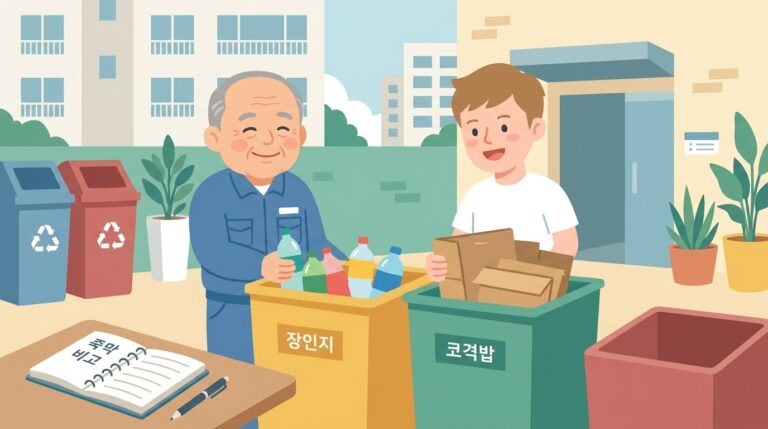
Master Korean Trash Sorting: Surviving the ‘Bunriseugeo’ Station Like a Local
Phase 1: Empathy (Welcome to the Jungle of Bunriseugeo!)
안녕하세요! (Annyeonghaseyo!) Hello there, future Seoulites and K-culture lovers! I’m your Daily Hangul editor, your friendly Korean neighbor.
Imagine this: You’ve just moved into a beautiful high-rise Korean apartment (아파트 – apateu). You look out the window, admiring the city lights, feeling like a character in your favorite K-drama. But then, you look down at your kitchen corner and see it—a growing pile of empty plastic delivery containers, soda cans, and cardboard boxes.
You gather your courage, pack everything into a bag, and walk down to the apartment’s 분리수거장 (bunriseugeo-jang / Trash Sorting Station). Suddenly, you freeze. There are ten different bins: one for clear plastic, one for colored plastic, one for paper, vinyl, glass… and an elderly resident (your apartment’s guardian angel, the Security Guard or 경비아저씨 – gyeongbi-ajeossi) is watching you with sharp, caring eyes.
Don’t panic! We’ve all been there. Sorting trash in Korea—known as 분리수거 (bunriseugeo)—is famously detailed, but it’s also a proud national habit. Today, we’ll learn 3 simple, survival-level Korean phrases that will turn you from a confused newcomer into a trash-sorting pro, earning a warm nod of approval from your neighborhood gyeongbi-ajeossi. Let’s dive in!
Phase 2: Key Expressions Deep Dive (The Survival Trio)
Let’s master the three most important phrases you’ll hear or need to say at the sorting station. Since we are focusing on A1 (Beginner) level, these are short, sweet, and highly effective!
1. 이거 어디에 버려요? (Igeo eodie beoryeoyo?)
- Pronunciation: Ee-goh uh-dee-eh buh-ryuh-yo? (Sounds like “Ego, uh-dee-eh?” + “buh-ryuh-yo” like burying a treasure but softer!)
- Meaning: Where do I throw this away?
- K-Culture Moment: Picture a scene from a slice-of-life drama. A young rookie resident stands before a row of colorful bins holding a pizza box. They turn to the security guard, holding up the box with a cute, puzzled face, asking: “이거 어디에 버려요?”
- Editor’s Insight: 이거 (Igeo) means “this,” 어디에 (eodie) means “where,” and 버려요 (beoryeoyo) means “throw away.” It’s the ultimate magic phrase for survival. When in doubt, just point at the item and ask this politely!
- Situation Spectrum: Casual ⚠️ | Semi-formal ✅ | Formal 🚫
- 🤔 Think About It: In many Western countries, sorting is done loosely in one or two big bins. In Korea, tiny details matter. Asking first shows you respect the community’s shared effort!
2. 일반 쓰레기예요? (Ilban sseuregi-yeyo?)
- Pronunciation: Eel-ban sseu-reh-gi-yeh-yo? (Sseu-reh-gi sounds like “suh-ray-gi” said quickly with a sharp ‘ss’ sound.)
- Meaning: Is this regular trash?
- K-Culture Moment: A character holding a greasy, unwashed chicken box wonders if it can be recycled. They ask their roommate, “일반 쓰레기예요?” to confirm if it goes into the standard paid trash bag.
- Editor’s Insight: 일반 (Ilban) means “regular/general” and 쓰레기 (sseuregi) means “trash.” In Korea, anything contaminated with food or grease cannot be recycled; it must go into the official general trash bag (일반 쓰레기봉투).
- Situation Spectrum: Casual ✅ | Semi-formal ✅ | Formal 🚫
- 🤔 Think About It: Why does Korea separate regular trash so strictly? Because regular trash is burned or buried, and space is precious on the Korean peninsula!
3. 이거 씻어서 버려요? (Igeo ssiseoseo beoryeoyo?)
- Pronunciation: Ee-goh shee-suh-suh buh-ryuh-yo? (Focus on the double ‘s’ in ssiseoseo—like “she-suh-suh”.)
- Meaning: Do I wash this and throw it away?
- K-Culture Moment: An eco-conscious character in a web-drama meticulously rinses a milk carton. They turn to their friend and ask, “이거 씻어서 버려요?” as a reminder of good recycling manners.
- Editor’s Insight: 씻어서 (ssiseoseo) comes from 씻다 (ssitda) meaning “to wash/rinse.” Rinsing food containers is golden rule #1 of Korean recycling. If you don’t rinse it, it’s just sseuregi (trash)!
- Situation Spectrum: Casual ✅ | Semi-formal ✅ | Formal 🚫
Phase 3: Textbook Korean vs. Real Korean
Let’s look at how textbooks teach this versus how real Koreans actually talk near the recycling bins!
Situation 1: Asking where to put plastic bottles
- 📖 Textbook: “이 플라스틱 병은 어느 곳에 배출합니까?” (Where do I discharge this plastic bottle?) – Sounds like a government manual!
- 🗣️ Real Korean: “이거 플라스틱에 버려요?” (Do I throw this in the plastic?)
- 💡 Why the difference? Real Koreans keep it short and use the category name (Plastic, Paper, Vinyl) as the destination.
Situation 2: Confirming if food waste is correct
- 📖 Textbook: “이것은 음식물 쓰레기통에 넣어야 합니까?” (Should I put this into the food waste container?) – Way too long!
- 🗣️ Real Korean: “이거 음식물이에요?” (Is this food waste?)
- 💡 Why the difference? 음식물 (Eumsikmul) is short for food waste. Koreans simply ask if the item is “food waste” directly.
Phase 4: K-Culture Deep Dive & Non-Verbal Manners
4-1. The “Gyeongbi-ajeossi” Smile & Nod
- The Power of “Nunchi” (눈치): When you approach the sorting area, make eye contact with the resident security guard (경비아저씨). Give a soft, 15-degree bow and say “안녕하세요” (Annyeonghaseyo). This instantly shows you are a respectful resident who wants to do things right.
- Hand Gestures: When asking “이거 어디에 버려요?”, hold the item with both hands slightly or point politely with an open palm rather than a single finger. It shows great manners!
4-2. The “Zero-Waste” K-Drama Trend
If you watch modern K-dramas, you’ll notice characters sorting trash meticulously. Korea has one of the highest recycling rates in the world (over 60%!). Showing a character recycling properly is a common way K-dramas portray a person as neat, responsible, and “good spouse material!”
Phase 5: Real-Life Roleplay Scenario
Setting: Sunday evening at the apartment complex’s recycling station.
Characters:
* You: A friendly beginner holding a delivery soup container.
* Mr. Kim (경비아저씨): The apartment’s veteran guard who looks tough but is extremely warm-hearted.
Mr. Kim: (Sweeping the floor, looks up)
"안녕하세요! 분리수거 하러 오셨어요?"
(Hello! Are you here to do recycling?)

You: 🎭 (Bowing slightly, smiling nervously)
"네, 안녕하세요!"
(Yes, hello!)

Mr. Kim: (Points to your bag)
"그거 플라스틱은 라벨 떼고 버려야 해요."
(For those plastics, you have to peel off the labels before throwing them away.)

You: 🎭 (Nodding and holding up a greasy delivery container)
"아, 네! ...저기, 이거 일반 쓰레기예요?"
(Ah, yes! ...Excuse me, is this regular trash?)

Mr. Kim: (Shakes head gently)
"아니요, 플라스틱이에요. 근데 물로 씻어야 해요."
(No, it's plastic. But you have to wash it with water.)

You: 🎭 (Showing the container)
"이거 씻어서 버려요?"
(Do I wash this and throw it away?)

Mr. Kim: (Nods warmly)
"네! 깨끗이 씻으면 플라스틱이에요. 안 씻으면 일반 쓰레기!"
(Yes! If you wash it clean, it's plastic. If not washed, regular trash!)

You: 🎭 (Smiling with relief)
"아하! 감사합니다!"
(Aha! Thank you!)

Mr. Kim: "잘하시네! 다음에도 물어봐요!"
(You're doing great! Ask me next time too!)
🔀 Interactive Branching Point
You have a cardboard box with shipping tape still stuck on it. What do you do?
* Choice A: Throw the box straight into the paper bin with the tape on.
* Choice B: Remove the plastic tape entirely, fold the box flat, and say to Mr. Kim: “이거 종이에 버려요?” (Do I throw this in the paper?)
* Choice C: Leave it next to the bin and run away quickly.
Feedback:
- Choice A (Risk): Mr. Kim might gently call you back! In Korea, tape is vinyl, and boxes must be pure paper. Always peel the tape off first.
- Choice B (Best): Perfect! 🌟 Mr. Kim will give you a big smile. You removed the non-paper part (tape) and asked politely in Korean. Excellent job!
- Choice C (Bad): Oh no! The security cameras (CCTV) are watching, and you might get a gentle warning from the management office later.
Phase 6: 10-Second Emotion Shadowing Drill
Let’s practice speaking with real Korean feelings!
- [🥺 Confused & Asking for Help]
- “이거 / 어디에 / 버려요?”
- Igeo / eodie / beoryeoyo?
- [💡 Aha! Moment of Realization]
- “아! / 씻어서 / 버려요?”
- Ah! / ssiseoseo / beoryeoyo?
- [😊 Super Friendly & Polite]
- “감사합니다! / 수고하세요!”
- Gamsahabnida! / Sugohaseyo! (Thank you! Keep up the great work!)
Phase 7: K-Culture Mini-Dictionary
- 분리수거 (Bunriseugeo) | Trash Sorting / Recycling | The systematic separation of waste into specific categories.
- 일반 쓰레기 (Ilban Sseuregi) | General Waste | Non-recyclable trash that goes into municipal prepaid bags.
- 음식물 쓰레기 (Eumsikmul Sseuregi) | Food Waste | Biodegradable food scraps. (Rule of thumb: If an animal can eat it, it’s food waste!).
- 경비실 (Gyeongbisil) | Security Office | The heart of any Korean apartment complex where you can find help.
Phase 8: Traveler’s Survival Kit
Survival Phrases TOP 3
- 비닐은 어디예요? (Binireun eodiyeyo?)
- Where is the vinyl/plastic bag section?
- Pro Tip: Used for bread wrappers and plastic snack bags!
- 이거 그냥 버려요? (Igeo geunyang beoryeoyo?)
- Do I just throw this away as is?
- Pro Tip: Ask this when you aren’t sure if you need to disassemble something.
- 캔은 여기 맞아요? (Kaeneun yeogi majayo?)
- Is this the right place for cans?
- Pro Tip: Point to the bin and ask this to double-check.
Editor’s Travel Note
- Essential App: If you are living or staying long-term in Korea, download the KakaoMap App or Naver Map App to find local community centers where they sometimes give out free food waste bins or recycling guides in English.
- Note: Trash rules can slightly vary by district (Gu) in Seoul, so checking local notices in your lobby is always a smart move! (Info current as of 2024).
Phase 9: “A Step Deeper” (Cultural Reflection)
In Korea, keeping the apartment clean is not just about rules; it is about 우리의 공간 (uri-ui gonggan – our shared space). Because Korea is densely populated, cooperation is key. When you sort trash carefully, you are actively showing respect for the environment and the workers who handle it. It is a quiet but powerful way of saying, “I care about this community.”
💬 Your Turn: How does recycling work in your country? Is it as strict as Korea? Let me know in the comments below!
Phase 10: FAQ & Common Mistakes
Q: Can I throw chicken bones into the Food Waste (음식물) bin?
A: No! Animal bones (chicken, pork, beef), eggshells, and onion skins are too hard for animals to digest, so they must go into the 일반 쓰레기 (General Trash) bag.
Q: What is the special bag for general trash called?
A: It is called 종량제 봉투 (Jongryangje bongtu). You must buy these at local convenience stores or supermarkets. You cannot use normal plastic shopping bags for general trash!
Q: When can I do recycling?
A: In some apartments, you can do it anytime. In others, there is a designated “Recycling Day” (e.g., only Sunday night to Monday morning). Check with your landlord or look at the lobby signs!
🚨 Common Mistakes Alert!
- Mistake 1: Leaving plastic labels on water bottles.
- Correct Action: Peel off the clear label completely and put it in ‘Vinyl’, then crush the clear bottle and put it in ‘Clear Plastic’.
- Mistake 2: Putting dirty pizza boxes in the Paper bin.
- Correct Action: If it’s stained with oil/sauce, tear off the dirty parts and throw them in General Trash. Only clean cardboard can be recycled.
Phase 11: Action Mission
- Bronze Medal: Look at one item of trash in your room right now. Say out loud: “이거 어디에 버려요?”
- Silver Medal: Take a screenshot of our







