

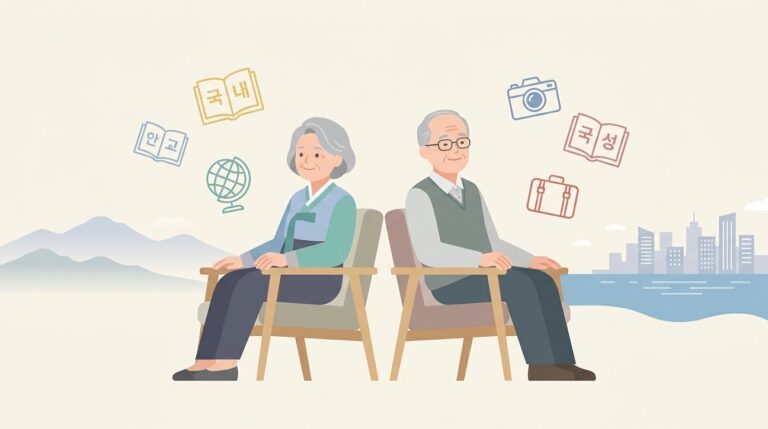
Marriage, Reimagined: Deciphering Korea’s ‘Jolhon’ (Marriage Graduation) Phenomenon
Phase 1: Empathy (An Immersive Opening)
안녕하세요! (Annyeonghaseyo!) It’s your Daily Hangul editor and cultural navigator here.
Imagine this: A Korean silver-haired couple who have been married for forty years sit down for a quiet dinner. There is no shouting, no dramatic betrayal, and no legal battle in sight. Yet, they calmly agree to stop living under the same roof, stop keeping track of each other’s daily schedules, and pursue their own independent lives—all while remaining legally married.
This isn’t a scene from a sci-fi flick; it is the reality of 졸혼 (Jolhon – ‘Marriage Graduation’), a rapidly rising trend among South Korea’s older generations.
As a C2-level learner, you already know how deeply rooted family values and societal expectations are in Korea. But when you watch modern K-dramas like Once Again (한 번 다녀왔습니다) or read Korean editorials, you might notice sophisticated discussions around emotional independence in old age. Understanding Jolhon is your key to grasping the shifting paradigms of modern Korean family dynamics. Today, we’re diving deep into the high-level vocabulary, cultural subtexts, and emotional nuances of this fascinating social shift.
Phase 2: Deep Dive into 3 Core Expressions
Let’s dissect three high-level expressions crucial for discussing this demographic shift.
1. 졸혼하다 (Jol-hon-ha-da)
- Pronunciation: Jol-hon-ha-da (Think of “Jol” as in “joll-y”, and “hon” sounding like the first syllable of “hon-ey” with a short ‘o’.)
- Meaning: To graduate from marriage (Legally married, but living independent lives by mutual agreement).
- K-Culture Moment: In family variety shows or weekend dramas, when adult children realize their aging parents are no longer sharing a bedroom or have rented separate apartments without getting a divorce, they often ask: “엄마, 아빠… 혹시 졸혼하신 거예요?” (Mom, Dad… did you perhaps “graduate” from your marriage?)
- Editor’s Insight: This portmanteau combines 졸업 (卒業 – graduation) and 결혼 (結婚 – marriage). It is not a legal term, but a social construct borrowed from the Japanese concept sotsukon. It highlights a compromise: avoiding the social stigma and legal headaches of late-life divorce (황혼이혼) while reclaiming personal autonomy.
- Situation Spectrum: Casual (✅) | Semi-formal (✅) | Formal (✅)
- 🤔 Think About It: In many Western cultures, you are either married, separated, or divorced. Why do you think Korean society created a “buffer zone” like Jolhon instead of choosing clean-cut divorces?
2. 각자의 삶을 개척하다 (Gak-ja-ui salm-eul gae-cheok-ha-da)
- Pronunciation: Gak-ja-ui salm-eul gae-cheok-ha-da (Pronounce “gae-cheok” like “get-chock” but with a very soft ‘g’ sound.)
- Meaning: To pioneer/carve out one’s own life.
- K-Culture Moment: This is a classic phrase used in high-brow talk shows or literary essays discussing late-life independence. It describes the proactive act of finding hobbies, travel plans, and social circles separate from one’s spouse.
- Editor’s Insight: While ‘개척하다’ is traditionally used for pioneering wilderness or markets, using it with ‘각자의 삶’ (each other’s lives) adds an active, dignified, and pioneering tone to senior citizens who refuse to be passive bystanders in their golden years.
- Situation Spectrum: Casual (⚠️ – sounds a bit too dramatic for casual banter) | Semi-formal (✅) | Formal (✅)
- 🤔 Think About It: How does this contrast with the traditional Korean expectation of bubu (부부 – married couple) being “one flesh and soul” (일심동체)?
3. 구속을 탈피하다 (Gu-sok-eul tal-pi-ha-da)
- Pronunciation: Gu-sok-eul tal-pi-ha-da (“Gu-sok” sounds like “goo-sock”; “tal-pi” sounds like “tahl-pee”.)
- Meaning: To break free from constraints/shackles.
- K-Culture Moment: Used by characters who feel suffocated by patriarchal family duties—such as preparing ancestral rites (제사) or catering to a demanding spouse’s daily whims.
- Editor’s Insight: ‘탈피하다’ literally means shedding skin (like a snake). It signifies a profound, liberating transformation. Combined with ‘구속’ (restriction/confinement), it beautifully illustrates the psychological release felt by older women who have spent decades prioritizing family over self.
- Situation Spectrum: Casual (🚫) | Semi-formal (✅) | Formal (✅)
- 🤔 Think About It: What kind of societal constraints in your culture do older generations wish to “shed”?
Phase 3: Textbook Korean vs. Real-Life Korean
Let’s compare textbook phrasing with the authentic, high-level conversational nuance used by native speakers.
Situation 1: Explaining why an elderly couple lives apart
- 📖 Textbook Korean: “그 부부는 이혼하지 않고 따로 살기로 결정했습니다.” (That couple decided to live separately without divorcing.)
- 🗣️ Real-Life Korean: “그분들은 서로의 여생을 리스펙트해서 졸혼이라는 타협점을 찾으신 거래요.” (I heard they found a compromise called ‘Jolhon’ out of mutual respect for how they want to spend the rest of their lives.)
- 💡 Why is it different? The real-life version uses the loanword ‘리스펙트’ (respect) and ‘타협점’ (compromise), softening the clinical reality of separation into an amicable, respectful life choice.
Situation 2: Expressing envy of a senior’s independent lifestyle
- 📖 Textbook Korean: “나이가 들어서 혼자 사니 편해 보입니다.” (Living alone in old age looks comfortable.)
- 🗣️ Real-Life Korean: “자식들 다 키워놓고 뒤늦게나마 온전한 자기 삶을 누리시는 모습이 참 보기 좋더라고요.” (It looks so wonderful to see them finally enjoying a life entirely of their own, long after finishing raising their kids.)
- 💡 Why is it different? The real-life phrase uses sophisticated adverbial constructions (‘뒤늦게나마’ – albeit late) and evocative verbs (‘누리다’ – to enjoy/bask in), showing deep empathy for the cultural burden of parenting in Korea.
Phase 4: K-Culture Deep-Dive & Non-Verbal Manners
4-1. Nunchi & Gestures: Navigating the Delicate Subject
When discussing Jolhon with Koreans, especially older generations, remember these subtle cues:
* The Sidelong Sigh (하아~): When talking about traditional marital duties, a soft sigh represents decades of unspoken sacrifice (한 – Han). Do not interrupt this sigh; it is an emotional release.
* Careful Nodding (끄덕임): Avoid overly enthusiastic high-fives or direct celebrations of separation. Keep your nods slow and empathetic. Jolhon is often a bitter-sweet compromise, not a clean-cut party.
4-2. Cultural Code: The Burden of “K-Daughter-in-Law” (K-며느리)
To understand why Jolhon is so popular among older Korean women, you must understand the weight of being a K-Myeoneuri (K-daughter-in-law). For decades, these women managed not only their households but also served their parents-in-law, organized demanding family holidays (Chuseok, Seollal), and faded into the background as “Mom” or “someone’s wife.” Jolhon is their symbolic “retirement ceremony” from domestic labor.
Phase 5: Interactive Roleplay Scenario
Setting: A classy tea house in Insadong. You (Ji-min) are catching up with your high school mentor, Professor Park (62), who recently initiated a Jolhon arrangement with her husband.
Characters:
- 지민 (Ji-min – You): An empathetic, culturally fluent former student.
- 박 교수 (Professor Park): An elegant, intellectual woman enjoying her newly found solitude.
1. 지민: 🎭 (따뜻한 차를 권하며) 교수님, 얼굴이 몰라보게 편안해 보이세요. 요즘 서재에서 혼자 지내시는 생활은 좀 어떠신가요?
   (Ji-min: [Offering warm tea] Professor, you look noticeably at peace. How is your new life living alone in your study these days?)

2. 박 교수: 🎭 (미소를 지으며 찻잔을 만진다) 말도 못 하게 홀가분해요, 지민 씨. 수십 년간 얽매여 있던 집안일과 의무에서 벗어나니, 비로소 내가 보이는 것 같아.
   (Prof. Park: [Smiling, touching her teacup] It is incredibly liberating, Ji-min. Having broken free from decades of household chores and obligations, I feel like I can finally see my true self.)

3. 지민: 🎭 (진지하게 고개를 끄덕이며) '결혼 졸업'이라는 선택이 결코 쉽지 않으셨을 텐데, 두 분의 결단이 참 대단하게 느껴집니다.
   (Ji-min: [Nodding seriously] Choosing to 'graduate from marriage' must not have been easy. I find both of your decisions truly admirable.)

4. 박 교수: 🎭 (조금 쓸쓸한 눈빛으로) 주변에서는 이혼하는 거냐며 수군대기도 했지. 하지만 우리는 서로를 미워해서가 아니라, 존중하기 때문에 거리를 두기로 한 거라네.
   (Prof. Park: [With a slightly lonely gaze] People around us whispered, asking if we were getting a divorce. But we decided to keep our distance not because we hate each other, but because we respect one another.)

5. 지민: 🎭 (공감의 눈빛으로) 맞아요. 전통적인 부부상에만 얽매이지 않고, 각자의 삶을 개척해 나가는 모습이 오히려 더 건강해 보여요.
   (Ji-min: [With empathetic eyes] Exactly. Instead of being bound by traditional marital roles, pioneering your own individual lives actually looks much healthier.)

6. 박 교수: 🎭 (지민의 손을 살포시 잡으며) 그렇게 이해해 주니 고맙군. 이제야 온전히 나 자신을 위한 아침을 맞이하는 기분이라네.
   (Prof. Park: [Gently holding Ji-min's hand] Thank you for understanding. I feel like I am finally waking up to mornings meant entirely for myself.)

7. 지민: 🎭 (미소를 지으며) 네, 교수님. 앞으로 집필하실 책도, 혼자 떠나실 여행도 온 마음으로 응원하겠습니다.
   (Ji-min: [Smiling] Yes, Professor. I will root for your upcoming book and your solo travels with all my heart.)

8. 박 교수: 🎭 (안도하며) 고마워요, 내 든든한 이해자.
   (Prof. Park: [Relieved] Thank you, my reliable confidante.)
🔀 Choose Your Response:
At turn 5, how would you respond to keep the conversation emotionally resonant?
* A) “그럼 아버님 식사는 이제 누가 챙겨드리나요?” (Then who takes care of father’s meals now?)
* B) “전통적인 부부상에만 얽매이지 않고, 각자의 삶을 개척해 나가는 모습이 오히려 더 건강해 보여요.” (Instead of being bound by traditional marital roles, pioneering your own individual lives actually looks much healthier.)
* C) “법적으로 이혼하시는 게 재산 분할에 더 유리하지 않나요?” (Wouldn’t a legal divorce be more advantageous for asset division?)
💡 Feedback:
- Best Choice (B): Demonstrates high-level emotional intelligence (눈치), validating her autonomy without bringing up archaic gender roles or cold financial matters.
- Bad Choice (A): Extremely regressive. Asking who will feed her husband undermines her hard-won liberation and highlights the patriarchal burden she just escaped.
- Risk Choice (C): Too clinical and intrusive for a teacher-student tea time, ruining the refined atmosphere.
Phase 6: 10-Second Emotional Shadowing Drill
Practice this high-level phrase with realistic pauses (/) and emotional tone indicators ([...]).
- The Sentence: “서로 미워해서가 아니라, / 온전한 자기 삶을 / 리스펙트하니까 / 졸혼을 택한 거죠.”
- Pronunciation Guide: Seo-ro mi-weo-hae-seo-ga a-ni-ra, / on-jeon-han ja-gi salm-eul / ree-seu-pek-teu-ha-ni-kka / jol-hon-eul taek-han geo-jyo.
- Emotional Roadmap:
[🥺 Understanding and soft]->[✨ Empowering and clear]->[😌 Calm and reassuring] - Breakdown: “It’s not because they hate each other, but because they respect each other’s complete individual lives that they chose to graduate from marriage.”
Phase 7: K-Culture Mini-Dictionary
- 황혼이혼 (Hwang-hon I-hon) | Twilight Divorce
- Divorce among couples who have been married for 20 years or more. It differs from Jolhon because it is a complete legal dissolution of the marriage.
- 개인주의 (Gae-in Ju-ui) | Individualism
- Historically viewed somewhat negatively in collective Korea, it is now being embraced by seniors as a healthy way to prioritize personal well-being over family sacrifices.
- 효도관광 (Hyo-do Gwan-gwang) | Filial Piety Tourism
- Trips funded by adult children for their aging parents. Modern Jolhon seniors often reject these group tours in favor of independent solo backpacking.
- 1인 가구 (Il-in Ga-gu) | Single-person Household
- No longer just a term for young 20-somethings. Elderly single-person households due to Jolhon or bereavement are transforming Korean housing and welfare policies.
Phase 8: Survivor’s Kit for Advanced Learners
Survival Phrases for Cultural Debates
- “세대가 변하면서 가족의 정의도 달라지고 있는 것 같습니다.”
- (As generations change, the definition of family also seems to be evolving.)
- Pro Tip: Use this to neutralize heated debates among older conversationalists.
- “제 주변에서도 졸혼을 긍정적으로 보시는 분들이 많아요.”
- (Even among my acquaintances, many view marriage graduation positively.)
- Pro Tip: Softens your own opinion by framing it as a general social observation.
- “형식보다 실질적인 행복이 더 중요하니까요.”
- (Because practical happiness is more important than mere formalities.)
- Pro Tip: Use this philosophical line to show sophisticated rhetorical flair.
Editor’s Travel Note
If you want to observe Korea’s active senior culture firsthand, visit the Tapgol Park Area in Seoul. Use the Naver Map App to find local vintage cafes where senior intellectuals gather to discuss literature, philosophy, and their independent lives. (Note: Local cultural trends and hotspot dynamics may vary over time.)
Phase 9: “Going One Step Deeper” (Reflective Essay)
In traditional Korean society, a person’s identity was defined by relationships: someone’s child, someone’s spouse, someone’s parent. The self was often secondary. Jolhon is not merely a lifestyle choice; it represents a revolutionary psychological shift in Korea. It is the elderly saying, “I love my family, but I also love myself.” It shows that even in the twilight of life, growth, self-actualization, and emotional independence do not stop.
💬 Your Turn: How does your home country view late-stage marriage issues? Do you have an equivalent concept to “Marriage Graduation,” or is divorce the only logical option? Let us know in the comments below!
Phase 10: FAQ & Common Mistakes
Q: Is Jolhon legally recognized in South Korea?
A: No, Jolhon is purely a social contract and a cultural lifestyle agreement. Legally, the couple remains married, which means they still retain inheritance rights and medical decision-making powers.
Q: How does Jolhon differ from a trial separation (별거)?
A: Separation (별거) often implies a relationship in crisis, bordering on divorce. Jolhon, on the other hand, is an amicable, mutual agreement to support each other’s individual lifestyles while maintaining a friendly, non-cohabitating relationship.
Q: Do adult children in Korea support their parents’ Jolhon?
A: Opinions are highly divided. While progressive younger generations respect their parents’ right to happiness, conservative children sometimes worry about social gossip or the logistics of caring for two separate households.
🚨 Common Mistakes Alert!
- Mistake 1: Confusing Jolhon (졸혼) with Hwanghon I-hon (황혼이혼).
- Correct Action: Remember that Jolhon maintains the legal marriage bond; Hwanghon I-hon breaks it legally.
- Mistake 2: Using the term “졸혼하다” to young newlyweds.
- Correct Action: This term is strictly reserved for long-term senior couples (usually married 20–40 years).
- Mistake 3: Pronouncing the ‘J’ in ‘Jolhon’ like a hard French ‘Je’.
- Correct Action: Keep it close to a soft English “J” (like in “joke”).
Phase 11: Action Mission
- 🥉 Bronze Mission: Write a 3-sentence diary entry in Korean expressing your personal thoughts on Jolhon using the word “타협점” (compromise).
- 🥈 Silver Mission: Share an article or a K-drama clip about elderly independence on social media, tagging your study group with the phrase “각자의 삶을 개척하다.”
- 🥇 Gold Mission: Initiate a conversation with a native speaker language exchange partner and ask: “한국의 졸혼 문화에 대해 어떻게 생각하세요?” (What do you think about Korea’s Jolhon culture?)
Phase 12: Interactive Quiz Challenge
1. Contextual Judgment
Which of the following scenarios best describes 졸혼 (Jolhon)?
* A) A couple divorces after 30 years because they can no longer stand each other.
* B) A senior couple stays legally married but lives in separate homes to pursue independent hobbies while meeting for occasional family dinners.
* C) A young couple decides to live together before getting married.
👉 Click to see the Answer & Explanation
Correct Answer: B
Explanation: B perfectly captures the essence of Jolhon—retaining the legal status of marriage while living independent lifestyles by amicable mutual consent. A is Hwanghon I-hon (twilight divorce), and C is Donggeo (cohabitation).
2. Fill in the Blank
“부모님은 서로 미워하시는 게 아니라, 각자의 삶을 ________하기 위해 졸혼을 선택하셨어요.”
* A) 포기 (po-gi – abandon)
* B) 개척 (gae-cheok – pioneer)
* C) 구속 (gu-sok – restrict)
👉 Click to see the Answer & Explanation
Correct Answer: B
Explanation: ‘개척’ (pioneering) fits perfectly, expressing the active pursuit of an independent lifestyle.
3. True or False
Jolhon couples usually go through a formal legal proceeding in Korean family courts.
* True / False
👉 Click to see the Answer & Explanation
Correct Answer: False
Explanation: Jolhon is a social and personal agreement. No court proceedings or legal documents are involved unless the couple separately decides to sign a personal wealth/lifestyle contract.







