

How to Talk About ‘One Year’ in Korean: Your Warm and Easy Guide!
안녕하세요! (Annyeonghaseyo!) Hello there, beautiful soul! I’m your chief editor and neighborhood Korean bestie from Daily Hangul.
Have you ever watched a K-Drama where the couple celebrates their “100-day anniversary” (백일 – baek-il) or talks about waiting “a whole year” for someone to return from travel? Or maybe you’ve tried planning your dream trip to Seoul to see the cherry blossoms in spring and the snowy palaces in winter?
When you are just starting your Korean journey (A1 level), talking about time can feel a bit scary. “Do I use native Korean numbers or Sino-Korean numbers?” “How do I say ‘this year’ vs ‘next year’?”
Don’t worry! I used to see my student Sarah panic every time she tried to book a one-year language program in Seoul. She kept mixing up the words for “year” and ended up accidentally telling her landlord she wanted to rent the room for “one day” instead of “one year”! We laughed so hard, but it taught me exactly how to make this super simple for you. Let’s master “One Year” (일 년 – il nyeon) together today! 🌸
Phase 2: Top 3 Essential Expressions for “One Year”
Let’s look at the three most important words you need to talk about years.
1. 일 년 (il-nyeon)
- Pronunciation: Il-nyeon (Sounds like “ill-nyeon”. Think of “ill” like feeling sick, and “neon” like a bright neon sign!)
- Meaning: One Year
- K-Culture Moment: You will hear this constantly in romance K-Dramas when characters promise: “일 년만 기다려줘” (Il-nyeon-man gi-da-ryeo-jwo – “Please wait for me for just one year.”)
- Editor’s Insight: To say “one year”, we combine 일 (il – the Sino-Korean number for “1”) and 년 (nyeon – the counter for “year”).
- Situation Spectrum: Casual ✅ | Semi-formal ✅ | Formal ✅ (Perfect for any situation!)
- 🤔 Think About It: In your language, do you count years using different number systems? In Korean, we use the Sino-Korean system (일, 이, 삼, 사…) for years, which actually makes it very logical once you learn the pattern!
2. 올해 (ol-hae)
- Pronunciation: Ol-hae (Sounds like “ole-heh”. “Ole” like the Spanish cheer, and “heh” like a soft giggle!)
- Meaning: This Year
- K-Culture Moment: At the beginning of January, idols on YouTube always say: “올해 건강하세요!” (Ol-hae geon-gang-ha-se-yo! – “Please be healthy this year!”)
- Editor’s Insight: This is a native Korean word. It sounds much friendlier and warmer than the Sino-Korean equivalent (금년 – geum-nyeon), which is mostly used in news broadcasts.
- Situation Spectrum: Casual ✅ | Semi-formal ✅ | Formal ✅
- 🤔 Think About It: “올해” literally comes from words meaning “the year that comes.” Isn’t it beautiful to think of the year as a guest arriving at your door?
3. 내년 (nae-nyeon)
- Pronunciation: Nae-nyeon (Sounds like “neh-nyeon”. Think of “neigh” like a horse sound, followed by “neon”!)
- Meaning: Next Year
- K-Culture Moment: When planning a concert or trip with friends: “내년에 한국 가요!” (Nae-nyeon-e han-guk ga-yo! – “I am going to Korea next year!”)
- Editor’s Insight: The “내” (nae) part comes from the Chinese character meaning “to come.” So it literally means “the coming year.”
- Situation Spectrum: Casual ✅ | Semi-formal ✅ | Formal ✅
- 🤔 Think About It: What is one big goal you want to achieve 내년 (next year)? Saying it out loud in Korean makes it feel closer!
Phase 3: Textbook Korean vs. Real-Life Korean
Sometimes, textbooks make us sound like robots. Let’s look at how to sound like a real Korean friend!
Scenario 1: Asking about someone’s stay in Korea
- 📖 Textbook Korean: “한국에 몇 년 동안 있을 겁니까?” (Han-gug-e myeot nyeon dong-an isseul geom-ni-kka? – “How many years will you be in Korea?” – Too stiff and formal!)
- 🗣️ 진짜 (Real) Korean: “한국에 얼마나 있을 거예요?” (Han-gug-e ol-ma-na isseul geo-yeo-yo? – “How long will you be in Korea?”)
- 💡 Why is it different? Real Koreans prefer to ask “how long” (얼마나) instead of rigidly asking “how many years” in casual chats. It feels much softer!
Scenario 2: Saying “I am 20 years old”
- 📖 Textbook Korean: “저는 이십 년 동안 살았습니다.” (Jeo-neun i-sip nyeon dong-an sar-at-seub-ni-da. – “I have lived for 20 years.” – Sounds like a legal document!)
- 🗣️ 진짜 (Real) Korean: “저 스무 살이에요!” (Jeo seu-mu sal-i-e-yo! – “I am 20 years old!”)
- 💡 Why is it different? When talking about age, we use 살 (sal – native Korean counter for age) instead of 년 (nyeon). Confusing these two is the #1 mistake beginners make!
Phase 4: K-Culture Deep-Dive & Non-Verbal Manners
4-1. New Year Bowing & Hand Gestures
When talking about the start of a new year (새해 – sae-hae), Koreans do a traditional deep bow called 세배 (se-bae) to their elders. If you are doing this online or in a casual setting, you can make a heart shape with your fingers (finger heart) or bring your hands together politely near your chest to show respect.
4-2. The “One-Year” Culture in Korea
In Korea, the concept of “one year” is deeply celebrated. Couples celebrate their 1주년 (il-ju-nyeon – 1st anniversary), babies celebrate their 돌잔치 (dol-jan-chi – 1st birthday party with a big feast!), and businesses celebrate their first year with special customer events. “One year” represents surviving, growing, and building a deep relationship (정 – jeong).
Phase 5: Real-Life Roleplay Scenario
Meet Ji-woo (지우), a super friendly Korean university student who is helping you register for a 1-year Korean language school in Seoul!
- Setting: A cozy student lounge near Yonsei University.
Ji-woo: 안녕하세요! 한국어 공부하러 오셨어요?
        (An-nyeong-ha-se-yo! Han-gug-eo gong-bu-ha-reo o-syeot-seo-yo?)
        "Hello! Did you come to study Korean?"

You: 🎭 [Smiling warmly] 네, 한국어 공부하러 왔어요.
     (Ne, han-gug-eo gong-bu-ha-reo wat-eo-yo.)
     "Yes, I came to study Korean."

Ji-woo: 한국에서 얼마나 공부할 거예요?
        (Han-gug-e-seo ol-ma-na gong-bu-hal geo-yeo-yo?)
        "How long will you study in Korea?"

You: 🎭 [Use your new expression] 일 년 동안 공부하고 싶어요!
     (Il nyeon dong-an gong-bu-ha-go sip-eo-yo!)
     "I want to study for one year!"

Ji-woo: 와, 일 년요? 그럼 내년까지 한국에 있겠네요!
        (Wa, il nyeon-yo? Geu-reom nae-nyeon-kka-ji han-gug-e it-get-nae-yo!)
        "Wow, one year? Then you will be in Korea until next year!"

You: 🎭 [Nodding excitedly] 네! 올해 시작해서 내년에 끝나요.
     (Ne! Ol-hae si-jak-hae-seo nae-nyeon-e kkeut-na-yo.)
     "Yes! I start this year and finish next year."

Ji-woo: 진짜 멋져요! 제가 맛집 많이 소개해 줄게요.
        (Jin-짜 meot-jyeo-yo! Je-ga mat-jib ma-ni so-gae-hae jul-ge-yo.)
        "That's so cool! I will introduce you to many delicious restaurants."

You: 🎭 [Gratefully clapping hands] 정말 감사합니다! 아주 신나요!
     (Jeong-mal gam-sa-hap-ni-da! A-ju sin-na-yo!)
     "Thank you so much! I am so excited!"
🔀 Interactive Choice Point
What will you say next to Ji-woo?
* A) “내년에 같이 밥 먹어요!” (Nae-nyeon-e gat-i bap meog-eo-yo! – “Let’s eat together next year!”)
* B) “일 년은 너무 길어요.” (Il-nyeon-eun neo-mu gir-eo-yo. – “One year is too long.”)
* C) “오늘 같이 커피 마셔요!” (O-neul gat-i keo-pi ma-syeo-yo! – “Let’s drink coffee today!”)
💡 Feedback on your choice:
- Choice A (Best!): Perfect! It shows you want to build a long-term friendship using the word “next year”. Ji-woo will smile and say “좋아요!” (Okay!)
- Choice B (Risk): Hmm, this might sound a bit negative or like you are already tired of Korea. Try to stay positive!
- Choice C (Bad): A bit too sudden! Slow down and enjoy the conversation flow first.
Phase 6: 10-Second Emotion Shadowing Drill
Let’s practice speaking with real Korean feelings! Pay attention to the pauses (/).
- [😊 Filled with hope and excitement]
- “올해 / 한국에 / 가요!”
- Ol-hae / han-gug-e / ga-yo!
- “This year, / I am going / to Korea!”
- [🥺 Worried but cute]
- “일 년 / 너무 / 길어요?”
- Il-nyeon / neo-mu / gir-eo-yo?
- “Is one year / too / long?”
- [🎉 Celebrating with friends]
- “벌써 / 일 년이에요!”
- Beol-sseo / il-nyeon-i-e-yo!
- “It’s already / one year!”
Phase 7: K-Culture Mini Dictionary
- 새해 (Sae-hae) | New Year | Literally means “New Sun/Year”. Used in greetings.
- 기념일 (Gi-nyeom-il) | Anniversary | Very important in Korean dating culture to count days and years.
- 한 살 (Han sal) | One year old | Used for age. In Korea, everyone traditionally turned a year older on New Year’s Day!
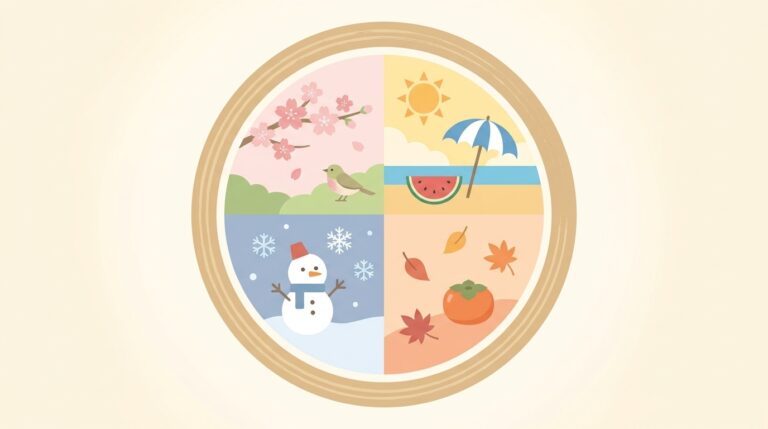
- 사계절 (Sa-gye-jeol) | Four Seasons | Korea has beautiful spring, summer, autumn, and winter over “one year”.
Phase 8: Survivor’s Travel Kit
Survival Phrases TOP 3
- 일 년 권 있어요? (Il-nyeon-gwon isseul-ggeo-yo? / Do you have a 1-year pass? – Great for gyms or subway cards!)
- 내년에 또 올게요! (Nae-nyeon-e tto ol-gae-yo! / I will come back next year! – Say this to your favorite restaurant owner.)
- 올해 마지막 여행이에요. (Ol-hae ma-ji-mak yeo-haeng-i-e-yo. / This is my last trip of this year.)
Editor’s Travel Note
If you plan to live in Korea for 일 년 (one year), you must download the Naver Map App immediately. Google Maps does not work well in Korea, but Naver Map will show you every single bus, train, and secret cafe in real-time!
(Note: App features and layouts may change over time without notice.)
Phase 9: “Going Deeper” (A Touch of Korean Culture)
In Korea, time is deeply connected to relationships. When Koreans say “Let’s meet next year,” they aren’t just saying a date—they are making a promise to keep you in their life. Because Korea has distinct four seasons, living “one year” with someone means experiencing the cold winter and the warm spring together. It means you are now true friends.
💬 Your Turn: How long have you been studying Korean? Let me know in the comments below using “일 년” or “올해”! I read every single comment! ❤️
Phase 10: FAQ & Common Mistakes
Q: What is the difference between 년 (nyeon) and 해 (hae)?
A: 년 (nyeon) is Sino-Korean and is used with numbers to count (e.g., 일 년, 이 년). 해 (hae) is native Korean and is used more poetically or in compound words like “올해” (this year) or “새해” (new year).
Q: Can I use Sino-Korean numbers like “일” (il) with “살” (sal) for age?
A: No! This is a major mistake. Always use native Korean numbers for age (e.g., 스무 살 – 20 years old) and Sino-Korean numbers for years of duration (e.g., 이십 년 – 20 years).
Q: How do I say “for one year”?
A: Simply add 동안 (dong-an – during/for) after the year. So, “일 년 동안” means “for one year.”
🚨 Beginner’s Danger Zone (Top 3 Mistakes)
- Saying “하나 년” (Hana nyeon) for one year: 🚫 Wrong! You must use the Sino-Korean number “일” (il). Say 일 년 (Il-nyeon) ✅.
- Confusing 내년 (Next year) with 내일 (Tomorrow): 🚫 “내일” is tomorrow! Don’t accidentally tell your boss you will finish the project next year when you mean tomorrow!
- Writing “일년” as one word in official documents: 🚫 Always write a space between the number and the counter: 일 년 ✅.
Phase 11: Your Daily Hangul Action Mission!
- Bronze Medal: Write “일 년” on a sticky note and stick it on your calendar!
- Silver Medal: Go to Instagram or TikTok, find a Korean video, and comment: “올해 한국어 공부해요!” (I am studying Korean this year!)
- Gold Medal: Use the phrase “내년에 한국 가요!” in a text message to a Korean language exchange partner.
🎮 K-Culture Mission: Watch your favorite K-Drama today and listen closely. Try to catch the moment they say “일 년” (il-nyeon) when a character leaves for study abroad!
Phase 12: Interactive Quiz Challenge!
Q1. Which word means “This Year”?
- A) 내년 (nae-nyeon)
- B) 올해 (ol-hae)
- C) 일 년 (il-nyeon)
Click for the Answer & Explanation!
Correct Answer: B) 올해 (ol-hae)
Explanation: ‘올해’ means this year. ‘내년’ means next year, and ‘일 년’ means one year!
Q2. Fill in the blank: “I will study for one year.” -> “_____ 동안 공부할 거예요.”
- A) 일 년 (il-nyeon)
- B) 한 살 (han-sal)
Click for the Answer & Explanation!
Correct Answer: A) 일 년 (il-nyeon)
Explanation: ‘동안’ means ‘for/during’. ‘일 년 동안’ means ‘for one year’. ‘한 살’ is used for a one-year-old baby’s age!
Q3. True or False: Koreans use native Korean numbers (하나, 둘, 셋) to count calendar years (e.g., 1 year, 2 years).
- A) True
- B) False
Click for the Answer & Explanation!
Correct Answer: B) False
Explanation: We use Sino-Korean numbers (일, 이, 삼) with ‘년’ (nyeon). So 1 year is ‘일 년’ (il-nyeon), not ‘하나 년’!






