

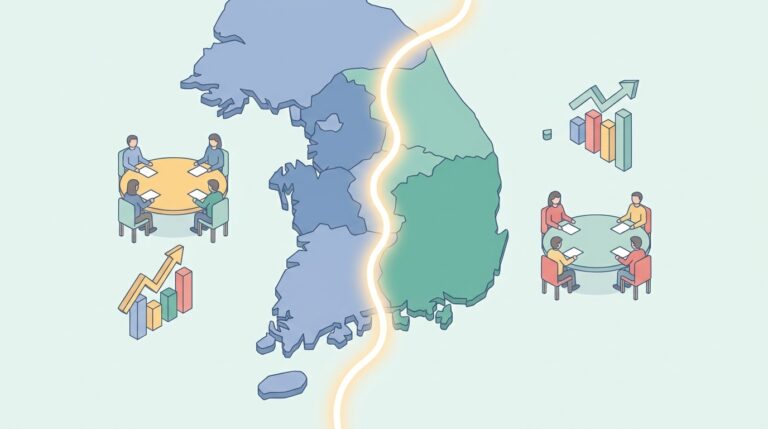
Navigating the Complexities of Inter-Korean Relations and Unification Costs
안녕하세요! Daily Hangul‘s Chief Editor and your personal cultural navigator here. Have you ever sat with Korean friends at a cozy pojangmacha (street food tent), sipping on soju, when the topic suddenly drifted from K-Dramas to the deep, nuanced waters of inter-Korean relations (남북 관계)?
As a C2-level learner, you aren’t just learning how to order food; you are mastering the art of high-level discourse. Many advanced learners tell me they feel hesitant to join these debates because the terminology feels incredibly heavy, and the socio-political emotional undercurrent (정서) is hard to grasp. Today, we will unpack the sophisticated vocabulary and cultural nuances surrounding the unique relationship between North and South Korea, and the pragmatic debate over unification costs (통일 비용).
Phase 2: Deep Dive into 3 Essential Expressions
1. 분단국가 (Divided Nation)
- Pronunciation: Bun-dan-guk-ga (Sounds like boon-dan-gook-gah)
- Meaning: Literally “divided nation.” It refers specifically to the geopolitical reality of the Korean Peninsula.
- K-Culture Moment: In the hit political thriller drama Crash Landing on You or the movie Joint Security Area (JSA), this term forms the foundational tension. Characters constantly navigate the tragedy of being a “divided nation.”
- Editor’s Insight: While “division” in English can sound purely administrative, 분단 carries a deep emotional weight of severed families (이산가족) and shared historical trauma.
- Situation Spectrum: Casual (⚠️ – too heavy for light banter) / Semi-formal (✅) / Formal (✅)
- 🤔 Think About It: How does your home country view its national borders compared to how Koreans view the heavily fortified DMZ as a symbol of temporary yet semi-permanent division?
2. 통일 비용 (Unification Costs)
- Pronunciation: Tong-il bi-yong (Sounds like tong-eel bee-yong)
- Meaning: Unification costs. The economic and social capital required to integrate the two Koreas.
- K-Culture Moment: Mentioned frequently in economic talk shows or political debates on channels like JTBC or KBS as younger generations voice concerns about tax hikes.
- Editor’s Insight: For the older generation, unification is a moral imperative (당위성). For the younger generation (MZ generation), it is increasingly viewed through a pragmatic, economic lens—hence the intense focus on “통일 비용.”
- Situation Spectrum: Casual (⚠️) / Semi-formal (✅) / Formal (✅)
- 🤔 Think About It: Is national identity built purely on shared ancestry, or does economic compatibility play a larger role in modern geopolitics?
3. 역사의 변곡점 (An Inflection Point in History)
- Pronunciation: Yeok-sa-ui byeon-gok-jeom (Sounds like yux-ah-ee byun-gok-jum)
- Meaning: An inflection point/turning point in history.
- K-Culture Moment: Used by news anchors during historic inter-Korean summits or major geopolitical shifts in East Asia.
- Editor’s Insight: This is a highly sophisticated, literary phrase. Utilizing “변곡점” (inflection point) instead of the simpler “전환점” (turning point) instantly elevates your Korean to a scholarly, statesman-like level.
- Situation Spectrum: Casual (🚫) / Semi-formal (⚠️) / Formal (✅)
- 🤔 Think About It: What moments in your own country’s history are universally agreed upon as a true “역사의 변곡점”?
Phase 3: Textbook Korean vs. Real-World Korean
Situation 1: Discussing the inevitability of unification
- 📖 Textbook Korean: “우리는 한민족이므로 반드시 통일해야 합니다.” (We must unify because we are one ethnic nation.)
- 🗣️ Real-World Korean: “감정적 당위성만으로 통일을 밀어붙이기엔, 젊은 세대의 경제적 부담이 너무 크지 않을까요?” (Isn’t the economic burden on the younger generation too heavy to push for unification solely based on emotional imperative?)
- 💡 Why the Difference? While textbooks focus on the traditional emotional sentiment of “one people” (한민족), modern intellectual discourse in Korea focuses heavily on pragmatic economic realities, cost-benefit analyses, and generational gaps in perception.
Situation 2: Describing unstable relations
- 📖 Textbook Korean: “남북 관계는 지금 나쁩니다.” (Inter-Korean relations are currently bad.)
- 🗣️ Real-World Korean: “남북 관계가 급격한 냉각기에 접어들면서, 지정학적 리스크가 다시 고조되고 있습니다.” (As inter-Korean relations enter a rapid cooling period, geopolitical risks are escalating once again.)
- 💡 Why the Difference? C2-level Korean requires using precise geopolitical vocabulary like “냉각기” (cooling period) and “지정학적 리스크” (geopolitical risk) rather than simple adjectives like “나쁘다” (bad).
Phase 4: K-Culture Deep Dive & Non-Verbal Manners
4-1. Geopolitical Nunchi (눈치) & Demeanor
When discussing inter-Korean relations in Korea, neutrality and intellectual empathy are key. Avoid overly dogmatic or highly opinionated statements early in the conversation. Instead, use a soft, contemplative head nod, look slightly downward when acknowledging the tragedies of the division, and use indirect phrasing like “~라는 시각도 있더라고요” (There is also a perspective that…) to show respect for the multi-faceted nature of the issue.
4-2. Cultural Code: The Cinema of Division
To truly understand the emotional landscape of this topic, watch movies like JSA (Joint Security Area) or The Spy Gone North (공작). They highlight the concept of 분단의 아픔 (the pain of division)—showing that beneath the political rhetoric, there is a deep, tragic human connection that transcends ideological lines. This dual reality of being technically at war (휴전) yet sharing the same cultural DNA is the core paradox of Korean foreign policy.
Phase 5: Interactive Roleplay Scenario
Setting: A high-level seminar reception in Seoul. You are speaking with Dr. Park (박 박사), a leading researcher in North Korean studies.
- 박 박사 (Dr. Park): “외국인의 시선에서 보시기에, 현재 한국의 통일 논의에서 가장 간과되고 있는 부분이 무엇이라고 생각하십니까?” (From a foreigner’s perspective, what do you think is the most overlooked aspect in Korea’s current unification debate?)
- You (C2 Learner): “🎭 Thinking deeply, speaking with a calm tone / 아무래도 단순한 경제적 통일 비용에만 매몰되어, 평화 공존으로 얻을 수 있는 ‘분단 비용’의 절감 효과를 간과하는 경향이 있는 것 같습니다.” (Perhaps we tend to be buried only in the economic costs of unification, overlooking the reduction of ‘division costs’ that peaceful coexistence could bring.)
- 박 박사 (Dr. Park): “아, 분단 비용(Division Costs)이라니! 매우 날카로운 지적이십니다. 사실 매년 소모되는 국방비와 지정학적 코리아 디스카운트만 줄여도 막대한 이득이니까요.” (Ah, division costs! That is a very sharp point. Indeed, just reducing the annual national defense spending and the geopolitical ‘Korea Discount’ would yield massive benefits.)
- You (C2 Learner): “🎭 Nodding in agreement / 맞습니다. 결국 통일은 단순한 사건이 아니라 오랜 기간에 걸친 역사의 변곡점이자 프로세스로 접근해야 할 것 같습니다.” (Exactly. Ultimately, unification should be approached not as a single event, but as a long-term historical inflection point and a continuous process.)
- 박 박사 (Dr. Park): “동감합니다. 하지만 젊은 세대들의 세금 부담 우려를 불식시키기가 쉽지 않네요. 이 간극을 어떻게 좁혀야 할까요?” (I agree. But it is not easy to dispel the younger generation’s worries about tax burdens. How should we bridge this gap?)
- You (C2 Learner): “🎭 Gesturing softly with hands / 당위성만을 강요하기보다는, 통일이 개인의 삶과 기회 창출에 어떤 실질적 이익을 주는지 구체적인 청사진을 제시해야 합니다.” (Rather than forcing only moral imperatives, we must present a concrete blueprint of how unification can offer practical benefits and opportunities for individual lives.)
- 박 박사 (Dr. Park): “역시 깊이 있는 통찰을 가지고 계시는군요. 다음 포럼에 토론자로 모시고 싶을 정도입니다.” (As expected, you possess deep insight. I would love to invite you as a panelist for our next forum.)
- You (C2 Learner): “🎭 Smiling modestly / 과찬이십니다. 한국의 특수한 상황을 이해하는 과정에서 저 또한 많은 것을 배우고 있습니다.” (You flatter me. I am also learning a great deal through the process of understanding Korea’s unique situation.)
🔀 Interactive Choice Points
If Dr. Park asks: “What is the biggest obstacle to unification right now?”
* Option A: “북한의 핵무기 개발과 군사적 도발이 가장 큰 걸림돌입니다.” (North Korea’s nuclear weapon development and military provocations are the biggest obstacles.)
* Feedback: Best (Safe & Fact-based). Direct, highly professional, and aligns with mainstream diplomatic discourse.
* Option B: “한국 젊은이들의 이기주의 때문입니다.” (It’s because of the selfishness of South Korean youth.)
* Feedback: Bad (Offensive). Labeling a generational economic anxiety as “selfishness” (이기주의) will alienate your conversation partner.
* Option C: “주변 강대국들이 한반도의 통일을 원하지 않기 때문 아닐까요?” (Isn’t it because neighboring superpowers do not want the unification of the Korean Peninsula?)
* Feedback: Risk (Provocative but intellectually engaging). It touches on sensitive geopolitics. Use only if you can back it up with sophisticated international relations terminology.
Phase 6: 10-Second Emotional Shadowing Drill
Practice saying this sentence with a balanced, analytical, yet empathetic tone. Pay attention to the pauses (/).
- Sentence: “남북 관계의 / 특수성을 고려할 때, / 단순한 감정적 접근보다는 / 철저한 비용 대비 편익 분석이 / 선행되어야 합니다.”
- Pronunciation Guide: Nam-buk gwan-gye-ui / teuk-su-seong-eul go-ryeo-hal ttae, / dan-sun-han gam-jeong-jeok jeop-geun-bo-da-neun / cheol-jeo-han bi-yong dae-bi pyeon-ik bun-seok-i / seon-haeng-deo-yeo-ya ham-ni-da.
- Emotional Signpost:
[🧠 Intellectually poised, speaking calmly and professionally] - Translation: “Considering the unique nature of inter-Korean relations, a thorough cost-benefit analysis must precede any simple emotional approach.”
Phase 7: K-Culture Mini-Dictionary
- 코리아 디스카운트 (Korea Discount) | The undervaluation of South Korean companies due to geopolitical risks surrounding North Korea.
- 이산가족 (Separated Families) | Families split between North and South Korea since the Korean War; a symbol of human tragedy.
- 햇볕정책 (Sunshine Policy) | The foreign policy of constructive engagement and warmth toward North Korea, famously initiated by President Kim Dae-jung.
- 흡수통일 (Unification by Absorption) | A scenario where one system completely absorbs the other (usually South absorbing North, similar to German reunification).
Phase 8: Traveler’s Geopolitical Survival Kit
- Expressing Neutrality: “이 문제는 워낙 다각적인 시각이 존재해서 조심스럽네요.” (This issue has so many diverse perspectives that I feel quite cautious discussing it.)
- Asking for Opinions gently: “혹시 한반도 평화 체제 구축에 대해 어떻게 생각하시나요?” (What are your thoughts on establishing a peace regime on the Korean Peninsula?)
- Wrapping up complex debates: “결국 평화로운 공존이 최우선 과제인 것 같습니다.” (In the end, peaceful coexistence seems to be the top priority.)
📌 Editor’s Note: When discussing sensitive topics, check the latest diplomatic atmosphere. Keep up to date on news via reliable sources such as the Yonhap News Agency English Version to understand current events in real-time.
Phase 9: “Going One Step Deeper” (Reflective Essay)
The word 우리 (Uri – We/Us) in Korean is highly inclusive, but when applied to North Korea, it reveals a fascinating psychological split. For the older generation, North Koreans are part of “우리” (our bloodline/minjok). For the younger generation, who grew up in an era of separation and economic disparity, North Korea is often viewed as a completely separate state. This shift from a “national family” to a “geopolitical neighbor” is perhaps the most significant cultural transition happening in Korea today.
💬 Your Turn
How is national identity defined in your country? Is it based on shared bloodline, shared values, or constitutional citizenship? Let’s discuss in the comments below!
Phase 10: FAQ & Avoiding Misunderstandings
Q: Can I talk about North Korea openly with my South Korean friends?
A: Yes, South Korea is a democratic nation with free speech. However, avoid making light of the threat of war, as military service is mandatory for South Korean men, making national security a highly personal and sensitive topic.
Q: Why do young Koreans seem less enthusiastic about unification?
A: It is primarily due to economic concerns. With high housing prices and competitive job markets, many young Koreans fear that the massive tax burden from “unification costs” would further jeopardize their economic future.
Q: Is the word “북괴” (North Korean puppets) okay to use?
A: Absolutely not. This is an extremely derogatory, politically charged historical term. Stick to neutral terms like “북한” (North Korea) or “북측” (the North side).
🚨 Common Mistakes Alert!
- Saying “빨갱이” (Communist/Red): This is a highly offensive political slur used to demonize political opponents. Never use it in academic or polite conversations.
- Confusing “통일 비용” (Unification Cost) with “분단 비용” (Division Cost): 통일 비용 is the cost of joining together. 분단 비용 is the ongoing cost of staying separated (defense, security). Mixing them up will confuse your argument.
- Using informal speech (반말) when discussing politics: Politics requires utmost respect. Always maintain polite honorifics (존댓말).
Phase 11: Action Missions
- 🥉 Bronze: Translate this sentence into your own words: “통일 비용은 단기적인 부담이지만, 장기적인 투자일 수 있습니다.”
- 🥈 Silver: Post a brief reflection on your Instagram or social media about a Korean division-themed movie (e.g., JSA or Crash Landing on You) using the tag
#DailyHanguland the word 분단국가. - 🥇 Gold: In your next conversation with a Korean friend, use the phrase 역사의 변곡점 to describe a major political event in your home country.
Phase 12: Interactive Quiz Challenge
1. Which term refers to the economic undervaluation of Korean stocks due to North Korean risks?
* A) 통일 비용 (Tong-il bi-yong)
* B) 코리아 디스카운트 (Korea Discount)
* C) 분단 비용 (Bun-dan bi-yong)
Click here for the Answer & Explanation
Correct Answer: B
Explanation: The “Korea Discount” specifically refers to the financial markets discounting South Korean stocks due to the geopolitical tensions with North Korea.
2. True or False: For C2 level discussions, saying “남북 관계가 나빠요” is the most natural and professional way to describe geopolitical tension.
* True
* False
Click here for the Answer & Explanation
Correct Answer: False
Explanation: While grammatically correct, it is too simple. A C2 learner should use more sophisticated phrasing like “남북 관계가 냉각기에 접어들었습니다” (Inter-Korean relations have entered a cooling period).







