

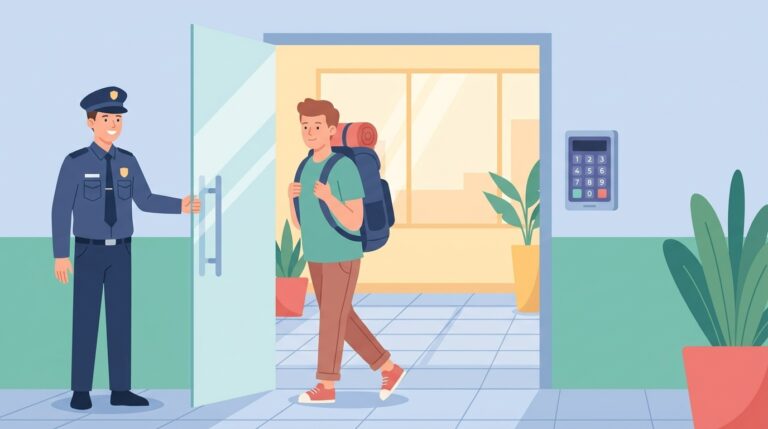
Master the Korean Apartment Common Entrance: Speak Like a Local From Day One
Phase 1: Empathy (Welcome to the Neighborhood!)
안녕하세요! (Annyeonghaseyo!) Hello there, future Seoulites and K-culture lovers! It’s your Korean bestie and Daily Hangul’s Senior Editor here.
Imagine this: You’ve just arrived at a beautiful high-rise Korean apartment (apateu, 아파트) after a long flight. You have three heavy suitcases, the air is crisp, and you are standing right in front of the common entrance (공동 현관 – gongdong hwangwan). There is a sleek digital keypad blinking at you. You press the buttons, but the door won’t open. Suddenly, a delivery rider or a friendly neighbor walks up behind you. Your heart races. How do you say “Could you open the door?” or “I am a guest in Room 104” without sounding like a robot?
Many of my students have shared how intimidating this exact moment can be. But don’t worry! Today, we are going to learn the absolute simplest, most practical A1-level expressions to help you breeze through the common entrance with confidence. Let’s make you look like a local who does this every single day!
Phase 2: Deep Dive into 3 Essential Expressions
Let’s break down the three most important phrases you’ll need at the common entrance.
1. 문 좀 열어 주세요 (Mun jom yeoreojuseyo)
- Pronunciation: Moon jom yuh-ruh-joo-seh-yo (Sounds like “Moon” + “jam” but with an ‘o’ + “yuh-ruh-jew-say-yo”)
- Meaning: Please open the door.
- K-Culture Moment: You’ve seen this in almost every K-drama! A character arrives home with hands full of fried chicken or groceries, looking helplessly at the security camera or a family member inside.
- Editor’s Insight: “문” (mun) means door, and “열어 주세요” (yeoreojuseyo) means “please open.” The magic word here is “좀” (jom). It literally means “a little,” but in Korean, it softens your request, making you sound extremely polite and natural!
- Situation Spectrum: Casual (⚠️) / Semi-formal (✅) / Formal (✅)
- 🤔 Think About It: In your home country, do you use a word like “just” or “a little” to make polite requests? How does it compare to the Korean “좀” (jom)?
2. 몇 호 가세요? (Myeot ho gaseyo?)
- Pronunciation: Myut ho gah-seh-yo? (Sounds like “Mee-yut” + “ho” + “gah-say-yo”)
- Meaning: Which unit/room number are you going to?
- K-Culture Moment: A kind elderly security guard (gyeongbi-ajeossi, 경비아저씨) pops his head out of his office near the entrance when he sees you struggling with the keypad.
- Editor’s Insight: “몇” (myeot) means “which/how many,” and “호” (ho) is the counter for room/apartment numbers. “가세요?” (gaseyo) means “Are you going?” Security guards or neighbors will ask this to help you dial in or to check if you belong in the building.
- Situation Spectrum: Casual (🚫) / Semi-formal (✅) / Formal (✅)
- 🤔 Think About It: Koreans value community safety, which is why neighbors or guards might ask where you are heading. It’s not nosiness; it’s caring safety!
3. 비밀번호가 뭐예요? (Bimilbeonhoga mwoyeyo?)
- Pronunciation: Bee-meel-bun-ho-gah mwo-yeh-yo? (Sounds like “Be-meal” + “bun-ho” + “gah” + “mo-ye-yo”)
- Meaning: What is the password/passcode?
- K-Culture Moment: You are staying at an Airbnb, and the host forgot to send you the digital door lock code. You text them this exact phrase!
- Editor’s Insight: “비밀번호” (bimilbeonho) is a combination of “비밀” (secret) and “번호” (number). “뭐예요?” (mwoyeyo) is the A1-standard way of asking “What is…?”
- Situation Spectrum: Casual (⚠️) / Semi-formal (✅) / Formal (✅)
- 🤔 Think About It: Why do you think Korea adopted digital keypads for almost every apartment entrance instead of physical metal keys? (Hint: Speed and convenience are core Korean values!)
Phase 3: Textbook Korean vs. Real-Life Korean
Let’s compare what dry textbooks teach you versus how Koreans actually talk in real life!
Situation A: Asking for the door lock code
- 📖 Textbook: “공동 현관의 비밀번호를 알려주십시오.” (Gongdong hwangwanui bimilbeonhoreul allyeojusipsio. – “Please inform me of the common entrance passcode.”) -> Too stiff, sounds like a military command!
- 🗣️ Real-Life: “비밀번호 좀 알려주세요.” (Bimilbeonho jom allyeojuseyo. – “Please let me know the password.”)
- 💡 Why the difference? Real Koreans prefer shorter, softer requests using “좀” (jom) and the friendly “-아/어 주세요” (-a/eo juseyo) ending.
Situation B: When a neighbor asks where you are going
- 📖 Textbook: “저는 백사 호에 거주하는 사람의 손님입니다.” (Jeoneun baek-sa hoe geojuhaneun saramui sonnimimnida. – “I am a guest of the person residing in Room 104.”) -> Way too long and robotic!
- 🗣️ Real-Life: “백사 호요!” (Baek-sa ho-yo! – “Room 104!”)
- 💡 Why the difference? In busy daily situations like entering an elevator or a lobby, adding “-요” (yo) to the room number is polite enough, incredibly fast, and perfectly natural.
Phase 4: K-Culture Deep Dive & Non-Verbal Manners
4-1. Nunchi (눈치) & Body Language
When standing at the common entrance of a Korean apartment, Nunchi (tact/situational awareness) is your best friend.
* The “Half-Bow” Gesture: If an resident opens the door with their keycard and holds it for you, do not just walk in. Make eye contact, bow your head slightly (about 15 degrees), and say a quick “감사합니다” (Gamsahamnida – Thank you).
* The Password Block: If you are entering the passcode, it is common courtesy to block the keypad slightly with your hand so others cannot easily see your code. It’s a universal safety habit in Korea!
4-2. The “Delivery Heaven” Culture
Korea is famous for its ultra-fast delivery services like Coupang Rocket Delivery and Baemin (food delivery). Because of this, the common entrance is always busy. Delivery riders often press the intercom button and yell “택배요!” (Taekbaeyo! – Delivery!) or “배달이요!” (Baedariyo! – Food delivery!) to get inside. Knowing this will help you understand the quick exchanges you hear in the lobby!
Phase 5: Real-Life Roleplay Scenario
Setting: You have just arrived at a cozy apartment building in Mapo, Seoul. You are carrying a backpack, looking at the common entrance screen. A friendly security guard, Mr. Kim (경비원), steps out to help you.
1. 경비원: 안녕하세요. 어디 가세요?
   (Annyeonghaseyo. Eodi gaseyo?)
   "Hello. Where are you going?"

2. 나 (You): 🎭 (Smiling warmly, pointing up)
   안녕하세요. 백사 호 가요.
   (Annyeonghaseyo. Baek-sa ho gayo.)
   "Hello. I'm going to Room 104."

3. 경비원: 아, 백사 호요? 비밀번호 아세요?
   (Ah, baek-sa ho-yo? Bimilbeonho aseyo?)
   "Ah, Room 104? Do you know the passcode?"

4. 나 (You): 🎭 (Scratching your head, looking embarrassed)
   아니요, 몰라요. 문 좀 열어 주세요.
   (Aniyo, mollayo. Mun jom yeoreojuseyo.)
   "No, I don't know. Please open the door."

5. 경비원: 네, 열어 드릴게요. 들어가세요.
   (Ne, yeoreodirilgeyo. Deureogaseyo.)
   "Okay, I will open it for you. Please go in."

6. 나 (You): 🎭 (Bowing politely)
   정말 감사합니다!
   (Jeongmal gamsahamnida!)
   "Thank you so much!"
🔀 Interactive Choice Point
The security guard asks: “몇 호 가세요?” (Which room are you going to?)
- Choice A: “백사 호요.” (Baek-sa ho-yo.)
- 💖 Best: Polite, clear, and perfectly natural for an A1 learner!
- Choice B: “백사 호.” (Baek-sa ho.)
- ⚠️ Risk: Skipping the “요” (yo) makes it informal (banmal). Since the guard is an elder, this might sound slightly rude.
- Choice C: “비밀번호가 뭐예요?” (Bimilbeonhoga mwoyeyo?)
- 🚫 Bad: Replying “What is the password?” when asked where you are going sounds defensive and avoids the question!
Phase 6: 10-Second Emotional Shadowing Drill
To sound natural, you need the right rhythm and emotion! Practice saying these out loud:
- [😊 Friendly & Polite]
안녕하세요! / 백사 호 / 가요.
(An-nyeong-ha-se-yo! / Baek-sa ho / gah-yo.) -
[🥺 Slightly Helpless & Pleading]
문 / 좀 / 열어 주세요~
(Mun / jom / yeo-ruh-joo-seh-yo~) -
[💖 Extremely Grateful]
정말 / 감사합니다!
(Jeong-mal / gam-sa-ham-ni-da!)
Phase 7: K-Culture Mini-Dictionary
- 공동 현관 (Gongdong Hwangwan) | Common/Main Entrance of a building.
- 비밀번호 (Bimilbeonho) | Passcode / PIN number.
- 경비실 (Gyeongbisil) | Security office / guard room located near the lobby.
- 호수 (Hosu) | Unit/Room number (e.g., 104호 is Baek-sa ho).
Phase 8: Survival Kit for Travelers
Survival Phrases TOP 3
- 여기 어떻게 들어가요? (Yeogi eotteoke deureogayo?)
- Pro Tip: “How do I enter here?” Use this if you are completely lost in front of the gate.
- 경비실이 어디예요? (Gyeongbisiri eodiyeyo?)
- Pro Tip: “Where is the security office?” Perfect when you need to find the guard for assistance.
- 카드키가 안 돼요. (Kadeukiga an dwaeyo.)
- Pro Tip: “My card key is not working.” Use this at the lobby desk if your RFID card fails.
🗺️ Editor’s Travel Note: When traveling in Korea, make sure to download the Naver Map App for highly precise building layouts and entrance locations. Google Maps often doesn’t show the exact location of apartment gates! (Note: App availability and interfaces are subject to change over time.)
Phase 9: “Going Deeper” (Cultural Reflection)
In Korea, the apartment is not just a building; it is a shared vertical village. Because of this, the “common entrance” acts as a boundary between the public street and private neighborhood safety. Respecting this space by keeping it quiet, holding doors for neighbors, and greeting the security guard (경비아저씨) is an essential part of Korean everyday harmony.
💬 Your Turn: Have you ever stayed in a modern apartment building with a security gate? How does it feel compared to the entryways in your hometown? Let us know in the comments below!
Phase 10: FAQ & Common Mistakes
Q: How do I read unit numbers like 104 or 1205?
A: We use Sino-Korean numbers!
* 104호 is read as 백사 호 (Baek-sa ho) [100 (백) + 4 (사)].
* 1205호 is read as 천이백오 호 (Cheon-i-baek-o ho) [1000 (천) + 200 (이백) + 5 (오)].
Q: Can I just slip in behind someone else without saying anything?
A: It is common, but it’s polite to make eye contact, nod slightly, and say “감사합니다” (Gamsahamnida) so you don’t look suspicious!
Q: What should I do if the intercom rings from the lobby to my room?
A: Simply pick up the phone, say “여보세요” (Yeoboseyo – Hello), and if it’s a delivery, say “문 열어 주세요” (Mun jom yeoreojuseyo) and press the ‘key’ button on your wall pad.
🚨 Common Mistakes Alert!
- Mistake 1: Saying “Open the door” as “문 열어” (Mun yeoreor).
- Why: This is informal language. Always add “주세요” (juseyo) to keep it polite!
- Mistake 2: Reading “호” as “번” (beon).
- Why: “번” is for generic numbers (like phone numbers). Apartment units always use “호” (ho).
Phase 11: Action Missions
- 🥉 Bronze Medal: Read the 3 core expressions out loud 5 times in front of your mirror.
- 🥈 Silver Medal: Share this post on your social media with the hashtag
#DailyHanguland write down your favorite expression from today. - 🥇 Gold Medal: Next time you watch a K-drama, try to spot the moment characters enter an apartment lobby and listen to what they say!
Phase 12: Interactive Quiz Challenge!
Test your knowledge below! Click on the toggle to check the answers.
1. What is the polite way to ask a guard to open the door?
- A) 문 열어
- B) 문 좀 열어 주세요
- C) 비밀번호
🔍 Click to see the Answer & Explanation
Correct Answer: B
Adding “좀” (softener) and “-주세요” (please) makes “문 좀 열어 주세요” the most natural and polite way to make a request!
2. True or False: You should use “번” (beon) to count room numbers (e.g., Room 104).
🔍 Click to see the Answer & Explanation
Correct Answer: False
We always use “호” (ho) for unit/room numbers in Korean apartments! (e.g., 백사 호)






