

Master Level Urbanism: Elevating Your Korean Beyond the Blueprint
안녕하세요! Welcome back to another edition of Daily Hangul (매일한글). I’m your resident cultural navigator and senior editor.
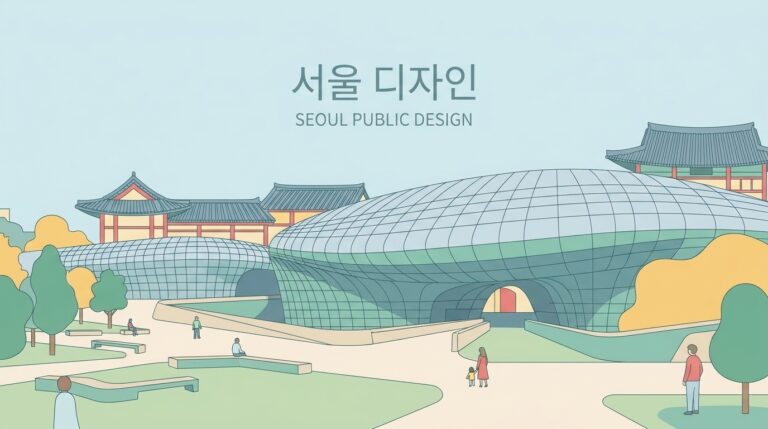
Have you ever strolled through Seoul’s Dongdaemun Design Plaza (DDP), or wandered through the transformed alleys of the Ikseon-dong Hanok Village? If so, you’ve witnessed Korea’s rapid transformation through urban regeneration and public design.
But here’s the challenge: When discussing these complex architectural marvels, the standard classroom Korean—designed for “ordering coffee” or “booking a hotel”—fails us. Advanced learners (CEFR C1) often struggle to articulate their critiques of urban space. Today, we’ll bridge that gap so you can analyze, critique, and appreciate Korean urban aesthetics just like a local architect.
Phase 1: Empathy (A Tale of Two Cities)
Imagine sitting in a sleek café overlooking the Cheonggyecheon Stream. You’re discussing the area’s transformation with a Korean colleague. You want to say, “The way they integrated the natural stream with the industrial ruins is a masterclass in urban rebirth.”
Instead, you find yourself saying: “이 강이 아주 예쁘고… 옛날 도시를 새롭게 만들었어요.” (This river is very pretty… and they made the old city new.) It’s grammatically correct, but it lacks the intellectual heft and nuance that match your actual professional intellect.
Our advanced learners constantly tell us: “I can read high-level news articles, but when discussing public design, I sound like a child.” Don’t worry. Today’s guide will equip you with the precise vocabulary and cultural insights to hold your own in any design studio or urban planning forum in Seoul.
Phase 2: Core Expressions Deep Dive
Let’s master three high-impact expressions that will immediately elevate your architectural discourse.
1. 도시의 맥락을 살리다 (Dosi-ui maeknag-eul sallida)
- Pronunciation: Doh-shee-ui maek-nahk-eul sahl-lee-dah (Think of “maek-nahk” as the pulse or ‘context’ of a city, and “sallida” as bringing it back to life).
- Meaning: To preserve and revive the urban context/heritage.
- K-Culture Moment: You’ll hear this constantly in design documentaries on JTBC or urban planning vlogs discussing how old industrial complexes in Seongsu-dong were transformed into trendy cultural spaces.
- Editor’s Insight: 맥락 (maegnak) literally means “context” or “pulse.” When you say you are “saving the context,” you mean you are not just demolishing old buildings (redevelopment), but weaving their history into the new design (regeneration).
- Situation Spectrum: Casual (⚠️ – too formal for casual chit-chat) | Semi-formal (✅) | Formal (✅)
- 🤔 Think About It: Does your native culture favor demolition and rebuilding (재개발), or preserving the historical “context” (맥락)?
2. 주변 경관과 어우러지다 (Jubyeon gyeonggwan-gwa eoureojida)
- Pronunciation: Joo-byeon gyeong-gwan-gwah eo-oo-reo-jee-dah (The “eo-oo-reo” rolls smoothly, mimicking the harmony it describes).
- Meaning: To blend harmoniously with the surrounding landscape.
- K-Culture Moment: Used by architects explaining why a new skyscraper’s facade reflects the surrounding mountains or traditional Hanok roofs.
- Editor’s Insight: 어우러지다 is a beautiful native Korean verb meaning to blend, harmonize, or mingle. It goes beyond mere visual match; it implies a deep, organic coexistence.
- Situation Spectrum: Casual (✅ – “여기 인테리어 주변이랑 잘 어우러진다!”) | Semi-formal (✅) | Formal (✅)
- 🤔 Think About It: How does your city manage the visual tension between historical landmarks and modern steel towers?
3. 시민들의 발길을 이끌다 (Simindeul-ui balgil-eul ikkeulda)
- Pronunciation: Shee-min-deul-ui bahl-gheel-eul ee-kkeul-dah (Feel the light bounce on “bal-gil”, which literally means “foot-steps”).
- Meaning: To draw the footsteps of citizens; to attract public engagement.
- K-Culture Moment: Often found in Seoul Metropolitan Government press releases detailing the success of pedestrian-friendly zones like the Seoullo 7017 sky garden.
- Editor’s Insight: Instead of the generic “사람들이 많이 오다” (many people come), using 발길을 이끌다 adds a poetic, dynamic movement to your description.
- Situation Spectrum: Casual (⚠️) | Semi-formal (✅) | Formal (✅)
- 🤔 Think About It: What kind of public design or installation successfully draws your footsteps in your hometown?
Phase 3: Textbook Korean vs. Real-World Korean
Let’s look at how everyday textbook Korean differs from C1-level professional native phrasing.
Scenario A: Describing a renovated old building
- 📖 Textbook: “오래된 건물을 고쳐서 멋지게 만들었습니다.” (They fixed the old building and made it cool.)
- 🗣️ Real-World: “낙후된 산업 유산의 원형을 보존하면서도 현대적으로 재해석했네요.” (They preserved the original form of the dilapidated industrial heritage while modernizing its interpretation.)
- 💡 Why it matters: Advanced Korean speakers use terms like 원형 보존 (preservation of original structure) and 재해석 (reinterpretation) to show intellectual depth.
Scenario B: Critiquing a chaotic street layout
- 📖 Textbook: “길이 너무 복잡하고 간판이 안 예뻐요.” (The street is too complex and the signs are not pretty.)
- 🗣️ Real-World: “간판들이 너무 난립해 있어서 도시 미관을 해치고 있어요.” (The signs are so disorderly and unregulated that they are ruining the city’s aesthetic.)
- 💡 Why it matters: 도시 미관 (urban aesthetics) and 난립하다 (to overflow/exist in a disorderly manner) are standard C1 terms used in urban criticism.
Phase 4: K-Culture Deep Dive & Non-Verbal Manners
4-1. Gestures & Eye Contact in Professional Dialogues
When discussing design or aesthetics with Korean professionals, avoid aggressive finger-pointing at blueprints or sites. Instead, use an open palm to point gently towards a structure. Maintain a contemplative nod (고개를 끄덕이다) and say “음… (Hmm…)” or “그렇군요 (I see)” before offering a counter-opinion. This shows you respect their design philosophy before introducing your own critique.
4-2. The Rise of ‘Newtro’ (뉴트로) in Seoul
Seoul is currently obsessed with Newtro (New + Retro). Look at the redevelopment of old breweries, public bathhouses, or abandoned train tracks (like the Gyeongui Line Forest Park). When discussing these areas, understanding the cultural pride Koreans feel toward preserving their rapid mid-20th-century modernization history is key. It’s not just “old stuff”; it’s the living history of their parents’ grit.
Phase 5: Real-World Roleplay Scenario
Setting: You are visiting the newly renovated “Nodeul Island” (노들섬) on the Han River with Min-woo, a local urban architect.
- Min-woo (민우): “이번 노들섬 프로젝트, 솔직히 어떻게 보셨어요?”
- You (C1 Learner): “대단히 인상적이었어요. 특히 / 서울의 자연과 / 주변 경관이 어떻게 어우러지는지 고민한 흔적이 보이더군요.”
- Min-woo (민우): “오, 그렇게 봐주시니 다행이네요. 어떤 부분이 가장 마음에 드셨나요?”
- You (C1 Learner): “인공적인 구조물을 최소화하고 / 도시의 맥락을 살린 점이 돋보였습니다.”
- Min-woo (민우): “그렇죠. 하지만 일각에서는 접근성이 떨어져서 시민들의 접근을 막는다는 비판도 있어요.”
- You (C1 Learner): “일리가 있는 지적입니다. 하지만 보행교가 완공되면 / 자연스럽게 시민들의 발길을 이끌 수 있을 것이라 봅니다.”
- Min-woo (민우): “역시 날카로우시네요. 디자인뿐만 아니라 공공의 기능성까지 내다보시다니요!”
- You (C1 Learner): “과찬이십니다. 공공 디자인은 결국 / 사람을 향해야 하니까요.”
🔀 Interactive Path Selection
How do you respond to Min-woo’s final compliment?
* A) “네, 맞아요. 제가 디자인 전공이라서 잘 압니다.” (Yes, correct. I majored in design so I know well.)
* B) “아니에요, 그냥 대충 보고 말씀드린 건데요.” (No, I just spoke off the cuff without thinking.)
* C) “그렇게 봐주시니 감사합니다. 한국의 공공 디자인은 요즘 세계적으로도 주목받고 있잖아요.” (Thank you for saying so. Korean public design is actually gaining global attention these days.)
💡 Feedback
- Path A (Risk): Too blunt and borderline arrogant. Korean professional circles favor humility.
- Path B (Bad): Excessive self-deprecation that undermines your own brilliant analysis.
- Path C (Best): Gracious, accepts the compliment, and connects it back to a macro cultural trend. Highly sophisticated!
Phase 6: 10-Second Emotional Shadowing Drill
Practice these with correct emotional pacing and pauses (/ indicates a natural breath pause).
[🧐 Thoughtful & Impressed]
“이 공간은 / 단순히 건물을 짓는 것을 넘어 / 도시의 숨통을 틔워주는 역할을 하네요.”
(This space does more than just construct buildings; it acts as a breathing space for the city.)-
[😔 Slightly Critical]
“과도한 랜드마크 위주의 건축은 / 오히려 주변 경관과의 조화를 해칠 수 있습니다.”
(An excessive focus on landmark architecture can actually disrupt the harmony with the surrounding landscape.)
Phase 7: K-Culture Mini Dictionary
- 도시 재생 (Dosi Jaesaeng): Urban Regeneration. Unlike “재개발” (demolition and reconstruction), this focusing on revitalizing neighborhoods while keeping their historic soul.
- 보행자 친화 (Bohaengja Chinhwa): Pedestrian-friendly. A key goal of modern Seoul infrastructure.
- 도시 미관 (Dosi Migwan): Urban Aesthetics. Refers to the visual cleanliness, signage regulations, and overall beauty of cityscapes.
- 핫플레이스 (Hot Place): Trendy areas. Often used to describe regenerated alleys (e.g., Seongsu, Mullae-dong) that have become social media magnets.
Phase 8: Travel & Urban Exploration Survival Kit
Survival Phrases
- “여기 옛날에는 어떤 곳이었어요?” (What used to be here in the past?) – Perfect for asking museum docents or locals at a regenerated café.
- “전망을 한눈에 볼 수 있는 곳이 어디인가요?” (Where is a place where I can see the entire panorama?)
- “이 근처에 걷기 좋은 골목길이 있나요?” (Are there any nice alleyways to walk along near here?)
Editor’s Travel Note
When navigating Seoul’s architectural highlights, Google Maps won’t cut it. Download the Naver Map App for pinpoint pedestrian routing through historical alleys. Also, visit the Seoul Hall of Urbanism & Architecture near Deoksugung Palace to see temporary exhibits on the city’s future projects for free!
Phase 9:
Frequently Asked Questions (FAQ)
Q: What does "도시의 맥락을 살리다 (Dosi-ui maeknag-eul sallida)" mean in Korean and how do you pronounce it?
A: In Korean, "도시의 맥락을 살리다 (Dosi-ui maeknag-eul sallida)" is pronounced [Doh-shee-ui maek-nahk-eul sahl-lee-dah (Think of "maek-nahk" as the pulse or 'context' of a city, and "sallida" as bringing it back to life] and means: To preserve and revive the urban context/heritage.
Q: What does "주변 경관과 어우러지다 (Jubyeon gyeonggwan-gwa eoureojida)" mean in Korean and how do you pronounce it?
A: In Korean, "주변 경관과 어우러지다 (Jubyeon gyeonggwan-gwa eoureojida)" is pronounced [Joo-byeon gyeong-gwan-gwah eo-oo-reo-jee-dah (The "eo-oo-reo" rolls smoothly, mimicking the harmony it describes] and means: To blend harmoniously with the surrounding landscape.
Q: What does "시민들의 발길을 이끌다 (Simindeul-ui balgil-eul ikkeulda)" mean in Korean and how do you pronounce it?
A: In Korean, "시민들의 발길을 이끌다 (Simindeul-ui balgil-eul ikkeulda)" is pronounced [Shee-min-deul-ui bahl-gheel-eul ee-kkeul-dah (Feel the light bounce on "bal-gil", which literally means "foot-steps"] and means: To draw the footsteps of citizens; to attract public engagement.







