

Conquer Korea’s Peaks Safely: Mastering the ‘입산 통제 기간’ (Seasonal Forest Fire Prevention Closures)
Phase 1: Empathy (An Editor’s Trailside Confession)
안녕하세요! It’s your K-culture navigator and Daily Hangul Editor, back with some tough-love trail wisdom.
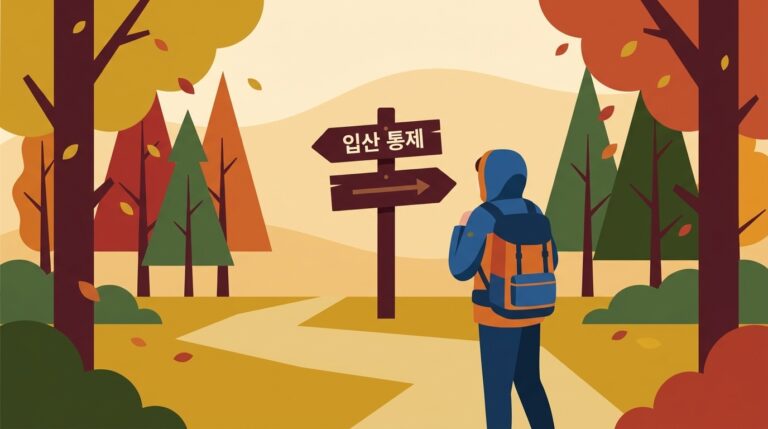
Imagine this: You’ve packed your hiking poles, laced up your trusty boots, and taken a two-hour bus ride from Seoul to the breathtaking Seoraksan National Park (설악산 국립공원). The air is crisp, the autumn leaves or spring blossoms are calling your name, and you can practically taste the rewarding pajeon (scallion pancake) and makgeolli (rice wine) at the trail’s end. But as you approach the trailhead, you are met with a giant, unyielding banner: ‘입산 통제’ (No Entry / Trail Closed).
Your heart sinks. You check your phone, but the online maps didn’t make this closure clear. Many of our advanced C1 learners—even those who can read Korean newspapers—frequently run into this exact wall because they aren’t familiar with Korea’s seasonal forest conservation systems.
This guide is built from real-life trail mishaps reported by our global community. Today, we aren’t just learning vocabulary; we are mastering the nuanced administrative, cultural, and environmental language you need to confidently navigate Korea’s mountain culture like a true local deungsan (hiking) pro.
Phase 2: Deep-Dive into the Top 3 Trailside Expressions
1. 입산 통제 (Ipsan Tong-je)
- Pronunciation: Ip-san tong-je (Sounds like “Ip” as in ‘sip’ + “san” as in ‘sand’ + “tong” as in ‘tongs’ + “je” as in ‘jest’)
- Meaning: Mountain Entry Restriction / Trail Closure
- K-Culture Moment: You will see this bolded in red on banners at the entrance of national parks or flashing on digital boards in subway stations near major hiking hubs like Bukhansan.
- Editor’s Insight: Ipsan (입산) literally means “entering the mountain” (입 = enter, 산 = mountain), and tongje (통제) means “control/restriction.” Unlike a simple “closed” sign, ipsan tongje carries legal weight. Disobeying it can result in heavy fines up to 500,000 KRW!
- Situation Spectrum: Casual 🚫 | Semi-formal ✅ | Formal ✅ (Highly administrative)
- 🤔 Think About It: In many Western countries, trails are hiked at your own risk year-round. Why does the Korean government take such a collective, hands-on approach to managing public nature spaces?
2. 산불 조심 기간 (San-bul Jo-sim Gi-gan)
- Pronunciation: San-bul jo-sim gi-gan (Sounds like “San” + “bul” as in ‘bull’ + “jo-sim” as in ‘caution’ + “gi-gan” as in ‘key-gone’)
- Meaning: Forest Fire Prevention Period
- K-Culture Moment: In K-Dramas featuring rural settings or mountain rangers, you’ll often see local volunteers wearing red vests patrolling the trails during early spring and late autumn chanting or carrying signs with this phrase.
- Editor’s Insight: Korea has two major dry seasons highly prone to forest fires: Spring (typically Feb 15 – May 15) and Autumn (typically Nov 1 – Dec 15). During these windows, large swaths of national parks are strictly off-limits to allow the ecosystem to rest and prevent devastating dry-season fires.
- Situation Spectrum: Casual ⚠️ | Semi-formal ✅ | Formal ✅
- 🤔 Think About It: How does your home country balance environmental preservation with public recreational access during dry seasons?
3. 우회로를 이용해 주세요 (U-hoe-ro-reul I-yong-hae Ju-se-yo)
- Pronunciation: Oo-hwe-ro-reul ee-yong-hae joo-seh-yo (Sounds like “Oo” + “hway” + “ro” as in ‘road’ + “reul” + “ee-yong” + “hae” + “joo-seh-yo”)
- Meaning: Please use the detour route.
- K-Culture Moment: When a ranger stops you at a closed trail fork, they will politely point toward an alternative path and use this phrase.
- Editor’s Insight: Uhoero (우회로) combines uhoe (detour/bypass) and ro (path/road). In Korean hiking culture, being turned away from a peak isn’t the end of the day—there is almost always a scenic lower-valley detour readily available.
- Situation Spectrum: Casual ⚠️ | Semi-formal ✅ | Formal ✅
- 🤔 Think About It: Notice how the Korean language frames directions indirectly (“use the detour”) rather than a blunt “Go back.” How does this reflect Korean politeness standards?
Phase 3: Textbook Korean vs. Real-World Korean
Advanced learners often sound too robotic on the trails. Let’s compare the sterile classroom phrasing with what seasoned hikers actually say.
Situation 1: Asking if a trail is open
- 📖 Textbook Korean: “이 등산로가 열려 있습니까?” (I deungsanroga yeollyeo isseumnikka? – Is this hiking trail open?)
- 🗣️ 진짜 Korean: “혹시 지금 이 코스 통제 구간인가요?” (Hoksi jigeum i koseu tongje guganingayo? – By any chance, is this course currently a restricted section?)
- 💡 Why the difference? Locals refer to specific hiking paths as “코스” (courses) or “구간” (sections) rather than the generic “등산로”. Using “혹시” (by any chance) softens the question beautifully.
Situation 2: Expressing disappointment about a closed trail
- 📖 Textbook Korean: “등산로가 닫혀서 매우 슬픕니다.” (Deungsanroga dachyeoseo maeu seulpeumnida. – I am very sad because the trail is closed.)
- 🗣️ 진짜 Korean: “아쉽게도 이번 시즌에는 입산 통제에 걸렸네요.” (Aswipgedo ibeon sijeuneneun ipsan tongjee geollyeonneyo. – Regrettably, we got caught by the mountain closure this season.)
- 💡 Why the difference? “걸리다” (to get caught/blocked by) is the natural idiomatic verb to use when your plans are thwarted by administrative schedules. “아쉽다” (to be a pity/regrettable) is far more natural than “슬프다” (sad) for missed recreational opportunities.
Phase 4: K-Culture Deep Dive & Non-Verbal Manners
4-1. Hiking Etiquette and ‘Nunchi’ on the Trail
In Korea, hiking is a highly socialized subculture with its own unspoken rules of Nunchi (social sensing):
* The Trail Greeting: When passing hikers on a narrow, steep path, it is customary to offer a cheerful, low-toned “안녕하세요” (Annyeonghaseyo) or “수고하십니다” (Sugohasipnida – “Thank you for your hard work/effort”). Keep your voice moderate; shouting in the quiet woods is considered bad manners.
* The Right of Way: Downhill hikers should yield to uphill hikers. Step to the side, make eye contact, and nod politely to let the ascending hiker pass.
4-2. The Peak-Season Culture: ‘Danpung’ and ‘Baekdu-daegan’
For Koreans, hiking is not just physical exercise; it’s a spiritual pilgrimage. During the autumn Danpung (crimson foliage) season, mountains like Seoraksan and Naejangsan draw millions. Understanding the seasonal cycles of the Baekdu-daegan (the mountainous spine of the Korean Peninsula) will help you plan around the Sanbul Josim Gigan so you don’t miss the peak colors.
Phase 5: Real-World Roleplay Scenario
Setting: You are at the base of Jirisan National Park (지리산 국립공원) in mid-November. You want to hike to the peak, but a park ranger (지킴이) is standing near a wooden barrier with a map.
Characters:
- 유진 (You): An eager advanced hiker.
- 지킴이 (Ranger Mr. Park): A friendly but firm park ranger.
- 유진: 안녕하세요! 오늘 천왕봉 코스로 올라가려는데, 이쪽 길로 가면 되나요?
(Annyeonghaseyo! Oneul Cheonwangbong koseuro ollegaryeoneunde, ijjok gillo gamyeon doenayo?)
Translation: Hello! I’m planning to go up the Cheonwangbong route today, do I go this way? -
지킴이: (Hand gesturing to the wooden barrier) 아, 오늘부터 산불 조심 기간이라 그 코스는 지금 입산 통제 중입니다.
(Ah, oneulbuteo sanbul josim giganira geu koseuneun jigeum ipsan tongje jung-imnida.)
Translation: (Hand gesturing to the wooden barrier) Ah, starting today is the Forest Fire Prevention Period, so that course is currently under mountain entry restriction. -
유진: (Slightly disappointed) 아, 정말요? 미리 확인을 못 했네요. 대피소 예약도 안 되는 건가요?
(Ah, jeongmalyo? Miri hwagineul mot haenneyo. Daepiso yeyakdo an doeneun geongayo?)
Translation: (Slightly disappointed) Oh, really? I couldn’t check in advance. Are shelter reservations also not available? -
지킴이: 네, 통제 기간에는 고지대 대피소 이용도 완전히 제한됩니다. 생태계 보호와 산불 예방을 위한 조치이니 양해 부탁드립니다.
(Ne, tongje giganeneun gojidae daepiso iyongdo wanjeonhi jehandoemnida. Saengtaege boho-wa sanbul yebangeul wihan jochi-ini yanghae butangdimnida.)
Translation: Yes, during the closure period, the use of high-altitude shelters is also completely restricted. It is a measure for ecological protection and fire prevention, so we ask for your understanding. -
유진: 그렇군요. 그럼 오늘 갈 수 있는 다른 안전한 코스가 있을까요?
(Geureokunyo. Geureom oneul gal su inneun dareun anjeonhan koseuga isseulkkayo?)
Translation: I see. Then is there another safe course I can hike today? -
지킴이: (Pointing to a map) 네, 이쪽 저지대 계곡 길은 개방되어 있습니다. 이 우회로를 이용하시면 안전하게 단풍을 즐기실 수 있어요.
(Ne, ijjok jeojidae gyegok gileun gaebangdoeeo isseumnida. I uhoeroreul iyonghasimyeon anjeonhage danpungeul jeulgisil su isseoyo.)
Translation: (Pointing to a map) Yes, this low-altitude valley trail over here is open. If you use this detour, you can safely enjoy the autumn foliage. -
유진: 알려주셔서 감사합니다! 안전하게 잘 다녀오겠습니다.
(Allyeojusyeoseo gamsahamnida! Anjeonhage jal danyeoogeseumnida.)
Translation: Thank you for letting me know! I will have a safe hike. -
지킴이: 네, 즐거운 산행 되시고 쓰레기는 꼭 되가져가 주세요!
(Ne, jeulgeoun sanhaeng doesigo sseuregineun kkok doegajyeoga juseyo!)
Translation: Yes, have a great hike and please make sure to take your trash back with you!
🔀 Interactive Choice Points
If the ranger tells you the trail is closed, how do you respond?
* Option A: “그냥 잠깐 들어갔다 오면 안 될까요? 아무 일도 안 만들게요.” (Can’t I just go in for a quick bit? I won’t cause any trouble.)
* Feedback (Bad): 🚨 Risk Alert! Trying to negotiate or slip past a ranger is highly disrespectful in Korea and can land you a massive fine. Korean national parks are heavily monitored by CCTV and rangers patrolling on foot.
* Option B: “아쉽지만 어쩔 수 없네요. 개방된 다른 추천 코스가 있나요?” (It’s a pity, but it can’t be helped. Are there other open courses you recommend?)
* Feedback (Best): 🌟 Perfect! Respectful, accepts the rules immediately, and proactively asks for local expert advice to pivot your day.
* Option C: “표지판이 없었는데 왜 미리 안내를 안 해줬어요?” (There was no sign, why didn’t you inform us in advance?)
* Feedback (Risk): ⚠️ Too Confrontational. While frustrating, the closure schedules are publicly posted on the Korea National Park Service website. Complaining to the low-level on-site ranger will only make the interaction tense.
Phase 6: 10-Second Emotional Shadowing Drill
Practice speaking with the authentic emotion of a seasoned hiker. Pay attention to the breath pauses (/) and intonation cues!
- [🥺 Disappointed & Polite]
- 아쉽게도 / 이번에는 / 입산 통제에 / 걸려버렸네요.
- A-swip-gae-do / i-beon-ae-neun / ip-san tong-je-ae / geol-lyeo-beo-ryeot-nae-yo.
- “Regrettably… / this time… / we got caught… / by the trail closure.”
- [😊 Bright & Determined]
- 아쉬운 대로 / 우회로로 / 안전하게 / 다녀오겠습니다!
- A-swi-un dae-ro / u-hoe-ro-ro / an-jeon-ha-gae / da-nyeo-o-get-seum-ni-da!
- “Since we have to settle… / via the detour / safely / I will go and come back!”
Phase 7: K-Culture Mini-Dictionary
- 등산객 (Deungsangaek) | Hiker / Mountaineer
- Refers specifically to people who gear up fully (colorful functional clothing, hiking poles, sun shields) to climb Korea’s peaks.
- 대피소 (Daepiso) | Mountain Shelter
- Mountain cabins on major peaks where hikers sleep overnight. Reservations are notoriously competitive and open on the National Park website on specific days.
- 하산 (Hasan) | Descending the Mountain
- Ha (down) + San (mountain). Frequently used in everyday life too, e.g., “이제 하산하자” (Let’s wrap up this project/day and head home).
- 뒷풀이 (Dwitpuri) | After-party / Post-activity gathering
- In hiking culture, this is the essential meal of pajeon and makgeolli eaten at the base of the mountain immediately after descending.
Phase 8: The Traveler’s Survival Kit
Survival Phrases TOP 3
- “이 등산로 통제 언제 풀려요?” (I deungsanro tongje eonje pullyeoyo?)
- Meaning: When will this trail’s closure be lifted?
- Pro Tip: Useful if you are planning a return trip later in the season.
- “여기서 가장 가까운 대피소가 어디예요?” (Yeogiseo gajang gakkaun daepisoga eodiyeyo?)
- Meaning: Where is the closest mountain shelter from here?
- Pro Tip: Critical in emergencies or when losing daylight.
- “대피소 예약은 필수인가요?” (Daepiso yeyageun pilsuingayo?)
- Meaning: Is a shelter reservation mandatory?
- Pro Tip: Yes, walk-ins are generally not allowed overnight.
Editor’s Travel Note
Before heading out, never rely solely on global map apps. Always download and check the Korea National Park Service Website or use the local Naver Map App to search for active alerts. Look out for the red alert icons labeled “통제” (Restricted) or “우회” (Detour).
Phase 9:
Frequently Asked Questions (FAQ)
Q: What does "입산 통제 (Ipsan Tong-je)" mean in Korean and how do you pronounce it?
A: In Korean, "입산 통제 (Ipsan Tong-je)" is pronounced [Ip-san tong-je (Sounds like "Ip" as in 'sip' + "san" as in 'sand' + "tong" as in 'tongs' + "je" as in 'jest'] and means: Mountain Entry Restriction / Trail Closure
Q: What does "산불 조심 기간 (San-bul Jo-sim Gi-gan)" mean in Korean and how do you pronounce it?
A: In Korean, "산불 조심 기간 (San-bul Jo-sim Gi-gan)" is pronounced [San-bul jo-sim gi-gan (Sounds like "San" + "bul" as in 'bull' + "jo-sim" as in 'caution' + "gi-gan" as in 'key-gone'] and means: Forest Fire Prevention Period
Q: What does "우회로를 이용해 주세요 (U-hoe-ro-reul I-yong-hae Ju-se-yo)" mean in Korean and how do you pronounce it?
A: In Korean, "우회로를 이용해 주세요 (U-hoe-ro-reul I-yong-hae Ju-se-yo)" is pronounced [Oo-hwe-ro-reul ee-yong-hae joo-seh-yo (Sounds like "Oo" + "hway" + "ro" as in 'road' + "reul" + "ee-yong" + "hae" + "joo-seh-yo"] and means: Please use the detour route.







