

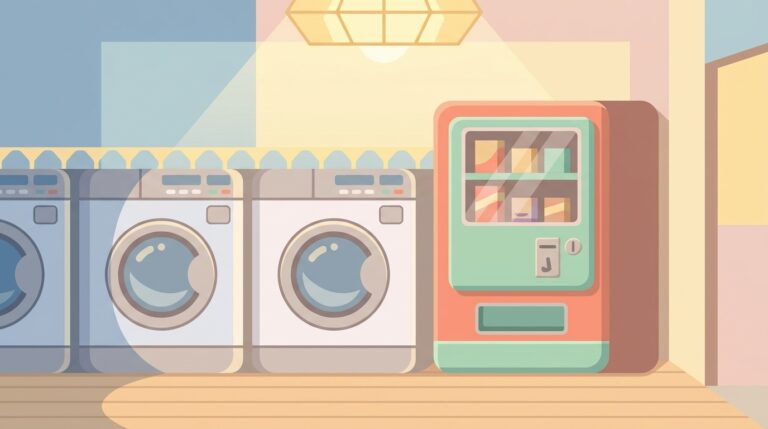
Master the Laundromat: How to Use a Detergent Vending Machine in Korea (세제 자판기 이용하기)
Phase 1: Empathy (Welcome, My Friend!)
안녕하세요! (An-nyeong-ha-se-yo!) Hello! I’m your Daily Hangul editor and your personal Korean culture navigator.
Imagine this: You are staying in a lovely Airbnb in Seoul. You’ve had an amazing week exploring Hanok villages, eating delicious Tteokbokki, and taking aesthetic photos. But now, your favorite outfits are dirty. You gather your clothes and head to a cozy, 24-hour coin laundromat (코인빨래방 – ko-in-ppal-rae-bang) down the street. It smells amazing inside, but suddenly, you freeze.
Where is the soap? You see a metallic vending machine on the wall with buttons and Korean text. Do you need coins? Do you tap your card? Don’t worry! Many of our global students have shared this exact moment of panic. Today, we’re going to master the exact words you need to buy detergent from a vending machine like a local. By the end of this guide, you’ll feel 100% confident doing your laundry in Korea!
Phase 2: Deep Dive into 3 Key Expressions
Let’s look at the three most important phrases you need to know when standing in front of that vending machine.
1. 세제 주세요 (Se-je ju-se-yo)
- Pronunciation: Se-je (sounds like “say-jeh”) ju-se-yo (sounds like “joo-say-yo”).
- Meaning: “Detergent, please.”
- K-Culture Moment: In K-Dramas like Crash Landing on You or Our Blues, you often see characters visiting local shops. Whenever a character wants to buy or ask for something politely, they add “주세요” (ju-se-yo) at the end.
- Editor’s Insight: “세제” (se-je) means detergent. Whether you are talking to a human mart owner or looking for the button on a touch screen, this is your gold-star word!
- Situation Spectrum: Casual (⚠️) | Semi-formal (✅) | Formal (✅)
- 🤔 Think About It: In English, we often say “Can I get…?” which focuses on what you can do. In Korean, “주세요” literally means “Please give me,” focusing on the action of the giver. It shows a warm connection between people!
2. 동전 교환기 어디 있어요? (Dong-jeon gyo-hwan-gi eo-di is-seo-yo?)
- Pronunciation: Dong-jeon (sounds like “dong-jun”) gyo-hwan-gi (sounds like “gyoh-whan-gee”) eo-di is-seo-yo? (sounds like “uh-dee ees-suh-yo”).
- Meaning: “Where is the coin changer?”
- K-Culture Moment: Older laundromats in Korea still require 500-won coins. Before you buy detergent, you might need to change your 1,000-won paper bills into coins. You will look for a machine that says “동전교환기”.
- Editor’s Insight: “동전” (dong-jeon) means coins, “교환기” (gyo-hwan-gi) means changer, and “어디 있어요?” (eo-di is-seo-yo?) means “Where is it?”. You can use “어디 있어요?” for anything you are looking for!
- Situation Spectrum: Casual (🚫) | Semi-formal (✅) | Formal (✅)
- 🤔 Think About It: Korea is almost a cashless society now, but coin laundromats are one of the unique places where physical coins are still widely used. It’s a fun, retro experience!
3. 카드로 할게요 (Ka-deu-ro hal-ge-yo)
- Pronunciation: Ka-deu-ro (sounds like “kah-deh-roh”) hal-ge-yo (sounds like “hal-geh-yo”).
- Meaning: “I will pay by card.”
- K-Culture Moment: Modern Korean coin laundromats have touch-screen kiosks where you can pay for everything, including detergent, with your credit card.
- Editor’s Insight: “카드” is the English word “Card” spoken with a Korean accent. “~로 할게요” means “I will do it by/with…”.
- Situation Spectrum: Casual (⚠️) | Semi-formal (✅) | Formal (✅)
- 🤔 Think About It: Koreans love speed and convenience. Saying “카드로 할게요” is the fastest way to get your payment done and get back to relaxing!
Phase 3: Textbook Korean vs. Real Korean
Let’s look at how textbooks teach you vs. how Koreans actually speak at a laundromat!
Situation 1: Asking if detergent is sold here
- 📖 Textbook Korean: 여기 세제를 판매합니까? (Yeo-gi se-je-reul pan-mae-hap-ni-ka?) – “Do you sell detergent here?” (Too formal, sounds like a business report!)
- 🗣️ Real Korean: 여기 세제 팔아요? (Yeo-gi se-je pal-ah-yo?) – “Do you sell detergent here?” (Natural, friendly, and easy to use with staff or other customers.)
- 💡 Why is it different?: Koreans prefer short, active verbs like “팔다” (to sell -> 팔아요) over formal Sino-Korean vocabulary like “판매하다” (to commercialize/sell) in daily life.
Situation 2: Asking someone for change
- 📖 Textbook Korean: 저에게 동전을 바꿔 주실 수 있습니까? (Jeo-e-ge dong-jeon-eul ba-kwo ju-sil su it-seup-ni-ka?) – “Would you be able to exchange coins for me?”
- 🗣️ Real Korean: 동전 좀 바꿔 주세요. (Dong-jeon jom ba-kwo ju-se-yo.) – “Could you please change some coins for me?”
- 💡 Why is it different?: Adding “좀” (jom – a little/please) softens the request instantly, making it sound polite without being overly dramatic or robotic.
Phase 4: K-Culture Deep Dive & Non-Verbal Manners
4-1. Laundromat Etiquette (눈치 – Nunchi)
In Korea, “눈치” (Nunchi) is your social radar. When using a coin laundromat:
* Bring your own bag: If you buy detergent from the machine, it usually comes in a small paper box or plastic sheet. Keep your basket nearby to carry things.
* No lingering inside the machine space: Once you purchase your detergent sheet or powder, move quickly to your machine so others can use the vending/exchange machine.
4-2. The K-Drama Laundromat Aesthetic
Have you noticed how many romantic scenes in K-dramas happen in coin laundromats? (Think of Run On or Weightlifting Fairy Kim Bok-joo). They are brightly lit, clean, and often play soft indie music. It’s a place for cozy waiting. Koreans often buy a coffee from a nearby convenience store and sip it while waiting for their laundry!
Phase 5: Real-Life Roleplay Scenario
Let’s practice! You are at a trendy laundromat in Hongdae. You want to buy a laundry sheet from the vending machine, but you only have a 10,000 won bill. You ask another customer (Yoon-a) for help.
Characters:
- You (A2 Learner): Friendly but a bit lost.
- Yoon-a (Friendly local customer): A helpful college student folding her clothes.
- You: 저기요… 혹시 동전교환기 어디 있어요?
(Jeo-gi-yo… hok-si dong-jeon-gyo-hwan-gi eo-di is-seo-yo?)
🎭 (Timidly pointing at your 10,000 won bill)
“Excuse me… by any chance, where is the coin changer?” -
Yoon-a: 아, 저기 자판기 바로 옆에 있어요!
(Ah, jeo-gi ja-pan-gi ba-ro yeop-e is-seo-yo!)
🎭 (Smiling and pointing to the corner of the room)
“Ah, it’s right next to the vending machine over there!” -
You: 아! 감사합니다. 혹시 카드도 돼요?
(Ah! Gam-sa-hap-ni-da. Hok-si ka-deu-do dwae-yo?)
🎭 (Holding up your debit card)
“Ah! Thank you. By any chance, does it take cards too?” -
Yoon-a: 자판기는 카드 안 돼요. 동전만 돼요.
(Ja-pan-gi-neun ka-deu an dwae-yo. Dong-jeon-man dwae-yo.)
🎭 (Shaking her head gently)
“The vending machine doesn’t take cards. Only coins.” -
You: 그렇군요. 그럼 세제는 얼마예요?
(Geu-reot-gun-yo. Geu-reom se-je-neun eol-ma-yeo-yo?)
🎭 (Looking closely at the detergent selection)
“I see. Then, how much is the detergent?” -
Yoon-a: 오백 원짜리 두 개, 천 원이에요.
(Oh-baek won-cha-ri du gae, cheon won-i-e-yo.)
🎭 (Showing two fingers)
“Two 500-won coins, so it’s 1,000 won.” -
You: 아, 알겠습니다! 도와주셔서 진짜 감사해요.
(Ah, al-get-seup-ni-da! Do-wa-ju-shyeo-seo jin-짜 gam-sa-hae-yo.)
🎭 (Bowing your head slightly with a bright smile)
“Ah, I understand! Thank you so much for helping me.” -
Yoon-a: 아니에요~ 빨래 잘 하세요!
(An-i-e-yo~ Ppal-rae jal ha-se-yo!)
🎭 (Waving friendly)
“No problem~ Have a good laundry!”
🔀 Interactive Choice Point
You are standing in front of the coin changer, but the machine screen shows an error code. What do you do?
- Option A: Walk up to Yoon-a and say: “이거 안 돼요. 도와주세요!” (I-geo an dwae-yo. Do-wa-ju-se-yo!)
- Option B: Just leave the laundromat and find another one.
- Option C: Check the wall for a phone number and call: “사장님, 기계가 고장 났어요.” (Sa-jang-nim, gi-gye-ga go-jang nat-seo-yo.)
Feedback:
- Best Choice – Option C: Fantastic! Most Korean laundromats are unattended, but they always have the owner’s phone number (“사장님 연락처”) printed on the wall. Calling them is the normal and fastest way to get help!
- Risk Choice – Option A: Yoon-a is just a customer, so she might not know how to fix it. However, because Koreans are friendly, she might try to help you look at it. Just make sure to say “죄송하지만…” (I’m sorry, but…) first!
- Bad Choice – Option B: No need to walk away with dirty clothes! The solution is usually very simple, and most owners can reset the machine remotely.
Phase 6: 10-Second Emotion Shadowing Drill
Let’s practice speaking with real Korean feelings!
* / means take a short breath.
* Follow the emotion guide in the brackets.
[🥺 Worried and confused]
저기요… / 혹시 / 동전교환기 / 어디 있어요?
(Jeo-gi-yo… / hok-si / dong-jeon-gyo-hwan-gi / eo-di is-seo-yo?)-
[😊 Relieved and happy]
아! / 카드도 / 돼요? / 다행이다!
(Ah! / ka-deu-do / dwae-yo? / da-haeng-i-da!) -
[💖 Extremely grateful]
도와주셔서 / 진짜 / 감사합니다!
(Do-wa-ju-shyeo-seo / jin-ja / gam-sa-hap-ni-da!)
Phase 7: K-Culture Mini Dictionary
- 코인빨래방 (Ko-in-ppal-rae-bang) | Coin Laundromat
- Self-service laundry shops open 24/7. Super popular among university students and solo dwellers in Korea.
- 종이세제 (Jong-i-se-je) | Paper/Sheet Detergent
- A light, dry sheet of detergent sold in Korean vending machines. You just toss it directly into the washing machine drum with your clothes!
- 바운스 (Ba-un-seu) | Dryer Sheets (Bounce)
- Koreans often call all dryer sheets “바운스” after the famous brand. You buy these from the vending machine to make your clothes smell amazing in the dryer.
- 동전교환기 (Dong-jeon-gyo-hwan-gi) | Coin Changer
- The machine that swallows your 1,000, 5,000, or 10,000 won bills and dispenses shiny 500-won coins.
Phase 8: Survivor’s Kit for Travelers
Survival Phrases TOP 3
- 세제 자판기 어디 있어요? (Se-je ja-pan-gi eo-di is-seo-yo?)
- Pro Tip: Use this if you can’t find the vending machine. It might be hidden behind a pillar!
- 500원짜리 있어요? (Oh-baek-won-cha-ri is-seo-yo?)
- Pro Tip: “Do you have 500-won coins?” Use this if you need to ask a friendly face nearby to swap a bill.
- 건조기 시트 주세요. (Geon-jo-gi si-teu ju-se-yo.)
- Pro Tip: “Dryer sheets, please.” Essential for keeping your clothes static-free in the dryer.
Editor’s Travel Note
Before heading out, make sure to search for “코인빨래방” (coin laundromat) on the Naver Map App. It will show you the closest 24-hour spots with real customer reviews! Note: Laundromat prices usually range from 4,000 to 6,000 won per load, and prices may change depending on location.
Phase 9: “One Step Deeper” (Cultural Reflection)
In Korea, coin laundromats are not just chore spaces; they are community hubs of comfort. Because apartments in Seoul can be small, young Koreans love using these spacious, warm laundromats as a escape. It is a quiet place to read a book, watch YouTube, or listen to the calming sound of spinning water. The next time you visit one, don’t rush—embrace the slow, peaceful vibe of Seoul’s neighborhood life.
💬 Your Turn: Have you ever done laundry in another country? What was the biggest surprise for you? Let us know in the comments below!
Phase 10: FAQ & Common Mistakes
Q: Can I use my international credit card at Korean laundromats?
A: Yes! Most modern laundromats with digital kiosks accept global credit cards (Visa/Mastercard). However, the smaller wall-mounted detergent vending machines often only accept cash (500-won coins). Always keep some 1,000 won bills in your wallet just in case!
Q: Do I put the paper detergent in the drawer or directly in the tub?
A: If you buy the sheet-type paper detergent (종이세제), throw it directly into the tub with your clothes, not in the detergent drawer. It dissolves completely in water!
Q: What should I do if the machine eats my money?
A: Look for a sign that says “고장 신고” (Report breakdown) or “문의” (Inquiry) on the wall. There will be a mobile phone number. Texting them with a photo of the machine via Papago translation will get you a quick refund or remote help!
🚨 Common Mistakes Alert!
- Mistake 1: Putting liquid liquid detergent into the dryer.
- Correct Action: Always look for the word 건조기 (Dryer) vs 세탁기 (Washer) on the sheets you buy.
- Mistake 2: Putting too many clothes in one machine to save money.
- Correct Action: Keep your clothes below the “적정선” (recommended line) marked on the glass door so they actually get clean!
- Mistake 3: Waiting inside while sitting on the folding table.
- Correct Action: The large tables are strictly for folding clean clothes. Use the chairs provided!
Phase 11: Action Missions
- Bronze Mission (Easy): Pronounce “세제 주세요” (Se-je ju-se-yo) out loud 3 times in front of your mirror with a polite head nod.
- Silver Mission (Medium): Go to Google Maps or Naver Maps, find a coin laundromat in Seoul, and find the words “동전교환” in the photo reviews.
- Gold Mission (Hard): The next time you watch a K-Drama, look closely at a laundromat scene. Spot the vending machine on the wall and point it out to a friend!
Phase 12: Interactive Quiz Challenge
Test your skills before you go!
1. Match the word to its meaning:
- A. 동전 (Dong-jeon)
- B. 세제 (Se-je)
- C. 카드 (Ka-deu)
👀 Click here for the Answer!
- A – Coin
- B – Detergent
- C – Card
2. True or False?
“In Korea, paper sheet detergent (종이세제) should be placed inside the plastic dispenser drawer of the washing machine.”
👀 Click here for the Answer!
- Answer: False!
- Explanation: Sheet detergent goes directly into the drum (tub) with your dirty clothes. It will not dissolve properly if stuffed into the tiny dispenser drawer!







