

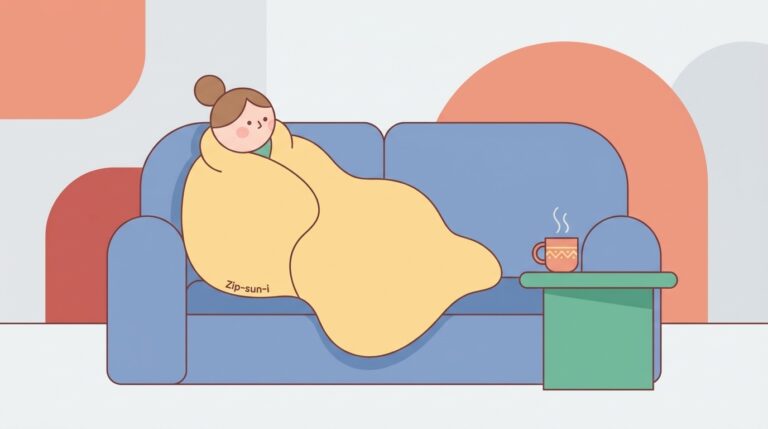
Hello, My Lazy Sunday Friends! Let’s Talk About Being Lazy in Korean
안녕하세요! (Annyeonghaseyo!) I’m your chief editor at Daily Hangul. We’ve all been there: your alarm goes off, but your bed is a warm, magical island, and you just cannot bring yourself to move. In English, you might say “I’m feeling lazy today.”
But how do you say this in Korean without sounding like you are giving a formal business presentation? Today, we are diving into the cozy, slow-paced world of “lazy” personality descriptions. Let’s learn how to express our inner couch potato in natural, friendly Korean!
Phase 2: Three Essential “Lazy” Expressions
1. 게을러요 (Gae-eul-leo-yo)
- Pronunciation: Gae-eul-leo-yo (Sounds like “get-all-low-yo” but smoother!)
- Meaning: I am lazy / (Someone) is lazy.
- K-Culture Moment: You often hear this in K-Dramas when a mother enters her teenager’s messy room on a Saturday afternoon, sighing while looking at them rolled up like a kimbap in their blanket.
- Editor’s Insight: This is the standard, most common dictionary word. It is a direct description of personality or temporary state.
- Situation Spectrum: Casual ✅ | Semi-formal ✅ | Formal ⚠️
- 🤔 Think About It: In Korea’s fast-paced “Palli-Palli” (hurry, hurry) culture, admitting “게을러요” is a sign of deep comfort and vulnerability with someone!
2. 귀찮아요 (Gwi-chan-ah-yo)
- Pronunciation: Gwi-chan-ah-yo (Sounds like “gwee-chahn-ah-yo”)
- Meaning: It’s too much hassle / I can’t be bothered.
- K-Culture Moment: The ultimate anthem of lazy characters in webtoons. They lie flat on the floor, staring at the ceiling, refusing to reach for the TV remote.
- Editor’s Insight: This doesn’t mean you are inherently a lazy person; it means a specific task (like washing dishes or going outside) is too annoying to do right now.
- Situation Spectrum: Casual ✅ | Semi-formal ✅ | Formal 🚫
- 🤔 Think About It: Why does a culture focused on efficiency have such a universally loved word for “everything is too much work”? It’s our collective vent button!
3. 아무것도 하기 싫어요 (A-mu-geot-do ha-gi sil-heo-yo)
- Pronunciation: Ah-moo-geot-do ha-ghee sheel-huh-yo
- Meaning: I don’t want to do anything.
- K-Culture Moment: Think of K-Pop idols during their reality shows on their rest days, lying on the sofa in oversized hoodies, completely zoned out.
- Editor’s Insight: A1 friendly! It breaks down to 아무것도 (anything) + 하기 싫어요 (hate to do/don’t want to do).
- Situation Spectrum: Casual ✅ | Semi-formal ✅ | Formal 🚫
- 🤔 Think About It: Sometimes, doing absolutely nothing is the best form of mental self-care.
Phase 3: Textbook Korean vs. Real-Life Korean
Scenario A: Explaining why you didn’t go to the gym
- 📖 Textbook Korean: “저는 운동을 하지 않습니다. 게으르기 때문입니다.” (Jeo-neun un-dong-eul ha-ji an-seub-ni-da. Gae-eul-reu-gi ttae-mun-im-ni-da.) – “I do not exercise. It is because I am lazy.” (Too robotic and dramatic!)
- 🗣️ Real-Life Korean: “운동하러 가기 너무 귀찮아요.” (Un-dong-ha-reo ga-gi neo-mu gwi-chan-ah-yo.) – “It’s just too much hassle to go work out.”
- 💡 Why is it different? Koreans prefer using “귀찮아요” (hassle) to express temporary laziness rather than labeling themselves as permanently lazy people.
Scenario B: Declining an invitation to go out on a cold day
- 📖 Textbook Korean: “저는 게으른 사람이라서 집에 있을 것입니다.” (Jeo-neun gae-eul-eun sa-ram-i-ra-seo jib-e is-seul geot-im-ni-da.) – “Because I am a lazy person, I will stay home.” (Sounds like a psychological self-diagnosis.)
- 🗣️ Real-Life Korean: “오늘 그냥 집에서 쉴래요.” (O-neul geu-nyang jib-e-seo swil-rae-yo.) – “Today I just want to rest at home.”
- 💡 Why is it different? “그냥” (just) paired with “쉴래요” (want to rest) is the polite, natural way to say “I’m being lazy today!”
Phase 4: K-Culture Deep Dive & Non-verbal Manners
4-1. The “Nu-wo-it-gi” (Lying Down) Gesture
When Koreans talk about being lazy, they often do not just say it. They use a classic body gesture: they mimic a falling leaf or pretend their head is melting onto a pillow, often sighing “Ah~” with closed eyes. If you are sitting on a chair, sliding down slightly while saying “귀찮아요” perfectly conveys the feeling!
4-2. The Cozy “Zip-sun-i” (집순이) / “Zip-dol-i” (집돌이) Culture
In K-Drama and K-Beauty vlogs, you’ll see characters proudly declaring themselves as a “Zip-sun-i” (Homebody – female) or “Zip-dol-i” (Homebody – male). Instead of seeing laziness as a bad thing, Korean youth have embraced the cozy aesthetic of staying home in cute pajamas, eating convenience store snacks, and watching Netflix.
Phase 5: Real-Life Roleplay Scenario
Setting: A cozy Saturday morning. Min-su (your energetic Korean friend) calls you (Yuki) to go hiking up Namsan Mountain.
- Min-su: 유키 씨! 오늘 날씨 진짜 좋아요. 같이 등산 가요! (Yuki-ssi! O-neul nal-ssi jin-ja jo-ah-yo. Gat-i deung-san ga-yo!)
🎭 (Excited, calling you with high energy) - Yuki (You): 아… 등산이요? 오늘 조금 귀찮아요. (Ah… deung-san-i-yo? O-neul jo-geum gwi-chan-ah-yo.)
🎭 (Yawning, wrapped in a blanket) - Min-su: 에이, 주말인데 집에만 있을 거예요? (E-i, ju-mal-in-de jib-e-man is-seul geo-ya-yo?)
🎭 (Teasing, trying to persuade you) - Yuki (You): 네, 오늘 아무것도 하기 싫어요. (Ne, o-neul a-mu-geot-do ha-ghee sheel-huh-yo.)
🎭 (Softly giggling, holding a cup of warm tea) - Min-su: 그럼 그냥 동네 카페에서 커피나 마실래요? (Geu-reom geu-nyang dong-ne ka-pe-e-seo keo-pi-na ma-sil-rae-yo?)
🎭 (Suggesting a low-energy compromise) - Yuki (You): 카페는 좋아요! 대신 조금 늦게 가요. (Ka-pe-neun jo-ah-yo! Dae-shin jo-geum neut-ge ga-yo.)
🎭 (Relieved, smiling) - Min-su: 알았어요. 오후 두 시에 만나요! (Al-at-seo-yo. O-hu du si-e man-na-yo!)
🎭 (Laughing at your lazy Saturday speed) - Yuki (You): 네, 그때 봐요! (Ne, geu-ttae bwa-yo!)
🎭 (Happily waving over the phone)
🔀 Choose Your Next Move!
- Option A: You tell Min-su: “저 진짜 게을러요.” (I’m really lazy.)
- Feedback: Bad. Sounds too self-deprecating for a casual friendly hangout invite!
- Option B: You tell Min-su: “귀찮아요. 안 가요.” (It’s a hassle. Not going.)
- Feedback: Risk. A bit too blunt and might hurt Min-su’s feelings if not said with a very playful voice.
- Option C: You tell Min-su: “오늘은 집에서 쉬고 싶어요!” (Today I want to rest at home!)
- Feedback: Best! Super natural, polite, and clearly sets your boundaries while keeping the friendship warm.
Phase 6: 10-Second Emotion Shadowing Drill
Practice speaking like a native! Follow the pauses (/) and live the emotion.
[🥺 Exhausted & cute voice]
아… / 진짜 / 귀찮아요. (Ah… / jin-ja / gwi-chan-ah-yo.)[😊 Cozy & happy lazy voice]
오늘 그냥 / 집에서 / 쉴래요. (O-neul geu-nyang / jib-e-seo / swil-rae-yo.)[😩 Total dramatic couch potato voice]
아무것도 / 하기 싫어요! (A-mu-geot-do / ha-gi sil-heo-yo!)
Phase 7: K-Culture Mini Dictionary
- 집순이 / 집돌이 (Zip-sun-i / Zip-dol-i) | Homebody | Used to proudly describe someone who loves staying at home instead of going out.
- 이불 밖은 위험해 (I-bul bakk-eun wi-heom-hae) | It’s dangerous outside the blanket | A popular internet slang meme used during cold winters or lazy weekends.
- 눕방 (Nup-bang) | Lying-down broadcast | A real trend where K-pop idols do live streams while comfortably lying in bed.
- 귀차니즘 (Gwi-chan-i-zeum) | Gwichanism | The fictional “philosophy/religion” of laziness. When someone is chronically lazy, they are a follower of “gwichanism.”
Phase 8: Traveler’s Survival Kit
Need to tell your tour guide or hotel host you need a slow morning? Here are three simple phrases:
- 늦게 출발해요 (Neut-ge chul-bal-hae-yo)
- Meaning: Let’s start/leave late.
- Pro Tip: Perfect for slow-travel days.
- 조금 쉴래요 (Jo-geum swil-rae-yo)
- Meaning: I want to rest a bit.
- Pro Tip: Say this to your travel buddies when your feet hurt!
- 배달해 먹어요 (Bae-dal-hae meog-eo-yo)
- Meaning: Let’s order delivery.
- Pro Tip: Korea’s delivery app culture is incredibly fast! Download the Naver Map app to find local spots near your accommodation.
Phase 9: “Going One Step Deeper”
In many Western cultures, being called “lazy” is a harsh criticism. In Korea, while hard work is highly valued, the physical and mental state of being “lazy” (especially during weekends) is treated with affectionate understanding. Phrases like “귀찮아” are used so commonly that they function as minor emotional stress-relievers.
💬 Your Turn: What is your favorite thing to do when you are feeling “귀찮아요”? Do you watch K-dramas, or just sleep? Tell us in the comments below!
Phase 10: FAQ & Common Mistakes
Q: Can I say “게을러요” to my boss at work?
A: No! Telling your boss “오늘 귀찮아요” (Today is a hassle) or “게을러요” (I am lazy) is highly unprofessional. Instead, say “조금 피곤합니다” (I am a little tired).
Q: Is “귀찮아” polite?
A: By itself without “요”, it is informal (Panmal). Only use “귀찮아” with close friends or children. Use “귀찮아요” with the “요” ending for everyday safe conversations.
Q: What is the most common mistake foreigners make?
A: Translating “I don’t feel like it” literally. Instead of trying to translate word-for-word, just use the simple “귀찮아요”!
🚨 The “Common Mistakes” Warning Board
- Incorrect: 저는 게으른 성격입니다! (Said at a job interview to sound humble)
- Correct Action: Never call yourself “게을러요” in formal settings. Use “꼼꼼해요” (I am meticulous/takes time) instead.
Phase 11: Action Mission!
- 🥉 Bronze Level: Say “귀찮아요” out loud to yourself next time you don’t want to get out of bed.
- 🥈 Silver Level: Share a story on Instagram with a picture of your bed and write: “이불 밖은 위험해” (It’s dangerous outside the blanket).
- 🥇 Gold Level: Gently use “오늘 좀 귀찮아요~” with your Korean language partner when discussing weekend plans.
Phase 12: Interactive Quiz Challenge
Q1. Which word means “It’s too much hassle/I can’t be bothered”?
* A) 게을러요
* B) 귀찮아요
* C) 바빠요
Click to reveal Answer!
Correct Answer: B) 귀찮아요
Explanation: “귀찮아요” is used when you find a specific task too annoying to do. “바빠요” means “I’m busy”!
Q2. True or False: You can politely tell your teacher “공부하기 귀찮아요.”
Click to reveal Answer!
Correct Answer: False!
Explanation: Telling a teacher you can’t be bothered to study is considered rude, even if you add the polite “요”!






