

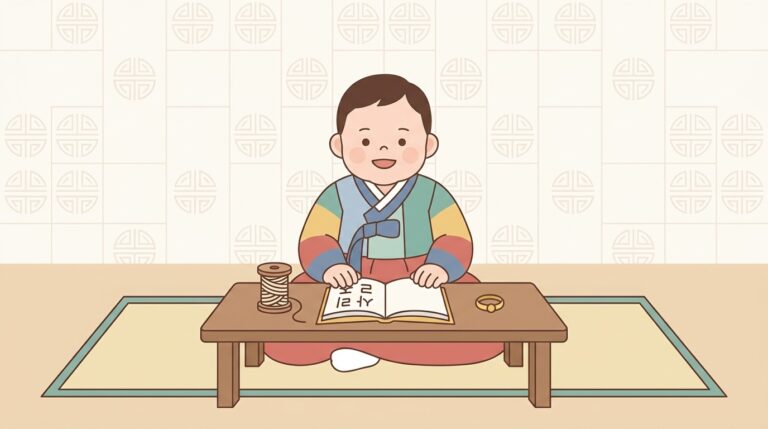
Celebrating a Miracle: Navigating Your First Korean Doljanchi (First Birthday Party) Like a Local
Phase 1: Empathy (Welcome to the Party!)
안녕하세요! (Annyeonghaseyo!) I’m your Daily Hangul editor and your personal cultural navigator.
Imagine this: You’ve just received a beautifully designed invitation. It’s not for a wedding or a corporate gala, but for a 돌잔치 (Doljanchi)—a Korean baby’s first birthday party. You might feel a wave of excitement, quickly followed by a tiny splash of panic. “What should I wear? Do I need to bring a gift? What on earth do I say to the parents?”
Don’t worry at all! Our global learner, Sarah, felt the exact same way when her Korean coworker invited her to his daughter’s first birthday. She was terrified of making a cultural faux pas. But with just a few key phrases and a quick understanding of the local etiquette, she not only had an amazing time but also deeply touched the baby’s family.
Today, you’re going to learn exactly how to navigate this beautiful milestone with confidence, charm, and the perfect touch of Korean politeness.
Phase 2: Deep-Dive into 3 Essential Expressions
Let’s look at three powerful expressions that will make you sound incredibly thoughtful and culturally aware.
1. 첫돌을 축하드려요! (Cheot-dol-eul chuk-ha-deu-ryeo-yo!)
- Pronunciation: Chut-dol-eul chook-ha-deu-ryeo-yo! (Sounds like “chut” as in “shuttle” + “dol” as in “doll” + “eul” + “chook-ha-deu-ryeo-yo”)
- Meaning: Happy first birthday! (Directly: “Congratulations on the first year!”)
- K-Culture Moment: In K-Dramas, you’ll see family members saying this while handing over a tiny, sparkling gold ring to the baby.
- Editor’s Insight: While “생일 축하해요” (Happy Birthday) is okay, using 첫돌 (first full year) shows you understand the unique historical and cultural significance of this specific milestone. Historically, infant mortality was high, so reaching the first year was—and still is—a huge cause for celebration!
- Situation Spectrum: Casual (⚠️ Only for very close friends), Semi-formal (✅ Perfect), Formal (✅ Excellent)
- 🤔 Think About It: In your culture, is there a specific, unique name for a baby’s first birthday, or do you use the general term? How does naming a milestone change its emotional weight?
2. 건강하고 밝게 자라기를 바랄게! (Geon-gang-ha-go balg-ge ja-ra-gi-reul ba-ral-ge!)
- Pronunciation: Gun-gang-ha-go balg-gae ja-ra-gi-reul ba-ral-gae!
- Meaning: I hope you grow up healthy and bright!
- K-Culture Moment: Written inside a beautiful card attached to a baby gift or whispered gently to the sleeping baby at the venue.
- Editor’s Insight: This is the ultimate blessing. Korean parents value “건강” (health) and “밝음” (brightness/cheerful personality) above all else during the early years. It carries a warm, auntie/uncle-like affection.
- Situation Spectrum: Casual (✅ Perfect for the baby), Semi-formal (✅ Great for a card), Formal (⚠️ A bit too intimate for strict business relations)
- 🤔 Think About It: Why do you think wishing for “brightness” (밝게) is so common in Korea? What qualities do parents in your country hope for most during a first birthday?
3. 돌잡이 때 뭐 잡을 것 같아요? (Dol-jab-i ttae mwo jab-eul geot gat-a-yo?)
- Pronunciation: Dol-jah-bee ttae mwo jah-beul gut gah-tah-yo?
- Meaning: What do you think the baby will grab during the Doljabi?
- K-Culture Moment: Guests chatting around the banquet tables, placing their raffle tickets into cups representing different items like a gavel, money, or a stethoscope.
- Editor’s Insight: The 돌잡이 (Doljabi) is the highlight of the party! The baby is placed in front of various objects, and whatever they grab first foretells their future. Money means wealth, a thread means long life, and a computer mouse means a tech genius. Asking this question instantly makes you part of the fun!
- Situation Spectrum: Casual (✅ Great), Semi-formal (✅ Excellent icebreaker), Formal (⚠️ Use slightly more polite endings if talking to senior bosses)
- 🤔 Think About It: If you had a Doljabi when you were one year old, which item do you think you would have grabbed? A book? A coin? A microphone?
Phase 3: Textbook Korean vs. Real-Life Korean
Let’s bridge the gap between classroom Korean and the warm, natural phrases Koreans actually use.
Situation 1: Congratulating the parents
- 📖 Textbook Korean: 아기의 첫 번째 생일을 축하합니다. (Agiyi cheot beonjjae saengireul chukhahabnida. – I congratulate the baby’s first birthday.)
- 🗣️ Real-Life Korean: 벌써 첫돌이라니 시간 진짜 빠르네요! 너무 축하드려요! (Beolsseo cheotdorirani sigan jinjja ppareuneyo! Neomu chukhadeuryeoyo! – Wow, it’s already their first birthday? Time flies so fast! Huge congratulations!)
- 💡 Why the difference? The textbook version is grammatically perfect but feels cold and clinical. Real-life Korean expresses awe at how fast the baby grew (시간 진짜 빠르네요!), which resonates deeply with tired, proud parents.
Situation 2: Blessing the baby
- 📖 Textbook Korean: 아기가 건강하기를 원합니다. (Agiga geonganghagireul wonhabnida. – I want the baby to be healthy.)
- 🗣️ Real-Life Korean: 아프지 말고 건강하게만 자라다오! (Apeuji malgo geonganghageman jaradao! – Don’t get sick, just grow up healthy!)
- 💡 Why the difference? “원합니다” sounds like a business requirement. The phrase “아프지 말고” (don’t get sick) is filled with genuine, warm protective affection, often used in emotional birthday letters.
Phase 4: K-Culture Deep-Dive & Non-Verbal Manners
4-1. Nunchi (눈치) & Gestures
- The Two-Handed Gift Hand-off: When giving the gift or the congratulatory envelope (축의금 봉투) to the parents, always hold it with both hands, or support your right wrist/forearm with your left hand. It shows deep respect.
- The Quiet Toast: If you drink with the parents, turn your head slightly away when taking a sip, especially if other elders are present at the table.
4-2. Cultural Code: The Golden Ring (금반지)
Historically, guests gifted 24k gold rings (돌반지 – dolbanji) weighing 1 don (3.75g) to wish the baby financial security. Nowadays, due to gold prices, cash envelopes (typically 50,000 to 100,000 KRW) or cute baby outfits are equally common and highly appreciated!
Phase 5: Real-Life Roleplay Scenario
Setting: You have arrived at a beautiful banquet hall in Seoul for your coworker Min-woo’s son’s Doljanchi. You meet Min-woo and his wife at the reception desk.
Characters:
* Min-woo (민우): Your friendly Korean coworker, looking sharp in a Hanbok.
* You: A warm, polite colleague eager to celebrate.
민우: 어머, Sarah 씨! 진짜 와주셨네요! 바쁘실 텐데 감사해요.
      (Eomeo, Sarah-ssi! Jinjja wajusyeotneyo! Bappeusil tende gamsahaeyo.)
      🎭 [Smiling brightly, bowing slightly]
      "Oh, Sarah! You actually came! Thank you so much for making the time!"

You: 초대해 주셔서 제가 더 감사하죠! 민우 씨, 오늘 너무 멋지세요!
     (Chodaehae jusyeoseo jega deo gamsahajyo! Min-woo-ssi, oneul neomu meotjiseoyo!)
     🎭 [Bowing in return, offering a warm smile]
     "I should thank you for inviting me! Min-woo, you look so handsome today!"

민우: 아이고, 아닙니다. 옷이 날개죠. 여기 제 아내예요. 인사 나누세요.
      (Aigo, animnida. Osi nalgaejo. Yeogi je anaeyeyo. Insa nanuseyo.)
      🎭 [Gesturing proudly to his wife]
      "Haha, not at all. Clothes make the man! This is my wife. Please say hello."

You: 안녕하세요! 아기가 아빠를 똑 닮아서 정말 잘생겼어요. 첫돌을 너무 축하드려요!
     (Annyeonghaseyo! Agiga appareul ttok dalmaseo jeongmal jalsaenggyeosseoyo. Cheotdoleul neomu chukhadeuryeoyo!)
     🎭 [Handing over the gift bag with both hands]
     "Hello! The baby looks exactly like his dad, so handsome! Happy first birthday!"

민우 아내: 어머나, 칭찬 감사해요! 한국말을 어쩜 이렇게 잘하세요? 감동이에요.
           (Eomeona, chingchan gamsahaeyo! Hangungmareul eojeom ireohge jalhaseyo? Gamdongieoyo.)
           🎭 [Clasps hands together, visibly touched]
           "Oh my, thank you for the compliment! How is your Korean so amazing? I'm so touched!"

You: 아니에요, 아직 많이 부족해요. 참, 오늘 돌잡이 때 준우가 뭐 잡을 것 같아요?
     (Anieyo, ajik mani bujokhaeyo. Cham, oneul doljabi ttae Jun-woo-ga mwo jabeul geot gat-a-yo?)
     🎭 [Tilting head curiously, gesturing toward the main stage]
     "No, I'm still lacking. By the way, what do you think Jun-woo will grab during the Doljabi today?"

민우: 저는 돈을 잡았으면 좋겠는데, 아내는 연필을 원하네요. 이따가 지켜봐 주세요!
      (Jeoneun doneul jabaseumyeon jokgetneunde, anaeneun yeonpireul wonhaneyo. Ittaga jikyeobwa juseyo!)
      🎭 [Laughing playfully with his wife]
      "I hope he grabs the money, but my wife wants the pencil. Keep an eye out for it later!"

You: 네, 정말 기대돼요! 맛있는 음식 먹으면서 기다릴게요!
     (Ne, jeongmal gidaedwaeyo! Masitneun eumsik meogeumyeonseo gidarilgeyo!)
     🎭 [Waving cheerfully as you head to your seat]
     "Yes, I'm really looking forward to it! I'll enjoy the delicious food while waiting!"
🔀 Interactive Choice Point
At the reception desk, there are raffle cups for the Doljabi. Which cup do you put your raffle ticket in?
* A: The Thread (실 – Sil): Best! Wishing the baby a long, healthy life is the most traditional, heartwarming gesture.
* B: The Money (돈 – Don): Good! It shows a fun, realistic wish for the baby’s future prosperity, aligning with Min-woo’s joke.
* C: The Computer Mouse (마우스): Risk! While modern, some older family members might not understand the joke if you bring it up too seriously.
Phase 6: 10-Second Emotion Shadowing Drill
Practice speaking with real Korean feelings! Pay attention to the pauses (/) and emotional cues.
[😊 Excited & Grateful]- 초대해 주셔서 / 진짜 감사해요!
- (Chodaehae jusyeoseo / jinjja gamsahaeyo!)
- “Thank you / so much for inviting me!”
[😍 Full of Admiration]- 아기가 / 엄마를 / 똑 닮아서 / 너무 귀여워요!
- (Agiga / eommareul / ttok dalmaseo / neomu gwiyeowoyo!)
- “The baby / looks exactly / like her mom, / she’s so cute!”
[🎉 Playful & Curious]- 돌잡이 때 / 뭐 잡을지 / 진짜 궁금해요!
- (Doljabi ttae / mwo jabeulji / jinjja gunggeumhaeyo!)
- “I’m so curious / what they will grab / during the Doljabi!”
Phase 7: K-Culture Mini Dictionary
- 돌잔치 (Doljanchi): The grand celebration of a baby’s first birthday, full of food, family, and tradition.
- 돌잡이 (Doljabi): The traditional fortune-telling game where the baby chooses an object symbolizing their future career or lifestyle.
- 돌반지 (Dolbanji): A 24k gold ring traditionally gifted to the baby for good fortune and health.
- 축의금 (Chugyigeum): Congratulatory money given in a clean white envelope at major life events like weddings and first birthdays.
Phase 8: Traveler’s Survival Kit
Survival Expressions TOP 3
- 화장실이 어디예요? (Hwajangsiri eodiyeyo? / Where is the restroom?) – Pro Tip: Most banquet halls have them located outside the main hall near the elevators.
- 이거 축의금 봉투 어디에 내요? (Igeo chugyigeum bongtu eodie naeyo? / Where do I submit this congratulatory cash envelope?)
- 음식 진짜 맛있네요! (Eumsik jinjja masitneyo! / The food is really delicious!) – A great compliment to pay to the hosting parents when leaving.
📌 Editor’s Travel Note:
To find the exact location of a banquet hall in Korea, do not rely on Google Maps as it is often inaccurate. Instead, download the KakaoMap App or Naver Map App to get highly accurate, real-time subway and walking directions.
Phase 9:
Frequently Asked Questions (FAQ)
Q: What does "첫돌을 축하드려요! (Cheot-dol-eul chuk-ha-deu-ryeo-yo!)" mean in Korean and how do you pronounce it?
A: In Korean, "첫돌을 축하드려요! (Cheot-dol-eul chuk-ha-deu-ryeo-yo!)" is pronounced [Chut-dol-eul chook-ha-deu-ryeo-yo! (Sounds like "chut" as in "shuttle" + "dol" as in "doll" + "eul" + "chook-ha-deu-ryeo-yo"] and means: Happy first birthday! (Directly: "Congratulations on the first year!")
Q: What does "건강하고 밝게 자라기를 바랄게! (Geon-gang-ha-go balg-ge ja-ra-gi-reul ba-ral-ge!)" mean in Korean and how do you pronounce it?
A: In Korean, "건강하고 밝게 자라기를 바랄게! (Geon-gang-ha-go balg-ge ja-ra-gi-reul ba-ral-ge!)" is pronounced [Gun-gang-ha-go balg-gae ja-ra-gi-reul ba-ral-gae!] and means: I hope you grow up healthy and bright!
Q: What does "돌잡이 때 뭐 잡을 것 같아요? (Dol-jab-i ttae mwo jab-eul geot gat-a-yo?)" mean in Korean and how do you pronounce it?
A: In Korean, "돌잡이 때 뭐 잡을 것 같아요? (Dol-jab-i ttae mwo jab-eul geot gat-a-yo?)" is pronounced [Dol-jah-bee ttae mwo jah-beul gut gah-tah-yo?] and means: What do you think the baby will grab during the Doljabi?







