

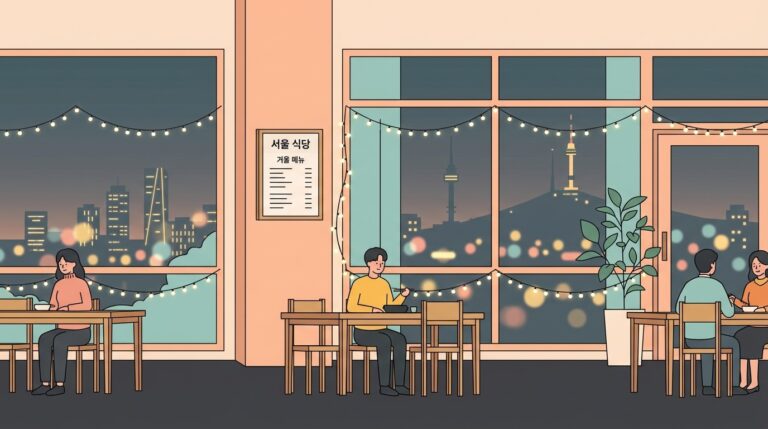
Christmas in Seoul: How to Secure Your Holiday Date Night (B2 Intermediate Guide)
Phase 1: Empathy (Welcome, My Friend!)
안녕하세요! Daily Hangul‘s Chief Editor here, your ultimate guide to mastering Korean through the lens of real, modern culture.
Imagine this: It’s mid-December in Seoul. The streets of Myeongdong and Hongdae are glowing with fairy lights, “All I Want for Christmas Is You” is drifting out of every cosmetic shop, and a crisp winter chill is in the air. You’ve planned the perfect Christmas Eve date with someone special. You arrive at that gorgeous, glass-walled Italian bistro in Gangnam, only to be met with a polite but devastating: “죄송합니다, 오늘 예약이 모두 마감되었습니다.” (I’m sorry, we are fully booked today.)
Ouch.
Here’s the cultural reality check: in Korea, Christmas is strictly a romantic couple’s holiday, not a family gathering like in the West. Because of this, securing a table on December 24th or 25th is an extreme sport. If you don’t book weeks in advance using the right Korean phrases, you might end up eating convenience store ramyeon in the freezing cold (which can be romantic, but maybe not Christmas romantic!).
Don’t panic! Today, we are going to master the exact intermediate-level Korean phrases and cultural hacks you need to secure that coveted Christmas reservation like a local. Let’s dive in!
Phase 2: Deep Dive into 3 Essential Expressions
Let’s look at three powerful phrases that will elevate your booking game from “clueless tourist” to “savvy Seoulite.”
1. 혹시 크리스마스 이브에 예약 가능한 테이블이 있을까요? (Hoksi Keuriseumaseu Ibeu-e yeyak ganeunghan teibeul-i isseulkkayo?)
- Pronunciation: Hohk-shee Keu-ree-seu-mah-seu ee-beu-eh yeh-yahk gah-neung-hahn teh-ee-beul-ee ee-sseul-kah-yoh?
- Meaning: “By any chance, is there a table available for reservation on Christmas Eve?”
- K-Culture Moment: You’ll hear this polite, slightly cautious phrasing in K-Dramas like Crash Landing on You or Business Proposal when a character is trying to secure a spot at a high-end restaurant under pressure.
- Editor’s Insight: Starting your sentence with 혹시 (hoksi – by any chance) is a magical politeness softener in Korean. It signals that you know they might be busy or full, making the staff much more willing to double-check their system for you.
- Situation Spectrum: Casual: 🚫 | Semi-formal: ✅ | Formal: ✅
- 🤔 Think About It: In your home country, is it common to use softeners like “by any chance” when booking, or do you prefer to get straight to the point?
2. 창가 자리나 야경이 보이는 곳으로 부탁드릴게요. (Changga jarina yagyeong-i boineun goseuro butakdeurilgeyo.)
- Pronunciation: Chahng-gah jah-ree-nah yah-gyung-ee boh-ee-neun goht-eu-roh boo-tahk-deu-reel-geh-yoh.
- Meaning: “Window seat or a place with a night view, please.”
- K-Culture Moment: Essential for those gorgeous rooftop cafes in Itaewon or Han River view restaurants in Yeouido.
- Editor’s Insight: The particle ~나 (na) means “or.” Using ~로 부탁드릴게요 (~ro butakdeurilgeyo) is the gold standard for polite requests in service situations. It is softer and warmer than just saying “~ 주세요” (~ juseyo / give me).
- Situation Spectrum: Casual: ⚠️ | Semi-formal: ✅ | Formal: ✅
- 🤔 Think About It: Koreans highly value “atmosphere” (분위기 – bunwigi) for romantic events. Why do you think aesthetic seating is so heavily emphasized in modern Korean dating culture?
3. 노쇼 방지를 위해 예약금을 미리 입금해야 하나요? (Nosyo bangji-reul wihae yeyakgeum-eul miri ipgeumhaeya hanayo?)
- Pronunciation: No-shyo bahng-jee-reul wee-hae yeh-yahk-geum-eul mee-ree eep-geum-hae-yah hah-nah-yoh?
- Meaning: “Do I need to deposit a reservation fee in advance to prevent a no-show?”
- K-Culture Moment: This is highly relevant for trendy areas like Seongsu-dong or Hannam-dong, where high-end dining spots use apps like Catch Table.
- Editor’s Insight: 노쇼 (No-show) is a direct loanword from English. To prevent this, many hot places in Seoul require a 예약금 (yeyakgeum – reservation deposit). Showing that you understand this system makes you look incredibly fluent and respectful of their business.
- Situation Spectrum: Casual: 🚫 | Semi-formal: ✅ | Formal: ✅
- 🤔 Think About It: How does the reservation deposit system in Korea compare to your country’s dining culture?
Phase 3: Textbook Korean vs. Real-Life Korean
Let’s compare the stiff, textbook sentences with how real Koreans actually talk on the phone or over messaging apps.
Situation 1: Asking if there are seats left
- 📖 Textbook: “크리스마스에 자리가 있습니까?” (Keuriseumaseue jari-ga isseumnikka? / Are there seats on Christmas?)
- 🗣️ Real-Life: “혹시 크리스마스 당일에 예약 다 찼나요?” (Hoksi Keuriseumaseu dang-il-e yeyak da chatnayo? / By any chance, are reservations all full for Christmas Day itself?)
- 💡 Why the difference? 당일 (dang-il) means “the exact day of,” which is much more precise. “다 찼나요?” (Is it completely full?) is the natural colloquial way to ask about availability rather than the robotic “있습니까?”
Situation 2: Asking to make a change to the time
- 📖 Textbook: “시간을 변경하고 싶습니다.” (Sigan-eul byeongyeonghago sipseumnida. / I want to change the time.)
- 🗣️ Real-Life: “혹시 시간을 조금 미룰 수 있을까요?” (Hoksi sigan-eul jogeum mirul su isseulkkayo? / By any chance, could we push the time back a little bit?)
- 💡 Why the difference? Directly saying “I want to change the time” can sound slightly demanding. Using 미루다 (miruda – to postpone/push back) or 당기다 (danggida – to pull forward/bring closer) makes your request specific and gentle.
Phase 4: K-Culture Deep Dive & Non-Verbal Manners
4-1. The Art of Telephone Polite Tone (비언어적 매너)
When calling a restaurant in Korea, your voice tone does 80% of the work.
* The Sol-Tone (솔톤): Koreans often raise their vocal pitch slightly to a “Sol” note (from Do-Re-Mi-Fa-Sol) when talking to customer service. It conveys friendliness and enthusiasm.
* Nodding on the phone: Even though they can’t see you, saying “아, 네~ 네~” (Ah, ne~ ne~) with a rhythmic head nod while listening shows active agreement and respect.
4-2. The Christmas “Catch Table” Culture
Gone are the days when you could just call a restaurant. In Korea, apps like Catch Table (캐치테이블) are absolute necessities. On highly anticipated booking days (usually December 1st for Christmas reservations), Koreans participate in 티케팅 (Ticketing – fighting for tickets/reservations online). You must have your payment details pre-registered and click the button at exactly 10:00:00 AM!
Phase 5: Real-Life Roleplay Scenario
Let’s practice! You are calling a trendy Italian bistro in Sinsa-dong named L’Amour. You are speaking to Ji-won, the restaurant manager.
[Scene: You are holding your phone, nervously dialing L'Amour at 2:00 PM on December 1st.]
- Ji-won (Manager): 여보세요, 이탈리안 비스트로 ‘라무르’입니다. 무엇을 도와드릴까요?
(Yeoboseyo, Itallian biseutero ‘Ramureu’imnida. Mueoseul dowadeurilkkayo? / Hello, this is Italian Bistro ‘L’Amour’. How may I help you?) -
You: 안녕하세요! 혹시 크리스마스 이브 저녁에 예약 가능한가요?
(Annyeonghaseyo! Hoksi Keuriseumaseu ibeu jeonyeok-e yeyak ganeunghan-gayo? / 🎭 Polite and upbeat: Hello! By any chance, is it possible to book for Christmas Eve dinner?) -
Ji-won (Manager): 아, 이브 저녁은 인기가 정말 많아서요. 몇 시쯤 원하시나요?
(Ah, ibeu jeonyeok-eun inki-ga jeongmal manhaseoyo. Myeot si-jjeum wonhasinayo? / Ah, Eve dinner is super popular. Around what time would you like?) -
You: 저녁 7시쯤 원하는데, 혹시 남은 테이블이 있을까요?
(Jeonyeok ilgop-si-jjeum wonhaneunde, hoksi nameun teibeul-i isseulkkayo? / 🎭 Eager but polite: I’d like around 7 PM, would there happen to be any tables left?) -
Ji-won (Manager): 잠시만요… 아, 7시는 다 찼고, 8시 반에 창가 자리가 하나 비어 있네요.
(Jamsimanyo… Ah, ilgop-sineun da chatgo, yeodeol-si ban-e changga jari-ga hana bieo inneyo. / One moment… Ah, 7 is full, but we have one window seat open at 8:30 PM.) -
You: 와, 다행이네요! 그럼 그 시간으로 예약해 주세요.
(Wa, dahaeng-ineyo! Geureom geu sigan-euro yeyakhae juseyo. / 🎭 Relieved and excited: Wow, what a relief! Then please book it for that time.) -
Ji-won (Manager): 네, 예약금 만 원을 입금해 주셔야 예약이 확정됩니다. 문자로 안내해 드릴게요.
(Ne, yeyakgeum man won-eul ipgeumhae jusyeoya yeyak-i hwakjeongdeumnida. Munja-ro annaehae deurilgeyo. / Yes, you must deposit a 10,000 KRW reservation fee to finalize the booking. I will send instructions via text.) -
You: 네, 문자 확인하고 바로 입금할게요. 감사합니다!
(Ne, munja hwakin-hago baro ipgeumhalgeyo. Gamsahamnida! / 🎭 Friendly: Yes, I will check the text and deposit it right away. Thank you!)
🔀 Choose Your Path!
What if Ji-won tells you: “죄송한데 그날은 예약이 완전히 마감되었습니다.” (I’m sorry, but booking is completely closed for that day.)
* A) “아… 그럼 어쩔 수 없죠. 안녕히 계세요.” (Ah… nothing we can do then. Goodbye.)
* 🔴 Feedback (Bad): You gave up too easily! You might miss out on a waiting list.
* B) “혹시 대기 명단에 이름을 올려놓을 수 있을까요? 취소 건이 생기면 연락 부탁드려요.” (By any chance, can I put my name on the waiting list? Please contact me if there is a cancellation.)
* 🟢 Feedback (Best!): Extremely fluent! Cancellations happen very often close to Christmas as people change plans.
* C) “그냥 구석 자리라도 만들어 주시면 안 돼요?” (Can’t you just make a corner seat for us anyway?)
* ⚠️ Feedback (Risk): Pushing too hard might make the staff uncomfortable. Korean service is polite, but boundaries are strict.
Phase 6: 10-Second Emotion Shadowing Drill
Let’s practice speaking with real Korean emotions. Pay attention to the pauses (/) and the emotional cues!
- [🥺 Desperate but polite]
- 혹시 / 예약이 / 정말 / 다 끝났나요?
- Hoksi / yeyak-i / jeongmal / da kkeutnannayo?
- (Is the booking / really / completely finished?)
- [😊 Expressing deep relief & excitement]
- 와, / 진짜 다행이네요! / 창가 자리로 / 꼭 부탁드릴게요!
- Wa, / jinjja dahaeng-ineyo! / changga jari-ro / kkok butakdeurilgeyo!
- (Wow, / what a massive relief! / The window seat / please, absolutely!)
Phase 7: K-Culture Mini-Dictionary
- 데이트 코스 (Deiteu Koseu | Date Course): A pre-planned sequence of dating spots (e.g., Cafe -> Restaurant -> Walk). Koreans love optimizing their routes!
- 분위기 깡패 (Bunwigi Kkangpae | Atmosphere Thug): Slang for a place with an incredibly amazing vibe or aesthetic.
- 노쇼 (Nosyo | No-Show): A customer who makes a reservation but doesn’t show up. Avoid being a “nosyo” at all costs!
- 티케팅 (Tiketing | Ticketing): The fierce process of securing reservations or tickets online in seconds.
Phase 8: The Traveler’s Survival Kit
Survival Phrases TOP 3
- “두 명인데 예약석 있을까요?” (Du myeong-inde yeyakseok isseulkkayo?)
- Pro Tip: Use this when walking into a restaurant without a booking on a busy evening.
- “혹시 예약금 환불 규정이 어떻게 되나요?” (Hoksi yeyakgeum hwanbul gyujeong-i eotteoke doenayo?)
- Pro Tip: Ask this if you think your plans might change, so you know the cancellation policy.
- “창가 자리 비면 거기로 옮겨주실 수 있나요?” (Changga jari bimyeon geogiri-ro omgyeojusil su innayo?)
- Pro Tip: If you get seated at a central table, use this polite phrase to snatch a window seat if it opens up.
Editor’s Travel Note
Before heading to Korea during the holiday season, make sure to download the Catch Table App on Google Play/App Store. It allows you to search for “Atmosphere Thugs” (분위기 깡패) and make instant deposits using international credit cards. Note: Information regarding app updates and booking policies may change over time.
Phase 9: “A Step Deeper” (Cultural Insight)
Why is Christmas in Korea so heavily centered around couples? Historically, Christmas was introduced to Korea as a modern, Western holiday rather than a deeply rooted traditional religious family event. Over the decades, media and commercial marketing successfully branded it as the ultimate romantic winter festival. This is why you will see lines wrapping around fancy restaurants and cake shops weeks in advance. It highlights how Korea absorbs global elements and beautifully reinvents them to fit local social dynamics.
💬 Your Turn: How is Christmas celebrated in your country? Is it a family holiday, or a romantic day for couples like in Korea? Let me know in the comments below!
Phase 10: FAQ & Common Mistakes
Q: Can I just walk into a popular restaurant in Gangnam on Christmas Eve without a reservation?
A: It is highly unlikely you will get a table between 5 PM and 9 PM. If you do, expect a wait time of 2 hours or more in sub-zero temperatures. Always book at least 2 to 3 weeks in advance!
Q: How do I pay the “reservation deposit” (예약금) if I don’t have a Korean bank account?
A: Apps like Catch Table now support international credit cards for foreign tourists. If a restaurant asks for a bank transfer (통장입금), you can politely ask if they accept credit cards via an online link.
Q: Do restaurants stay open late on Christmas?
A: Yes, most restaurants and cafes operate normally. However, public transport can be extremely crowded, so plan your transit times carefully.
🚨 The “Common Mistakes” Warning Board
- Saying “크리스마스에 약속 있어요” to mean “I have a booking”:
- What’s wrong: 약속 (yaksok) means a promise or social plans with friends. For commercial bookings (restaurants, hotels), you must use 예약 (yeyak).
- Forgetting to check the cancellation deadline:
- Many Korean places do not refund the reservation deposit if you cancel within 3 days of Christmas.
- Using high formal “~하십시오” style over the phone:
- It sounds too robotic. Stick to the friendly, warm “~요” (yo) or “~습니다” (seumnida) endings.
Phase 11: Action Missions
- 🥉 Bronze Mission: Read the Roleplay script out loud using the [Sol-Tone] pitch!
- 🥈 Silver Mission: Go to a restaurant review on Naver Maps and find the word 예약 (Reservation) or 창가 (Window seat) in the reviews.
- 🥇 Gold Mission: Next time you visit a restaurant, try booking over the phone using the phrase: “혹시 ~에 예약 가능한 테이블이 있을까요?”
Phase 12: Interactive Quiz Challenge
1. Which word means “reservation deposit” in Korean?
- A) 예금 (yegeum)
- B) 예약금 (yeyakgeum)
- C) 요금 (yogeum)
Click to reveal the Answer & Explanation
Correct Answer: B) 예약금 (yeyakgeum)
* Explanation: 예약 (Reservation) + 금 (Money/Fee) = 예약금. ‘예금’ means savings/deposit in a bank, and ‘요금’ means a general fee or fare.
2. Fill in the blank:
“혹시 창가 자리___ 예약할 수 있을까요?” (By any chance, could I book the window seat?)
* A) 가 (ga)
* B) 로 (ro)
* C) 를 (reul)
Click to reveal the Answer & Explanation
Correct Answer: B) 로 (ro)
* Explanation: ‘~로 예약하다’ means “to book as [something]” or “towards [something]”. In this context, it designates the specific selection of the window seat.
3. True or False: In Korea, Christmas is primarily a family holiday where people stay home to eat traditional food.
- A) True
- B) False
Click to reveal the Answer & Explanation
Correct Answer: B) False
* Explanation: Christmas in Korea is a major romantic holiday for couples. Seollal (Lunar New Year) and Chuseok are the main family-centric holidays in Korea.







