

Emergency Fashion Rescue: What to Say When a Button Pops Off in Korea!
Phase 1: Empathy (Welcome to the Fashion Rescue Center!)
안녕하세요! (An-nyeong-ha-se-yo!) Welcome back to another survival guide by your trusty K-Culture Navigator at Daily Hangul.
Imagine this: You are walking down the vibrant, trendy streets of Hongdae, rocking your favorite stylish trench coat. You stop at a beautiful photobox café, ready to strike a pose, when suddenly… clink, roll, roll. You look down, and one of your main coat buttons is rolling away on the concrete floor. Oh, the horror! 😱
Don’t panic! Whether you are heading to a job interview in Gangnam or meeting up with your K-friends in Seongsu-dong, wardrobe malfunctions happen to the best of us. In Korea, where being neat and presentable (깔끔하다 – kkal-kkeum-ha-da) is highly valued, knowing how to ask for a sewing kit or seek a quick repair is a total lifesaver.
Today, we will learn how to handle this exact situation like a local. No more awkward sign language or Google Translate fails! Let’s dive in.
Phase 2: Deep Dive into 3 Essential Expressions
Let’s master three highly practical expressions you can use when a button goes missing.
1. 단추가 떨어졌어요. (Dan-chu-ga tteo-reo-jyeot-eo-yo.)
- Pronunciation: Dan-choo-gah tteoh-ruh-jyuss-uh-yo (Sounds like “dan-chew” + “tough” with a soft ‘r’ + “yuss-uh-yo”)
- Meaning: The button fell off. (Direct Translation: “Button has fallen.”)
- K-Culture Moment: You will hear this in K-Dramas when the female lead’s sleeve catches on the male lead’s knit sweater, or when someone is nervously pulling at their clothes before an interview.
- Editor’s Insight: The verb ‘떨어지다’ (tteo-reo-jye-da) means “to fall” or “to drop.” It is natural, neutral, and the absolute best way to state your problem without sounding overly dramatic.
- Situation Spectrum: Casual ✅ | Semi-formal ✅ | Formal ✅
- 🤔 Think About It: In English, we say a button “came off” or “popped off.” In Korean, we focus on the direction of the action—it “fell down” (떨어지다). Isn’t it fascinating how different languages visualize movement?
2. 혹시 반느질고리 있어요? (Hok-si ba-neul-jil-go-ri it-eo-yo?)
- Pronunciation: Hok-shee bah-neul-jeel-go-ree eess-uh-yo? (Sounds like “hawk-she” + “bah-nool-jeel” + “go-ree” + “eess-uh-yo?”)
- Meaning: Do you happen to have a sewing kit?
- K-Culture Moment: Asking the hotel front desk or a convenience store clerk for a quick fix kit.
- Editor’s Insight: ‘혹시’ (hok-si) means “by any chance/perhaps” and is the ultimate magic word to soften any request in Korea. ‘바느질고리’ (ba-neul-jil-go-ri) is the traditional term for a small sewing box/kit, though many younger Koreans also call it a ‘실과 바늘’ (sil-gwa ba-neul – thread and needle).
- Situation Spectrum: Casual ✅ | Semi-formal ✅ | Formal ⚠️
- 🤔 Think About It: Koreans value politeness and not burdening others. Adding “혹시” shows that you are being considerate of the other person’s time and resources.
3. 이거 단추 좀 달아주실 수 있나요? (I-geo dan-chu jom da-ra-ju-sil su in-na-yo?)
- Pronunciation: Ee-guh dan-choo jom dah-rah-joo-sheel soo een-nah-yo?
- Meaning: Could you please sew this button on for me?
- K-Culture Moment: Handing your blazer to a professional alteration shop (수선소 – su-seon-so) or a dry cleaner (세탁소 – se-tak-so).
- Editor’s Insight: ‘달다’ (dal-da) means to attach or hang. The structure ‘~해주실 수 있나요?’ is a polite B1-level request form that shows excellent manners.
- Situation Spectrum: Casual 🚫 | Semi-formal ✅ | Formal ✅
- 🤔 Think About It: Why does Korean use ‘달다’ (to attach/hang) instead of ‘꿰매다’ (to sew) here? Because the ultimate goal is attaching the item to the clothing, not just the act of stitching!
Phase 3: Textbook Korean vs. Real Korean
Let’s see how school-book Korean differs from the lively expressions you actually hear on the streets of Seoul!
Situation A: Asking a close friend for help
- 📖 Textbook Korean: “제 옷의 단추가 떨어졌으니 도와주세요.” (Je ot-ui dan-chu-ga tteo-reo-jyeot-eu-ni do-wa-ju-se-yo. – My button fell off, so please help me.)
- 🗣️ 진짜 한국어 (Real Korean): “아, 대박… 단추 떨어졌다! 야, 너 실이랑 바늘 있어?” (Ah, dae-bak… dan-chu tteo-reo-jyeot-da! Ya, neo sil-i-rang ba-neul it-eo? – Oh gosh… my button fell off! Hey, do you have thread and needle?)
- 💡 Why the difference? Real friends use ‘대박’ (exclamation of shock/disbelief) and simple, direct casual speech (반말 – ban-mal) like ‘너 ~ 있어?’ instead of overly formal honorifics.
Situation B: Asking a hotel receptionist
- 📖 Textbook Korean: “실과 바늘을 저에게 기증해 주십시오.” (Sil-gwa ba-neul-eul jeo-e-ge gi-jeung-hae ju-sip-si-o. – Please donate thread and needle to me.)
- 🗣️ 진짜 한국어 (Real Korean): “저 혹시… 반느질고리 대여 가능한가요?” (Jeo hok-si… ba-neul-jil-go-ri dae-yeo gang-eung-han-ga-yo? – Excuse me, by any chance… is a sewing kit available for rent/borrowing?)
- 💡 Why the difference? ‘기증’ (donation) is way too formal and academic. Locals use ‘대여’ (rent/borrow) or simply ask if they have one to spare using polite conversational patterns.
Phase 4: K-Culture Deep Dive & Non-Verbal Manners
4-1. The Art of “Nunchi” & Asking Politely
When your button falls off in public, showing a slight look of embarrassment (난감한 표정 – nan-gam-han pyo-jeong) is natural. When asking for a sewing kit at a hotel or a café, tilt your head slightly and gently touch the area where the button is missing. This visual cue immediately communicates your distress and triggers the warm Korean helpfulness known as Jeong (정)!
4-2. The Savior: The Neighborhood “세탁소” (Se-tak-so)
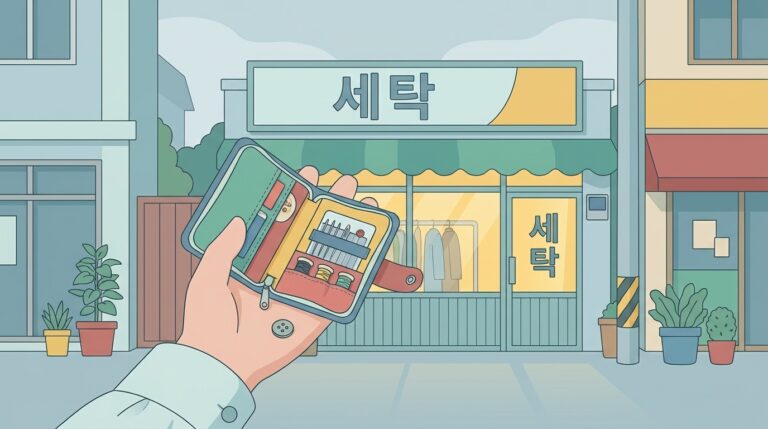
In Korea, dry cleaners (세탁소) do much more than wash clothes—they are neighborhood masters of quick alterations (수선 – su-seon). If you lose a button on a high-end coat, look for a sign that says “수선” (Alterations). The masters (사장님 – sa-jang-nim) can sew a button back on in 30 seconds, often charging next to nothing (around 1,000 to 2,000 KRW, or even free if you’re a regular!).
Phase 5: Real-Life Roleplay Scenario
Setting: You are at the lobby of a boutique hotel in Myeongdong. Your button just popped off right before you head out to a fancy dinner.
NPC Character: 민우 (Min-woo), the friendly hotel receptionist who is always eager to help.
- 민우: 안녕하세요, 손님! 어디 나가시나요? 오늘 날씨가 아주 좋네요.
(An-nyeong-ha-se-yo, son-nim! Eo-di na-ga-si-na-yo? Oh-neul nal-ssi-ga a-ju jhon-nae-yo.)
“Hello, guest! Are you heading out? The weather is lovely today.” - You (🎭 Looking embarrassed and pointing to your jacket): 저… 죄송한데, 지금 옷 단추가 떨어졌어요.
(Jeo… joe-song-han-de, ji-geum ot dan-chu-ga tteo-reo-jyeot-eo-yo.)
“Uh… excuse me, but my jacket button just fell off.” - 민우 (🎭 Gasps lightly): 어머, 정말이네요! 많이 난감하시겠어요.
(Eo-meo, jeong-mal-i-ne-yo! Ma-ni nan-gam-ha-si-get-eo-yo.)
“Oh dear, you’re right! You must be so flustered.” - You: 혹시 남는 반느질고리나 실과 바늘이 있을까요?
(Hok-si nam-neun ba-neul-jil-go-ri-na sil-gwa ba-neul-i is-seul-kka-yo?)
“By any chance, do you have a spare sewing kit or thread and needle?” - 민우 (🎭 Searches under the desk): 아, 여기 일회용 반느질 세트가 하나 있네요! 드릴게요.
(Ah, yeo-gi il-hoe-yong ba-neul-jil se-teu-ga ha-na in-nae-yo! Deu-ril-ge-yo.)
“Ah, here is a disposable sewing kit! Here you go.” - You (🎭 Smiling warmly): 와, 살았다! 정말 감사합니다.
(Wa, sal-at-da! Jeong-mal gam-sa-hap-ni-da.)
“Wow, I’m saved! Thank you so much.” - 민우: 아닙니다! 혹시 직접 하시기 어려우시면 근처 세탁소 위치 알려드릴까요?
(An-nim-ni-da! Hok-si jik-jeop ha-si-gi eo-ryeo-u-si-myeon geun-cheo se-tak-so wi-chi al-ryeo-deu-ril-kka-yo?)
“No problem! If it’s too difficult to do it yourself, should I show you the location of a nearby dry cleaner?” - You: 아니요, 제가 할 수 있어요. 도와주셔서 감사해요!
(An-i-yo, je-ga hal su is-seo-yo. Do-wa-ju-syeo-seo gam-sa-hae-yo!)
“No, I can do it. Thank you for your help!”
🔀 Interactive Choice Point!
What would you say if you wanted Min-woo to suggest a repair shop instead?
* Option A: “귀찮아요. 그냥 버릴래요.” (Too hassle, I will just throw it away.) – [Bad 🚫: Too blunt and wasteful!]
* Option B: “네, 근처 세탁소 어디에 있어요?” (Yes, where is the nearby dry cleaner?) – [Best ✅: Polite, natural, and gets you the local recommendation.]
* Option C: “돈 없는데 공짜예요?” (I don’t have money, is it free?) – [Risk ⚠️: Sounds a bit rude to ask about money first.]
Phase 6: 10-Second Emotion Shadowing Drill
Practice these lines with the exact emotional nuances of a native speaker! Pay attention to the pauses (/).
- [🥺 Disappointed & Worried]
“아… / 단추 떨어졌다… / 어떡하지?”
(Ah… / dan-chu tteo-reo-jyeot-da… / eo-tteok-ha-ji?)
“Oh no… / the button fell off… / what should I do?” -
[😊 Relieved & Grateful]
“와! / 혹시 이거 빌려주시는 거예요? / 진짜 / 감사해요!”
(Wa! / hok-si i-geo bil-ryeo-ju-si-neun geo-yeo-yo? / jin-jja / gam-sa-hae-yo!)
“Wow! / Are you lending this to me by any chance? / Really / thank you!”
Phase 7: K-Culture Mini Dictionary
- 바느질 (Ba-neul-jil) | Sewing / Needlework | Used when referring to the act of sewing things by hand.
- 실과 바늘 (Sil-gwa Ba-neul) | Thread and Needle | Literally “thread and needle.” It’s also a famous idiom in Korea used to describe inseparable couples or best friends!
- 수선소 (Su-seon-so) | Alteration Shop | A specialized shop for fixing clothes, adjusting sizes, or sewing zippers and buttons.
- 편의점 (Pyeon-ui-jeom) | Convenience Store | Places like GS25 or CU. Many larger convenience stores actually sell travel-sized sewing kits (여행용 반느질 세트)!
Phase 8: Traveler’s Survival Kit
Survival Expressions TOP 3
- “가장 가까운 세탁소가 어디예요?” (Ga-jang ga-kka-un se-tak-so-ga eo-di-yeo-yo?)
- Pro Tip: Use this when you need professional help fast.
- “이거 수선비 얼마예요?” (I-geo su-seon-bi eol-ma-yeo-yo?)
- Pro Tip: Ask this to know the cost of the repair beforehand.
- “실 혹시 검은색 있어요?” (Sil hok-si geom-eun-saek is-seo-yo?)
- Pro Tip: Helpful if you need a specific thread color (black/검은색, white/흰색).
Editor’s Travel Note
If you need to find a neighborhood repair shop instantly, do not use Google Maps (it is not fully optimized for Korea). Instead, open the Naver Map App and search for “옷 수선” (Clothing Alteration) or “세탁소”. It will show you the exact local spots, reviews, and operating hours! (Note: Map details may vary depending on local updates.)
Phase 9: “Going One Step Deeper”
In Korea, maintaining a tidy appearance is tied closely to showing respect for others. Going out with a visibly missing button or ripped clothing is often seen as a lack of preparation or care (단정하지 못하다 – dan-jeong-ha-ji mot-ha-da). This is why older generations in Korea are extremely quick to point out a loose thread or a hanging button to strangers—not to criticize, but out of warm communal care (정 – Jeong).
💬 Your Turn: Have you ever had a wardrobe malfunction while traveling? How did you solve it? Let us know in the comments below!
Phase 10: FAQ & Common Mistakes
Q: Can I buy a sewing kit at a regular Korean supermarket?
A: Yes! Look for “여행용 바느질 세트” (Travel Sewing Kit) in the household goods section of Daiso or larger convenience stores like GS25.
Q: Is “꿰매다” (Kkwe-mae-da) the same as “달다” (Dal-da)?
A: No. “꿰매다” means to stitch or sew up a tear, while “달다” specifically means to attach an object (like a button or a badge) to the clothing.
Q: What should I call the shop owner at a repair shop?
A: You can politely address them as “사장님” (Sa-jang-nim), which means “business owner.” It works perfectly for both male and female shop owners!
🚨 Common Mistakes Alert!
- Wrong: “단추가 죽었어요.” (My button is dead.) ❌
- Correct: “단추가 떨어졌어요.” (My button fell off.) ⭕
- Why: In English, we sometimes jokingly say a device or part “died,” but in Korean, “죽다” is only used for living organisms. Always use “떨어지다” for buttons!
Phase 11: Action Mission
- Bronze Mission 🥉: Read the 10-Second Shadowing Drill out loud 3 times in front of a mirror with realistic facial expressions!
- Silver Mission 🥈: Bookmark this post and share it with a friend who is planning a trip to Korea.
- Gold Mission 🥇: Next time you go to Daiso in Korea, find the sewing section and successfully locate a “바느질 세트”!
Phase 12: Interactive Quiz Challenge
Test your skills with our quick mini-quiz!
- What is the correct Korean word for “sewing kit”?
- True or False: In Korea, a “세탁소” (dry cleaner) only washes clothes and does not fix buttons.
Click here for the Answers & Explanations!
- Answer: 반느질고리 (or 바느질 세트).
- Answer: False. Korean 세탁소 are absolute wizards at quick alterations and button repairs!







