

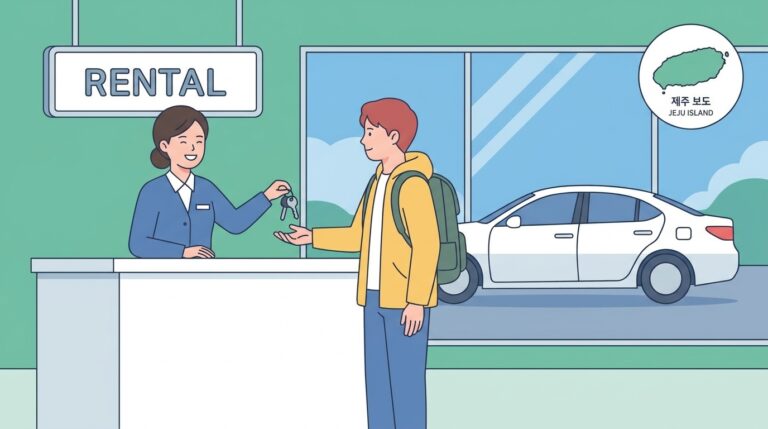
Renting a Car in Korea? Here’s How to Choose the Right Insurance Without the Stress!
안녕하세요! (Annyeonghaseyo!) Hello, my lovely Daily Hangul family! It’s your K-culture navigator and chief editor.
Are you planning a dreamy road trip through the breathtaking coastal roads of Jeju Island or driving along the scenic East Sea? Renting a car in Korea is one of the best ways to explore hidden gems. But let’s be real—when you sit down at the rental desk and the staff starts asking you about 보험 (bo-heom / insurance), your mind might go blank.
In popular K-Dramas, we often see characters driving sleek cars, but we rarely see them filling out rental agreements! In real life, choosing the right insurance can make the difference between a stress-free trip and an unexpected budget disaster. Don’t worry, your Korean bestie is here to help you navigate the rental desk with confidence, using simple A2-level Korean that anyone can master!
Phase 2: Key Expressions for Car Rental Insurance
Here are the top 3 expressions you need to know when securing your rental car insurance.
1. 보험 가입할게요. (Bo-heom ga-ip-hal-ge-yo.)
- Pronunciation: bo-hum gah-eep-hal-geh-yo (Sounds like “bo” in boat + “hum” + “gah-eep” + “hal-geh-yo”)
- Meaning: I will sign up for insurance.
- K-Culture Moment: Imagine a scene in a travel variety show like New Journey to the West, where the cast members are budget-planning for their road trip and responsibly choosing their insurance before heading out.
- Editor’s Insight: The word 가입 (ga-ip) means joining or signing up (for a membership, insurance, or club). Adding -할게요 (-hal-ge-yo) expresses your polite intention or promise to do something.
- Situation Spectrum: Casual (⚠️) | Semi-formal (✅) | Formal (✅)
- 🤔 Think About It: In your home country, is it common to buy full insurance for rental cars, or do you rely on credit card coverage? Korean rental companies almost always recommend their own in-house plans.
2. 완전자차로 해주세요. (Wan-jeon-ja-cha-ro hae-ju-se-yo.)
- Pronunciation: wan-jun-jah-chah-ro hae-joo-seh-yo (Sounds like “one-jun” + “jah-chah” + “ro” + “hae-joo-say-yo”)
- Meaning: Please make it Super Collision Damage Waiver (Full Coverage).
- K-Culture Moment: You are renting a cute compact car in Jeju. To avoid any scratches from narrow basalt-stone walls, you confidently tell the agent this phrase.
- Editor’s Insight: 자차 (ja-cha) is short for “자신의 차량 손해” (own vehicle damage coverage). 완전 (wan-jeon) means “complete” or “perfect.” Combining them gives you 완전자차 (wan-jeon-ja-cha), which is the equivalent of Super Collision Damage Waiver (SCDW) with zero deductible.
- Situation Spectrum: Casual (🚫) | Semi-formal (✅) | Formal (✅)
- 🤔 Think About It: Why do you think “complete” (완전) is used here? It shows how much Koreans value peace of mind and speed when resolving roadside issues!
3. 사고 나면 어떻게 해요? (Sa-go na-myeon eo-tteo-ke hae-yo?)
- Pronunciation: sah-go nah-myun uh-ttuh-keh hae-yo (Sounds like “sah-go” + “nah-myun” + “uh-tuck-kay” + “hae-yo”)
- Meaning: What should I do if an accident happens?
- K-Culture Moment: A dramatic moment in a romance drama where the car gets a flat tire in the countryside, and the driver nervously asks this question over the phone.
- Editor’s Insight: 사고 (sa-go) means accident, and 나면 (na-myeon) means “if it happens/arises.” This is a crucial survival question to ask before you leave the parking lot.
- Situation Spectrum: Casual (⚠️) | Semi-formal (✅) | Formal (✅)
- 🤔 Think About It: Asking for emergency procedures beforehand is highly respected in Korea, showcasing your responsible nature.
Phase 3: Textbook Korean vs. Real-Life Korean
Let’s compare what textbooks teach you versus what real Koreans say at the rental desk.
Situation 1: Choosing Full Coverage
- 📖 Textbook Korean: “종합 보험에 가입하고 싶습니다.” (Jong-hap bo-heom-e ga-ip-ha-go sip-seub-ni-da. – I would like to sign up for comprehensive insurance.)
- 🗣️ Real-Life Korean: “완전자차로 해주세요.” (Wan-jeon-ja-cha-ro hae-ju-se-yo. – Please make it full coverage.)
- 💡 Why the difference? While comprehensive insurance is grammatically correct, “완전자차” is the industry-standard term that instantly tells the clerk you want zero liability.
Situation 2: Asking about Extra Costs
- 📖 Textbook Korean: “추가 비용이 발생합니까?” (Chu-ga bi-yong-i bal-saeng-hap-ni-ka? – Does an additional cost occur?)
- 🗣️ Real-Life Korean: “추가 요금 더 있어요?” (Chu-ga yo-geum deo is-seo-yo? – Is there any extra fee?)
- 💡 Why the difference? “발생합니까” sounds like a written contract. Real people use “더 있어요?” (is there more?) for a friendly, conversational tone.
Phase 4: K-Culture Deep Dive & Non-Verbal Manners
4-1. Nunchi (눈치) & Desk Etiquette
When dealing with insurance contracts in Korea, show 눈치 (Nunchi – situational awareness) by nodding slightly as the agent explains the exclusions (like towing or tire damage, which sometimes aren’t included in standard full coverage). Double-check by pointing at the paper and saying “타이어도 돼요?” (Ta-i-eo-do dwae-yo? / Are tires covered too?).
4-2. The Jeju Island Rental Culture
Jeju Island is the rental car capital of Korea. Because of the winding roads and narrow alleyways near local cafes, almost 90% of tourists choose 완전자차 (Full Coverage). It’s so common that rental offices have automated kiosks where you can select “완전자차” with just one click!
Phase 5: Real-Life Roleplay Scenario
Meet 민지 (Minji), the friendly rental agent at “Seoul Car Rental.”
- Minji (Agent): 어서 오세요! 예약 확인해 드릴게요. (Eo-seo o-se-yo! Ye-yak hwa-gin-hae deu-ril-ge-yo.)
🎭 Welcoming you with a polite bow and looking at her computer screen.
“Welcome! Let me check your reservation.” - You: 안녕하세요! 제 이름은 존이에요. (An-nyeong-ha-se-yo! Je i-reum-un Jon-i-e-yo.)
🎭 Smiling and handing over your International Driving Permit.
“Hello! My name is John.” - Minji (Agent): 네, 존 님. 기본 보험만 선택하셨는데, 보험 변경하시겠어요? (Ne, Jon-nim. Gi-bon bo-heom-man seon-taek-ha-syeot-neun-de, bo-heom byeon-gyeong-ha-si-ges-seo-yo?)
🎭 Pointing to the contract paper.
“Yes, Mr. John. You only selected basic insurance. Would you like to change your insurance?” - You: 완전자차로 해주세요. (Wan-jeon-ja-cha-ro hae-ju-se-yo.)
🎭 Answering confidently with a polite smile.
“Please make it full coverage (SCDW).” - Minji (Agent): 탁월한 선택이세요! 혹시 모를 사고에 대비해 안전합니다. (Tak-wol-han seon-taek-i-se-yo! Hok-si mo-reul sa-go-e dae-bi-hae an-jeon-hap-ni-da.)
🎭 Nodding in approval.
“Excellent choice! It is safe in case of any unexpected accidents.” - You: 사고 나면 어떻게 해요? (Sa-go na-myeon eo-tteo-ke hae-yo?)
🎭 Tapping the emergency contact number on the brochure.
“What should I do if an accident happens?” - Minji (Agent): 이 번호로 연락하시면 24시간 긴급 출동이 갑니다. (I beon-ho-ro yeon-rak-ha-si-myeon sumul-ne-si-gan gin-geup chul-dong-i gap-ni-da.)
🎭 Drawing a circle around the customer service phone number with a red pen.
“If you call this number, a 24-hour emergency team will dispatched.” - You: 네, 감사합니다! (Ne, gam-sa-hap-ni-da!)
🎭 Taking the keys and car documents with both hands as a sign of respect.
“Yes, thank you!”
🔀 Interactive Choice Point
Minji asks if you want to add “Tire and Wheel coverage” for an extra 5,000 KRW ($4 USD) per day. What do you say?
- A) “괜찮아요, 안 할게요.” (Gwaen-chan-ha-yo, an hal-ge-yo. / It’s okay, I won’t do it.)
- B) “네, 그것도 추가해 주세요.” (Ne, geu-geot-do chu-ga-hae ju-se-yo. / Yes, please add that too.)
- C) “타이어는 왜 안 돼요?” (Ta-i-eo-neun wae an dwae-yo? / Why aren’t tires covered?)
Feedback:
- Best Choice (B): Highly recommended! Tire damage is common on coastal/mountain roads, and standard “full coverage” often excludes wheels.
- Risky Choice (A): Saves you pocket money, but you might face a hefty bill if a sharp stone punctures your tire on Jeju’s volcano roads.
- Bad Choice (C): A bit too direct/confrontational for standard Korean customer service culture, though acceptable if you genuinely want details.
Phase 6: 10-Second Emotion Shadowing Drill
Let’s practice speaking like a native! Pay attention to the pauses (/) and emotional tone.
- [😊 Friendly and Confident]
완전자차로 / 해주세요!
(Wan-jeon-ja-cha-ro / hae-ju-se-yo!) - [🥺 Slightly Concerned but Polite]
사고 나면 / 어떻게 해요?
(Sa-go na-myeon / eo-tteo-ke hae-yo?) - [🙋♂️ Curious and Clear]
추가 요금 / 더 있어요?
(Chu-ga yo-geum / deo is-seo-yo?)
Phase 7: K-Culture Mini-Dictionary
- 자차보험 (Ja-cha-bo-heom) | Collision Damage Waiver (CDW). Protection for your rental vehicle.
- 면책금 (Myeon-chaek-geum) | Deductible / Excess. The amount you pay out-of-pocket before insurance kicks in.
- 긴급출동 (Gin-geup-chul-dong) | Roadside Emergency Assistance. 24/7 service dispatched for jumpstarts, flat tires, or towing.
- 블랙박스 (Beul-raek-bak-seu) | Dashcam. Absolutely essential in Korea for proving fault in traffic disputes.
Phase 8: Traveler’s Survival Kit
Survival Expressions TOP 3
Frequently Asked Questions (FAQ)
Q: What does "보험 가입할게요. (Bo-heom ga-ip-hal-ge-yo.)" mean in Korean and how do you pronounce it?
A: In Korean, "보험 가입할게요. (Bo-heom ga-ip-hal-ge-yo.)" is pronounced [bo-hum gah-eep-hal-geh-yo (Sounds like "bo" in boat + "hum" + "gah-eep" + "hal-geh-yo"] and means: I will sign up for insurance.
Q: What does "완전자차로 해주세요. (Wan-jeon-ja-cha-ro hae-ju-se-yo.)" mean in Korean and how do you pronounce it?
A: In Korean, "완전자차로 해주세요. (Wan-jeon-ja-cha-ro hae-ju-se-yo.)" is pronounced [wan-jun-jah-chah-ro hae-joo-seh-yo (Sounds like "one-jun" + "jah-chah" + "ro" + "hae-joo-say-yo"] and means: Please make it Super Collision Damage Waiver (Full Coverage).
Q: What does "사고 나면 어떻게 해요? (Sa-go na-myeon eo-tteo-ke hae-yo?)" mean in Korean and how do you pronounce it?
A: In Korean, "사고 나면 어떻게 해요? (Sa-go na-myeon eo-tteo-ke hae-yo?)" is pronounced [sah-go nah-myun uh-ttuh-keh hae-yo (Sounds like "sah-go" + "nah-myun" + "uh-tuck-kay" + "hae-yo"] and means: What should I do if an accident happens?







