

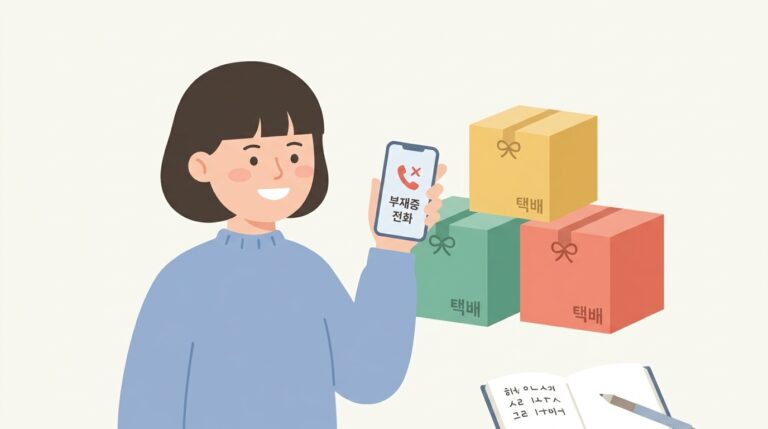
Missed a Call from Korea? Don’t Panic! Simple A1 Korean Phone Guide
안녕하세요! (An-nyeong-ha-se-yo!) Hello! I am your lead editor and your friendly Korean bestie from Daily Hangul.
We have all been there. You are watching your favorite K-drama, eating some delicious ramyun, and suddenly your phone vibrates. An unknown Korean number flashes on the screen. You freeze. “What if it is important? What if it is my delivery driver? What do I say?” You let it ring, and now you have a 부재중 전화 (bu-jae-jung jeon-hwa) — a missed call.
Don’t worry! Today, we are going to learn how to handle missed calls like a local, using super simple, bite-sized A1-level Korean. Let’s dive in!
Phase 2: Key Expression Deep Dive
Here are the 3 magic expressions you need when dealing with a missed call.
1. 전화했었어요? (Jeon-hwa-haet-eoss-eo-yo?)
- Pronunciation: Jun-wha-hate-us-uh-yo? (Sounds like “Jun-wha” + “hate” + “us” + “yo”)
- Meaning: Did you call?
- K-Culture Moment: You will hear this in almost every romantic K-drama when the main lead builds up the courage to call their crush back after seeing a missed call.
- Editor’s Insight: This is the friendliest, most common way to ask someone if they called you. It is polite but not too stiff.
- Situation Spectrum: Casual ⚠️ | Semi-formal ✅ | Formal 🚫
- 🤔 Think About It: In English, we often say “I missed your call.” In Korean, we focus on the other person’s action first: “Did you call?”
2. 부재중 전화가 와서요. (Bu-jae-jung jeon-hwa-ga wa-seo-yo.)
- Pronunciation: Boo-jae-joong jun-wha-gah wah-suh-yo.
- Meaning: I got a missed call (so I am calling back).
- K-Culture Moment: Used when calling back a delivery driver (택배 아저씨) or a local shop owner.
- Editor’s Insight: The “-요 (-yo)” ending makes it polite. It naturally explains why you are calling them back without sounding rude.
- Situation Spectrum: Casual ⚠️ | Semi-formal ✅ | Formal ✅
- 🤔 Think About It: Why does Korean grammar use “because/so” (-서요) to end sentences? It is because Korean speakers love leaving things slightly soft and open-ended to sound polite!
3. 누구세요? (Nu-gu-se-yo?)
- Pronunciation: Noo-goo-seh-yo?
- Meaning: Who is this? / Who is calling?
- K-Culture Moment: When a character gets a call from an unsaved number in a drama and answers with a curious face.
- Editor’s Insight: Be careful! Only use this when you really don’t know who is calling. Say it with a soft, rising tone so it doesn’t sound too sharp.
- Situation Spectrum: Casual ⚠️ | Semi-formal ✅ | Formal 🚫
- 🤔 Think About It: Does asking “Who are you?” feel direct in your language? In Korean, adding “-세요” makes “Who” polite enough for everyday phone calls.
Phase 3: Textbook Korean vs. Real Korean
Let’s compare what dry textbooks teach you versus what real Koreans actually say on the phone.
Situation 1: Calling a friend back
- 📖 Textbook: 전화를 못 받아서 죄송합니다. (Jeon-hwa-reul mot bat-ah-seo joe-song-ham-ni-da.) – “I am sorry for not answering your call.” (Too formal for friends!)
- 🗣️ Real Korean: 어, 왜 전화했어? (Eo, wae jeon-hwa-haet-eo?) – “Oh, why did you call?”
- 💡 Why the difference? Close friends in Korea immediately use casual language (반말 – Banmal) and drop formal apologies. It shows you are close!
Situation 2: Asking who is calling politely
- 📖 Textbook: 성함이 어떻게 되십니까? (Seong-ham-i eo-tteo-ke doe-sim-ni-kka?) – “What is your honorable name?” (Way too formal for a simple missed call!)
- 🗣️ Real Korean: 실례지만 누구세요? (Sil-rye-ji-man nu-gu-se-yo?) – “Excuse me, but who is this?”
- 💡 Why the difference? “실례지만” (Excuse me but) softens the question “누구세요?” making it perfectly polite for daily life.
Phase 4: K-Culture Deep Dive & Manner Tips
1. The Power of “Nunchi” (눈치) on the Phone
When calling someone back in Korea, timing is everything. If you call back within 10 minutes, you don’t need a long explanation. Just say “전화했었어요?” (Did you call?). If you call back hours later, it is polite to start with a soft apology: “늦게 연락해서 죄송합니다” (Sorry for contacting you late).
2. K-Delivery Culture
Korea has the best delivery system in the world! If you order food or a package, the delivery person (택배 기사님) might call you if they cannot find your building. If you miss their call, always text or call them back instantly using: “택배 받기로 한 사람인데요…” (I am the person supposed to receive the package…).
Phase 5: Interactive Roleplay Scenario
You see a missed call from an unknown Korean number. You decide to call back. The person who answers is Minjun (민준), a friendly local courier.
- Minjun: 여보세요? (Yeo-bo-se-yo?)
🎭 Answers the phone with a busy, friendly voice. - You: 여보세요. 부재중 전화가 와서요. (Yeo-bo-se-yo. Bu-jae-jung jeon-hwa-ga wa-seo-yo.)
🎭 Say it politely: “Hello. I got a missed call.” - Minjun: 아, 네! 혹시 이름이 어떻게 되세요? (Ah, ne! Hok-si i-reum-i eo-tteo-ke doe-se-yo?)
🎭 Asks kindly: “Ah, yes! What is your name by any chance?” - You: 저는 [Your Name]입니다. (Jeo-neun [Your Name]-im-ni-da.)
🎭 State your name clearly. - Minjun: 아, [Your Name] 씨! 택배 때문에 전화했어요. 문 앞에 두고 갈까요? (Ah, [Your Name] ssi! Taek-bae ttae-mun-e jeon-hwa-haet-eo-yo. Mun ap-e du-go gal-ka-yo?)
🎭 Sounds relieved: “Ah, [Your Name]! I called about your delivery. Shall I leave it in front of the door?” - You: 네, 문 앞에 두고 가세요. 감사합니다! (Ne, mun ap-e du-go ga-se-yo. Gam-sa-ham-ni-da!)
🎭 Smile and say: “Yes, please leave it in front of the door. Thank you!” - Minjun: 네, 좋은 하루 되세요! (Ne, joe-un ha-ru doe-se-yo!)
🎭 Friendly farewell: “Yes, have a nice day!” - You: 네, 감사합니다! (Ne, gam-sa-ham-ni-da!)
🎭 End with a cheerful tone.
🔀 Your Turn! Choose your reply if Minjun asks: “Where should I leave it?”
- A) 아무 데나 던져주세요. (Just throw it anywhere.)
- B) 문 앞에 두고 가세요. (Please leave it in front of the door.)
- C) 그냥 가져가세요. (Just take it back.)
Feedback:
- A (Risk): Too blunt! “던져주세요” means “throw it.” It might sound rude to the hard-working delivery driver.
- B (Best): Super polite and standard! It is the perfect phrase for apartment living in Korea.
- C (Bad): If you say this, they will literally return your package to the sender!
Phase 6: 10-Second Emotion Shadowing Drill
Let’s practice speaking with real Korean feelings. Pay attention to the pauses (/) and the emotions!
[😊 Cheerful & Curious]- 전화했었어요? (Jeon-hwa / haet-eoss-eo-yo?)
[🥺 Slightly apologetic & Soft]- 부재중 전화가 / 와서요… (Bu-jae-jung / jeon-hwa-ga / wa-seo-yo…)
[📞 Confident & Polite]- 여보세요? / 누구세요? (Yeo-bo-se-yo? / Nu-gu-se-yo?)
Phase 7: K-Culture Mini Dictionary
- 여보세요 (Yeo-bo-se-yo) | Hello (on the phone only) | Used only when answering or initiating a phone call. Never use this face-to-face!
- 택배 (Taek-bae) | Home Delivery / Package | Korea’s world-famous, ultra-fast shipping culture.
- 부재중 (Bu-jae-jung) | Absence / Missed | Often combined with “전화” (call) to mean missed call.
- 연락 (Yeon-rak) | Contact / Communication | Used when you want to say “Keep in touch” (연락해요).
Phase 8: Survivor Kit for Travelers
Survival Phrases TOP 3
- 다시 전화해 주세요. (Da-si jeon-hwa-hae ju-se-yo.)
- Pro Tip: “Please call me back again.”
- 한국어 잘 못해요. (Han-guk-eo jal mot-hae-yo.)
- Pro Tip: “I can’t speak Korean well.” (Perfect for getting native speakers to speak slowly!)
- 문자 남겨주세요. (Mun-ja nam-gyeo-ju-se-yo.)
- Pro Tip: “Please leave a text message.”
📌 Editor’s Travel Note: When traveling in Korea, download the Naver Map App for navigating and finding contact numbers for local cafes and shops. Note: App interface and features may change over time without notice.
Phase 9:
Frequently Asked Questions (FAQ)
Q: What does "전화했었어요? (Jeon-hwa-haet-eoss-eo-yo?)" mean in Korean and how do you pronounce it?
A: In Korean, "전화했었어요? (Jeon-hwa-haet-eoss-eo-yo?)" is pronounced [Jun-wha-hate-us-uh-yo? (Sounds like "Jun-wha" + "hate" + "us" + "yo"] and means: Did you call?
Q: What does "부재중 전화가 와서요. (Bu-jae-jung jeon-hwa-ga wa-seo-yo.)" mean in Korean and how do you pronounce it?
A: In Korean, "부재중 전화가 와서요. (Bu-jae-jung jeon-hwa-ga wa-seo-yo.)" is pronounced [Boo-jae-joong jun-wha-gah wah-suh-yo.] and means: I got a missed call (so I am calling back).
Q: What does "누구세요? (Nu-gu-se-yo?)" mean in Korean and how do you pronounce it?
A: In Korean, "누구세요? (Nu-gu-se-yo?)" is pronounced [Noo-goo-seh-yo?] and means: Who is this? / Who is calling?







