

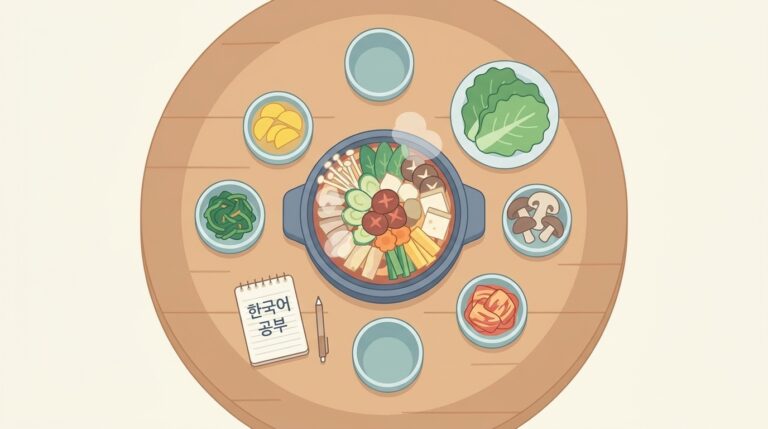
Navigating Hoe-sik (Korean Company Dinner) as a Vegetarian: Your Ultimate Survival Guide
Phase 1: Empathy (Welcome, My Vegetarian Chingu!)
안녕하세요! (An-nyeong-ha-se-yo!) Hello! It’s your Daily Hangul editor and your trusted K-culture navigator.
Imagine this: You’ve just landed your dream internship in Seoul. You’re thrilled! But then, a notification pops up on the company group chat: “Today is Hoe-sik (회식 – company dinner) night! We are going for Samgyeopsal (삼겹살 – pork belly)!”
Your heart sinks. As a vegetarian or vegan, your mind starts racing: “Will there be anything I can eat? Will I ruin the team atmosphere if I say I don’t eat meat? How do I politely explain my dietary preferences without sounding difficult?”
If you have felt this anxiety, you are not alone. In Korea’s traditionally meat-heavy social dining culture, standing out can feel intimidating, especially under the gaze of your Busangnim (부사장님 – vice president) or Bujangnim (부장님 – department manager). But don’t pack your bags just yet! Today, we are going to learn how to master the art of the Korean Hoe-sik as a vegetarian with style, grace, and flawless B2-level Korean. Let’s dive in!
Phase 2: Deep Dive into 3 Essential Expressions
Let’s arm you with three powerful phrases that will save your stomach and your social standing at any Korean dinner table.
1. 저는 고기를 못 먹어서, 야채 위주로 먹을게요. (Jeo-neun go-gi-reul mot meog-eo-seo, ya-chae wi-ju-ro meog-eul-ge-yo.)
- Pronunciation Analogy: “Chuh-neun go-ghee-reul mot muck-uh-suh, yah-chae wee-joo-ro muck-eul-gae-yo.” (Think of “wee-joo” as in “we juice” without the ‘s’).
- Meaning: “Since I can’t eat meat, I’ll focus on eating vegetables.”
- K-Culture Moment: Picture a modern K-Drama office scene where the trendy junior employee confidently but politely sets a boundary during dinner prep, and the manager nods in understanding.
- Editor’s Insight: Using 못 먹어서 (mot meog-eo-seo – cannot eat) rather than 안 먹어서 (an meog-eo-seo – do not eat) is a subtle psychological hack in Korea. “Do not eat” can sometimes sound like a stubborn personal choice or pickiness, whereas “cannot eat” frames it as a firm limitation, which Koreans find easier to accommodate without further questioning.
- Situation Spectrum: Casual (✅) / Semi-formal (✅) / Formal (⚠️ – In highly formal settings, you might say “육류는 체질에 맞지 않아…” but this is perfect for general company dinners.)
- 🤔 Think About It: In your home country, is it more common to say “I don’t eat meat” (choice) or “I can’t eat meat” (limitation)? How does this shift the listener’s reaction?
2. 혹시 육수나 소스에 고기 성분이 들어가나요? (Hok-si yuk-su-na so-seu-e go-gi seong-bun-i deo-reo-ga-na-yo?)
- Pronunciation Analogy: “Hoke-shee yook-soo-nah so-seu-eh go-ghee sung-boon-ee deor-uh-gah-nah-yo?” (Rhyme “yook” with “book”).
- Meaning: “By any chance, are there meat ingredients in the broth or sauce?”
- K-Culture Moment: You are at a Kimchi stew (Kimchi-jjigae) restaurant. Even though it looks vegetarian, you know that Korean cuisine heavily utilizes anchovy-and-kelp broth (Myeolchi-yuksu) or beef stock (Sagol-yuksu). You ask the server this to double-check.
- Editor’s Insight: This is a crucial question in Korea because many people think “no visible meat chunks” equals “vegetarian.” Broths (Yuksu) and fermented pastes (like Gochujang or Ssamjang) often contain hidden fish extract, shrimp paste, or beef powder.
- Situation Spectrum: Casual (✅) / Semi-formal (✅) / Formal (✅)
- 🤔 Think About It: Why is it important to ask about “ingredients” (seong-bun) rather than just “meat” (gogi) when dining in a country with a rich history of fermented cooking?
3. 단체 주문할 때 제 메뉴는 따로 주문해도 괜찮을까요? (Dan-che ju-mun-hal ttae je mae-nyu-neun tta-ro ju-mun-hae-do gwaen-chan-eul-kka-yo?)
- Pronunciation Analogy: “Dahn-cheh joo-moon-hal ttae jeh meh-nyoo-neun ttah-ro joo-moon-hae-do gwen-chahn-eul-kkah-yo?”
- Meaning: “When ordering for the group, would it be okay if I order my menu separately?”
- K-Culture Moment: The team is ordering five large plates of Jokbal (pig’s trotters) to share. You speak up to ask if you can get a side of Yachae-jeon (vegetable pancake) or Makguksu (buckwheat noodles) just for yourself.
- Editor’s Insight: Korean dining is highly communal, sharing large platters. Asking to order “separately” (ttaro) can feel like breaking the harmony. By adding 괜찮을까요? (gwaen-chan-eul-kka-yo? – would it be okay?), you show deep respect for the group harmony while looking after your needs.
- Situation Spectrum: Casual (✅) / Semi-formal (✅) / Formal (✅)
Phase 3: Textbook Korean vs. Real-Life Korean
Let’s look at how textbooks teach vegetarian phrases versus how native Koreans actually express them to sound natural and polite.
Situation 1: Declining a meat dish offered by a superior
- 📖 Textbook Korean: “저는 채식주의자라서 고기를 먹지 않습니다.” (Jeo-neun chae-sik-ju-ui-ja-ra-seo go-gi-reul meok-ji an-seup-ni-da.) – “I am a vegetarian, so I do not eat meat.” (A bit too rigid, cold, and textbook-like).
- 🗣️ Real-Life Korean: “제가 체질상 고기를 잘 못 먹어서요, 죄송합니다!” (Je-ga che-jil-sang go-gi-reul jal mot meog-eo-seo-yo, joe-song-ham-ni-da!) – “My constitution doesn’t handle meat well, so I can’t really eat it, I’m sorry!”
- 💡 Why the Difference? In Korea, declaring yourself a “vegetarian” (Chae-sik-ju-ui-ja) can sometimes trigger unnecessary debates or curiosity. Framing it as 체질상 (che-jil-sang – due to my constitution/body type) makes it sound like a personal health matter, which Koreans instantly respect and rarely argue with.
Situation 2: Suggesting an alternative restaurant
- 📖 Textbook Korean: “고기 없는 식당으로 갑시다.” (Go-gi eop-neun sik-dang-eu-ro gap-si-da.) – “Let’s go to a restaurant that has no meat.” (Sounds demanding and imperative).
- 🗣️ Real-Life Korean: “혹시 비건 옵션이 있는 곳으로 가도 괜찮을까요? 제가 몇 군데 알아봤어요!” (Hok-si bi-geon op-syeon-i in-neun gos-eu-ro ga-do gwaen-chan-eul-kka-yo? Je-ga myeot gun-de a-ra-bwas-seo-yo!) – “By any chance, would it be okay if we go somewhere with vegan options? I looked up a few places!”
- 💡 Why the Difference? Initiative is key! Showing that you’ve done the homework (“I looked up a few places!”) relieves the host of the burden of finding a place that accommodates everyone, showing great Nunchi (social wit).
Phase 4: K-Culture Deep Dive & Non-Verbal Manners
4-1. The Art of “Nunchi” (눈치) at the BBQ Table
In a Korean BBQ setting, the youngest or lowest-ranking person usually cuts and grills the meat. Even if you don’t eat meat, do not sit idle!
* The Gesture: Pick up the tongs (jip-ge) and scissors (ga-wi) to grill for others. If a senior colleague insists on doing it, help by setting up the side dishes (banchan), pouring water, or placing sesame leaves (kkaen-nip) nearby. This shows you are fully participating in the social bonding of Hoe-sik, even if you aren’t eating the main meat.
4-2. The “Ssam” (쌈) Savior
At a pork or beef BBQ restaurant, you can survive beautifully and delicious by eating Ssam (wraps). Take a lettuce leaf (sang-chu) or sesame leaf, add grilled garlic (manul), grilled onions, rice, and Ssamjang (savory soybean paste). If anyone asks why you aren’t eating meat, pop a massive veggie wrap in your mouth, smile, and say, “I love wraps so much!”
Phase 5: Real-Life Roleplay Scenario
Setting: A bustling Korean BBQ restaurant in Gangnam. Your team is gathered for a welcome dinner. You are sitting next to Manager Kim (김 과장님), who is eager to feed everyone.
Characters:
- Manager Kim (김 과장님): Friendly, traditional, loves sharing food.
- You (B2 Learner): A polite expat who wants to maintain a great relationship but is strictly vegetarian.
- Manager Kim: 자, 신입사원 들어왔으니까 오늘 마음껏 먹어요! 삼겹살 대박 맛있어!
(Ja, sin-ip-sa-won deor-o-was-seu-ni-kka o-neul ma-eum-kkeot meog-eo-yo! Sam-gyeop-sal dae-bak mas-is-seo!)
“Now that our new recruit is here, eat to your heart’s content today! This pork belly is amazing!” -
You: 🎭 [Smiling warmly, putting down the water cup]
과장님, 환영해 주셔서 정말 감사합니다! 보기만 해도 진짜 맛있어 보여요.
(Gwa-jang-nim, hwan-yeong-hae ju-syeo-seo jeong-mal gam-sa-ham-ni-da! Bo-gi-man hae-do jin-cha mas-is-eo bo-yeo-yo.)
“Manager, thank you so much for welcoming me! Just looking at it makes it look delicious.” -
Manager Kim: 🎭 [Placing a juicy piece of pork in front of you]
얼른 먹어봐요. 한국 삼겹살은 처음이지?
(Eol-leun meog-eo-bwa-yo. Han-guk sam-gyeop-sal-eun cheo-eum-i-ji?)
“Hurry up and try some. Is this your first time having Korean pork belly?” -
You: 🎭 [Waving hands slightly in a polite, apologetic gesture]
아, 과장님 죄송해요! 제가 사실 체질상 고기를 잘 못 먹어서요.
(Ah, gwa-jang-nim joe-song-hae-yo! Je-ga sa-sil che-jil-sang go-gi-reul jal mot meog-eo-seo-yo.)
“Ah, Manager, I’m so sorry! Actually, due to my constitution, I can’t really eat meat.” -
Manager Kim: 🎭 [Surprised, eyes wide]
어머, 진짜로? 고기를 아예 안 먹어요? 그럼 먹을 게 없어서 어떡해?
(Eo-meo, jin-cha-ro? Go-gi-reul a-ye an meog-eo-yo? Geu-reom meog-eul ge eop-seo-seo eo-tteok-hae?)
“Oh, really? You don’t eat meat at all? Then what will you do with nothing to eat?” -
You: 🎭 [Pointing happily to the side dishes]
걱정하지 마세요! 저 반찬이랑 야채 쌈 싸 먹는 거 진짜 좋아해요. 그리고 버섯이랑 마늘 구워 먹으면 정말 맛있거든요!
(Geok-jeong-ha-ji ma-se-yo! Jeo ban-chan-i-rang ya-chae ssam ssa meok-neun geo jin-cha jo-ah-hae-yo. Geu-ri-go beo-seot-i-rang ma-neul gu-weo meog-eu-myeon jeong-mal mas-it-geot-deon-yo!)
“Don’t worry! I really love wrapping side dishes in veggies. And grilled mushrooms and garlic are absolutely delicious!” -
Manager Kim: 🎭 [Relieved]
그래요? 에구, 그래도 미안하네. 찌개라도 따로 시켜줄까요?
(Geu-rae-yo? E-gu, geu-rae-do mi-an-ha-ne. Jji-gae-ra-do tta-ro si-kyeo-jul-kka-yo?)
“Is that so? Oh dear, but I still feel bad. Should I order a separate stew for you?” -
You: 🎭 [Nodding politely with gratitude]
우와, 감사합니다! 혹시 된장찌개에 고기 없이 해달라고 부탁드려도 괜찮을까요?
(U-wa, gam-sa-ham-ni-da! Hok-si doen-jang-jji-gae-e go-gi eop-si hae-dal-la-go bu-tak-deu-ryeo-do gwaen-chan-eul-kka-yo?)
“Wow, thank you! Would it be okay to ask them to make the soybean paste stew without meat?”
🔀 Choose Your Path!
How would you handle Manager Kim offering you a shot of Soju next?
- Option A: “저는 채식주의자니까 술도 안 마십니다.” (I am a vegetarian, so I don’t drink alcohol either.)
- Option B: “술은 괜찮습니다! 한잔 주십시오!” (Alcohol is fine! Please give me a glass!)
- Option C: “죄송하지만 제가 요즘 약을 먹고 있어서 술은 탄산음료로 대신 받아도 될까요?” (I’m sorry, but I’m taking medicine lately, so could I take soda instead of alcohol?)
💡 Feedback:
- Option A (Bad): Too defensive and ruins the mood. Vegetarianism doesn’t automatically mean you don’t drink alcohol, and saying this abruptly might make you seem unapproachable.
- Option B (Best – if you drink): Great! Many vegetarians in Korea join the drinking culture happily as it shows you are still participating in the team bonding.
- Option C (Best – if you don’t drink): Superb. Using “taking medicine” (yak) is the absolute best polite excuse in Korea to avoid drinking without making anyone feel bad.
Phase 6: 10-Second Emotional Shadowing Drill
Let’s practice speaking with real Korean emotion. Pay attention to the pauses (/) and tone markers!
- [🥺 Apologetic & Soft]
아, 죄송해요! / 제가 체질상 / 고기를 잘 못 먹어서요.
(Ah, joe-song-hae-yo! / Je-ga che-jil-sang / go-gi-reul jal mot meog-eo-seo-yo.) -
[😊 Bright & Reassuring]
걱정 마세요! / 저 / 야채 쌈 싸 먹는 거 / 진짜 좋아해요!
(Geok-jeong ma-se-yo! / Jeo / ya-chae ssam ssa meok-neun geo / jin-cha jo-ah-hae-yo!)
Phase 7: K-Culture Mini-Glossary
- 채식주의자 (Chae-sik-ju-ui-ja) | Vegetarian
- Usage: Used in formal discussions or medical forms, though “채식(Chae-sik)” is more common day-to-day.
- 비건 (Bi-geon) | Vegan
- Usage: Becoming very trendy in youth neighborhoods like Hongdae and Itaewon. Many cafes now display the word “비건”.
- 회식 (Hoe-sik) | Company Dinner
- Usage: A crucial corporate ritual in Korea designed for bonding, usually involving multiple rounds (1차, 2차).
- 쌈 (Ssam) | Vegetable Wrap
- Usage: The ultimate survival tool. Anything wrapped in lettuce/sesame leaf with sauce is a “Ssam.”
Phase 8: Traveler’s Survival Kit
Survival Phrases TOP 3
- 고기 빼고 야채만 넣어주세요. (Go-gi ppae-go ya-chae-man neo-hyeo-ju-se-yo.)
- “Please take out the meat and put only vegetables.”
- 이 식당에 채식 메뉴가 있나요? (I sik-dang-e chae-sik mae-nyu-ga in-na-yo?)
- “Are there vegetarian dishes at this restaurant?”
- 멸치 육수도 안 먹어요. (Myeol-chi yuk-su-do an meog-eo-yo.)
- “I don’t eat anchovy broth either.” (Crucial for strict vegans/vegetarians).
🗺️ Editor’s Travel Note
When navigating Seoul, standard maps might not highlight vegan spots well. Download the HappyCow App and use Naver Map (search for “비건 식당” – Vegan Restaurants) for the most updated local vegetarian spots in Korea!
Phase 9: “A Step Deeper” (Cultural Insight)
Historically, Korean cuisine was heavily plant-based, influenced by Buddhist temple food (Sachal-eumsik). However, following rapid economic growth in the late 20th century, meat consumption became synonymous with prosperity and hospitality. This is why older generations might show concern when you say you don’t eat meat; to them, feeding you meat is an act of deep affection. Understanding this helps you accept their pushiness not as disrespect, but as a slightly misguided form of love.
💬 Your Turn: Have you ever had to explain your dietary preferences in another culture? How did they react? Let us know in the comments below!
Phase 10: FAQ & Common Mistakes
Q: Can I find vegetarian food at normal Korean restaurants?
A: Yes, but you must customize. Dishes like Bibimbap (비빔밥) or Sundubu-jjigae (순두부찌개) can easily be made vegetarian if you explicitly ask to omit the meat (“gogi ppae-juseyo”).
Q: Is Kimchi vegetarian?
A: Usually, no. Traditional Kimchi contains salted shrimp (saeujeot) or fish sauce (aekjeot). If you are a strict vegan, look for designated vegan Kimchi brands.
Q: What should I do if my boss insists I try the meat?
A: Don’t panic. Gently smile, bow your head slightly, and repeat: “제가 정말 먹고 싶은데, 체질 때문에 힘드네요. 죄송합니다!” (I really want to eat it, but my constitution makes it hard. I’m sorry!). They will back off.
🚨 Common Mistakes Alert!
- Mistake 1: Saying “저는 고기를 싫어해요” (I hate meat).
- Why: It sounds childish or overly critical of the food others are enjoying.
- Correction: Say “고기가 몸에 안 맞아요” (Meat doesn’t suit my body).
Phase 11: Action Mission
- 🥉 Bronze: Read the “Shadowing Drill” aloud 3 times in front of your mirror.
- 🥈 Silver: Post a picture of your favorite vegetarian food on Instagram and tag us using the phrase #야채위주로먹을게요!
- 🥇 Gold: Next time you visit a restaurant, ask the server: “혹시 고기 성분이 들어가나요?”
Phase 12: Interactive Quiz
1. Which phrase means “Please take out the meat”?
- A) 고기 넣어주세요
- B) 고기 빼주세요
- C) 고기 맛있어요
👉 Click to reveal the Answer & Explanation
Correct Answer: B
- Explanation: “빼주세요” (ppae-ju-se-yo) means “please take out/exclude.” “넣어주세요” (neo-hyeo-ju-se-yo) means “please put in.”
2. True or False: Traditional Korean Kimchi is always vegetarian.
- A) True
- B) False
👉 Click to reveal the Answer & Explanation
Correct Answer: B (False)
- Explanation: Traditional Kimchi almost always contains fish sauce or fermented shrimp paste for depth of flavor.







