

Master Korea’s Recycling: How to Separate Plastic Wrappers Like a Local ♻️
Phase 1: Empathy (Welcome, My Friend!)
안녕하세요! (Annyeonghaseyo!) I’m your Daily Hangul editor and your personal Korean culture guide.
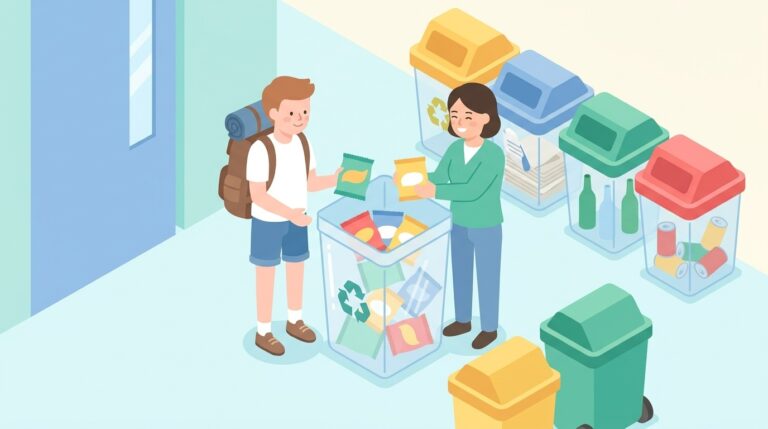
Picture this: You just finished a delicious pack of Korean spicy ramen (불닭볶음면) or opened a cute K-beauty face mask pack in your cozy Seoul Airbnb. You walk over to the trash bin, ready to throw the empty plastic wrapper away, when suddenly you see a row of different bins. Your Korean friend or host gently points and says, “비닐은 따로 모아주세요” (Please collect the vinyl wrappers separately).
Wait, vinyl? Like record players? 🎶
Actually, in Korea, “비닐” (binil) refers to all flexible plastic wrappers, snack bags, and grocery bags. Sorting them separately is one of the most common challenges for expats and travelers in Korea because the rules are so detailed! But don’t worry. Today, we’ll master this eco-friendly Korean superpower together with 3 simple expressions that will make you look like a recycling pro.
Phase 2: Top 3 Essential Expressions Deep Dive
1. 비닐 따로 모아야 해요 (binil ttaro moaya haeyo)
- Pronunciation: bee-neel ttah-roh moh-ah-yah hae-yo (Sounds like “bee-kneel” + “tah-row” + “mo-ah-yah”)
- Meaning: “We have to collect plastic wrappers separately.”
- K-Culture Moment: You will hear this constantly from your Korean guesthouse host, Airbnb landlord, or colleagues in the office kitchen.
- Editor’s Insight: 따로 (ttaro) means “separately,” and 모으다 (moeuda) means “to collect.” Together with 해야 해요 (haeya haeyo – must/have to), this is the ultimate eco-rule in Korea.
- Situation Spectrum: Casual (⚠️ 비닐 따로 모아) | Semi-formal (✅ 비닐 따로 모아야 해요) | Formal (✅ 비닐은 따로 모아주셔야 합니다)
- 🤔 Think About It: In many Western countries, thin plastic wraps are thrown into general waste. Why do you think Korea separates them so strictly? (Hint: Korea is small, and recycling space is precious!)
2. 깨끗이 씻어서 버려주세요 (kkaekkeusi siseoseo beoryeojuseyo)
- Pronunciation: kkae-kkeut-ee shee-suh-suh buh-ryuh-joo-seh-yo
- Meaning: “Please wash it clean before throwing it away.”
- K-Culture Moment: This is a golden rule! If your delivery food containers or plastic wrap have food sauce (like spicy tteokbokki red sauce) on them, they cannot be recycled.
- Editor’s Insight: 씻어서 (siseoseo) means “wash and then…” if the red stain doesn’t come off even after rinsing, it actually has to go into the general waste (일반 쓰레기)!
- Situation Spectrum: Casual (⚠️ 깨끗이 씻어 버려) | Semi-formal (✅ 깨끗이 씻어서 버려주세요) | Formal (✅ 깨끗이 세척 후 배출해 주세요)
3. 이거 그냥 버려도 돼요? (igeo geunyang beoryeodo dwaeyo?)
- Pronunciation: ee-guh geun-yahng buh-ryuh-doh dwae-yo?
- Meaning: “Can I just throw this away (in the general trash)?”
- K-Culture Moment: Use this handy question when you are standing in front of the recycling bins, looking confused. Any kind Korean neighbor passing by will gladly help you.
- Editor’s Insight: 그냥 (geunyang) means “just” or “as it is.” 버려도 돼요? (beoryeodo dwaeyo?) means “Is it okay to throw away?”
- Situation Spectrum: Casual (✅ 이거 그냥 버려도 돼?) | Semi-formal (✅ 이거 그냥 버려도 돼요?) | Formal (🚫)
Phase 3: Textbook Korean vs. Real Korean
Let’s compare what textbooks teach with what real Koreans say on the street!
Situation 1: Asking where to put the plastic wrap
- 📖 Textbook: 비닐 수거함이 어디에 있습니까? (binil sugeohami eodie isseumnikka?) – “Where is the plastic wrapper collection box?”
- 🗣️ Real Korean: 비닐 어디다 버려요? (binil eodida beoryeoyo?) – “Where do I throw the vinyl?”
- 💡 Why the difference? Textbooks use the formal “수거함 (collection box),” but locals simply say 어디다 버려요? (Where do I throw it?) which is much faster and natural.
Situation 2: Confirming if something is recyclable
- 📖 Textbook: 이것은 재활용이 가능한 품목입니까? (igeoseun jaehwaryongi ganeunghan pummogimnikka?) – “Is this an item that is eligible for recycling?”
- 🗣️ Real Korean: 이거 재활용 돼요? (igeo jaehwaryong dwaeyo?) – “Does this recycle? / Can I recycle this?”
- 💡 Why the difference? Koreans love efficiency (빨리빨리 – Palli-palli). Instead of long words like “가능한 품목 (eligible item),” they just ask if it 돼요? (Does it work/Is it okay?).
Phase 4: K-Culture Deep Dive & Non-Verbal Manners
4-1. The “Nunchi” (눈치) of Recycling
When you recycle in Korea, you are participating in a huge community effort. Here are some silent rules:
1. The Double-Check Glance: Before tossing your bag, look inside the bin to see what others did. If you see only clean plastic snack bags, make sure your bag matches that level of cleanliness.
2. The Fold-and-Press: Don’t throw bulky, air-filled bags into the bin. Koreans always fold or tie plastic wraps into small, flat shapes to save space!
4-2. The “Bun-ri-su-geo” (분리수거) Culture
In K-dramas, you often see characters bonding (or arguing!) while sorting trash outside their apartments. It’s a true slice of daily Korean life. Doing this correctly shows that you respect the local community and the environment.
Phase 5: Real-Life Roleplay Scenario
Setting: Outside a cozy neighborhood villa in Mapo, Seoul. You are standing with a handful of clean plastic wrappers next to the trash zone. Your sweet landlord, Min-su (민수), is organizing the bins.
- 민수: 어! 안녕하세요! 분리수거 하러 나오셨어요?
(Eo! Annyeonghaseyo! Bunrisugeo haereo naosyeosseoyo?)
🎭 Smiling warmly and holding a green recycling bag
“Oh! Hello! Did you come out to do the recycling?” -
You: 네! 그런데… 이거 그냥 버려도 돼요?
(Ne! Geureonde… igeo geunyang beoryeodo dwaeyo?)
🎭 Pointing to the plastic ramen wrappers in your hand
“Yes! But… can I just throw this away?” -
민수: 아, 그건 라면 봉지네요. 비닐은 따로 모아야 해요.
(Ah, geugeon ramyeon bongjineyo. Binireun ttaro moaya haeyo.)
🎭 Pointing to a large transparent bag hanging on the wall
“Ah, those are ramen bags. We have to collect vinyl separately.” -
You: 아, 진짜요? 여기에 넣으면 돼요?
(Ah, jinjayo? Yeogie neoeumyeon dwaeyo?)
🎭 Pointing at the transparent bag
“Oh, really? Do I put them in here?” -
민수: 네, 맞아요! 그런데 잠깐만요, 빨간 양념이 묻어있네요!
(Ne, majayo! Geureonde jamkkanmanyo, ppalgan yangnyeomi mudeoitneyo!)
🎭 Leaning in to look closer at the wrapper
“Yes, correct! But wait a second, there is red sauce on it!” -
You: 아… 씻어서 버려야 해요?
(Ah… siseoseo beoryeoya haeyo?)
🎭 Looking a bit embarrassed
“Ah… do I have to wash it before throwing it away?” -
민수: 네! 깨끗이 씻어서 버려주세요. 안 지워지면 일반 쓰레기에 버려야 해요.
(Ne! Kkaekkeusi siseoseo beoryeojuseyo. An jiwojimyeon ilban sseuregie beoryeoya haeyo.)
🎭 Giving a friendly, encouraging thumbs-up
“Yes! Please wash it clean before throwing it. If it doesn’t wash off, you must throw it in the general trash.” -
You: 아하! 알겠습니다. 다시 씻어 올게요! 감사합니다!
(Aha! Algetseumnida. Dasi siseo olgeyo! Gamsahamnida!)
🎭 Bowing slightly with a grateful smile
“Aha! I understand. I will go wash it again and come back! Thank you!”
🔀 Interactive Choice Point
What will you do next?
* A. Run back to your room, wash the wrapper with dish soap, and dry it perfectly.
* B. Say “Oh, too hard!” and secretly throw the dirty plastic into the general waste bin right now.
* C. Use a tissue to wipe the red grease off quickly and put it in the vinyl bin.
Feedback:
- Best Choice (A): Great job! Washing it cleanly is the standard way to recycle in Korea. You gained 100+ Respect points from Min-su!
- Bad Choice (B): Oh no! Doing this might cause the building to get fined. Your landlord might check the CCTV and feel disappointed.
- Risk Choice (C): Red oil stains do not wash off with just dry tissue. It will contaminate the rest of the vinyl bag, so it’s better to wash it with water or put it in general waste!
Phase 6: 10-Second Emotion Shadowing Drill
Let’s practice speaking with real-life emotions! Pay attention to the pauses (/).
- [🥺 Worried & Confused]
이거 / 그냥 / 버려도 돼요?
(I-geo / geun-yang / beoryeodo dwae-yo?) -
[💡 Aha! Realization]
아! / 비닐은 / 따로 / 모아야 해요?
(Ah! / bi-nil-eun / ttah-ro / moh-ah-yah hae-yo?) -
[😊 Politer & Friendly]
깨끗이 / 씻어서 / 버릴게요!
(Kkae-kkeut-ee / shee-suh-suh / buh-ril-gae-yo!)
Phase 7: K-Culture Mini Dictionary
- 분리수거 (bun-ri-su-geo) | Recycling / Separation of Trash
- Usage: Every household in Korea does “분리수거” once or twice a week on designated days.
- 일반 쓰레기 (il-ban sseu-re-gi) | General Waste
- Usage: Non-recyclable trash that goes into the official district plastic bags (종량제 봉투).
- 음식물 쓰레기 (eum-sik-mul sseu-re-gi) | Food Waste
- Usage: Anything animals can eat. (Yes, bones and shells are NOT food waste, they are general waste!)
- 비닐류 (bi-nil-ryu) | Plastic Film / Vinyl Category
- Usage: You will see this word printed on snack packaging with a little recycling triangle mark.
Phase 8: Travel Emergency Survival Kit
Survival Phrases TOP 3
- “이거 어디에 버려요?” (Igeo eodie beoryeoyo?) – “Where do I throw this?”
- Pro Tip: Ask this to a convenience store clerk when you finish your snack inside.
- “이거 재활용 돼요?” (Igeo jaehwaryong dwaeyo?) – “Is this recyclable?”
- Pro Tip: Use this when sorting complex items like plastic bottles with paper labels.
- “비닐봉지 필요하세요?” (Binilbongji piryohaseyo?) – “Do you need a plastic bag?”
- Pro Tip: Cashiers at supermarkets will ask this. Remember, they cost around 50~100 KRW!
Editor’s Travel Note 🗺️
When traveling in Korea, you won’t find many public trash cans on the streets of Seoul. This is to encourage people to take their trash home and recycle! If you are lost or looking for public amenities, use Naver Map App to locate nearby subway stations, which always have public trash bins separated by type.
Phase 9: “Going One Step Deeper” (Cultural Insight)
In Korea, recycling is not just an individual option; it is a civic duty. The “Standard Plastic Bag System” (종량제) was introduced in 1995. Since you have to pay money to buy general trash bags, separating your recyclables (which is free!) is highly encouraged. This collective care for the neighborhood is deeply rooted in the Korean mindset of community harmony.
💬 Your Turn: Does your country have strict recycling rules like Korea? Leave a comment below with your country’s style! Let’s chat!
Phase 10: FAQ & Common Mistakes
Q: Can I put dirty plastic bags in the vinyl recycling bin?
A: No. If the plastic wrap has oil, food stain, or dirt that cannot be washed off, it must go into the 일반 쓰레기 (general waste) bag.
Q: What does the “비닐류” mark on my snack box mean?
A: It means the material is plastic wrap/film. You should sort it into the designated vinyl collection basket, not the general plastic container bin.
Q: Can I put bubble wrap (뽁뽁이 – ppok-ppok-i) in the vinyl bin?
A: Yes! Clean bubble wraps and plastic delivery mail bags (without the paper address stickers) can be recycled as vinyl.
🚨 Common Mistakes Alert!
- Leaving stickers on vinyl: Always peel off shipping labels or paper stickers from plastic bags before recycling.
- Throwing away dirty ramen cups: If the red soup stain won’t wash off with water, throw it in general trash!
- Mixing wet tissues: Wet tissues (물티슈) look like cloth or paper, but they are general waste. Do not recycle them!
Phase 11: Action Mission for Today
- 🥉 Bronze Mission: Go to your kitchen right now and check the back of any Korean snack bag for the word “비닐류”.
- 🥈 Silver Mission: Record yourself saying “비닐 따로 모아야 해요” with a bright smile and share it with your study buddy!
- 🥇 Gold Mission: Next time you go to a Korean mart, bring your own eco-bag (장바구니) and say “봉투는 괜찮아요” (Bongtuneun gwaenchanayo – I’m fine without a bag).
Phase 12: Interactive Quiz Challenge
1. Match the Trash!
Which of the following must go into the General Trash (일반 쓰레기) instead of the Vinyl bin?
* A) A clean, dry potato chip bag
* B) A plastic wrapper stained with tteokbokki sauce that won’t wash off
* C) Clean shipping bubble wrap
Reveal Answer & Explanation
Answer: B
Explanation: If it has red food stains that can’t be washed clean, it cannot be recycled and must go into the general waste bag! Clean chip bags (A) and bubble wrap (C) go to the vinyl bin.
2. Korean Culture True or False?
In Korea, you can buy general trash bags (종량제 봉투) at any convenience store or supermarket in your district.
Reveal Answer & Explanation
Answer: True
Explanation: Yes! You must buy the specific bag designated for your local district (gu/구). You can easily buy them at the counter of any convenience store like GS25, CU, or 7-Eleven by asking for “종량제 봉투 (jong-ryang-je bong-tu)”.







