

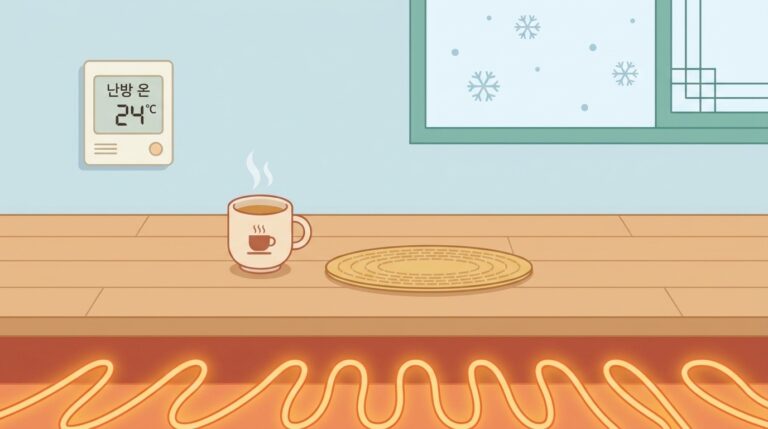
Stay Warm! How to Turn on the Boiler (보일러 켜다) in Korea Like a Local
Phase 1: Empathy (Welcome to Your Cozy Korean Winter! ❄️)
안녕하세요! (An-nyeong-ha-se-yo!) Your friendly Korean bestie and Daily Hangul Editor is here!
Imagine this: You’ve just arrived at your dream Airbnb in Seoul. Outside, the winter wind is freezing, and you can see your breath in the air. You run inside, excited to warm up, but wait… you look at the wall and see a small, mysterious plastic box with Korean buttons flashing at you. There’s no English, just words like ‘외출’, ‘온수’, and ‘난방’.
Panic sets in. “How do I turn this thing on? Am I going to freeze tonight?” 🥶
Don’t worry! This is the ultimate rite of passage for anyone living or traveling in Korea. Korean floor heating, known as Ondol (온돌), is absolute heaven once you know how to use it. Today, we are going to learn the absolute easiest, A1-level way to say “Turn on the boiler” so you can ask your host or landlord for help, and understand exactly what buttons to press. Let’s make sure you stay cozy and warm!
Phase 2: Deep Dive into 3 Key Expressions
Let’s learn the three most important words you need to survive a Korean winter.
1. 보일러 켜다 (Bo-il-leo kyeo-da)
- Pronunciation: Bo-il-ler (like the English word ‘boiler’) + kyeo-da (sounds like ‘cyuh-dah’)
- Meaning: To turn on the boiler
- K-Culture Moment: You will hear this in almost every winter K-Drama. Characters come home from a long, dramatic day, rub their frozen hands together, and immediately say, “Boiler turn on!”
- Editor’s Insight: In Korea, we don’t usually say “turn on the heater” (히터 켜다) for homes. We say “turn on the boiler” (보일러 켜다) because our heating comes from hot water pipes under the floor!
- Situation Spectrum:
- Casual (with friends): 보일러 켜 (Bo-il-leo kyeo) ✅
- Semi-formal (with landlord/Airbnb host): 보일러 켜주세요 (Bo-il-leo kyeo-ju-se-yo) ✅
- Formal (business): 보일러를 가동해 주십시오 (Bo-il-leo-reul ga-dong-hae ju-sip-si-o) ⚠️ (Too formal for daily life!)
- 🤔 Think About It: In many Western countries, heating warms the air. In Korea, we warm the floor first. How does your home country heat up during winter?
2. 난방 (Nan-bang)
- Pronunciation: Nan-bang (sounds like ‘nahn-bahng’)
- Meaning: Heating (Room Heating)
- K-Culture Moment: On the boiler controller on the wall, you will see a button labeled 난방. This is the magic button that heats up your floor!
- Editor’s Insight: If you only want to warm the room (and not take a shower), make sure this mode is activated. It’s the ultimate key to survival.
- Situation Spectrum:
- Casual: 난방 해 (Nan-bang hae) ✅
- Semi-formal: 난방 켜주세요 (Nan-bang kyeo-ju-se-yo) ✅
- Formal: 난방을 시작합니다 (Nan-bang-eul si-jak-ham-ni-da) 🚫 (Sounds like an automated machine voice!)
- 🤔 Think About It: Why do you think Koreans love sitting and sleeping on the floor? (Hint: It’s because of this amazing nan-bang system!)
3. 온수 (On-su)
- Pronunciation: On-su (sounds like ‘ohn-soo’)
- Meaning: Hot Water
- K-Culture Moment: You are in the shower, and suddenly the water turns ice-cold. You scream! You forgot to turn on the 온수 button on the controller.
- Editor’s Insight: Some older boilers require you to specifically press ‘온수’ to get hot water for your shower. Don’t forget this, or you’ll have a very shocking morning!
- Situation Spectrum:
- Casual: 온수 나와? (On-su na-wa? – Is hot water coming out?) ✅
- Semi-formal: 온수 안 나와요 (On-su an na-wa-yo – Hot water is not coming out) ✅
- Formal: 온수 사용이 원활하지 않습니다 (On-su sa-yong-i won-hwal-ha-ji ans-sum-ni-da) 🚫 (Too robotic!)
- 🤔 Think About It: The word ‘온’ (On) means ‘warm’ and ‘수’ (Su) means ‘water’. Easy to remember, right?
Phase 3: Textbook Korean vs. Real Korean
Let’s compare what textbooks teach you versus what real Koreans actually say when they are cold!
Situation 1: Asking someone to turn on the heating
- 📖 Textbook: “난방 기기를 작동시켜 주세요.” (Nan-bang gi-gi-reul jak-dong-si-kyeo ju-se-yo. – “Please operate the heating appliance.”)
- 🗣️ Real Korean: “보일러 좀 켜주세요.” (Bo-il-leo jom kyeo-ju-se-yo. – “Please turn on the boiler.”)
- 💡 Why is it different? Nobody uses the word “heating appliance” (난방 기기) in real life. It sounds like a legal manual! Just say “Boiler” (보일러).
Situation 2: Saying “I am freezing!”
- 📖 Textbook: “날씨가 매우 춥습니다.” (Nal-ssi-ga mae-u chup-sum-ni-da. – “The weather is very cold.”)
- 🗣️ Real Korean: “추워 죽겠어요!” (Chu-wo juk-get-seo-yo! – “I’m freezing to death!”)
- 💡 Why is it different? Koreans love using the dramatic expression “~죽겠어요” (~dying/to death) to emphasize how they feel. It shows real, raw emotion!
Phase 4: K-Culture Deep Dive & Non-verbal Manners
4-1. Gesture & Nunchi (눈치)
- The “Frozen Hand” Rub: When asking someone to turn on the boiler, rub your hands together and blow warm air onto them. This visual signal, combined with “Bo-il-leo jom…”, instantly triggers Korean hospitality. They will rush to turn it up for you!
- Taking off your socks: If you visit a Korean home, the floor might feel warm instantly. It is polite to walk around barefoot or with clean socks to fully enjoy the floor heating, but always ask if you should keep your socks on.
4-2. The Cozy Korean “Ondol” Culture
Have you ever wondered why Koreans sit on the floor to watch TV, eat at low tables, or even sleep on the floor on a thick futon (이불 – i-bul)? It’s all because of Ondol (온돌)! In winter, the warmest spot in the entire house is the floor. Koreans even have a phrase: “엉덩이가 뜨겁다” (My butt is hot/warm), which represents the ultimate winter comfort.
Phase 5: Real-life Roleplay Scenario
Meet Min-su (민수), your friendly Airbnb co-host. You just arrived at your studio apartment in Seoul, and it’s freezing!
- Setting: A cozy but chilly studio apartment near Hongdae.
Turn 1 (You): 🫨 (Shivering) 저기요, 민수 씨... 방이 너무 추워요.
             (Jeo-gi-yo, Min-su ssi... bang-i neo-mu chu-wo-yo.)
             "Excuse me, Min-su... the room is so cold."

Turn 2 (Min-su): 😲 아! 진짜요? 보일러 안 켰어요?
                (Ah! Jin-짜-yo? Bo-il-leo an kyeot-seo-yo?)
                "Oh! Really? You didn't turn on the boiler?"

Turn 3 (You): 😰 네, 보일러 어떻게 켜요?
             (Ne, bo-il-leo eo-tteok-hae kyeo-yo?)
             "Yes, how do I turn on the boiler?"

Turn 4 (Min-su): 👉 이 빨간색 '전원' 버튼을 누르세요.
                (I ppal-gan-saek 'jeon-won' beot-teun-eul nu-reu-se-yo.)
                "Press this red 'Power' button."

Turn 5 (You): 🧐 아, '전원'... 눌렀어요! 그다음은요?
             (Ah, 'jeon-won'... nul-reot-seo-yo! Geu-da-eum-eun-yo?)
             "Ah, 'Power'... I pressed it! What's next?"

Turn 6 (Min-su): 🔥 '난방' 버튼을 누르고 온도를 올리세요.
                (‘Nan-bang’ beot-teun-eul nu-reu-go on-do-reul ol-li-se-yo.)
                "Press the 'Heating' button and turn up the temperature."

Turn 7 (You): 👍 아! 따뜻해지고 있어요. 고맙습니다!
             (Ah! Tta-tteut-hae-ji-go is-seo-yo. Go-map-sum-ni-da!)
             "Ah! It's getting warm. Thank you!"

Turn 8 (Min-su): 😊 다행이네요! 이제 따뜻하게 주무세요.
                (Da-haeng-i-ne-yo! I-je tta-tteut-ha-ge ju-mu-se-yo.)
                "What a relief! Now, sleep warmly."
🔀 Choose Your Path!
What do you say next to Min-su?
- A) “샤워하고 싶어요. 온수 어떻게 켜요?” (I want to shower. How do I turn on the hot water?)
- B) “보일러 꺼주세요.” (Please turn off the boiler.)
- C) “에어컨 켜주세요.” (Please turn on the air conditioner.)
💡 Feedback:
- Selecting A (Best Choice): 🌟 Great! You remembered ‘온수’ (hot water). Min-su will gladly show you how to switch to hot water mode so you don’t get a cold shower.
- Selecting B (Bad Choice): 🥶 Oh no! If you turn it off now, you will freeze tonight! Save this for spring.
- Selecting C (Risky Choice): ❄️ Turning on the air conditioner in the middle of winter? Min-su will look at you very confused!
Phase 6: 10-Second Emotion Shadowing Drill
Speak with emotion! Follow the pauses (/) and make sure to sound dramatic.
- [🥺 Cold & Shivering]
- 추워 / 죽겠어요. / 보일러 / 좀 / 켜주세요!
- Chu-wo / juk-get-seo-yo. / Bo-il-leo / jom / kyeo-ju-se-yo!
- “I’m freezing to death. Please turn on the boiler!”
- [😊 Warm & Relieved]
- 와, / 이제 / 진짜 / 따뜻해요!
- Wa, / i-je / jin-ja / tta-tteut-hae-yo!
- “Wow, now it’s really warm!”
Phase 7: K-Culture Mini-Dictionary
- 전원 (Jeon-won) | Power / On-Off | The most important button on any Korean appliance. Press this first!
- 외출 (Oe-chul) | Out-of-home / Eco Mode | Literally means “going out”. Use this mode when you leave the house to save gas money without letting the pipes freeze.
- 온돌 (Ondol) | Korean floor heating | The traditional and modern system of heating rooms through floor pipes.
- 이불 (I-bul) | Blanket / Futon | A thick, cozy blanket. Laying this on a heated floor traps the heat and makes a perfect sleeping spot.
Phase 8: Traveler’s Survival Kit
Survival Phrases TOP 3
- 보일러 고장 났어요. (Bo-il-leo go-jang nat-seo-yo.)
- Pro Tip: “The boiler is broken.” Use this if the floor is still ice-cold after 1 hour.
- 뜨거운 물 안 나와요. (Tteu-geo-un mul an na-wa-yo.)
- Pro Tip: “Hot water is not coming out.” Perfect for telling your host when the shower is cold.
- 실내 온도 어떻게 조절해요? (Sil-nae on-do eo-tteok-hae jo-jeol-hae-yo?)
- Pro Tip: “How do I control the indoor temperature?”
Editor’s Travel Note ✈️
When booking an Airbnb in Korea, always look at the host’s guide manual. Most hosts upload photos of the boiler controller with English translations. If they don’t, you can use the camera feature on the Papago Translation App to translate the Korean buttons in real-time! (Disclaimer: Appliance models vary, so always consult your host before pressing unknown buttons.)
Phase 9:
Frequently Asked Questions (FAQ)
Q: What does "보일러 켜다 (Bo-il-leo kyeo-da)" mean in Korean and how do you pronounce it?
A: In Korean, "보일러 켜다 (Bo-il-leo kyeo-da)" is pronounced [Bo-il-ler (like the English word 'boiler'] and means: To turn on the boiler
Q: What does "난방 (Nan-bang)" mean in Korean and how do you pronounce it?
A: In Korean, "난방 (Nan-bang)" is pronounced [Nan-bang (sounds like 'nahn-bahng'] and means: Heating (Room Heating)
Q: What does "온수 (On-su)" mean in Korean and how do you pronounce it?
A: In Korean, "온수 (On-su)" is pronounced [On-su (sounds like 'ohn-soo'] and means: Hot Water






